 FEXLINK Research Institute
Direct Answer
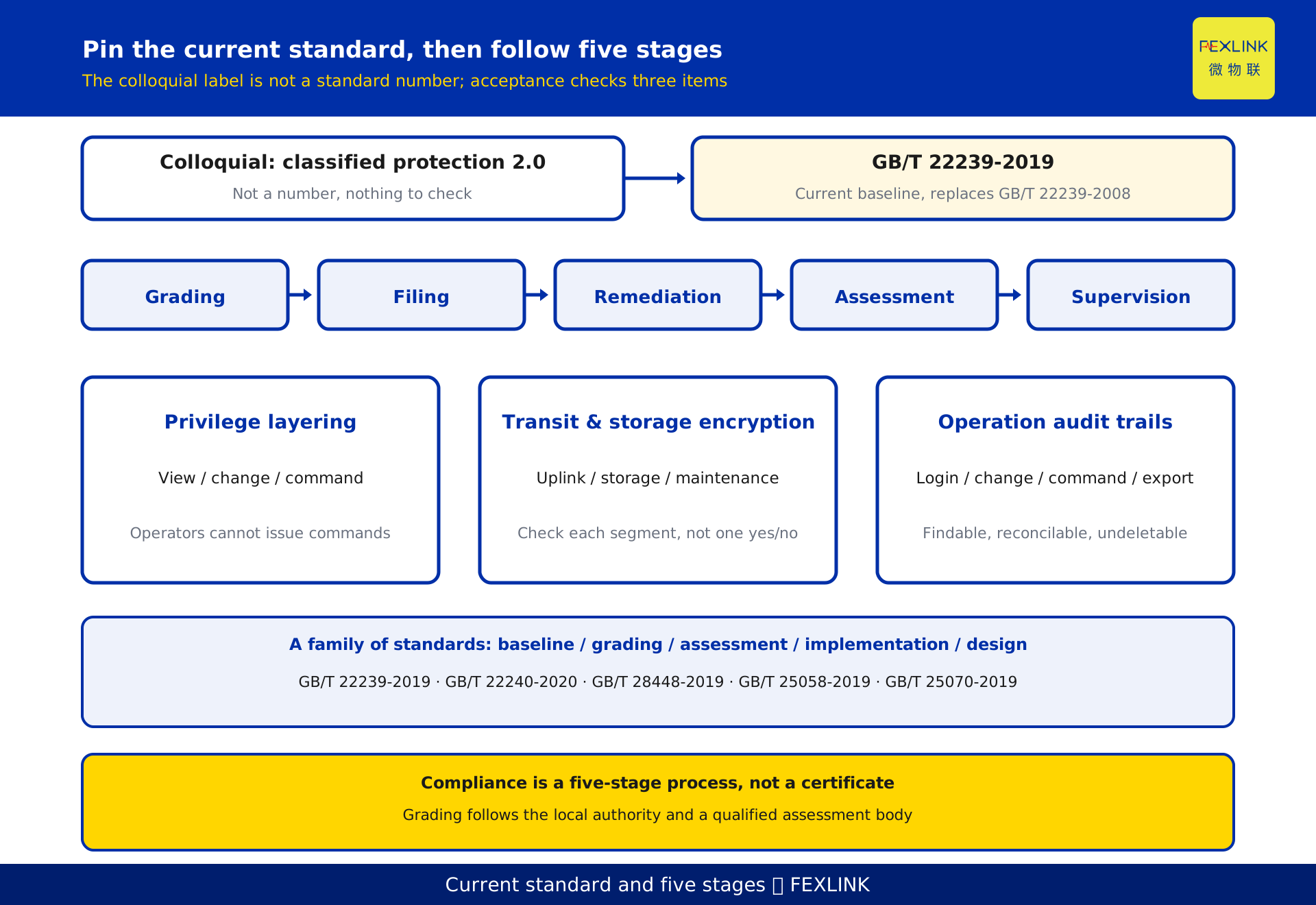
Whether a monitoring platform needs cybersecurity classified protection is not a matter of how important it feels, or whether it touches the public internet. It starts with the grade assigned to the system, settled by the filing opinion of the local public security authority and the judgement of a qualified assessment body; this article issues no blanket verdict such as "must be Level 3". Three things are certain. The Cybersecurity Law of the People's Republic of China establishes a classified protection system covering non-classified networks and information systems built, operated, maintained or used within the country, so an internal network is not automatically exempt. The colloquial label "classified protection 2.0" is not a standard name: the current baseline is GB/T 22239-2019, and grading follows GB/T 22240-2020. And what acceptance should scrutinise is not a certificate but three mandatory checks - layered account privileges, encryption in transit and at rest, and operation audit trails - plus whether the security boundary between field side and platform side has been drawn. Recording evidence against a checklist beats arguing about whether the regime applies.
What "Classified Protection 2.0" Actually Refers To
Tender documents often say "complies with classified protection 2.0". That sentence cannot be executed: it is neither a standard number nor a formal title. The baseline in force is GB/T 22239-2019, Information security technology - Baseline for classified protection of cybersecurity, released 2019-05-10 and effective 2019-12-01, which fully replaced the withdrawn GB/T 22239-2008; a 2025 review confirmed it remains valid. The shift from "information system security" in the old title to "cybersecurity" is not editorial: protected objects expanded from conventional information systems to cloud computing, big data, the Internet of Things, mobile interconnection and industrial control systems. A monitoring platform sits squarely in the IoT and industrial control extension.
Getting the name right prevents citing a withdrawn edition and gives all security work one shared reference. This article states only names, numbers and status: no clause numbers, tables or assessment scores.
Applicability Starts With Grading
Whether a platform is "important" or its data "sensitive" is a grading question, not a construction question. The method comes from GB/T 22240-2020, Information security technology - Classification guide for classified protection of cybersecurity, also current, released 2020-04-28 and effective 2020-11-01, fully replacing GB/T 22240-2008. There are five protection levels, the first lowest and the fifth highest. Grading considers the objects affected and the degree of harm when business information security and system service security are compromised - not budget, point count or display size.
Three questions deserve early attention: does the platform cross organisational or legal-entity boundaries; does it aggregate energy-use or electrical-safety operational data that may be treated as important data; can it issue commands to field devices. These are prompts, not a grading conclusion. The assigned level, whether a level assessment is required, and which authority accepts the filing are determined by the local authority and a qualified assessment body.
A Family of Standards, Not a Certificate
A family of current national standards each governs one part. GB/T 22239-2019 is the baseline: what must be achieved. GB/T 22240-2020 is the classification guide: which level applies. GB/T 28448-2019 covers assessment requirements: how compliance is judged. GB/T 25058-2019 is the implementation guide: how construction and remediation are sequenced. GB/T 25070-2019 covers security design requirements: how the solution is architected. A construction plan cites the implementation guide and design requirements, an assessment basis cites the assessment requirements, and the overall objective cites the baseline. Collapsing them into "complies with classified protection 2.0" leaves nothing to check item by item.
Cryptography runs on a parallel track. GB/T 39786-2021 sets baseline requirements for information system cryptography application across four aspects: physical and environmental security, network and communications security, device and computing security, and application and data security. It is accompanied by commercial cryptography application security assessment, commonly called crypto assessment. The two workstreams are separate; whether either is required, and when, is again a matter for the authority and assessment body.
Five Stages From Grading to Supervision
The cycle breaks into five sequential stages: grading, filing, construction and remediation, level assessment, and supervision and inspection. Without a grade there is nothing to file; without a filing and plan there is no grade-appropriate construction; without completed remediation there is no assessment; the assessment conclusion feeds into subsequent supervision.
Where acceptance stalls depends on when security work was placed. The classic failure is a platform already in production whose tender and contract never mentioned classified protection, with evidence requested just before handover: the account model, log structure and link encryption are fixed, and change costs far exceed design-time costs. The first two stages need a named owner at design and contract signing; remediation and assessment need their own window.
Check One: Layered Account Privileges
Unlike an ordinary dashboard, a monitoring platform can push parameters, remote controls or resets to field devices, so mixed-up privileges cost more than a chart. Ask who may view, who may change configuration, and who may issue commands. Three privilege tiers should map to distinct roles rather than one shared administrator account; default passwords, shared accounts and unrevoked credentials are common gaps. An account register tying roles, scope, approver and change time beats a verbal assurance.
Evidence is a role-privilege matrix, an account list, provisioning and revocation approvals, and configuration screenshots of failed-login handling. The test is simple: take an ordinary operator account and confirm attempts to change configuration or issue commands are refused and recorded. None of this needs new hardware, which is why it gets skipped under pressure.
Check Two: Encryption in Transit, at Rest, and Where Cryptography Sits
Encryption must be verified segment by segment. First, the uplink from field side to platform side: an edge gateway sends data over a public network or leased line, so the channel needs server authentication and confidentiality protection, and the platform must verify the access identity of field devices. Second, inside the platform and its database: whether important data is protected in storage and backups, who manages keys, and how they rotate. Third, the maintenance channel: remote administrative login should not bypass the first two constraints.
Where national cryptographic algorithms sit depends on whether the problem is identity authentication, transport confidentiality or storage integrity. When adopting standards-compliant commercial algorithms such as the publicly documented SM2, SM3 and SM4 families, selection, product compliance and whether crypto assessment is needed follow current cryptography administration requirements and a qualified assessment body. No determination is made here.
Evidence includes link configuration, key management records, an encryption scope statement and the assessment conclusion where applicable. The four aspects of GB/T 39786-2021 are a self-review skeleton, not a scoring sheet; no scores, thresholds or determination tables are provided.
Check Three: Operation Audit Trails
The point is not log volume but reconstructing who did what, to which object, when, and with what result. At least four classes of action should be covered: login and logout, configuration and privilege changes, commands issued to the field, and bulk data exports. Each record needs a subject, timestamp, object and outcome on a common time base, or events cannot be correlated across devices and platforms. Logs should not be easy for a business account to alter or delete.
Retention periods, log field detail and centralised auditing follow current requirements and the assessment body's opinion; no month counts or field tables are given. A better acceptance test is a controlled operation on site: change one non-critical configuration, export one test dataset, then find both entries in the audit records and resolve them to a specific operator account. Findable, reconcilable and undeletable - only then does this check pass.
The three checks form one chain: privileges decide who acts, encryption protects data and commands, and the audit trail makes actions traceable. Remove any one and the other two lose evidentiary force.
Field Side vs Platform Side: Drawing the Boundary
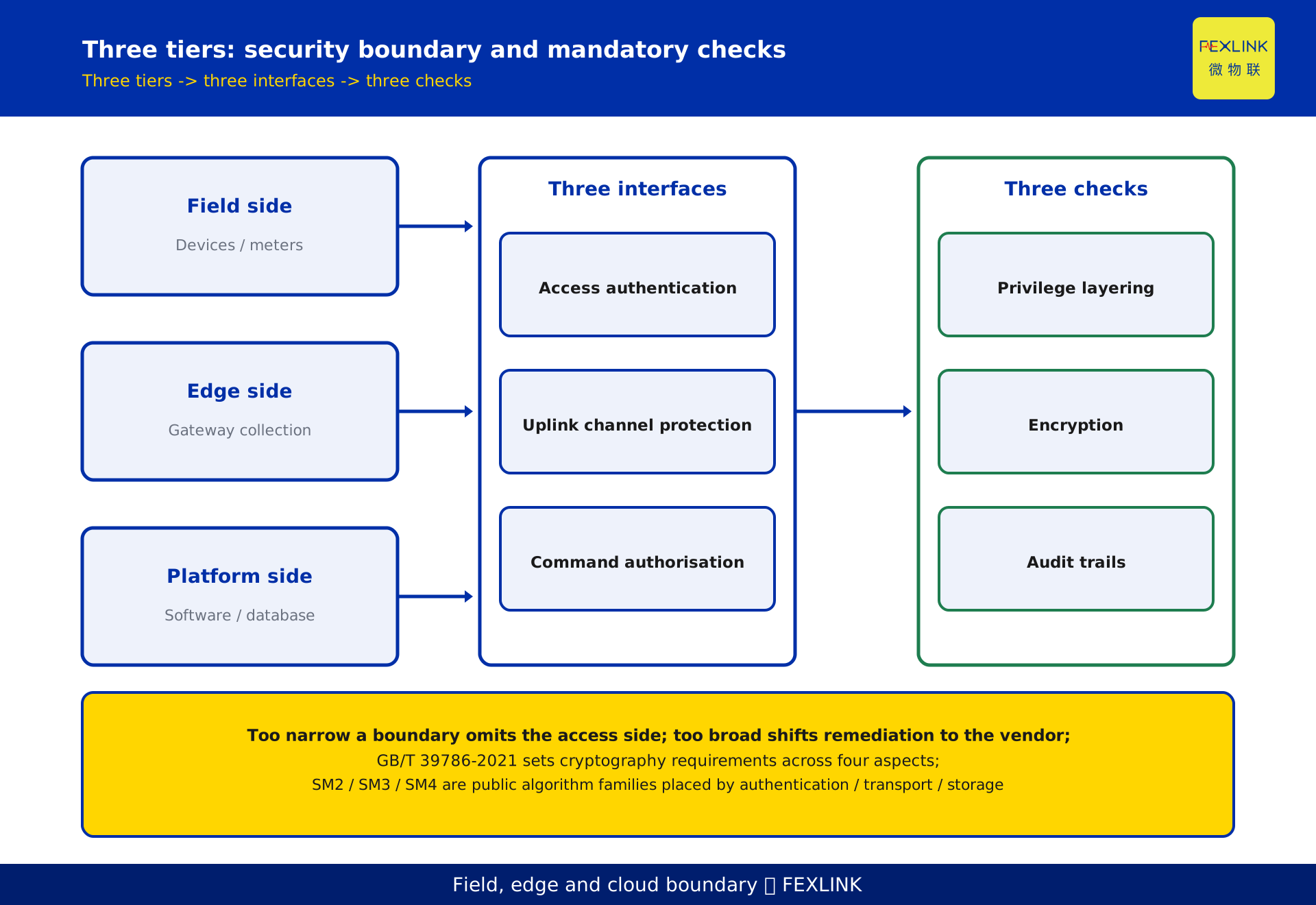
Across the device, edge and cloud tiers the platform is usually the main graded object, but the boundary must be written into the plan: only the platform software and database, or also edge gateways and the field collection network. Too narrow omits the access side; too broad lands remediation for many field devices on the platform vendor.
Three interfaces must be explicit: identity authentication and an allowlist for field devices or gateways connecting to the platform; channel protection on the uplink; and authorisation plus logging when the platform issues commands. These are where the three mandatory checks land on the boundary. A table of who owns each interface and who supplies evidence beats debating whether something counts as platform or field.
One frequent error treats "field devices are not directly on the public internet" as an exemption. The graded object is judged by overall data flows, not by one device's address. If data aggregates on the platform and is accessed across departments, access-side controls remain in scope.
A Platform Security Acceptance Checklist
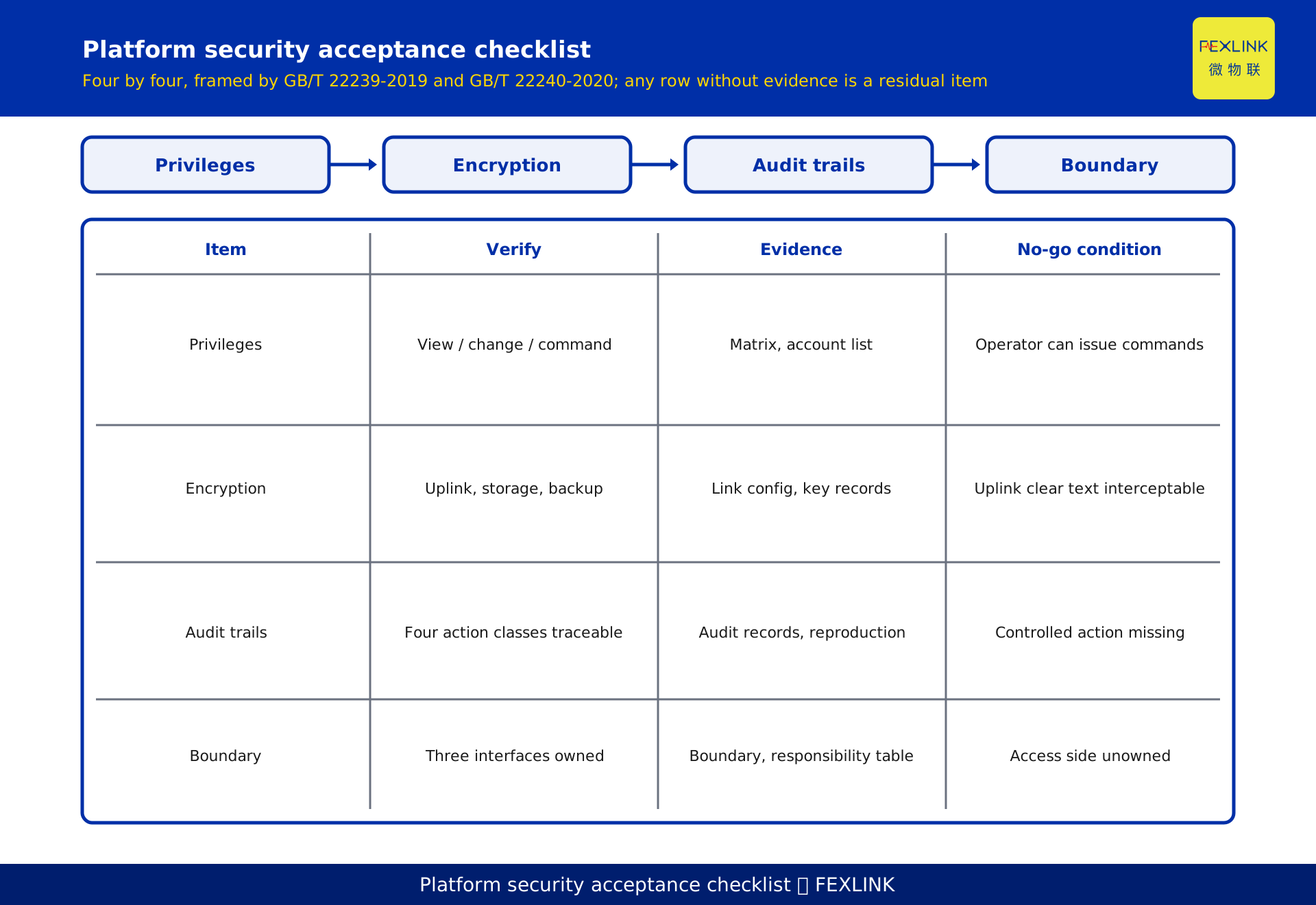
The table is a constructed illustration: four rows for the three mandatory checks and boundary definition, four columns for the item, what to verify, evidence, and the no-go condition. Scenarios are de-identified, represent no real project, and map to no specific protection level.
| Acceptance item | What to verify | Evidence | No-go condition |
|---|---|---|---|
| Privilege layering | View / change / command roles separated; default passwords and shared accounts removed; register complete | Role-privilege matrix, account list, provisioning and revocation approvals | An ordinary account can issue commands or change configuration |
| Encryption | Uplink channel protection, access identity verification, storage and backup protection, key management | Link configuration, certificate and key records, encryption scope statement | Uplink interceptable in clear text, or keys held by business accounts |
| Operation audit trails | Login, configuration change, command issuance and bulk export traceable; logs not alterable by business accounts | Sample audit records, controlled-operation reproduction, time synchronisation description | Controlled operation absent from audit records or not resolvable to an account |
| Security boundary | Graded object scope stated; ownership assigned for access authentication, channel protection and command authorisation | Boundary statement, interface responsibility table, topology and data flow diagram | Access side unowned, or boundary inconsistent with topology |
The table converts "how good is the security" into signable questions. Any row without evidence should be listed as a residual item with an agreed closure date.
Frequently Asked Questions (FAQ)
Q: Is an internal-network platform exempt?
No. The regime covers non-classified networks and information systems built or operated within the country; public internet connection is not the test. Grading and filing follow the local authority's opinion.
Q: Does passing classified protection mean buying a security appliance?
No. There are five stages - grading, filing, construction and remediation, level assessment, and supervision and inspection. Procurement belongs at most to the third. Without grading, filing and management controls, the process stays empty.
Q: Who decides the assigned level?
The operating organisation grades the system using GB/T 22240-2020, then the result goes through expert review, filing with the local public security authority and confirmation by an assessment body. This article only flags directions worth attention and issues no verdict on a required level.
Q: Are national cryptographic algorithms and crypto assessment mandatory on every project?
Not uniformly. Whether cryptography requirements apply and whether a commercial cryptography application security assessment is needed depend on system grade, sector and authority requirements, and follow current rules and a qualified assessment body. This article only states that encryption should be checked across the uplink, storage and maintenance channels.
Q: Should I read this article or the one on equipment, electrical and metering standards?
That article maps equipment-side and metering standards at acceptance; this one covers platform-side grading and the three mandatory checks. Use both for a full list, but never substitute equipment conformity for the level assessment conclusion.
Scope and Limitations
- This article applies to acceptance-stage security verification for non-classified monitoring and supervision platforms operated within the country. Offline devices with local display only and no backhaul are outside its scope.
- Standard names, numbers and status follow the national standards full-text disclosure system and current local authority texts: GB/T 22239-2019 is current and fully replaced GB/T 22239-2008; GB/T 22240-2020 is current and fully replaced GB/T 22240-2008; GB/T 28448-2019, GB/T 25058-2019, GB/T 25070-2019 and GB/T 39786-2021 are all current. The article positions these standards only, quoting no clause numbers, technical requirement tables, assessment scores, thresholds or penalty amounts.
- Grading conclusions, whether a level assessment or crypto assessment is required, the authority accepting a filing, and retention periods are determined by the filing opinion of the local public security authority and the conclusions of a qualified assessment body. This is a methodological overview, not a compliance determination, legal opinion or procurement recommendation.
- The checklist and all scenarios are constructed illustrations. Parks, factories and buildings are generic labels with no client, project or place names. The registry lists no related products, so no product model, security parameter or protection capability figure is cited.
- SM2, SM3 and SM4 appear only as examples of publicly documented algorithm families; selection and applicability follow current cryptography administration requirements.
- No outcome figures - compliance pass rates, assessment scores, investment amounts or remediation durations - enter the conclusions.
Frequently Asked Questions
Does a Monitoring Platform Need Cybersecurity Classified
Whether a monitoring platform needs cybersecurity classified protection is not a matter of how important it feels