 FEXLINK Research Institute
Direct Answer
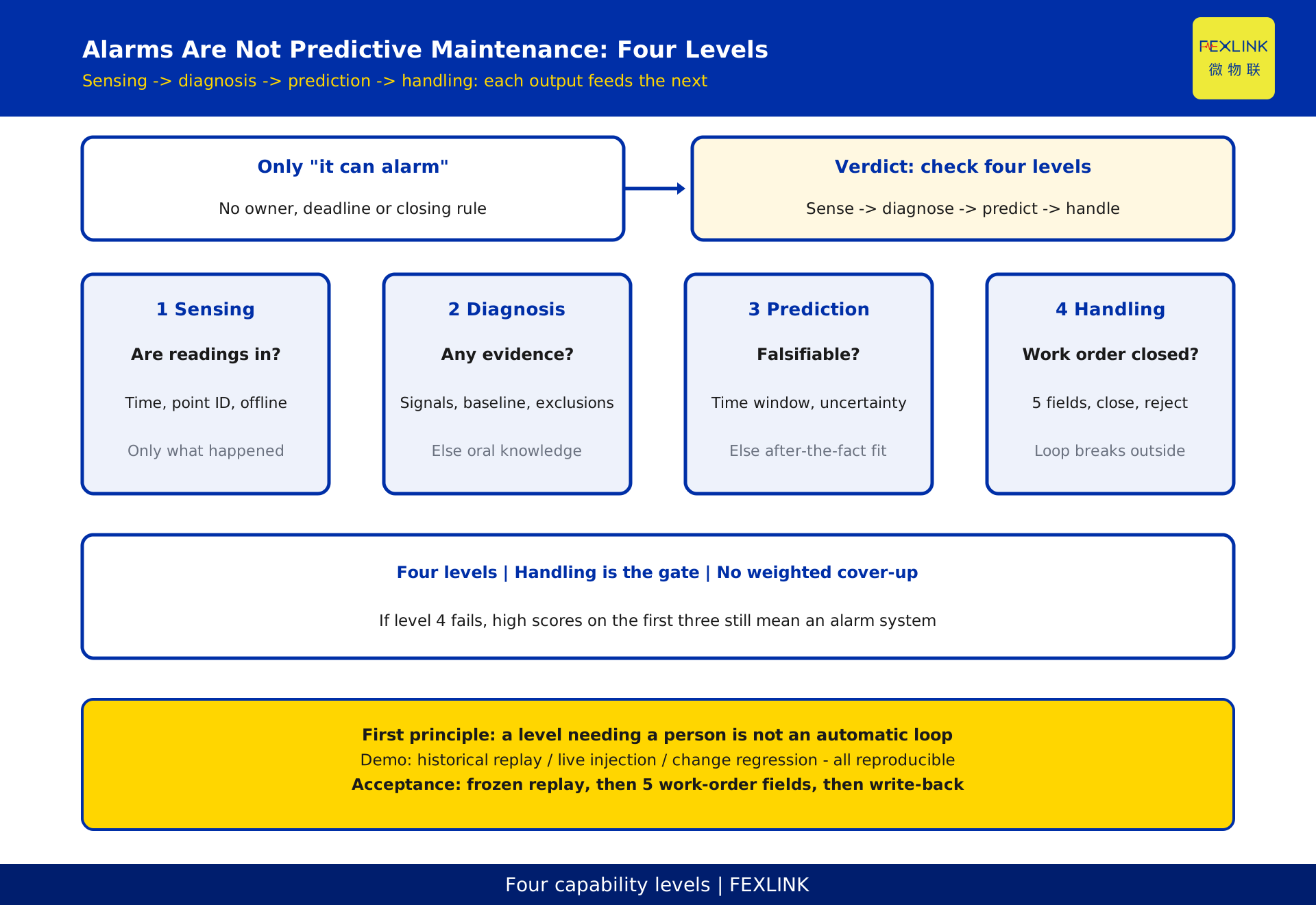
Do not select a predictive maintenance solution by ticking a feature list. Check four capability levels in sequence: sensing -> diagnosis -> prediction -> handling. Pushing a message at a threshold crossing is level 1. Fusing several signals into a diagnosis with evidence is level 2. A forecast with a time window, expressed uncertainty and a counter-example that can disprove it is level 3. Turning the conclusion into a work order with trigger evidence, suggested action, owner, deadline and closing rule - and letting field staff write back to close it - is level 4. Use a gate, not a weighted sum: if level 4 fails, high scores on the first three still describe a monitoring and alarm system. For acceptance, make the vendor replay the same historical data and reproduce the conclusion, rather than looking for "AI prediction" on a slide. This article selects capability depth, not multi-protocol gateway selection or per-asset threshold calibration.
1. Why "It Can Alarm" Is Not "It Can Predict"
An alarm states a fact about what already crossed a limit. A prediction judges that something may happen within a future window and warrants action now; the data, owners and acceptance methods differ. A delivered system that only pushes messages is rarely missing one algorithm module. Two links are broken between the data chain and the workflow chain: turning a threshold crossing into an evidenced diagnosis, and turning a conclusion into a task with an owner, a deadline and a closing rule.
Three confusions follow. Alarm counts as capability: a high count may only mean sensitive thresholds or unsuppressed chatter. A dashboard curve as prediction: it plots history that already happened. A push message as dispatch: no owner, deadline or closing rule, so the process still runs outside the platform.
2. Four Capability Levels: What One Alarm Must Pass Through
| Level | Input | Required output | If missing |
|---|---|---|---|
| 1 Sensing | Raw readings and thresholds | Limit-crossing event with timestamp and point ID | All later judgement is manual |
| 2 Diagnosis | Event, related signals, baseline | Conclusion with an evidence chain: which anomaly, on what grounds | Knowledge stays with one experienced engineer |
| 3 Prediction | Conclusion and trend series | Forecast with a time window plus a withdrawal rule | "Early warning" cannot be verified or recomputed |
| 4 Handling | Forecast, roles, operating rules | Work order and field write-back with owner, deadline, closing rule | The loop still runs outside the platform |
The output of one level is the input of the next; if any level needs a person to complete it, there is no automatic loop. These are capability layers, not product tiers, and need not be bought at once - but the contract must state which level is delivered now, what the next adds and who adds it. Calling a sensing-only phase one "predictive maintenance ready" creates the expectation gap hardest to close later.
3. Level 1, Sensing: Verifiable Traits and Acceptance Questions
At least four traits can be checked on site: an event can be traced back to a raw record by point ID and timestamp; the threshold source, its author and the reason for any change are logged; de-duplication and chatter suppression rules can be explained and reproduced; and collection interruption, device offline and "no alarms, all healthy" appear as three distinct states.
Ask two questions. Pick a historical alarm at random and have the vendor trace its source and time in the raw records. Then set one point offline and see whether the platform reports "no anomalies" or "collection interrupted, data not interpretable". The second is most often skipped: showing a silent failure as calm is worse than a false alarm, because the next three levels are built on data that does not exist.
Dense sensing answers what happened, never why or what to do next.
4. Level 2, Diagnosis: From a Curve to a Defensible Conclusion
A diagnosis must be recomputable: which signals were used, which baseline compared, which disturbances excluded, and which class the conclusion belongs to. Three traits: evidence references that open the raw curve and triggering event; consistent wording for the same anomaly on different circuits; and a "needs human confirmation" grade instead of a confident label for every case.
Acceptance runs both ways. Feed a historical segment with a known cause and check the conclusion against that year's treatment record. Then feed a disturbance-only segment and see whether a conclusion is still forced. A screen saying "anomaly, please inspect" is an alarm reworded, not a diagnosis.
Diagnosis also determines what prediction can consume. If only a label is emitted, with no related signals or baseline references, trend extrapolation can only crunch a single-point series and cannot justify itself.
5. Level 3, Prediction: Falsifiable or Not Prediction
Three hard requirements apply. A time window: not "there is risk", but which window, judged by which observed quantity, under what condition. Uncertainty: grades, ranges or conditions, not one unrecomputable percentage. Counter-example handling: if nothing happens in the window, define how to withdraw the judgement, record the case and correct the baseline. Retain historical snapshots storing the judgement with the data visible at that moment.
Acceptance hinges on freezing the data visible at the time: replay a past day, give the system only data available before that day, then compare its judgement with later actual records. A hit rate computed with data produced afterwards is not prediction; it is after-the-fact fitting.
So isolated accuracy or lead-time figures in marketing material should not be acceptance criteria. Ask what the denominator is, whether data was frozen, how non-events are recorded and how counter-examples are written back. Without these, a high number cannot be recomputed or defended in a dispute.
6. Level 4, Closed-Loop Handling: A Work Order Is Not a Notification
A record deserves the name work order only if it carries five field classes: trigger evidence (which event, which curve), diagnosis and suggested action, priority and deadline, owner and acceptance confirmation, and field write-back plus closing rule. Missing any one class drops it back to "message push".
Two tests are easily missed. Closable: field staff write back and close, and the platform lists unclosed items, instead of flipping a status flag. Rejectable: a field-judged false alarm is returned with a reason that feeds thresholds and rules. With push but no write-back, work order counts rise while closure rates cannot be computed.
Fields must align with operating rules: team allocation, closing authority and timeout escalation are set by the responsible party, not copied from a software default. This level is won on process contract, not algorithms.
7. On-Site Demonstration Checklist
Put three verification steps into the procurement annex. Each requires on-site reproducibility, exportable results and traceable operations.
| Step | On-site action | Pass criterion |
|---|---|---|
| Historical replay | Same segment with a known anomaly, frozen visibility | Conclusion agrees with the treatment record; evidence opens the raw curve |
| Live injection | Construct one limit crossing and one offline point | Event, conclusion and work order appear in order; offline is not confused with healthy |
| Change regression | Change a threshold or add a point, then replay | Historical conclusions stay stable; all five field classes remain complete |
State three prohibitions: no pre-recorded video from a preloaded environment, no judging from screenshots alone, and no "the algorithm keeps learning" instead of on-site output. Both parties sign and retain results as numbered acceptance annexes. The checklist is not fault-finding; it replaces "does the capability exist" with "can it be reproduced right now".
8. A Capability Scorecard
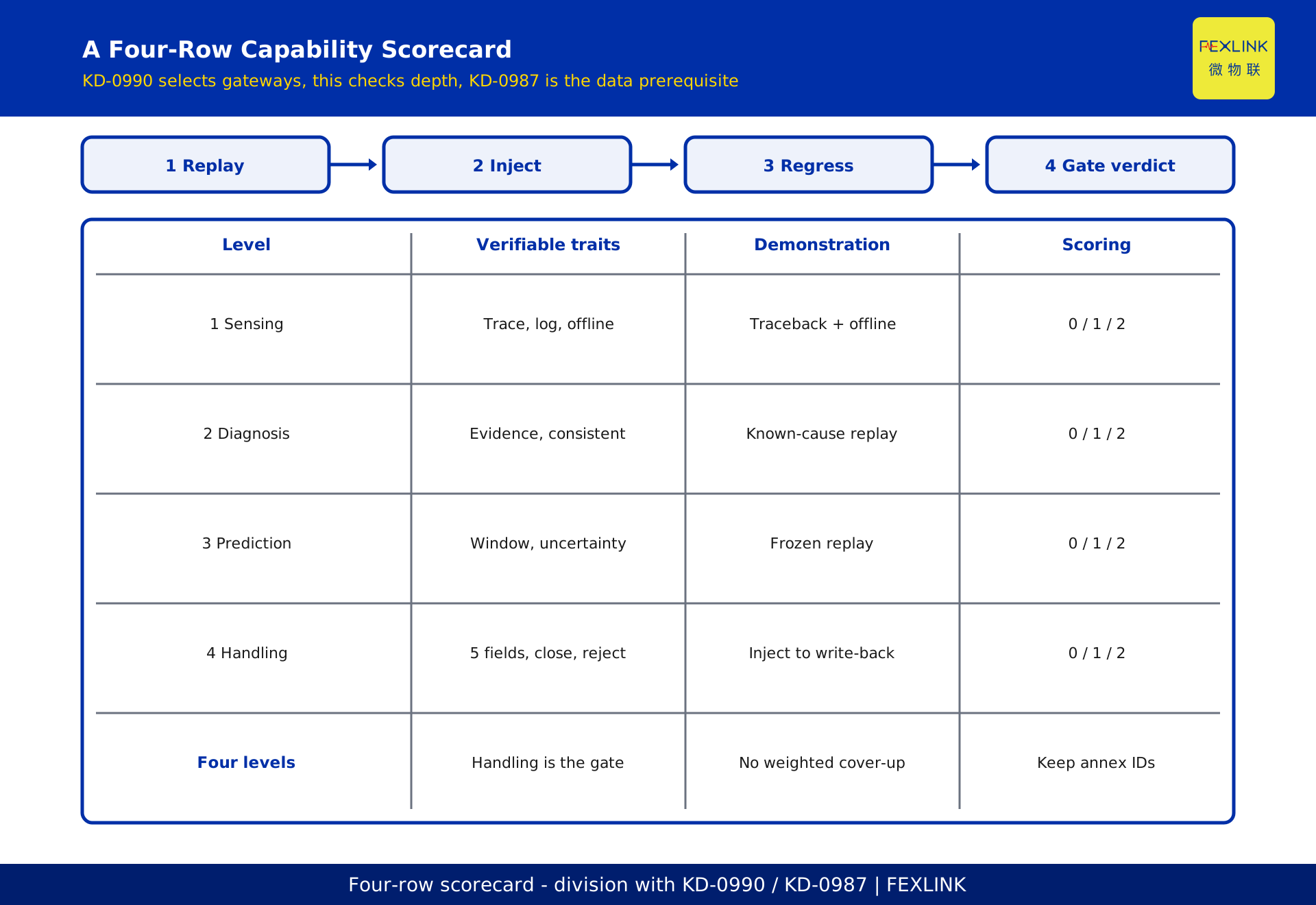
| Level | Verifiable traits | Demonstration | Scoring |
|---|---|---|---|
| 1 Sensing | Raw traceback, threshold log, offline distinguishable | Traceback + offline injection | 0 cannot show / 1 needs a person / 2 produced automatically |
| 2 Diagnosis | Citable evidence, consistent wording, confirmation grade | Replay + disturbance data | Same three grades |
| 3 Prediction | Time window, uncertainty, counter-example handling | Frozen-data replay | Same three grades |
| 4 Handling | Five field classes, closable, rejectable | Injection through to write-back | Same three grades |
The rule is a gate, not a weighted sum: below 2 on level 4 never counts as a closed loop, and 0 on level 3 never counts as predictive maintenance. A weighted total hides a broken process - full marks on the first three and zero on the fourth still yields a respectable six points. Keep an evidence annex ID column so acceptance points back to the record. The score is an internal tool, not an industry rating or pass line.
9. A De-Identified Example: Reading Two Demonstration Records
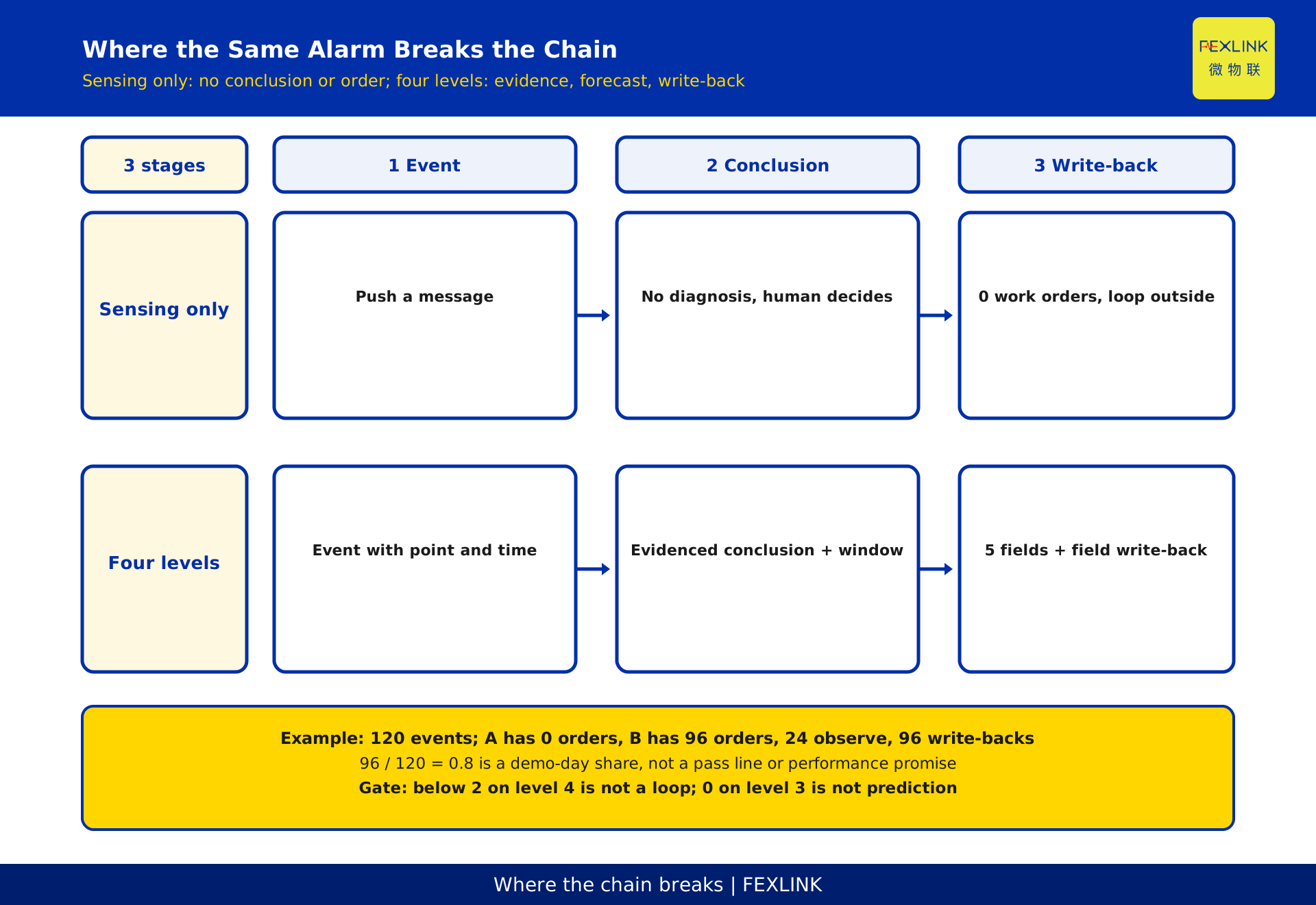
Replay the same 30 days of history with 120 limit-crossing events. Two constructed demonstration records follow.
Vendor A: all 120 events push messages, 0 work orders generated automatically, 0 diagnosis conclusions, with conclusions written up manually after the meeting; score sensing 2, diagnosis 0, prediction 0, handling 0. Vendor B: of 120 events, 96 work orders generated automatically, 24 marked as observe-without-dispatch, and 96 closed by field write-back; score sensing 2, diagnosis 2, prediction 1 (a windowed judgement exists but counter-example handling records are missing), handling 2.
Read it in three steps. 96 / 120 = 0.8 describes only the automatic work-order share that day; it is neither a pass line nor a performance promise. Vendor B's prediction score of 1 still needs the withdrawal action and its evidence to reach 2. Vendor A stays outside the comparison range because level 4 is 0, however polished its message channel. Neither is exempted from the level 4 check by a high total. All quantities are constructed; the scenario is de-identified.
10. Procurement Traps and Division of Labour
Four traps recur: treating "integration-ready, extensible" as capability already delivered; treating a model name as an acceptable output; treating a work order interface as a closed work order; and treating preloaded demonstration data as field data. The first two mistake possibility for fact, the last two mistake one short link for the whole chain.
Four boundaries are fixed. KD-0990 selects a multi-protocol access gateway; this article selects capability depth. KD-0985 covers per-asset threshold calibration, not developed here. KD-0987 covers the technical self-audit of data accuracy, completeness, timeliness and usability - a prerequisite, not repeated here. KD-0988 covers management result indicators such as closure rate; this article gives only work order fields and closing rules, not dashboards or KPI sets.
On product roles: the multi-element controller family published by FEXLINK sits at the sensing layer and the Tianyan forecasting model at diagnosis and prediction, while work orders and write-back belong to platform-side process capability. This shows only which layer each capability occupies; it evaluates no specific model and implies no measured performance.
Frequently Asked Questions (FAQ)
Q: Must all four levels be bought at once?
A: No. Phases are fine, but the contract and acceptance documents must state the current level, what the next adds, who adds it and when. Calling a sensing-only phase one "predictive maintenance" creates an expectation gap, not a price gap.
Q: Can a high prediction accuracy figure serve as acceptance evidence?
A: A lone percentage cannot. Ask what the denominator is, whether data was frozen to what was visible at the time, how non-events are recorded and how counter-examples are written back. Without these, the number cannot be recomputed or defended in a dispute; use frozen historical replay instead.
Q: With an existing work order system, must the platform still be checked?
A: Yes, beyond the interface: can the conclusion travel with its evidence, can field write-back return to the platform, and can rejection records feed the rules. Forwarding alarm text alone leaves the chain broken outside the platform, and the platform never sees an unclosed list.
Q: On a small site with no dedicated maintenance team, how is level 4 judged?
A: Owners may hold several roles, but fields cannot be dropped: who accepts, by when, and on what evidence it closes must still be written down, or "closed" is just a status change. Team size affects deadlines, not the requirements themselves.
Q: Can the scorecard be weighted into a total for ranking?
A: A reference total may sit in an appendix, but the conclusion column must keep the gate. When level 4 fails, a higher weighted total more easily hides the broken link. Ranking is for comparing offers; the gate is for classification.
Scope and Limitations
This article is for maintenance managers, procurement staff and solution selectors who hold a point register and operating rules and are evaluating predictive maintenance offers. It applies to electrical safety, energy and equipment condition monitoring projects; a trial operation may check only levels 1 and 2. It is not a tender or contract template, and constitutes no selection, purchasing or compliance commitment.
Limitations: the four levels, scorecard, three demonstration steps and the example are generic method illustrations, not any company's product grading or assessment basis. The figures 30 days, 120 events, 96 work orders, 24 observe items, 0 and 0.8 are constructed examples; no product model, parameter, price or point scale is involved, no standard number or clause is cited, and no performance commitments such as accuracy, lead days, energy savings, incident reduction or payback period are given. The controller family and forecasting model are named only as publicly disclosed references for sensing-layer and prediction-layer roles, with no evaluation of specific models or inferred measured behaviour. Freeze actual acceptance criteria against the contract, operating rules and local requirements. All cases are de-identified.
Frequently Asked Questions
Beyond Just Alarms
Do not select a predictive maintenance solution by ticking a feature list