 FEXLINK Research Institute
Direct Answer
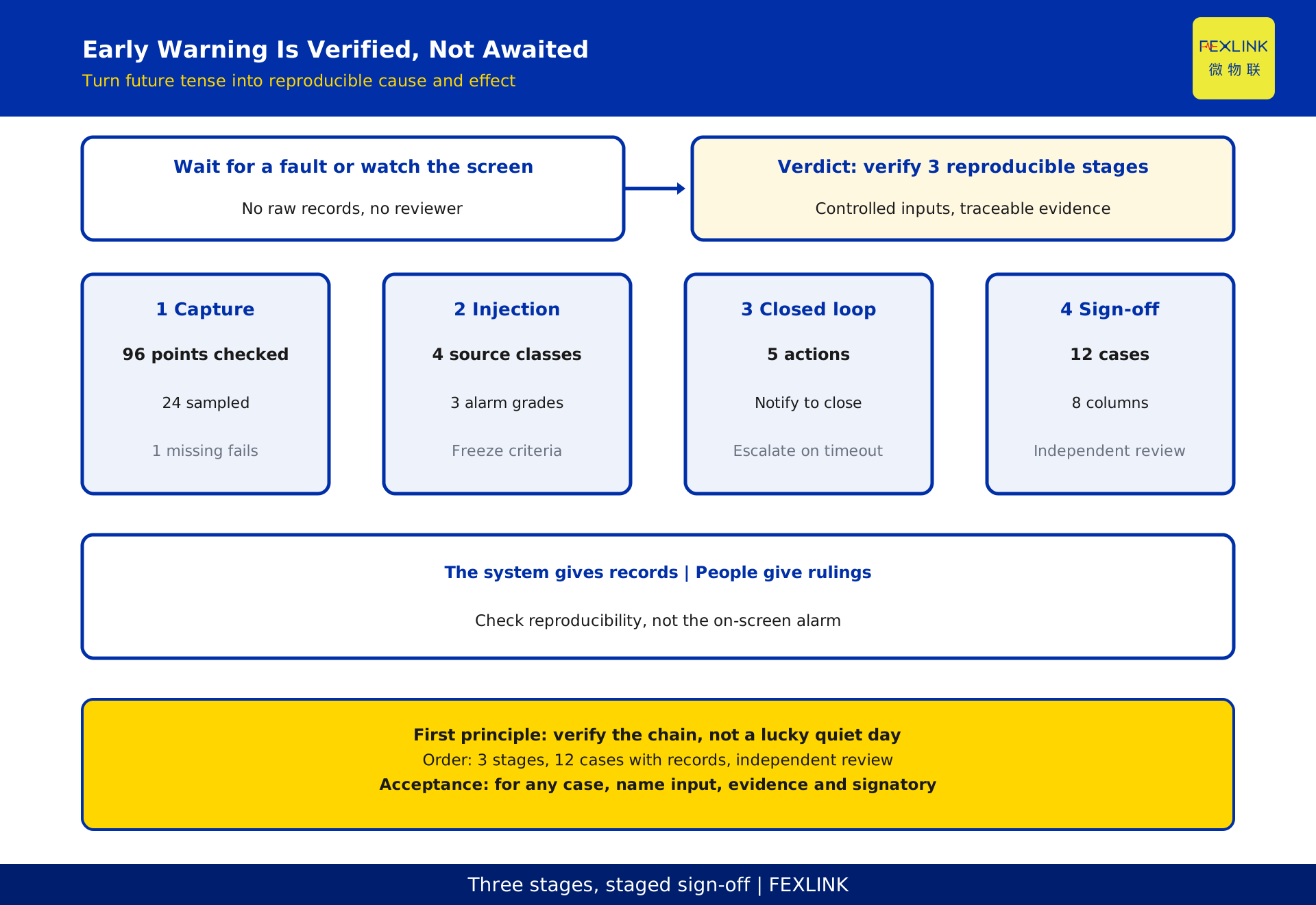
Early warning is future tense: on acceptance day there is usually no real fault to show, so a lit screen proves nothing. The approach splits "useful" into 3 stages: capture verification confirms points and data are complete; controlled injection uses reproducible inputs to trigger each alarm level; a closed-loop drill walks through the 5 actions of alarm, notification, work order, handling and closure. Each stage has its own input, pass evidence and sign-off owner. Together they answer whether a hazard is reported and handled - not whether the site is quiet today. This organises acceptance; it is no national limit or pass line. Thresholds, injection levels and pass criteria come from the contract and design documents; no compliance table is issued.
One. Early Warning Is Future Tense: There Is No Fault to Show on Acceptance Day
Checklists often say "demonstrate early warning", yet nothing can be shown: a healthy installation has no hazard, and creating one is unsafe and unpermitted. The demo degrades into paging through screens or clicking a historical alarm - testing the display, not the capability. Worse, treating "no alarm" as a pass rewards silence: raise the criteria, disable a channel, stop the push, and the screen looks equally clean. Manufacturing a fault also crosses into live work and continuity. Neither route works, so the object is wrong: test not "is there a hazard now" but "does the chain act as agreed when features appear". Rewriting future tense as a reproducible input-output relationship gives acceptance a footing.
Two. Break "Useful" Into 3 Verifiable Stages
The stages are sequential: incomplete data makes injection results impossible to attribute, and no alarm leaves the drill without a start. The table fixes each stage's question, input and pass evidence so criteria are not negotiated on site.
| Stage | Question | Input | Pass evidence | Common failure |
|---|---|---|---|---|
| Capture verification | Are data complete, correct and mapped to real points | Point list and raw records from the same window | Point-by-point check sheet and clock sync record | Wrong mapping, missing channel |
| Controlled injection | Does a feature trigger an alarm at the right level | Controlled source and frozen criteria | Graded trigger log and timestamps | Unfrozen criteria, wrong level |
| Closed-loop drill | Is the alarm received and the case closed | One alarm produced by injection | Notification, dispatch, handling, closure records | No acknowledgement, no escalation |
The stages test build completeness, criteria and chain, and operating mechanics. Collapsing them into "the system works" means nothing; each needs sign-off.
Three. Stage 1: Capture Verification
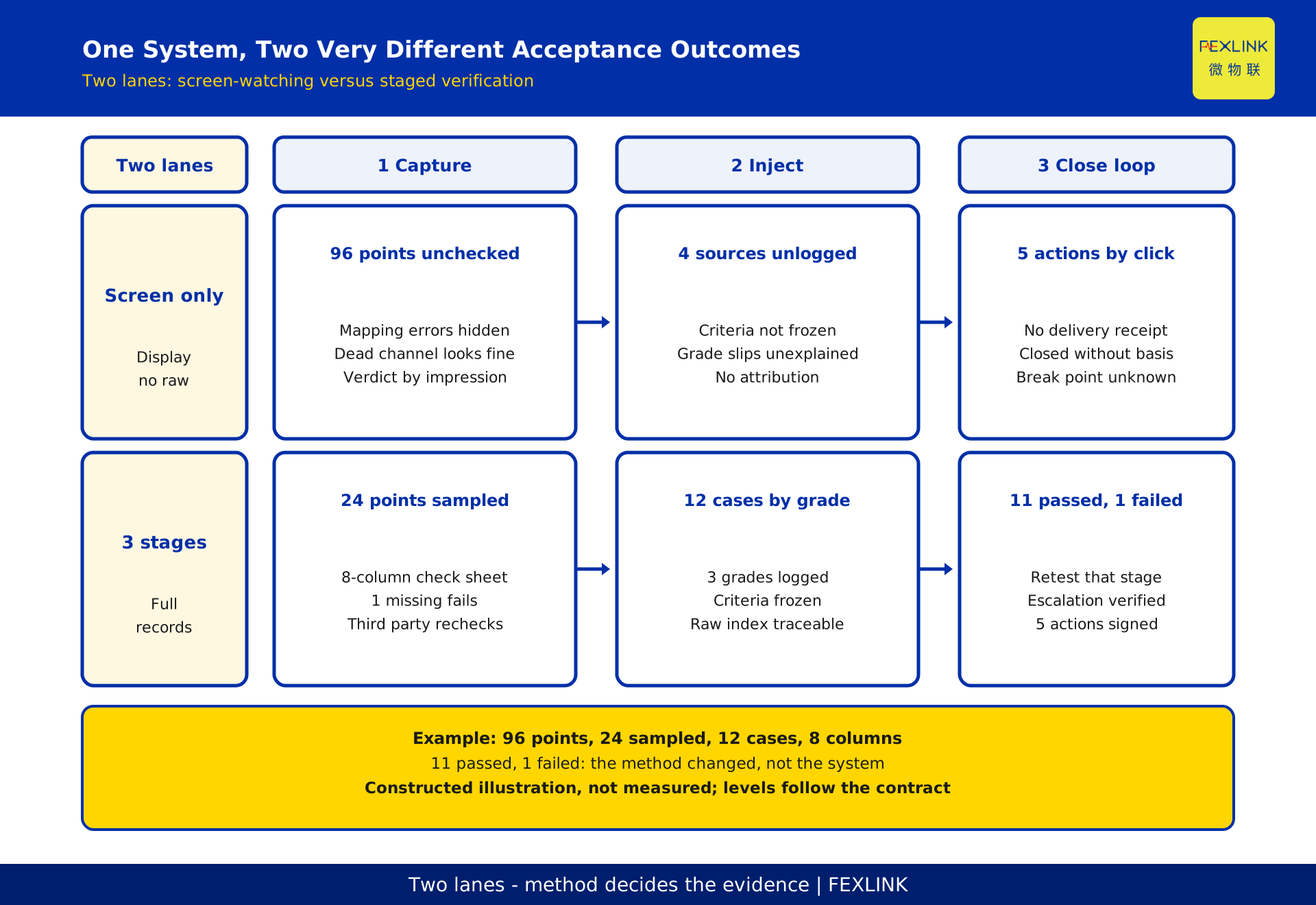
This stage proves one thing: the system sees the real points and is not silently dropping data. Check the design list row by row, then compare raw records with platform readings in one window. Take a de-identified constructed switchroom: 96 points listed, 24 sampled, checking identifier, circuit assignment, unit, sampling instant and clock source. If 1 point is missing, this stage fails - "everything else was fine" is no substitute. Sampling tests the mapping; the full list still needs a signature on every row.
| Check column | What to record | Why it is required |
|---|---|---|
| Point identifier | Design and system IDs | Prevents crossed points and wrong circuits |
| Circuit assignment | Cabinet and circuit name | Alarms land on an actionable location |
| Unit and scaling | Unit, ratio, coefficient | Readings compare; grades do not slip |
| Sampling instant | Timestamp with time zone | Injection and alarm can be aligned |
| Clock source | Sync method and record | Cross-device evidence holds |
| Channel state | Online, interrupted, self-test | Separates "no alarm" from "no capture" |
| Raw record | Concurrent curve or source reading | Third party can recheck |
| Sign-off | Checker, date, version | Responsibility is anchored |
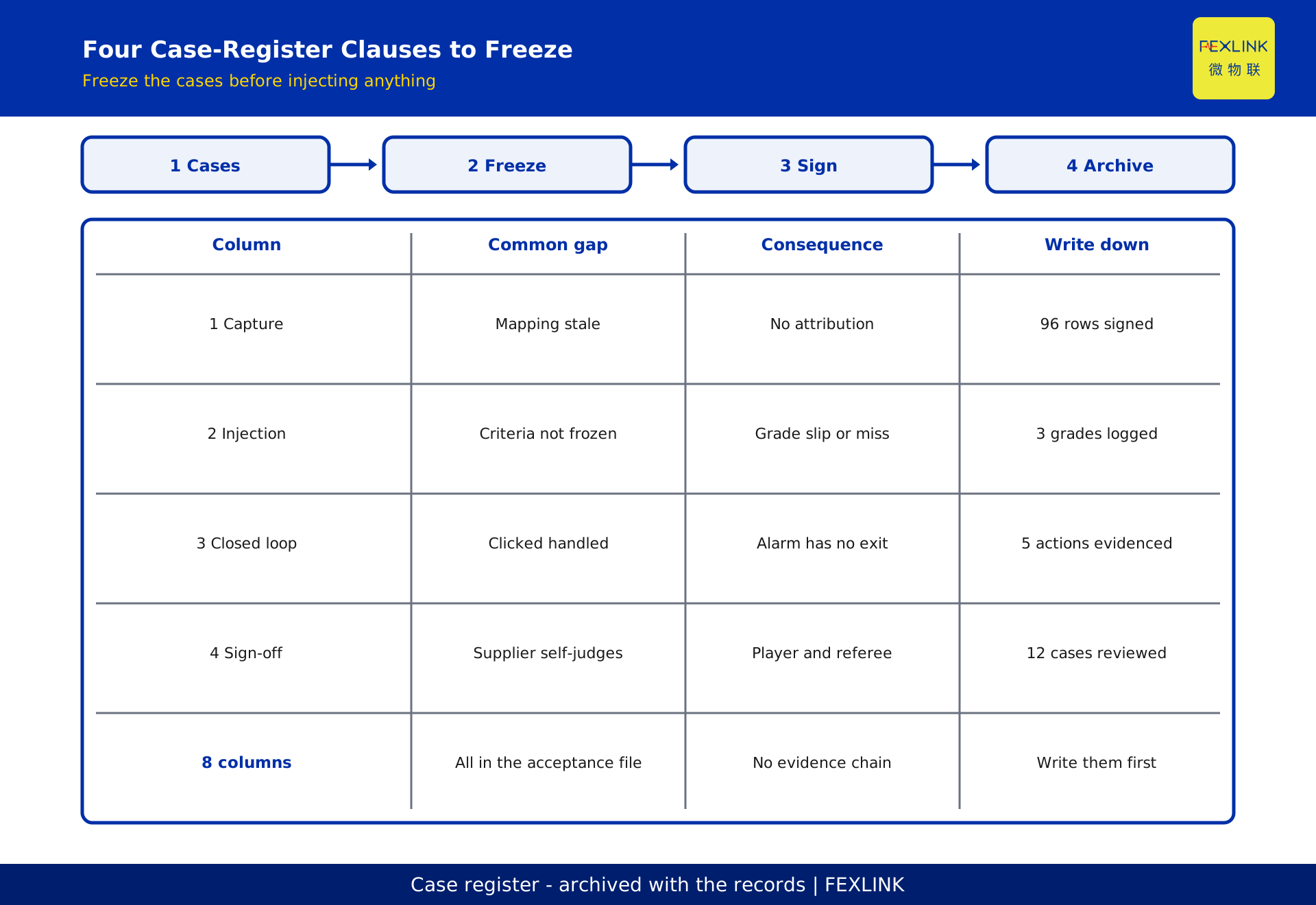
The output is an 8-column check sheet plus frozen criteria and configuration versions. Without a freeze, Stage 2 cannot say which criteria fired; any change restarts the count.
Four. Stage 2: Controlled Injection
The principle is "change only the input under test, not the running circuit": apply a reproducible, measurable, reversible feature at the sensor or secondary side and see whether the system alarms against frozen criteria. Sources fall into 4 classes: standard-source electrical signals, simulated temperature rise, simulated residual current, and communication or channel state injection. These describe roles, not magnitudes; injection points, values and duration are set by qualified personnel and recorded on the case sheet.
Injection logs both "what was applied" and "what the system returned": the applied side records device, point, times, level and operator; the system side records alarm time, grade, criteria version and raw index. Both timestamps need one clock reference, or "early" has no meaning. Reversal and reset must also be written down: restore the state, confirm the channel is normal, and write the drill marker so drill alarms stay out of operating statistics. Injection covers every grade and key circuit, case numbers mapping to records.
Five. Triggering Graded Alarms: A 3-Level Injection Matrix
Grading matters. If the system only knows "alarm" and "no alarm", criteria have no structure and response cannot be prioritised. Define 3 levels against frozen criteria, prepare ascending injection steps, apply them grade by grade, and record whether the result lands as expected, grades slip or anything is missed. Level spacing comes from the contract and design documents; no values here.
| Level | Injection side | System side | Judgement focus |
|---|---|---|---|
| Attention | Apply a low step near the criteria | Raw detail, time, criteria version | No false upgrade, no silence |
| Warning | Apply and hold a mid step | Alarm record, notification trigger | Correct grade, traceable latency |
| Action | Apply a high step and reset | Escalation chain, dispatch start | Triggers closure, reversible |
Beyond the three rows, run one reverse check each: does the alarm recover after withdrawal, is the drill marker complete, and does residual state affect the next step. Grade slips and misses fail this stage; fixes are a criteria-step review and a capture-chain inspection, not a rerun. False-alarm rate statistics belong to a companion article; drill alarms are not counted here.
Six. Injection Safety and Traceability
Injection touches energised equipment; safety outranks test results. Work permits, supervision, isolation, device applicability and prohibited circuit types must appear on the case sheet, confirmed by the owner. Circuits where protection or continuity could be affected get no physical injection; use secondary-side signals or a vendor-approved method. A dedicated person watches the operating side and stops on any anomaly.
Traceability rests on 2 things. First, full logging: case sheets, injection records, system details and reset confirmations are archived together, each case pointing back to a raw index. Second, separated responsibility: the integrator injects, while owner, supervisor or an agreed independent reviewer signs the judgement; the integrator cannot declare its own pass. Drill alarms carry a marker and stay apart from real alarms, preventing polluted reports and drill data quoted as measured performance.
Seven. Stage 3: Closed-Loop Drill
An alarm has value only when handled: start from one injection-produced alarm and complete 5 actions: generate it on the correct circuit, deliver notification to the named owner, create a work order at the right grade, handle the case with evidence written back, and close it against a defined basis. Every action needs a timestamp, owner and record.
| Action | Evidence to see | Where it breaks |
|---|---|---|
| Alarm generation | Raw index and grade | Wrong circuit, grade slip |
| Notification delivery | Receipt and recipient | Owner list out of date |
| Work order creation | Order ID and creation time | Grade not mapped to dispatch rule |
| Field handling | Handling record, before and after readings | No write-back, no evidence |
| Closure and archive | Closure basis and sign-off | Closed casually, no basis |
The drill also tests timeout and escalation: when nobody accepts the notification or picks up the order, does it escalate as agreed? This stage is easiest to fake by clicking "handled", so pick any case and name the timestamp, owner and evidence for each of the five actions. If not, the loop exists only in the diagram.
Eight. A Constructed Example: A 12-Case Acceptance Test Table
Below is a de-identified constructed format, not a real project, measured data or a recommended count. Assume 24 of 96 points sampled, and 4 injection classes with 3 levels produce 12 cases. The table has 8 columns, each answering "can a third party redo this".
| Column | What to record | Review use |
|---|---|---|
| Case ID | Unique number and version | Points back to the sign-off sheet |
| Stage | Capture, injection or loop | Assigns the conclusion |
| Injection point and class | Which of the 4 classes | Input is reproducible |
| Criteria version | Frozen version | Definition is checkable |
| Expected result | Grade and action sequence | Judgement has a basis |
| Actual record | Raw index and timestamp | Evidence is traceable |
| Conclusion | Pass, fail or held | No reliance on impression |
| Sign-off | Operator, reviewer, date | Responsibility is anchored |
Constructed result: 11 cases pass and 1 fails on "no notification receipt, no timeout escalation"; fix by updating the owner list and configuring escalation. Only that case and its linked stage are retested, and all 12 cases finally pass. Two cautions: the count is illustrative, the real number follows scale and contract; "all pass" means only these 12 cases were exercised, not that the system will work on a real hazard, and it is no performance promise.
Nine. Common Failures and Where to Fix Them
Writing failure modes into the acceptance file reduces argument better than pass conditions alone. The four rows cover common failures, each with a fix rather than "test again".
| Symptom | Stage | Usual root cause | Fix |
|---|---|---|---|
| Points disagree, channel has no data | Capture verification | Mapping not updated, no self-test | Repair mapping, restore channel, re-sign check sheet |
| No alarm after injection, or grade slip | Controlled injection | Criteria not frozen, steps mismatched | Check criteria version, redo grading matrix |
| Alarm exists, nobody accepts notification | Closed-loop drill | Owner list out of date | Update list, configure timeout escalation |
| Missing sign-off or no traceable index | All three stages | Evidence not archived together | Add evidence, name independent reviewer |
Disputed items follow the agreed hold and co-signing rules; deleting cases, changing criteria or narrowing scope to make results look good is not allowed. A definition change is a contract change and restarts the count after written sign-off. Retest from that stage and keep both record versions.
Ten. Roles and Responsibilities
The linked solutions, the electrical hazard early-warning system and the predictive maintenance solution, are a qualitative split: the former sits on the alarm-producing side where criteria, grading and output are formed; the latter sits on the predictive-output side and must also be covered by the three stages; the platform holds raw records, notification, dispatch and evidence archiving. No model parameters, capability claims, inferred performance, procurement commitment, or substitute for the contract, design documents and qualified bodies. Responsibility splits three ways: the integrator supplies the point list, frozen configuration and raw records and performs injection; the independent reviewer checks cases and rules on conclusions; owner and supervisor confirm case sheets, safety boundaries and pass criteria and sign off. A party that operates and judges its own pass cannot be rechecked.
Frequently Asked Questions (FAQ)
Q: With no real fault on acceptance day, is controlled injection alone enough?
No. Injection answers only "will it alarm", not "is data complete" or "will anyone handle it". The 3 stages carry independent evidence; without capture verification results cannot be attributed, and without the drill there is no exit.
Q: Could injection disturb production or trigger protection?
Safety boundaries outrank test results. Work permits, supervision and isolation must be confirmed first; circuits where protection or continuity could be affected get no physical injection, use secondary-side signals or a vendor-approved method. A dedicated person watches the operating side and stops on any anomaly.
Q: Do drill alarms count as operating-period false alarms?
No. Drill alarms carry a marker and are isolated from real alarms; they do not enter operating-period details. Mixing them in pollutes the metric and lets drill data be mistaken for measured performance. The definition has a companion article.
Q: If all 12 cases pass, can we write "early warning is effective"?
No. A pass means only these 12 cases walked the chain under constructed conditions. The acceptance file should say "passed case by case as agreed", with no performance promise or universal pass line.
Q: If one stage fails, must the whole acceptance start over?
No. Each stage is signed separately and retested after remediation. But a change to criteria versions or point mapping affects later stages, so linked stages must be assessed and affected cases redone.
Scope and Limitations
Applies to acceptance of electrical monitoring and early-warning projects with defined alarm output, full raw details and independent review. Not for systems with only summary screens and no raw detail, or where one demo replaces staged sign-off. The standard number in the registry does not match this topic after name verification; its scope covers fire-safety management of storage occupancies, so this article cites no standard numbers, clause numbers or compliance tables, and sets no thresholds, limits, injection magnitudes, grade steps or performance promises. Criteria and pass conditions come from the contract, design documents and qualified bodies. The 96 points, 24 sampled points, 12 cases, 11 passes, 1 failure and 8-column table in Section Eight are de-identified, not measured values or recommended ratios. Solution names are a qualitative split, not a procurement commitment or a substitute for the contract and third-party conclusions.
Frequently Asked Questions
The System Claims Early Warning—How Do You Actually Prove It Works at Acceptance?
Early warning is future tense: on acceptance day there is usually no real fault to show, so a lit screen proves nothing