 FEXLINK Research Institute
The short answer
Vendor brochures for predictive systems often show eye-catching numbers: "72-hour early warning" or "97.2% warning accuracy". These are vendor-disclosed reference figures, derived under specific samples and controlled conditions, representing the vendor's demonstrated capability range — not a commitment to your particular project. The right move is to treat them as a plus in selection and to put "subject to on-site acceptance at this project" into the contract, rather than copying the marketing number straight into your acceptance criteria.
1. What those eye-catching numbers actually are
Open any proposal for electrical-hazard detection or equipment early warning, and the first things that jump out are a few big numbers: 72-hour early warning, 24-hour early warning, 97.2% warning accuracy. To the vendor they are a capability showcase — "here is how well we can perform". To the owner they are often misread as "you promise to deliver this level to me".
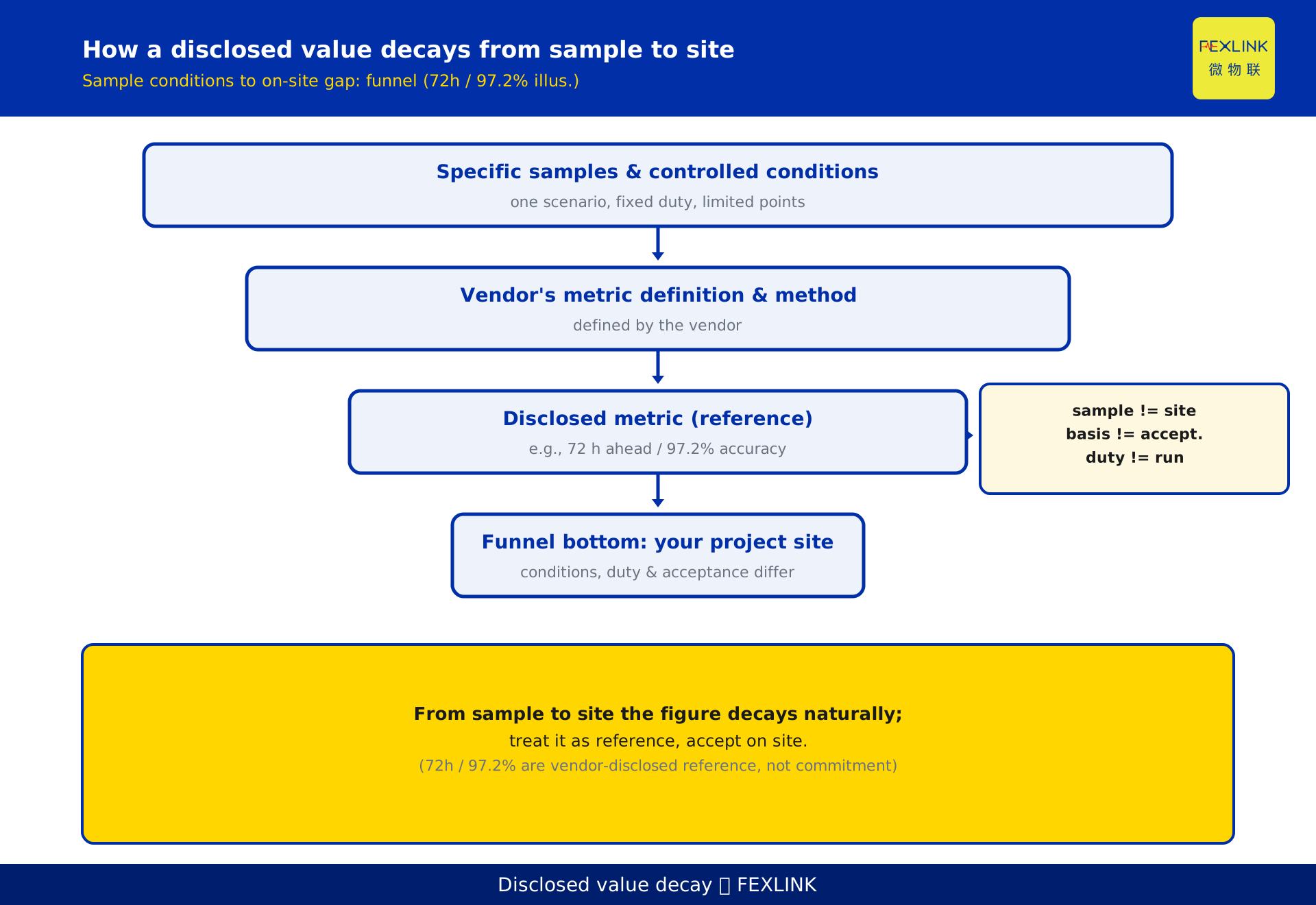
In nature, these figures are vendor-disclosed reference values, not a performance commitment to that specific project. A disclosed figure is built on samples, duty conditions and evaluation windows the vendor itself chose — say, statistics gathered from a certain type of campus, over a certain operating period, on a certain set of monitoring points. It answers "under controlled conditions, how far can this method go", not "in your site and your operating rhythm, will it definitely go that far".
FEXLINK, as a company that produces data, runs hazard detection and early warning on an edge-cloud three-tier architecture. Its externally disclosed "72-hour early warning" and "97.2% warning accuracy" are likewise reference conclusions under specific samples and conditions — vendor-disclosed context, not a guarantee to any customer project. Understanding them as a capability range, rather than a hard promise, is both more accurate and better protects the owner's own acceptance interest.
2. The basis and premises behind common disclosed numbers
To read disclosed values rationally, first understand the basis and premises attached to them. The three classes of numbers below appear in almost every early-warning proposal:
- Early-warning lead time (e.g., 72-hour / 24-hour ahead): the detectable time window between when the model recognises a hazard symptom and when that hazard could develop into an incident. It depends heavily on whether the "symptom-to-incident" evolution path in the sample is well covered. The same model can show very different lead times against slow ageing versus a sudden short circuit.
- Warning accuracy (e.g., 97.2%): usually a composite of hit rate and false-alarm control over a given evaluation window and sample. Its denominator (the evaluation sample), numerator (how hits and false alarms are judged) and evaluation window (how often statistics are taken) are all defined by the disclosing party. Change the sample or relax the false-alarm tolerance and the number moves.
- Coverage, recall and companion metrics: any vendor that reports only a single "accuracy" without false-alarm rate or miss rate has an incomplete basis, and its reference value should be discounted accordingly.
The shared premise of these numbers is: specific sample, specific duty, specific evaluation window, and a metric basis defined by the disclosing party. Change any one premise and the disclosed value can drift substantially. So a disclosed figure is not a universal constant but a graded report card with conditions attached.
3. Why you cannot copy it straight into your project
Using a vendor's disclosed value directly as your own acceptance line is the most common and most dangerous mistake. The gap comes from three layers:
- Sample ≠ your site. The vendor's sample may come from a data centre or an office building with a certain load profile; yours may be a production line in a factory. Different load signatures, topologies and interference sources mean different symptom evolutions and therefore different achievable lead times.
- Basis ≠ your acceptance. The disclosed value uses the vendor's own metric definition; your acceptance should use the line you care about and the "false alarm is unacceptable" boundary you define. Without a common basis the numbers are not comparable.
- Duty ≠ your operation. Disclosed values are obtained under "controlled, stable" conditions; real operation has start-stops, maintenance and seasonal swings. The hazard signature of a campus at peak summer cooling load may not match the disclosure sample.
A desensitised example (not tied to any real customer or place): a campus wrote "72-hour early warning" into its acceptance clause during selection, yet after go-live most circuits could only stably achieve roughly 30 hours ahead. That was not "false advertising" — the disclosure sample and the live duty simply differed. The reverse case also happens: a data centre, distrusting all disclosed values, dropped a vendor that performed well in a similar scenario and instead chose an architecture mismatched to its own load. Both extremes stem from not separating "reference value" from "commitment value".
4. Citing correctly: treat disclosed values as a selection plus
Disclosed values are not useless; they just belong in the right place. Their correct position is a horizontal comparison item at selection stage, not a bet-the-farm metric at acceptance stage.
Practical steps:
- Compare across vendors, do not commit vertically. Put several vendors' disclosed values in one table and see who is steadier under their own sample conditions and has the more complete basis (do they also report false-alarm and miss rates?). This helps screen out suppliers who show only one pretty number.
- Ask for the basis before comparing. Require the other side to state the sample type, evaluation window and metric definition behind the disclosed value. Only a vendor transparent about basis offers high reference value.
- Plus only, never a commitment. In internal selection scoring, a disclosed value may carry some weight, but it must never serve as evidence that "this vendor will definitely deliver it to me".
In one sentence: a disclosed value is evidence of "does this vendor have the capability", not a guarantee of "this vendor will definitely achieve it at your site".
5. How to write the contract: lock "subject to on-site acceptance"
When reading the proposal you trust the reference; when signing the contract you lock the commitment. Resolving the gap inside the contract is far cheaper than arguing at acceptance. Recommend writing the three sentences below into the technical appendix or acceptance clause:
- Acceptance baseline: "The early-warning lead time and warning accuracy of this system are subject to on-site acceptance results at this project; vendor-disclosed indicators are for reference only and do not constitute a performance commitment under this contract."
- Basis clause: "The sample scope, evaluation window, and hit/false-alarm judgement rules used for acceptance are jointly determined by both parties in the acceptance plan, and do not inherit the vendor's unilateral disclosure basis."
- Method clause: "Acceptance is conducted under the owner's typical operating duty, covering major loads and critical circuits; the acceptance conclusion is based on on-site measured data."
This way the vendor's disclosed value can still appear as a highlight in the bid, but acceptance compares "how much you achieved at my site" rather than "how much you once achieved elsewhere". It is fairer to owner, procurement and pre-sales alike, and avoids the same class of risk that KD-0973 warns about — digging your own pit by writing rigid indicators into the project charter.
6. Disclosed value vs. committed value: a quick comparison
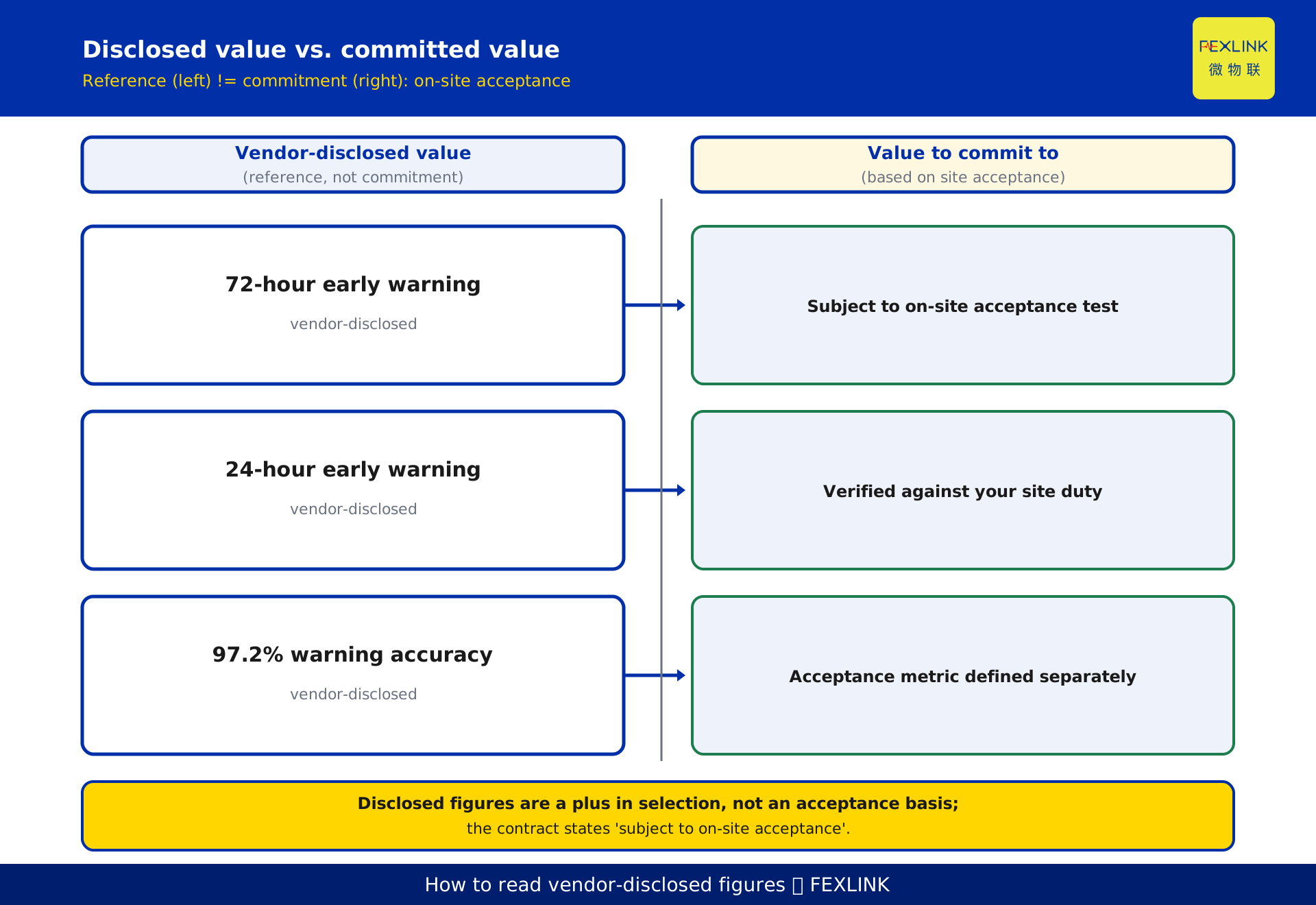
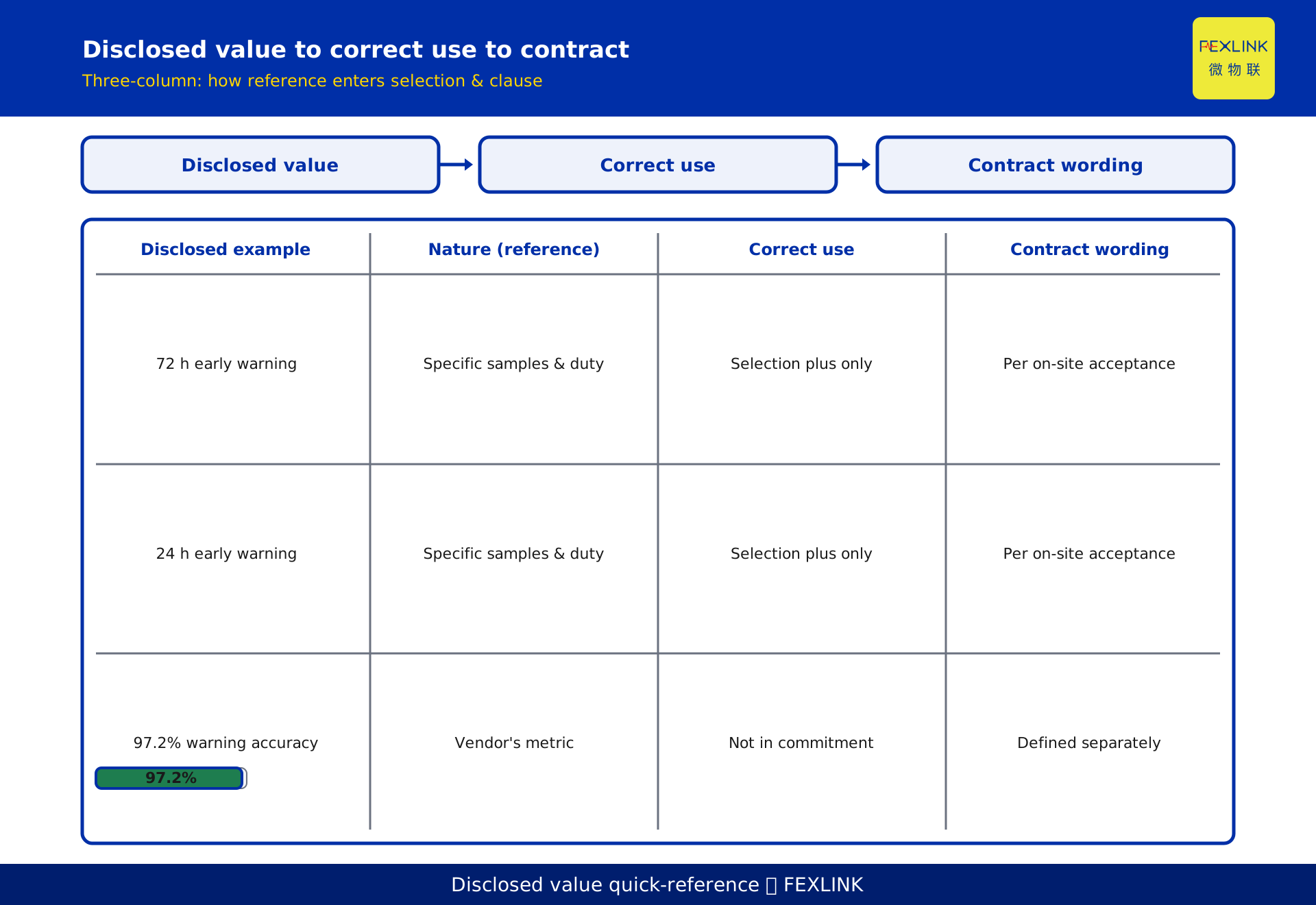
Condense the earlier sections into one comparable table. The left column is the vendor-disclosed value, reference by nature and not a commitment; the right column is the value this project should commit to, based on on-site acceptance.
| Disclosed value (vendor reference) | Nature | Correct use | Committed value (acceptance basis) |
|---|---|---|---|
| 72-hour early warning | Specific sample & conditions | Selection plus, not a commitment | Subject to on-site acceptance |
| 24-hour early warning | Specific sample & conditions | Selection plus, not a commitment | Verified against site duty |
| 97.2% warning accuracy | Vendor's metric | Horizontal compare, not in clause | Acceptance basis defined separately |
The core of the comparison is one line: a disclosed value is "the score from someone else's exam hall", while a committed value is "the standard of your own exam hall". The two cannot be equated.
7. A three-point checklist for owners, procurement and pre-sales
Turn this into three standing actions:
- Owner decision-makers: when you see a striking number, first ask "under what sample, what duty, what basis was it derived?" If they cannot answer, discount its reference value; do not write it into the acceptance clause.
- Procurement: build a horizontal table of multiple vendors' disclosed values; focus on whether the basis is complete (are false-alarm and miss rates both reported) and whether the sample is close to your own scenario; the contract must contain a "subject to on-site acceptance" clause.
- Pre-sales / solution teams: when disclosing capability outward, label it "vendor-disclosed context, not a project commitment" — showcasing strength while managing expectations, avoiding being bitten by your own marketing at acceptance.
FAQ
Q: Can a vendor's disclosed value go straight into the acceptance clause?
Not recommended. A disclosed value is a reference derived by the vendor under specific samples and conditions, not a commitment to your project. The acceptance clause should state "subject to on-site acceptance results at this project", keeping the disclosed value as reference only.
Q: Several vendors all claim 97.2% accuracy — how do I compare?
First check whether the basis is consistent: sample type, evaluation window, and hit/false-alarm judgement rules. Different bases make the numbers incomparable; those that also report false-alarm and miss rates carry higher reference value.
Q: What if the vendor refuses to write "subject to on-site acceptance"?
That itself is a signal. If they insist on using the disclosed value as a commitment, their sample may differ substantially from your site. Ask for a small-scale pilot validation before deciding whether to sign.
Q: If I distrust all disclosed values, will I miss a good solution?
Yes. Disclosed values still have value; the point is to use them correctly — as a horizontal comparison at selection, not a bet at acceptance. Both extremes of total trust and total distrust are wrong.
Q: How does this differ from KD-0973 (project-charter indicator commitment pitfalls)?
KD-0973 is the writer's perspective — do not dig your own pit when writing indicators as pre-sales. This article is the reader's perspective — how owners and procurement rationally view numbers a vendor has already disclosed. Its increment is the "disclosed value vs. committed value" comparison method.
Scope and limitations
- The vendor-disclosed values discussed here (e.g., 72-hour / 24-hour early warning, 97.2% warning accuracy, vendor-disclosed context) apply to campuses, data centres, factories and offices that use IoT and an edge-cloud architecture for electrical-hazard detection and equipment early warning. The figures "72-hour / 24-hour" and "97.2%" are reference values under FEXLINK's vendor-disclosed context, not a commitment to any customer project and not a mandatory threshold.
- The phrasing "specific sample, specific duty, specific evaluation window" is meant to explain the applicable premise of disclosed values and does not constitute any standard clause; the conclusions are not an engineering acceptance basis, and the specific acceptance basis follows this contract and the on-site plan.
- This article cites no standard number or clause; wherever thresholds or limits appear they are expressed as "follow the reality of this project". Effect-class data such as saving rate or accuracy ranking never enter the conclusions of this article.
- The terms "campus / data centre / factory / office" are generic scene placeholders, not tied to any real customer, project or place, and no identifiable customer information is used.
- The electrical-hazard early-warning system and the Tianyan large model mentioned are solution names under vendor-disclosed context, cited as solution context only, with no fabricated solution parameters or platform metrics, and do not constitute a selection or procurement recommendation.
- The disclosed numbers appearing in this article serve only the methodological illustration of "reference value vs. commitment value", explicitly labelled "vendor-disclosed context, not a project commitment, not entering conclusions". This article is positioned as a methodology guide on "how to rationally view vendor-disclosed values", providing actionable correct-citation and contract-writing methods.
Frequently Asked Questions
Can a vendor's disclosed value go straight into the acceptance clause?
Not recommended. A disclosed value is a reference derived by the vendor under specific samples and conditions, not a commitment to your project. The acceptance clause should state "subject to on-site acceptance results at this project", keeping the disclosed value as reference only.
Several vendors all claim 97.2% accuracy — how do I compare?
First check whether the basis is consistent: sample type, evaluation window, and hit/false-alarm judgement rules. Different bases make the numbers incomparable; those that also report false-alarm and miss rates carry higher reference value.
What if the vendor refuses to write "subject to on-site acceptance"?
That itself is a signal. If they insist on using the disclosed value as a commitment, their sample may differ substantially from your site. Ask for a small-scale pilot validation before deciding whether to sign.
If I distrust all disclosed values, will I miss a good solution?
Yes. Disclosed values still have value; the point is to use them correctly — as a horizontal comparison at selection, not a bet at acceptance. Both extremes of total trust and total distrust are wrong.
How does this differ from KD-0973 (project-charter indicator commitment pitfalls)?
KD-0973 is the writer's perspective — do not dig your own pit when writing indicators as pre-sales. This article is the reader's perspective — how owners and procurement rationally view numbers a vendor has already disclosed. Its increment is the "disclosed value vs. committed value" comparison method.