 FEXLINK Research Institute
The short answer
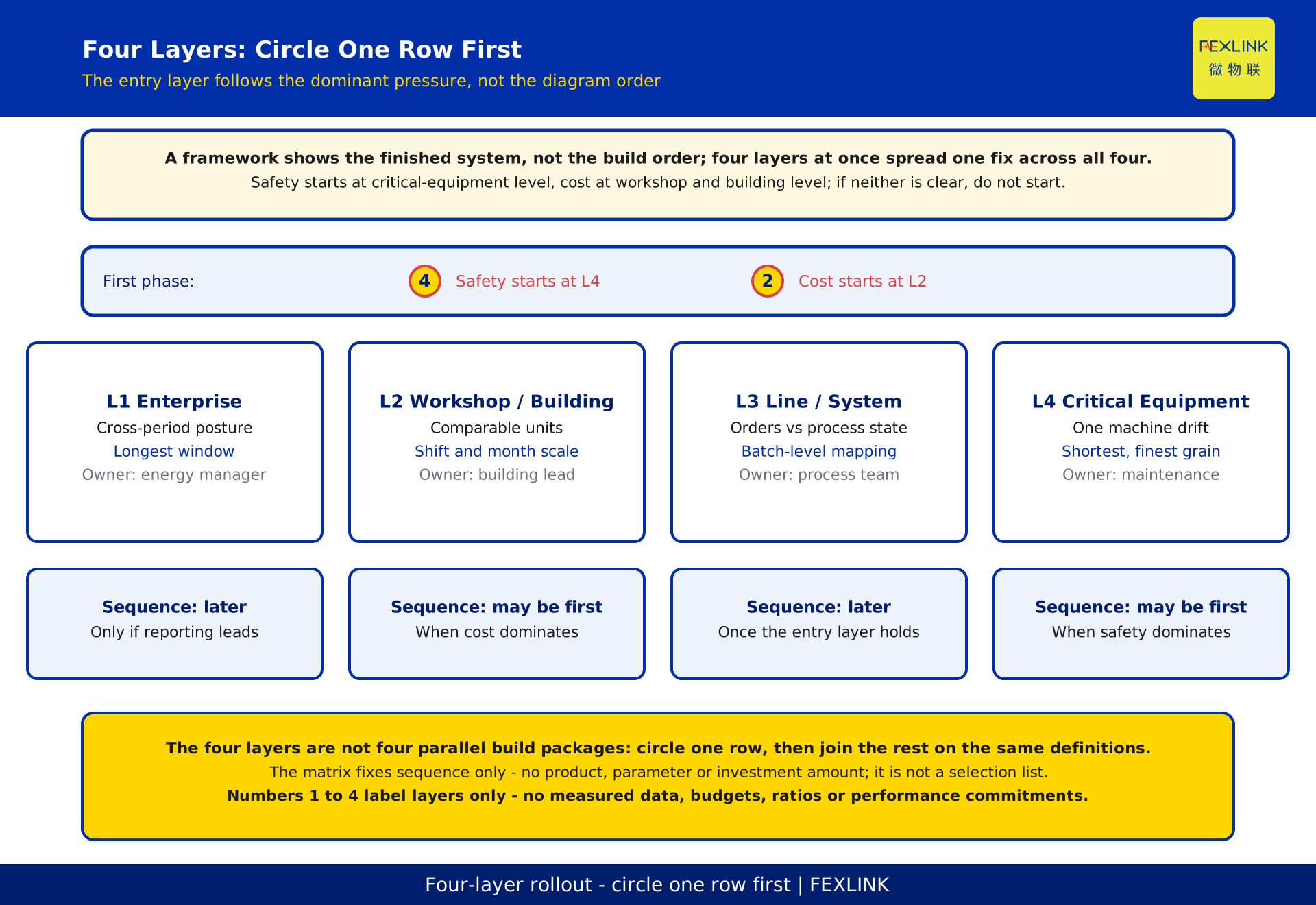
Do not start at the top of the framework diagram. Enter at the layer that hurts most, finish it, then roll upward on the same definitions — the three-step way to put this framework to work in your plant. Safety pressure starts at the critical-equipment level; cost and benchmarking pressure starts at the workshop and building level; if neither is clear, do not start, and rewrite the pain as one testable sentence. A framework describes the finished system, not the build order; confusing them is why a good-looking framework never lands. Layer and model names come only from the already accepted framework reading in this library; no dimension is added. The numbers 1 to 4 label layers and steps only, not measured data, budgets, ratios, deadlines or performance commitments.
What "four layers, three dimensions" actually names
The official wording registered in the accepted framework reading is "Energy–Carbon Autonomy 4×3×2": four sensing dimensions form the data foundation, three core models carry decisions, two sets of actions provide execution. The four dimensions, top down, are enterprise level, workshop and building level, production line and system level, and critical-equipment level; the three models are safety, energy and efficiency. The "three dimensions" in the title is a loose label for analytical views, not a second framework; this article adds no definition and sets no parallel coordinate systems.
Official scheme documents are not held in this library, and governance rules require an official framework's dimensions, layers and elements to come from official documents alone. So this article quotes those names and discusses entry-layer choice and evolution only; definitions and acceptance criteria belong to the official documents.
The four layers run on different time scales
The four layers are not four copies of one job; each watches a different time window. Higher up the window is longer and a single judgement reaches further; lower down it is shorter and closer to one machine's changing state. Enterprise level cares about cross-period posture and external reporting, workshop and building level about comparable accounting units, production line and system level about mapping work orders to process state, critical-equipment level about whether one machine has drifted from its own normal state. Only relative scale is claimed: no sampling period, deadline or threshold.
Building all four at once makes four teams with four rhythms share unvalidated definitions, so one correction hits all four. Starting with one layer lets definition problems surface in a controllable scope, be fixed once, then copied upward.
Three models, three different questions
The three core models are three analytical views over one data foundation, not three systems to build separately. Following the accepted wording: safety answers "will something go wrong", energy answers "how should energy be used", efficiency answers "how well are we doing".
Those questions test whether the entry layer was chosen correctly. If the urgent problem is "stop the incidents", build the layer supporting a safety judgement; if it is "we cannot tell which workshop uses more", build the layer supporting comparable definitions. Asking all three at once usually yields a dashboard for every view and a work order for none. A model is not a layer; the two must not be multiplied into modules. The first phase needs only the matching question answered clearly; other views are later directions, outside scope and acceptance.
Why starting at the top stalls halfway
"Build the cockpit first" is the most common opening and the one most likely to stall. Top-level views consume aggregations from below; without stable output they are assembled from manual entries or temporary interfaces, and survive no follow-up: where did the number come from, who owns it, how is a change traced? The trail breaks at the third question, and repair means changing display, interface and field collection after the budget has gone into the screen.
A top-level conclusion also needs cross-period data before it stands, and a top-level view naturally asks for "everything", so the boundary keeps growing. All three point one way: pick a layer that can produce a conclusion on its own, get definitions, ownership and traceability working in a usable loop, then aggregate.
Step 1: translate the pain into an entry layer
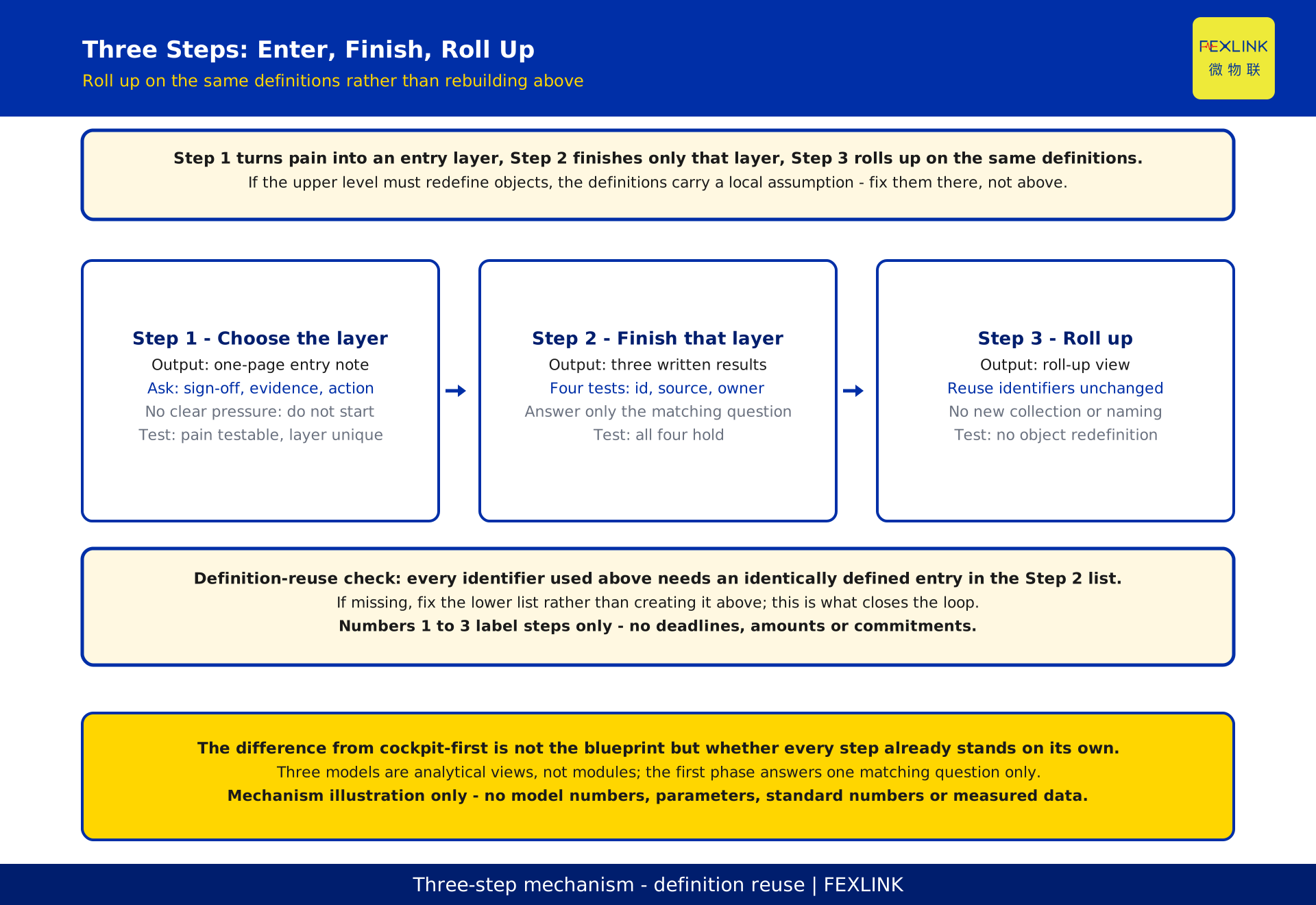
Step 1 draws no architecture and lists no devices. It turns "we want this under control" into a testable pressure and maps it onto one layer.
| Dominant pressure | Build first | Why | Out of first phase |
|---|---|---|---|
| Safety incidents | L4 critical-equipment level | Pressure sits on one machine's state drift; the conclusion points to an action | No enterprise roll-up, no cross-site benchmarking |
| Cost and benchmarking | L2 workshop and building level | Pressure sits on "who uses more"; comparable definitions come first | No single-machine state, no process attribution |
| Neither is clear | Do not start | No testable criterion; any layer will be overturned later | No placeholder dashboard |
The mapping asks three things: who signs off, can the evidence be obtained inside that layer, can the conclusion become an action; if one fails, rewrite the pain. The output is one page: one sentence of pain, one entry layer, one completion test, one exclusion list — the baseline for the next two steps and the cheapest guard against scope creep.
Step 2: finish that one layer only
The classic mistake is bringing in the layer above "since we are already connected", which forces definitions to serve two rhythms and doubles the rework area.
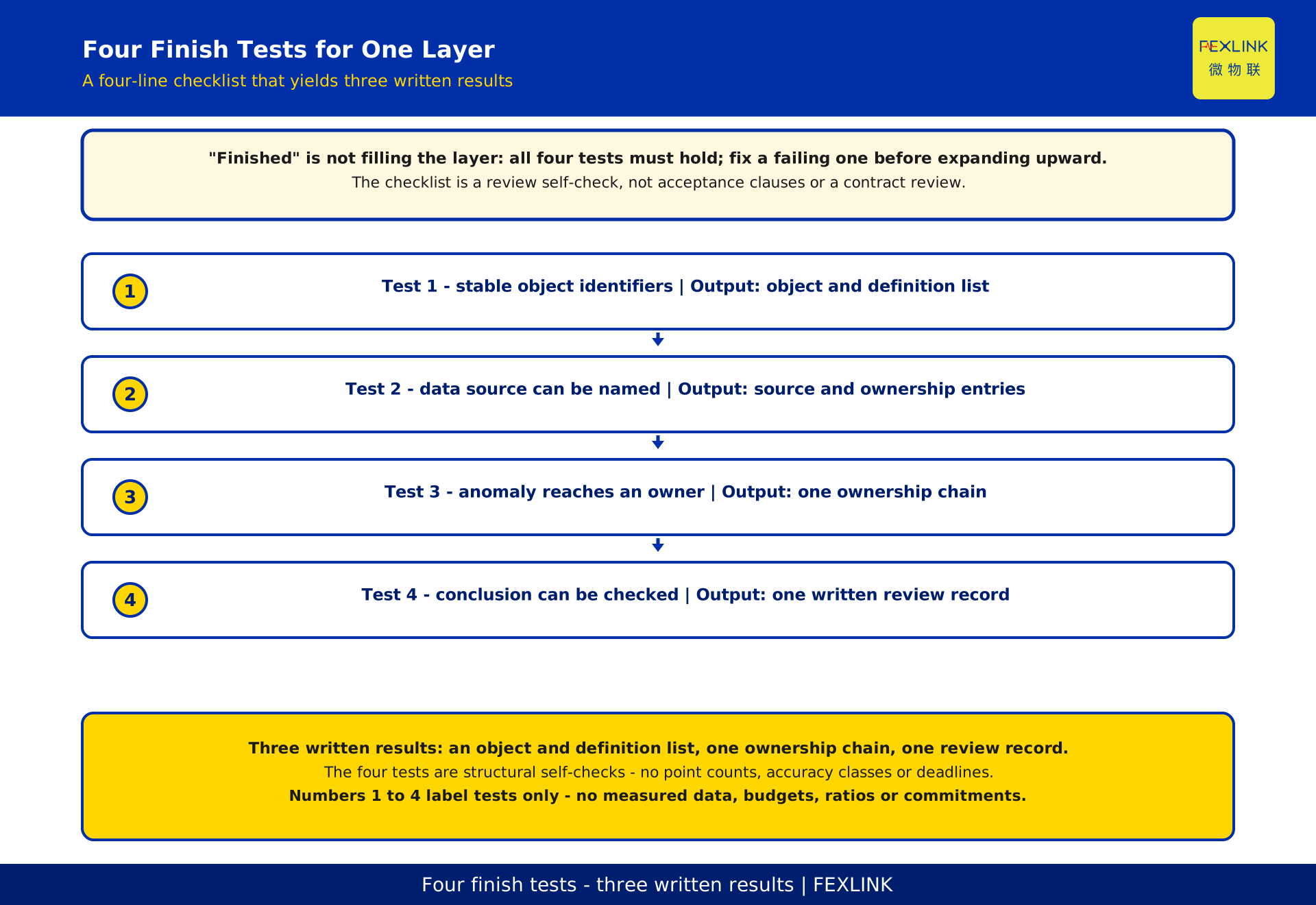
"Finished" has a short test: does every object have a stable identifier, can the data source be named, does an anomaly reach an owner, and can the conclusion be checked? All four must hold; if one fails, fix it and do not expand. There is no point count, accuracy class or deadline here — those are project design inputs. The first phase answers only the question matching the pain, not three dashboards; the other views are later directions. Deliverables stay modest: an object and definition list, one ownership chain, one review record, all in writing before the layer can roll upward.
Step 3: roll up on the same definitions
Step 3 is where "from a diagram to your own plant" closes: roll up, do not rebuild above. Extend the identifiers, definitions and ownership chain that work at the entry layer into the view one level up, unchanged — no second collection path or naming scheme. If the upper level must redefine objects to produce a number, Step 2 definitions carry a local assumption; fix them there, not above.
| Step | Sole output | Completion test | Common drift |
|---|---|---|---|
| Step 1 | One-page entry note | Pain testable, layer unique | Treating "get it under control" as a mandate |
| Step 2 | Definitions, ownership chain, review record | All four finish tests hold | Bringing in the layer above |
| Step 3 | Roll-up view on the same definitions | No object redefinition above | A separate collection and naming scheme |
The sequence runs bottom up, and every step must already stand on its own.
A layer, focus and investment-priority matrix
The first three steps compress into one table for kick-off confirmation, not a selection list. "Investment priority" is a sequencing test relative to the entry layer chosen here, not a general rating, and it maps to no budget or ratio.
| Layer | Question | Role that judges | Priority test |
|---|---|---|---|
| L1 enterprise level | Overall posture, external reporting | Energy or electrical manager | Bring forward only if reporting dominates |
| L2 workshop and building level | Whether accounting units compare | Workshop or building lead | First phase when cost dominates |
| L3 production line and system level | Work orders vs process state | Process and production management | Extend once the entry layer is stable |
| L4 critical-equipment level | Whether one machine has drifted | Equipment and maintenance lead | First phase when safety dominates |
Read it as "circle one row, then decide when the other three join". The table fixes sequence only — no product, parameter or investment amount.
Three hand-offs where the method breaks
Failures usually sit at a hand-off, not inside a step.
Between Step 1 and Step 2, the failure is "the entry note says L4, but implementation starts with a roll-up screen". Treat that page as the scope baseline for any new display request.
Between Step 2 and Step 3, the failure is "the upper level needs numbers, so it invents its own names". Run a definition-reuse check: every identifier used above needs an identically defined entry in the Step 2 list; otherwise fix the lower list.
Between models and layers, the failure is treating three views as modules across every layer. State in the scope document that the first phase answers one question. All three hold only with a written baseline.
An anonymised walk-through
A manufacturing site asked to "bring power use and equipment condition under one roof" and attached a complete framework diagram. Method illustration only: no customer name, region, inferable scale, outcome data or real project.
Step 1 questions showed the real worry was anomalies spotted too late, not monthly reports. Safety pressure dominated, the entry layer was L4 critical-equipment level, and the exclusion list ruled out a roll-up view and benchmarking. Step 2 put identifiers, data sources and the anomaly-to-owner chain in writing, answering only "will something go wrong"; Step 3 reused those identifiers one level up once the review record was stable.
No numbers are needed: the test is whether each step left a reviewable written result and whether the upper level still needs objects redefined. For a cost-driven owner, Step 1 would circle L2 and the rest stay unchanged.
When this method does not apply
First, several legacy subsystems need consolidating: the tension is the data model and alarm merging, not an entry layer; a separate article covers that. Second, the pressure is funding phases, not layers: investment sequencing uses different criteria and should not share this table. Third, the framework is not yet confirmed with the owner: settle the official wording and acceptance requirements first, or the dispute moves to implementation. No product list, parameters, standard numbers, measured data, budgets or performance commitments; all numbers label layers, steps and views.
Frequently asked questions (FAQ)
Q: If the diagram is complete, why not build it all at once?
The four layers have different time scales and owners. Building them together makes four lines share unvalidated definitions, so one correction hits all four, and a top-level conclusion needs stable output from below. Reuse working definitions upward: same blueprint, contained risk.
Q: If we start at L4, will we ever connect to L1?
That depends on whether Step 2 wrote reusable identifiers and definitions, not which layer came first. No redefinition above means a roll-up on the same definitions; if needed, the lower ones carry a local assumption — fix them there.
Q: Is "three dimensions" an official set of three dimensions?
No. The official structure registered in the accepted reading is four sensing dimensions, three core models and two sets of actions; the title's "three dimensions" is a loose label for analytical views. No new three-part structure is defined here, and official dimensions, layers and elements come from official documents alone.
Q: Must all three models go live together?
No, and it is not advisable. The first phase answers only the question matching the entry point: safety asks "will something go wrong", cost asks "who uses more, and where is the gap". The other views are later directions, outside scope, acceptance and commitments. A model is a view, not a module.
Q: Are these numbers measured data, and can they be used for a budget?
No to both. The numbers 1 to 4 label layers, steps and views; matrix priorities are sequencing tests, not ratings. There is no measured data, budget, ratio, deadline, point count or performance commitment. Related-product and related-standard fields are empty in the registry, so no model numbers, parameters or standard numbers are offered; actual investment belongs to project documents.
Scope and limitations
This article applies to the initiation and scheme-review stage of a new or rebuilt supervisory system, when an entry layer and evolution sequence must be chosen, for owners' energy or electrical managers, project managers and solution architects. It answers "which layer first", not framework definitions, product selection, parameter design, investment amounts or contractual boundaries.
Four limitations. First, official scheme documents are not held in this library; layer and model names come only from the already accepted framework reading and were not checked against the official texts, so definitions and acceptance criteria belong to those documents and no framework is invented. Second, the registry records empty related-product and related-standard fields, so there are no model numbers, parameters, standard numbers, clause numbers or conformity judgements; related solution names are names only. Third, the numbers 1 to 4 are structural labels and figure numbers a subset of the same set; there is no measured data, budget, ratio, deadline, sampling period or performance commitment, and the walk-through is a method illustration. Fourth, adjacent article identifiers stay in a structural field: this article covers a new project's entry layer, an existing one covers consolidating legacy subsystems, and another covers funding phases.
Every deliverable is DRAFT_PENDING_REVIEW with owner_review_required=true, and the generator does not self-approve. Independent QA, owner review, release registration and release-package verification are pending. Unpublished; not a basis for selection or acceptance.
Frequently Asked Questions
Putting a 4-Layer
Do not start at the top of the framework diagram