 FEXLINK Research Institute
Direct Answer
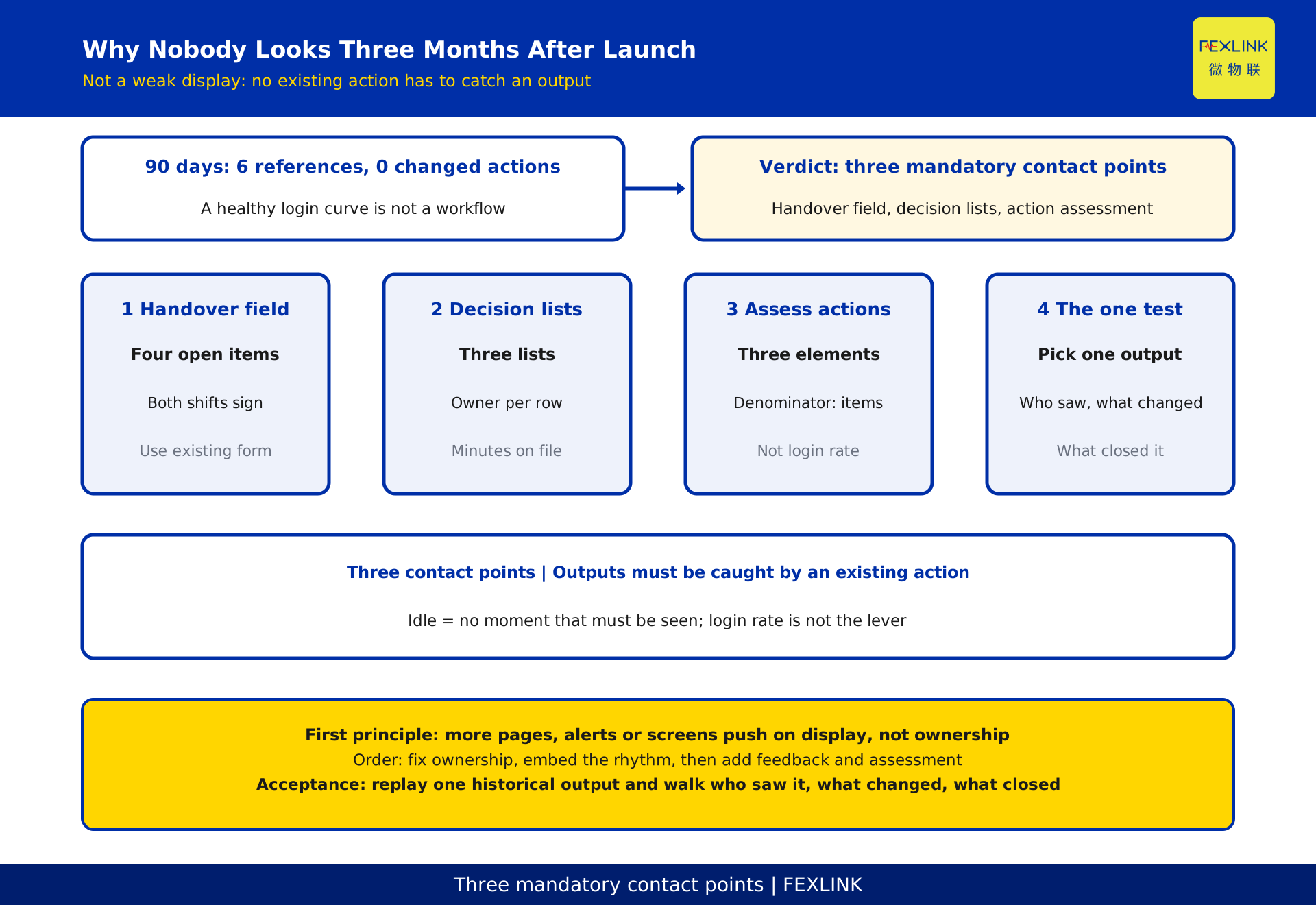
A monitoring system nobody opens after three months is usually not a bad interface or a careless shift team. It was delivered as a display, not a working mechanism: it produces outputs, yet no organisational action must catch them. The fix is not more pages, notifications or a bigger screen, but attaching outputs to existing workflows through three mandatory contact points: a fixed field in the shift handover, a monthly report written as a decision request, and assessment tied to provable handling actions. There is one test: pick any output from last week and name who saw it, which action changed, and what closed it. If nobody can, a healthy login curve still means idle. This covers post-launch operations, not review-stage rejection (KD-0970) or how alarms become work orders (KD-0984).
1. Change the Test: Idle Means No Moment That Must Be Seen
Treat "nobody looks" as an attitude problem and the remedy becomes reminders. Treat it as a missing mechanism and it lands on process. Launch delivers the ability to look — pages, charts, permissions, a wall display — but rarely who must look when, what follows, and what trace remains.
Login rate is the easiest wrong lever. It is an outcome measure, lifted by a notice, an assessment target or catch-up clicks, and says nothing about which pages were opened or whether any action followed.
Here, idle means no mandatory connection between an output and an organisational action. A platform admired at acceptance then forgotten is the same as one opened daily that changes nothing. Do not read the curve: pick one alert from last week and find its handling record.
2. Three Breaks: No Owner, No Rhythm, No Feedback
Idle is three connections breaking in sequence, and they cannot compensate for one another. With an owner but no fixed moment, daily work displaces the check. With a routine but no owner, everybody seeing means nobody acting. With both but no feedback, the routine hollows out.
| Break | Visible symptom | What is actually missing | Self-check question |
|---|---|---|---|
| No owner | Anomalies sit on a shared board; nobody claims them | No single person must respond to each output | Can you name the role for any one alert? |
| No rhythm | Logged in when remembered, untouched for weeks | Output is not embedded in handovers or meetings | Which existing meeting cannot finish without it? |
| No feedback | Seen and handled, then silence | Results and closing basis never flow back | Which check last month changed one concrete action? |
All three breaks sit outside the system; a new feature applies force inside it. This is why idle is often seeded at acceptance: points, screens and permissions were checked, but not whether a usage mechanism reached a named role. Design-stage disagreement belongs to KD-0970.
3. Contact Point One: Put System State Into the Shift Handover
The cheapest contact point is the handover that already happens. A shift sheet already carries unfinished items; making system state a fixed field adds no meeting or system. It needs four items: open items, longest open duration, items added this shift, and the recipient. Both staff sign, so the shift log becomes usage evidence.
Write open items, not "all normal". Normal conveys nothing; an open item has a recipient and forces the next shift to act. Use definitions the system can verify, agreed and recorded before launch.
Attach only to existing routines. A daily meeting created for the system alone is soon cancelled; a handover is signed and non-duplicable, so a required field makes looking part of the shift.
4. Contact Point Two: Make the Monthly Report a Decision Request
Most monthly reports are data summaries nobody has to decide on, so nobody needs them. Invert the report and it becomes the second contact point: the body is three lists — open items with owners, overdue items with blockers, and decisions required with options. Every row needs an owner and a next step; the meeting walks the rows and records resolutions.
Consider a constructed contrast. One site's report had 12 pages of charts and 0 decision requests, so nobody had to respond; rewritten as three lists, the meeting has rows that must be answered. 12 pages measures volume, not use.
The report also closes the third break: decisions requested last month are reported back. If they cannot be, the blocker is written into the list.
5. Contact Point Three: Assess Actions, Not Logins
Responsibility belongs in job descriptions and assessment as "provable handling actions", not login counts. A provable action names which output it answers, which action ran, and who confirmed closure against what basis. This is the responsibility logic of KD-0984 applied on the organisational side.
Two distortions need guarding. Assessing only closure counts encourages under-recording and quick closes; assessing only response time encourages looser deadlines. Check complete traces, an independent reviewer and recurring problems, with the denominator fixed to items needing action. Thresholds and weights are set by the responsible party; no universal number or pass line is given here.
6. A De-Identified Example: 6 References in 90 Days, Still Idle
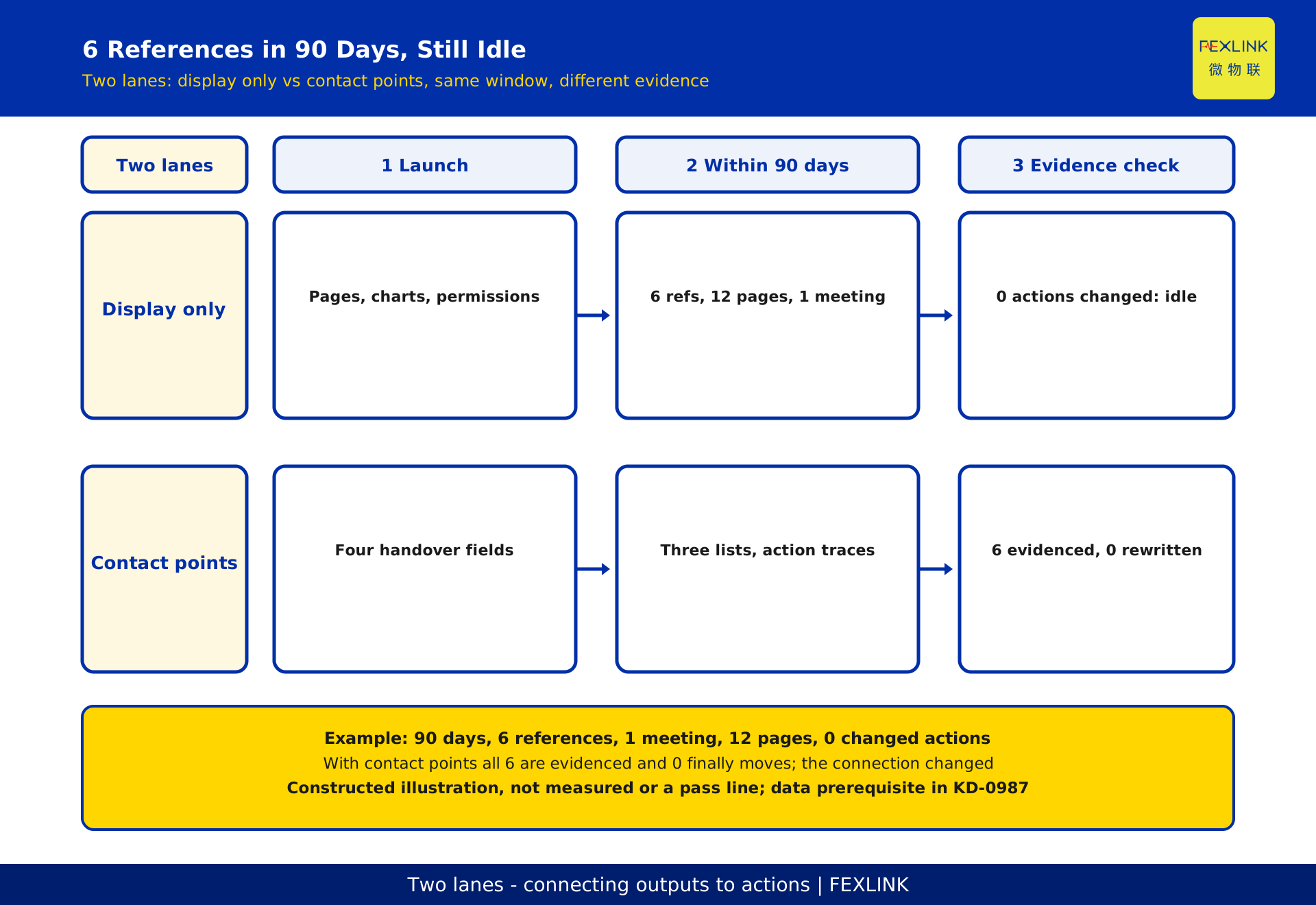
Run one constructed dataset through the test. In the 90 days after launch a site produced several alerts; the shift log holds 6 traceable references to outputs; 1 monthly meeting was held, with a 12-page report. Tracing every reference, 0 of them changed a concrete handling action. By a login measure this site has users; by this test it is idle. None of the 6 references formed the full chain of who saw it, what changed and what closed it, and the 1 meeting produced no request requiring an answer.
Look at the same window after contact points are attached. The handover field fixes four items, so open items have a recipient; the report becomes three lists, so the meeting has rows to walk; assessment rests on action traces, so results and reviewers are written back. Now each of the 6 references can be evidenced, the 1 meeting has minutes, and the figure of 0 changed actions finally moves. What changed is the connection, not data volume.
All figures are de-identified constructions, not measured values, recommendations or pass lines, with no client, project, site or vendor names. Replacing "did anybody look" with "is there a provable action" reverses the verdict.
7. Four "Rescue" Moves That Speed Up Abandonment
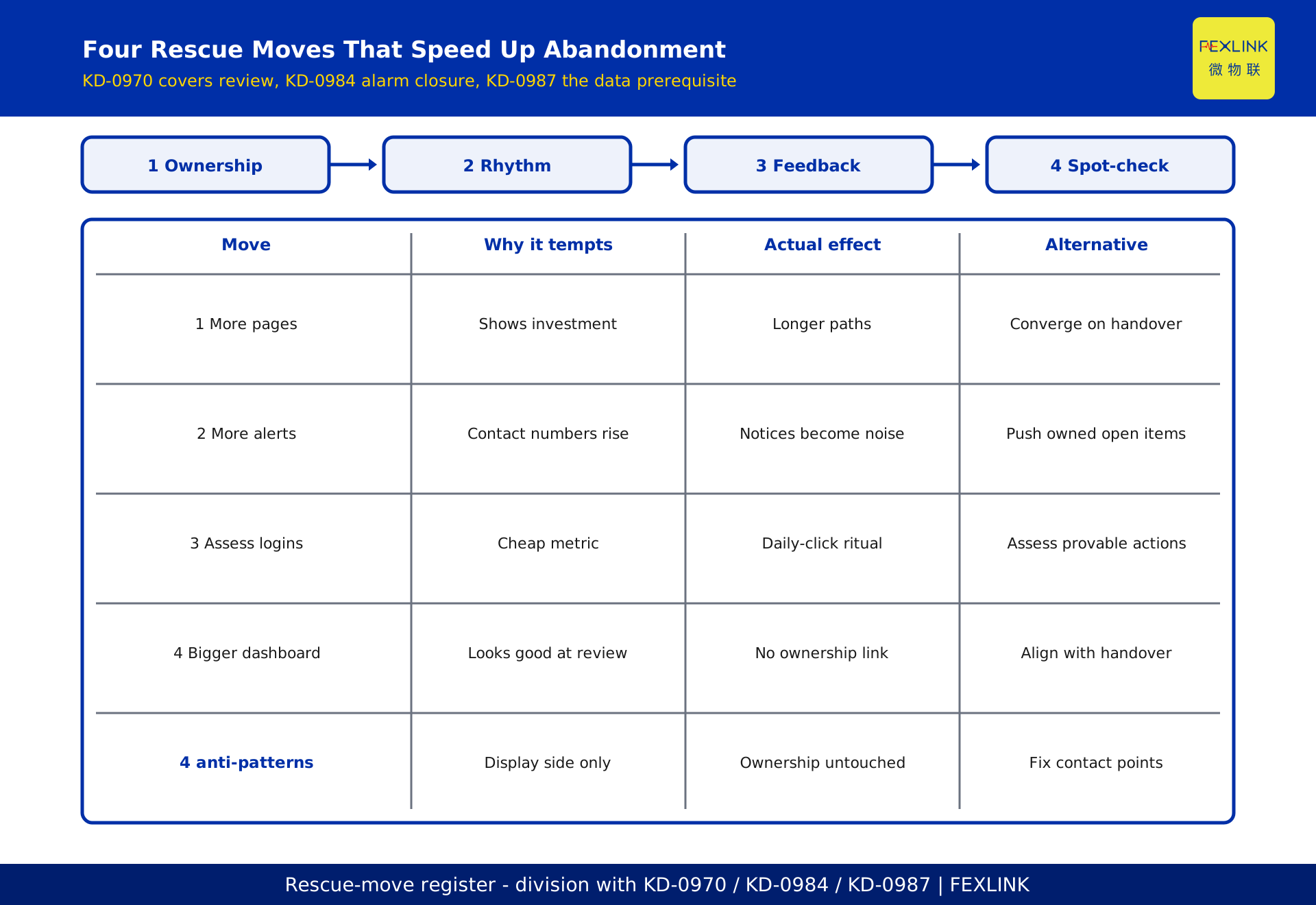
The four most common reactions push on the display side, so they make things worse: each makes the system louder or prettier without making any output obligatory to catch.
| Move | Why it tempts | Actual effect | Alternative |
|---|---|---|---|
| Add features and pages | Shows continuing investment | Longer paths; occasional users find less | Converge on what handover and meetings use |
| Add alerts and pushes | Contact numbers rise at once | Notices become noise; muting is rational | Push only open items with one owner |
| Assess login rate | Cheap, ready-made metric | Produces a daily-click ritual | Assess provable actions and review traces |
| Build a bigger dashboard | Best impression at review | Stronger display, still no ownership | Align the screen with the four handover items |
8. Three 30-Day Stages (Illustrative)
No major rework is needed. Move through three 30-day stages in a fixed order — ownership, rhythm, then feedback and assessment — leaving one checkable artefact per stage. This is illustrative, not a standard duration or pass line.
| Stage | Action | Artefact and check |
|---|---|---|
| One: ownership | Classify outputs, name one responding role and recipient per class, freeze the definition of "open" | Ownership table; any output can be named to a role |
| Two: rhythm | Deploy the handover field and monthly lists using existing forms and meetings, no new system | Continuous signatures and minutes; any field traces to a shift |
| Three: feedback | Write back results, reviewers and closing basis; report last month's decisions | Feedback record; then repeat the evidence spot-check from Section 6 |
9. Handover Checklist: Treat the Usage Mechanism as a Deliverable
If idle is seeded at acceptance, the handover list belongs beside the functional list. It needs four items: an ownership table, a rhythm table (shifts, meetings, fixed fields), trace templates (handover fields, list rows, minute template), and a worked evidence sample. Missing items are recorded with an owner and a completion arrangement.
Verification is simple: do not let the supplier demo the dashboard. Ask the responsible party to pick one historical output and walk "who saw it — what changed — what closed it". If it fails, display capability was delivered, not a usage mechanism. This mirrors the frozen-history replay in KD-0986, but tests the organisational chain.
10. Common Mistakes and Division of Labour
Three recurring mistakes: blaming staff awareness and running training instead of changing process; treating "somebody logged in" as "the system is used"; and treating the fix as a campaign that fades when monthly feedback stops. None leaves an evidence chain.
Boundaries are fixed. KD-0970 covers designs rejected by operations at review; this article covers post-launch idle. KD-0984 covers the technical chain of grouping, grading, dispatch and write-back, and this article borrows only its single-owner and closing-basis logic. KD-0986 covers four capability levels from alert to work order, KD-0987 the four data-quality lines, KD-0988 management value metrics, and KD-0969 the architecture-stage data chain. The increment here is three organisational contact points and idle defined as the absence of a moment that must be seen.
The registry field related_products is empty; related_solutions lists the digital electrical supervision system and the predictive-maintenance solution. They appear only as a qualitative split: the former carries outputs and handling flow, the latter supplies forecast outputs needing catching. This implies no model capability or measured performance and is no procurement promise.
Frequently Asked Questions (FAQ)
Q: Logins are rising. Why call the system idle?
A: Login rate measures contact, not handling. Pick one output from last week; if nobody can say who saw it, what changed and what closed it, more logins are still only contact.
Q: Can we skip a new meeting and put the check straight into the handover?
A: That is the recommended route. A shift sheet already has an unfinished-items field. Fix open items, longest open duration, new items and the recipient there; the signature is the trace.
Q: Will management think a report without charts is too thin?
A: Charts can be appended, but the body should be three lists: open items with owners, overdue items with blockers, and decisions with options. 12 pages with 0 decision requests means the report never entered the workflow.
Q: Will assessing action traces encourage under-recording and quick closes?
A: Yes, so closure counts and response times cannot stand alone. Check complete traces, independent review and recurring problems, with the denominator fixed to items needing action.
Q: The system has been idle for half a year. Can the stages still work?
A: Yes, if the order holds: ownership table, then handover field and monthly lists, then feedback and assessment. Keep one evidence spot-check before and after; judge by a real changed action, not login volume.
Scope and Limitations
This applies to monitoring and early-warning systems already commissioned, with stable outputs and declining use, for operations leads, project managers and operators reviewing a launch. It does not apply to schemes still under review, and does not replace sector operating rules or shift regulations.
No standard number, clause or compliance limit is cited; no universal pass line, threshold or weight is set. The 90 days, 6 references, 1 monthly meeting, 12 pages of charts and 0 changed actions in Section 6, the three 30-day stages in Section 8, and the ownership table, three lists, four fixed fields and four handover artefacts are de-identified constructions, not measured values or recommendations. Deadlines and stages are confirmed and recorded by the responsible party.
No model, parameter, price or point count is given, and no accuracy, login uplift, closure uplift, days of early detection, incident reduction, energy saving or payback figure is promised. The two solution names come from related_solutions and serve only as a qualitative split between output generation and carriage; they imply no capability or measured performance. Three contact points are an organisational mechanism, not a substitute for the data-quality prerequisite (KD-0987), the alarm-closure mechanism (KD-0984) or threshold calibration (KD-0985). If data cannot be trusted or outputs lack a single-owner rule, fix the prerequisite first. D10 still requires independent QA review.
Frequently Asked Questions
Nobody Logs In After Three Months
A monitoring system nobody opens after three months is usually not a bad interface or a careless shift team