 FEXLINK Research Institute
Direct Answer
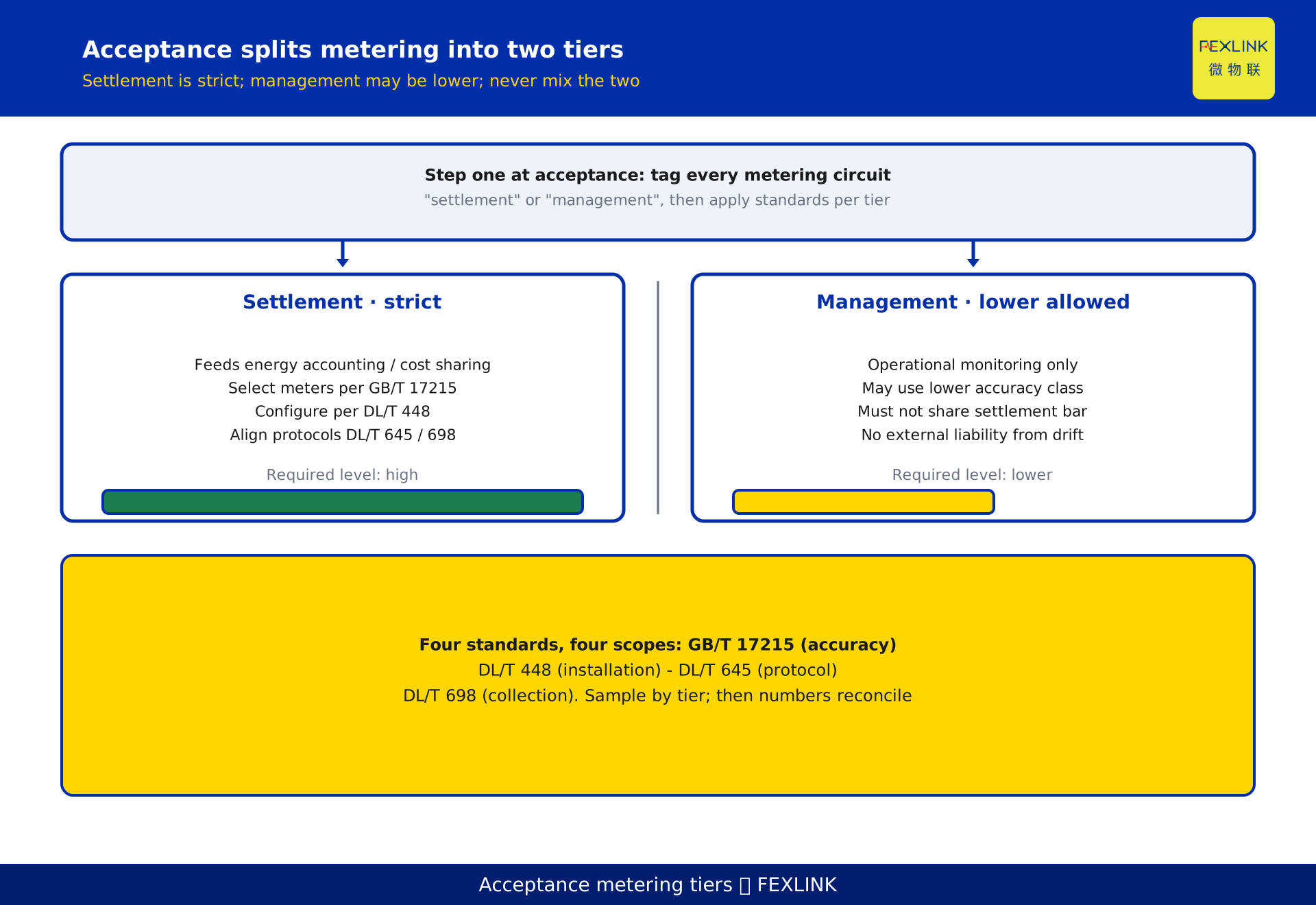
At project acceptance, when a monitoring platform also serves energy billing and cost allocation, its metering data must survive reconciliation. The hard standards split into two tiers. Metering that feeds settlement—energy accounting, cost sharing, or external billing—must use high-accuracy meters selected against the accuracy requirements of GB/T 17215, be configured as a metering installation per DL/T 448, and complete its communication-protocol alignment under DL/T 645 / DL/T 698. Metering used only for operational monitoring may use lower-accuracy meters, but the two tiers must not share the same standard of scrutiny. At acceptance, sample and verify reading deviations by tier so the numbers truly reconcile.
1. Why Settlement Metering and Management Metering Need Separate Standards
When one monitoring platform plays both the "see the energy use" and "settle the bill" roles, its metering data carries two fundamentally different purposes. The first is settlement metering: the data enters energy accounting, cost allocation, and even external billing, so any deviation becomes money or liability directly. The second is management metering: the data is used only for internal operational monitoring, trend analysis, and shift comparison, where deviations do not translate into external accountability.
The two purposes demand very different meters. Settlement metering is strict: it must be selected against accuracy standards for electrical energy metering, configured per the technical-management requirements for metering installations, and reliably aligned to communication protocols, because it must survive line-by-line reconciliation by a third party or the owner. Management metering is looser: a meter used for operational monitoring may sit at a lower accuracy class as long as it still reveals trends and anomalies; it need not reach settlement grade.
The most common trap is applying management metering's relaxed bar to settlement metering, or over-specifying settlement-grade meters on every circuit and wasting budget. Standards separate the two tiers precisely to avoid "strict where it should be loose, and loose where it should be strict." The first step at acceptance is to tag every metering circuit as "settlement" or "management," then apply the standards tier by tier.
2. How Accuracy Classes Map to Meter Selection (GB/T 17215)
GB/T 17215 is the foundational standard covering accuracy of AC measuring equipment—active and reactive energy meters and similar devices—setting out accuracy classes, basic requirements, and test methods. Its job is to give a uniform yardstick for "is this meter accurate enough," not to decide which meter belongs where.
The selection logic is simple: circuits that feed settlement must meet higher accuracy requirements so the shared and accounted figures are trustworthy; circuits used only for management monitoring may adopt a lower accuracy class and spend the budget where it matters. Importantly, this article does not cite or compare specific accuracy-class codes—thresholds differ widely across industries and voltage levels. The actual class should follow the design documents, the procurement technical specification, and the latest product selection manual, confirmed by on-site calibration. At acceptance we verify that selection matches purpose, rather than pronouncing on the standard itself.
3. How a Metering Installation Is Configured to Pass (DL/T 448)
DL/T 448 is the industry standard for the technical management—including configuration—of electricity metering installations. It governs how metering points are set, how instrument transformers combine with meters, secondary circuits, and metering cabinets or boxes. Its focus is the installation as a whole: a good meter alone is not enough; the transformer ratio, secondary-voltage drop, wiring method, and installation environment each can distort the whole measurement if non-compliant.
Three lessons for acceptance. First, settlement-circuit installations must be checked clause by clause against DL/T 448, not judged by the meter alone. Second, management-monitoring circuits may take a lighter configuration, but the distinction must be explicit and archived. Third, every installation's configuration must match the design drawings and as-built records—avoid "one set on paper, another on site." This article only describes the standard's coverage qualitatively; it cites no clause numbers and fabricates no configuration parameters.
4. Compliance Points for Meter Communication Protocols (DL/T 645 / DL/T 698)
Once meter readings must flow automatically into the platform to support reconciliation, the communication protocol becomes unavoidable at acceptance. Two standards come up together. DL/T 645 is the communication protocol for multi-function electricity meters, defining the data frames, data items, and interaction flow of local meter reading. DL/T 698 covers the electricity information collection and management system, addressing the collection terminal, the master station, and the information-collection and management architecture between them.
Protocol compliance at acceptance rests on four checks. First, protocol consistency: platform, collector, and meter must agree on one protocol and one set of data-item definitions, or the fields they read will not line up. Second, data completeness: whether all key metering quantities—active energy, reactive energy, demand, and so on—are actually collected, with no gaps. Third, clock synchronization: a consistent time base across meters and gateways, so reconciliation does not misalign data through time drift. Fourth, link reliability: meter-reading success rate, retransmission, and gap-filling mechanisms. Compliance is not "can it read a number," but "can it read the number stably, completely, and reconcilably."
5. How Acceptance Reconciliation Samples and Verifies
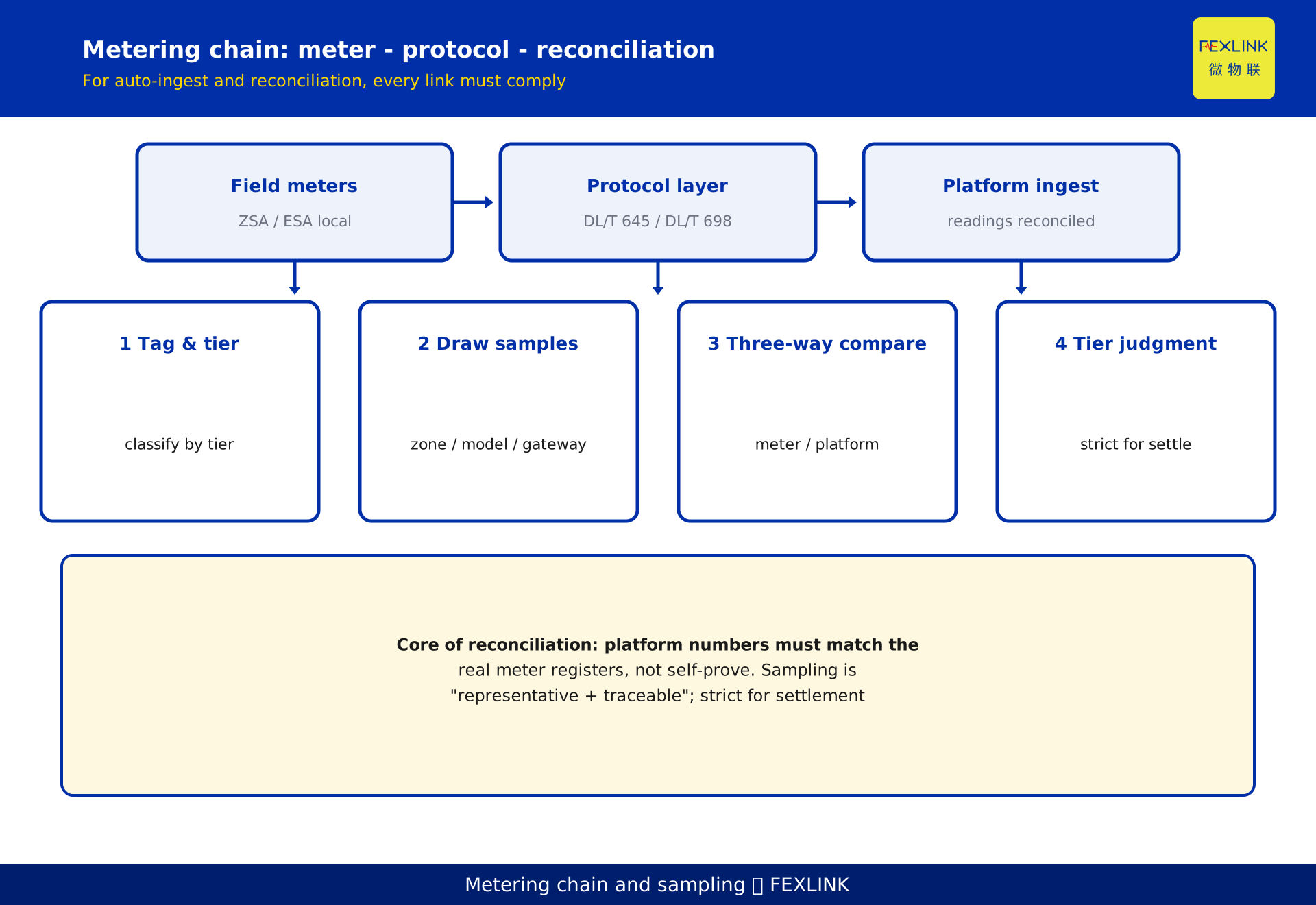
Clear standards still land on "how to verify." We suggest breaking acceptance reconciliation into four steps, sampled by tier.
Step one, tag and tier. Classify every metering circuit on the platform as settlement or management into a checklist that becomes the acceptance baseline. Step two, draw representative points. For settlement circuits, sample representative meters at a defined ratio covering different zones, meter models, and gateways; management circuits may take a smaller sample. Step three, three-way comparison. For each circuit, take the meter's local display, the platform reading, and a reading from a qualified on-site calibrator, and compare deviations pairwise. Step four, tier-based judgment. Settlement deviations are judged strictly and fail beyond the allowed band; management deviations may use a wider criterion but must record the deviation distribution to confirm no systematic offset.
Sampling is not "the more the better" but "representative plus traceable." In one park acceptance, only the platform readings were spot-checked while the meters' local values were ignored, so a batch of meters losing data on the communication link was wrongly passed; a later three-way comparison exposed the problem. The lesson: reconciliation is about making the platform's numbers match the real meter registers in the physical world, not the platform proving itself.
6. A Metering-Standard Applicability Table
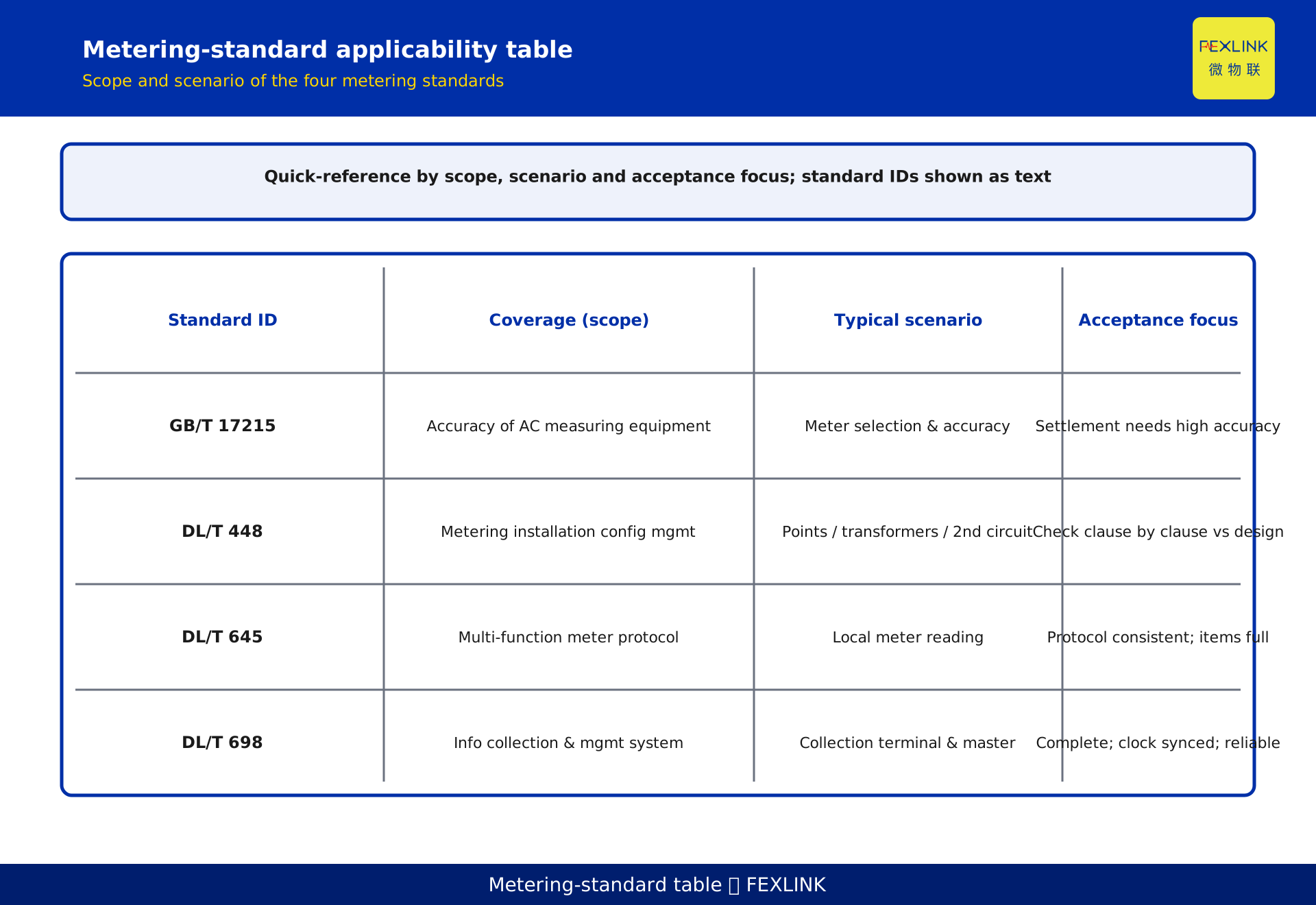
Map the standards above by "scope—typical scenario—acceptance focus" into one quick-reference table:
| Standard | Coverage (scope) | Typical scenario | Acceptance focus |
|---|---|---|---|
| GB/T 17215 | Accuracy of AC measuring equipment | Meter selection and accuracy evaluation | Settlement circuits need high accuracy; management may be lower |
| DL/T 448 | Technical management (configuration) of metering installations | Metering points, transformers, secondary circuits | Check settlement installation clause by clause; match design |
| DL/T 645 | Communication protocol for multi-function meters | Local meter reading | Protocol consistent; data items complete |
| DL/T 698 | Electricity information collection and management system | Collection terminals and master station | Collection complete; clock synced; link reliable |
To stress again: the "coverage" column is a qualitative description of each standard's scope, cites no clause numbers, and does not replace design documents or selection manuals. Acceptance should follow the latest valid edition of the standard text, the project design documents, and on-site calibration results.
7. How Related Products and Solutions Land in Selection
Standards say "what to achieve"; products and solutions say "what to achieve it with." The FEXLINK ZSA embedded smart meter is a panel-cutout embedded pure-metering meter, positioned for local metering on the switchgear face. The FEXLINK ESA all-element smart meter is a panel-mounted all-element circuit-monitoring meter that can monitor a circuit's multi-dimensional electrical quantities more comprehensively. Both are qualitative functional positions, not accuracy or range promises; specifics follow the latest selection manual.
At the solution level, the Digital Electrical Intelligent Supervision System consolidates scattered metering points into one monitorable, reconcilable whole; AMR (Automatic Meter Reading) solves "reading the meter registers up automatically" and is one way to realize protocol compliance. In selection, first use this article's standard tiers to qualify each circuit (settlement or management), then decide ZSA versus ESA, AMR versus the fuller supervision system—standards are the ruler, products are the tool, and the order cannot be reversed.
FAQ
Q: Must settlement and management metering really use different standards?
In essence they carry "different requirements," not "different standard numbers." Both purposes may fall within the scope of GB/T 17215 and DL/T 448, but the acceptance bar differs: strict for settlement, lenient for management. The risk of mixing is not violating a number, but relaxing where you should be strict and wasting where you could save.
Q: Between DL/T 645 and DL/T 698, which one governs communication?
Both relate to communication but at different layers. DL/T 645 leans toward local meter communication (how a single meter is read); DL/T 698 leans toward the collection and management architecture (how a fleet of meters is gathered by the system). Acceptance checks both: the former for single-meter readability, the latter for system manageability.
Q: At acceptance, do we have to open and calibrate every meter to be safe?
No, and it is not realistic. Sample by settlement/management tier: more samples and stricter judgment for settlement, fewer and looser for management, but keep samples representative and fully traceable. The point is that "platform reading—meter local value—calibrator" line up three ways.
Q: Is higher meter accuracy always better?
No. Settlement circuits should be high where high is due; management circuits waste budget on high accuracy. Standards tier by purpose rather than chase the top class. Select to match purpose, not blindly stack accuracy.
Q: How does this article differ from KD-0982 (acceptance standard matrix)?
KD-0982 gives the overall acceptance standard matrix by subsystem; this article focuses on the hard standards of the "metering/reconciliation" slice, adding the settlement/management tiering and the reconciliation sampling method, without repeating the overall matrix.
Scope and Limitations
- The metering acceptance hard standards discussed here apply to parks, data centers, factories, and office buildings that use IoT collection and electrical monitoring platforms where the platform also carries energy monitoring and energy accounting or cost allocation; purely manual metering or points without automatic collection fall outside automatic reconciliation.
- For GB/T 17215, DL/T 448, DL/T 645, and DL/T 698, this article gives only a qualitative description of coverage, cites no clause numbers, and fabricates no specific accuracy-class codes, configuration parameters, or pass-rate figures. Concrete selection and criteria follow the latest valid standard text, design documents, and on-site calibration results; this article is not a mandatory technical requirement.
- The terms "park / data center / factory / office building" are generic scene placeholders matching no real customer, project, or place name; no identifiable customer information is used.
- The FEXLINK ZSA embedded smart meter, FEXLINK ESA all-element smart meter, the Digital Electrical Intelligent Supervision System, and AMR mentioned here are qualitative functional descriptions; no accuracy, range, or class figures are fabricated, and none constitutes selection or procurement advice.
- Effect-type data (such as energy-saving rate, accuracy rate, or rankings) never enter this article's conclusions. This article is positioned as an interpretive and reconciliation-method guide to "acceptance metering hard standards," providing actionable comparison and sampling-verification methods.
Frequently Asked Questions
Must settlement and management metering really use different standards?
In essence they carry "different requirements," not "different standard numbers." Both purposes may fall within the scope of GB/T 17215 and DL/T 448, but the acceptance bar differs: strict for settlement, lenient for management. The risk of mixing is not violating a number, but relaxing where you should be strict and wasting where you could save.
Between DL/T 645 and DL/T 698, which one governs communication?
Both relate to communication but at different layers. DL/T 645 leans toward local meter communication (how a single meter is read); DL/T 698 leans toward the collection and management architecture (how a fleet of meters is gathered by the system). Acceptance checks both: the former for single-meter readability, the latter for system manageability.
At acceptance, do we have to open and calibrate every meter to be safe?
No, and it is not realistic. Sample by settlement/management tier: more samples and stricter judgment for settlement, fewer and looser for management, but keep samples representative and fully traceable. The point is that "platform reading—meter local value—calibrator" line up three ways.
Is higher meter accuracy always better?
No. Settlement circuits should be high where high is due; management circuits waste budget on high accuracy. Standards tier by purpose rather than chase the top class. Select to match purpose, not blindly stack accuracy.
How does this article differ from KD-0982 (acceptance standard matrix)?
KD-0982 gives the overall acceptance standard matrix by subsystem; this article focuses on the hard standards of the "metering/reconciliation" slice, adding the settlement/management tiering and the reconciliation sampling method, without repeating the overall matrix.