 FEXLINK Research Institute
Direct Answer
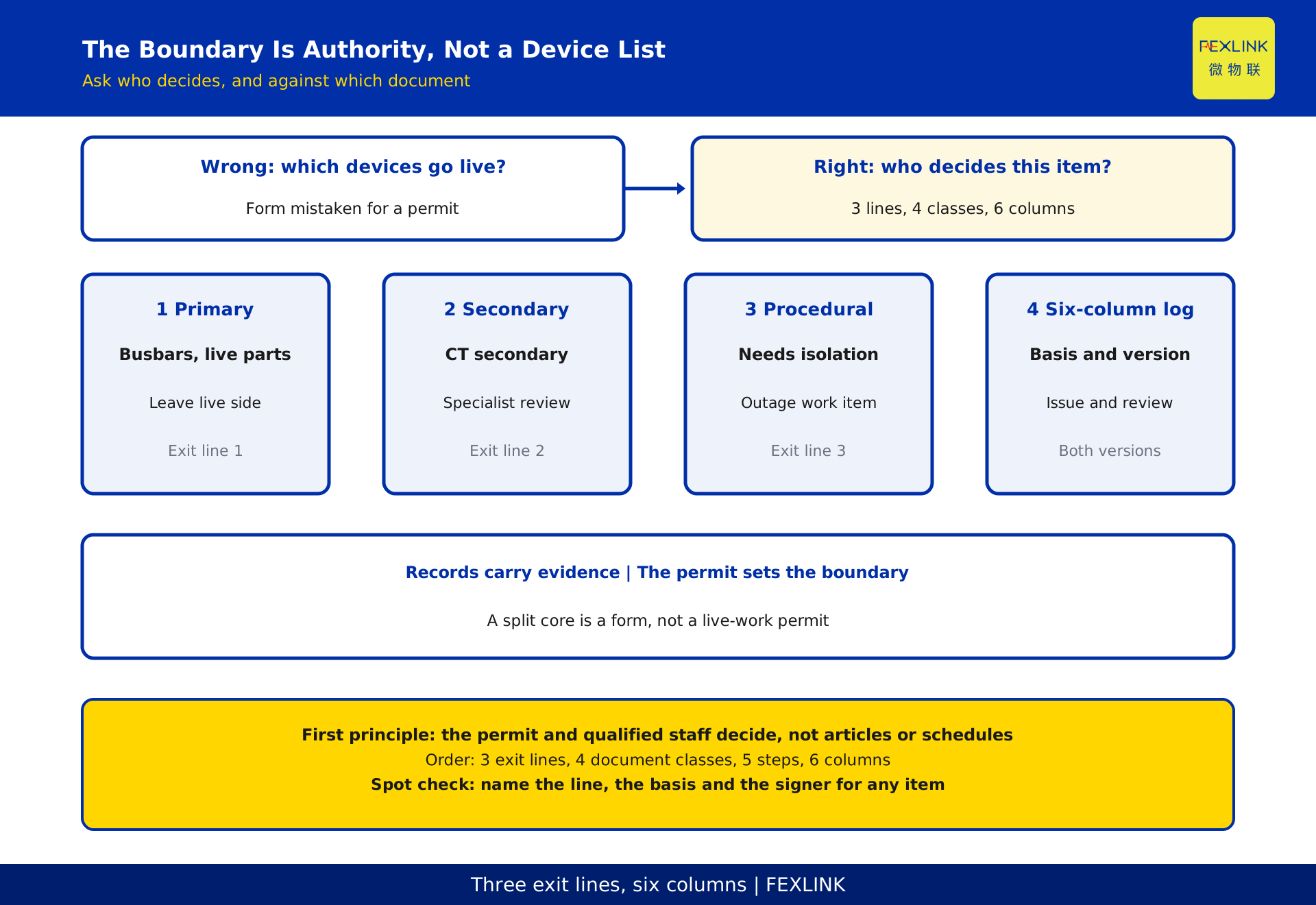
On a retrofit that cannot be shut down, the first question is not which devices may be fitted live. It is who decides each work item, against which document, and who signs when the item falls outside the live-side boundary. A split core describes a core that opens and closes; it is not a permit to install on an energised circuit. This article gives neither a list of live-installable devices nor any work method. It gives a documentation method: 3 exit lines, 4 classes of governing documents, a 5-step review, a 6-column register and one de-identified example. Actions touching primary conductors, busbars or energised parts; disconnection or connection of CT secondary, protection or metering circuits; and work requiring de-energisation confirmation, voltage testing, earthing or lockout/tagging, all fall outside the live side. Qualified personnel assess them against the permit, the safety code and the design documents; the permit decides whether an outage is needed. The registry states positively that split-core transformers, wireless temperature sensors and non-contact sensors can be installed live under prescribed protection. This article does not adopt that claim: authority rests with the permit, not an article or a schedule.
1. Ask the Right Question: From "Can We" to "Who Decides"
"Can we install it without a shutdown?" compresses three questions: does the construction allow the fitting, is the action permitted, and who has authority to say yes. They belong to different documents. A form factor only proves a fitting method exists; a manual cannot state this circuit's operating state or isolation envelope; schedule pressure cannot sign the permit. Change the question and the deliverable changes: not a list of things to do live, but a register where every item carries its basis, verdict, issuer and reviewer. A list invites people to follow it; a register forces them to justify each line.
2. Three Exit Lines: Any One Ends Live-Side Work
A boundary is drawn more reliably by asking what an action touches than by enumerating devices. Any one is sufficient to exit; short duration or an observer grant no exemption.
| Exit line | Trigger | Destination |
|---|---|---|
| 1 Primary | Touching primary conductors, busbars or energised parts, or needing isolation to approach | Leave the live side; send to the outage window |
| 2 Secondary | Disconnecting or connecting CT secondary, protection or metering circuits | Specialist assessment; never on a live-side list |
| 3 Procedural | Requiring de-energisation confirmation, voltage testing, earthing or tagging | By definition an outage work item |
Line 2 is separate because an open CT secondary circuit in service can produce a dangerous voltage. That is a qualitative reason for specialist assessment; no handling method is given. This section classifies only, with no clearance distances, insulation ratings, protective-equipment types, voltage values or operation sequences; those come from the safety code, the permit and the design documents.
3. Split-Core CTs: Being Clampable Is Not Being Live-Installable
A split core solves one problem of form: a transformer can be fitted without dismantling a primary conductor. It changes the construction sequence, not the electrical boundary. Connect the device into an existing metering or protection circuit and the object of work becomes part of a secondary circuit, so line 2 applies. That relationship must be judged by qualified personnel against the operating state, not inferred from the last project. Even unwired, approaching energised parts or entering an isolation envelope activates lines 1 and 3. No split-core transformer is listed as live-installable here, and no fitting technique, closing order or test connection is given. The registry lists such devices beside wireless sensors as live-installation examples; a safety correction applies: they are sequence differences only, not authorisation. Whether an outage is needed returns to the 3 exit lines and the permit.
4. Four Classes of Governing Documents
A boundary decision cannot rest on a verbal agreement on site. It needs a traceable chain of authority. When they conflict, the contractor does not choose.
| Class | What it answers | What it does not |
|---|---|---|
| 1 Design documents and drawings | Which circuit an item belongs to; topology before and after | Whether the site permits it now |
| 2 Equipment manuals and type documents | Product form, fitting conditions, interfaces | Whether it is allowed now |
| 3 Safety codes and the permit system | Who may decide, isolation, authorisation, issue and supervision | Circuit ownership |
| 4 Qualified personnel and the owner's electrical team | Applying the documents to the operating state and work envelope | Replacing the first three |
For authorisation and isolation, class 3 governs; for circuit ownership, return to class 1; for sequence, consult class 2.
5. A Five-Step Review and a Six-Column Register
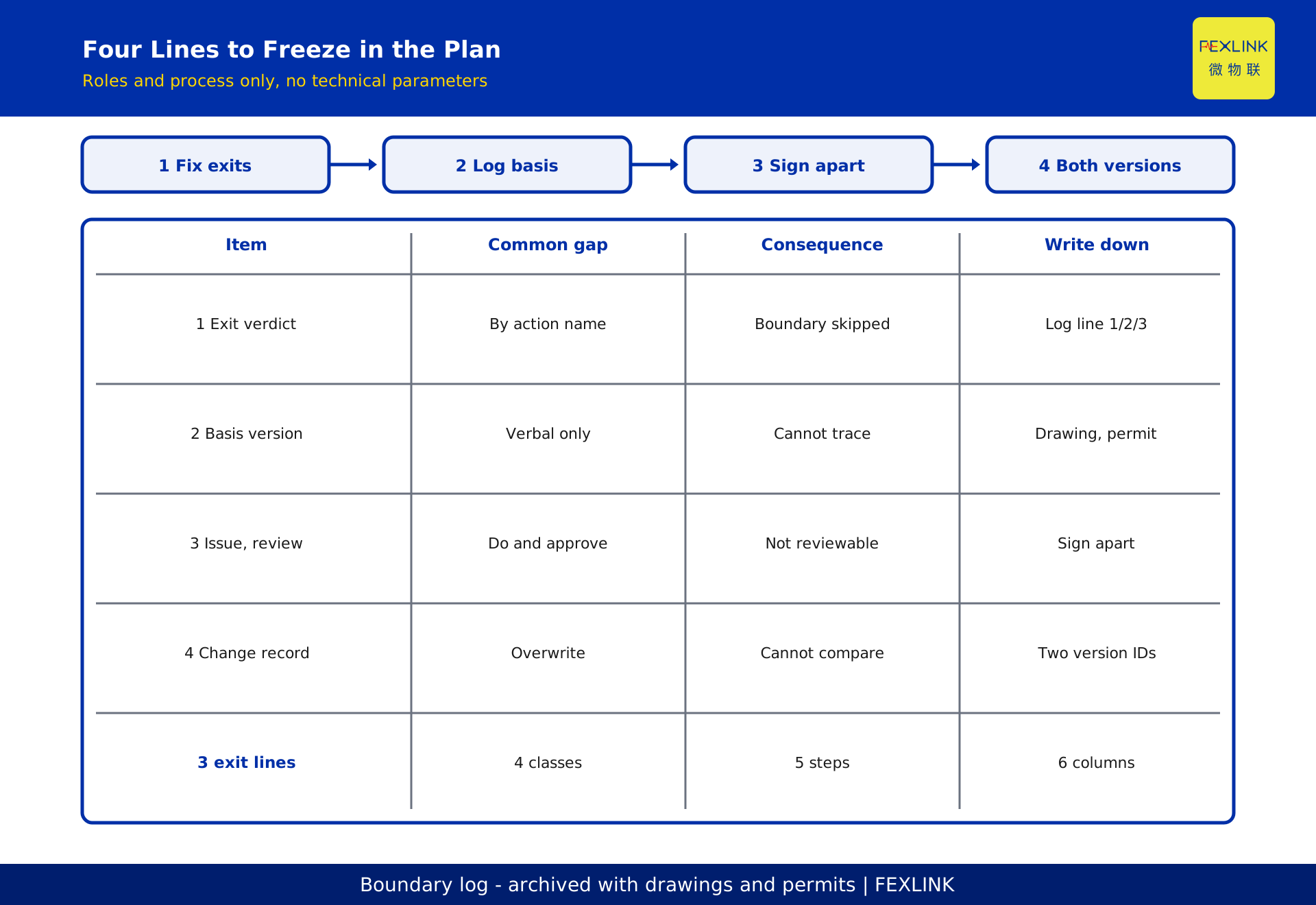
A paragraph saying "take care during live work" gives nobody anything to check. A workable plan registers items in 5 steps: split work into decidable items by circuit; mark primary, secondary or isolation contact; record the basis and version; write the verdict, sending exited items to the outage window and unclear ones to specialist assessment; and have issue and review signed separately, keeping both versions on change. The carrier is a 6-column register:
| Column | Content | If missing |
|---|---|---|
| 1 Item and circuit | Split by circuit, not by crew or by day | Nobody knows which section |
| 2 Parts touched and line number | Which of 1 / 2 / 3 applies | An exit is absorbed verbally |
| 3 Basis and version | Which drawing, manual, code or permit | Returns cannot be traced |
| 4 Verdict and destination | Outage window, or specialist assessment | Work starts before decision |
| 5 Issuer and reviewer | Signed separately, never both roles | The verdict cannot be reviewed |
| 6 Change record and versions | Keep both versions, never overwrite | Before and after cannot be compared |
All 6 columns answer one question: could a third party repeat the decision?
6. A De-identified Example: Registering Boundaries Item by Item
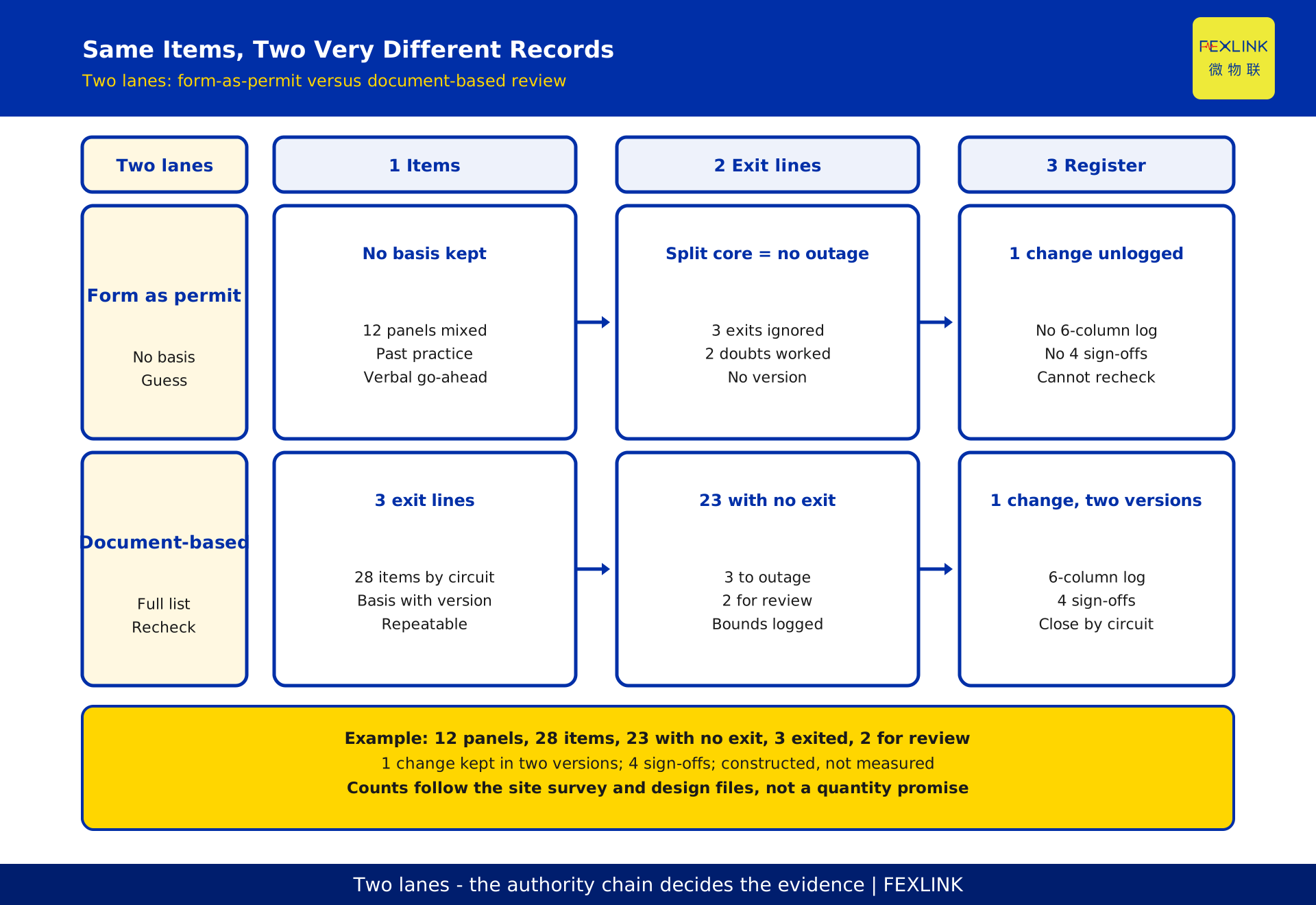
This is a constructed illustration, not a real project or measured data. A distribution-room retrofit covers 12 panels and 28 work items, with as little downtime as possible requested.
| Verdict class | Items | Destination |
|---|---|---|
| No exit line touched (external fixing, cable routing, point-list check) | 23 | Proceed by sequence, with basis and version recorded |
| Line 2 touched (secondary circuit wiring) | 3 | All sent to the outage window |
| Drawings disagree with circuit ownership on site | 2 | Specialist assessment; returned to the designer, no work started |
Items such as external fixing are recorded as "no contact with the main circuit", based on circuit ownership in the design documents and the work envelope in the permit. One change of envelope keeps both register versions. The final register is frozen with 4 sign-offs: contractor, owner's electrical team, permit issuer and independent reviewer. What matters is that every line names its exit line, basis, signer and change path.
7. Division of Labour with the Outage-Window Article
Boundary decisions and scheduling are separate, and the order cannot be reversed. Classify by exit line first; only then do exited items enter outage coordination. The scheduling article covers alignment, staggering and deferral; this article covers only which items should never be on the live side. Neither provides a permit. Four prohibited actions belong in the plan: do not reclassify an exited item under schedule pressure; do not replace issue and review with a verbal instruction; do not let the performer decide the boundary alone; and do not overwrite the previous register version. "We only fit it, we do not wire it" is the same error: the permit decides whether an isolation envelope is involved, not the contractor's name for the action.
8. Six Common Misreadings
Six misreadings recur: reading "split-core" as "no outage needed"; reading a manufacturer's instructions as authorisation; substituting the last project for this circuit's ownership check; substituting short duration or an observer for an issued permit; treating "fitted but not wired" as proof no circuit was touched; and inferring from non-contact measurement that no assessment is needed. All six use a fact unrelated to decision authority in place of the permit. Every doubt enters the specialist-assessment column; it is not absorbed verbally at a briefing.
9. Writing Protection and Supervision Requirements: Roles, Not Parameters
Protection sections in plans often contradict themselves: one paragraph copies protective requirements, the next says "follow site conditions". Treat the section as roles and process, not a parameter table. State who issues and supervises the permit, who decides and reviews the boundary, which re-issue path applies on change, and how the register, drawings and permits are archived with both versions. This article stays at the document layer: no protection class, clearance distance, insulation value or tool type, since those come from the applicable code and permit and vary with voltage level and operating mode.
10. Roles and Responsibilities
Four parties carry responsibility. The contractor and integrator submit the circuit-split item list, basis documents with versions and the 6-column register, run the 5-step review and do not rule on exited items. The owner's electrical team and the designer confirm circuit ownership, topology and exit verdicts, with a written determination where drawings and site differ. Qualified personnel and the permit issuer decide authorisation and the isolation envelope against the operating state. An independent reviewer checks the register and sign-offs; performer and approver must not coincide. The split-core current transformer and wireless temperature node in the registry are registered as products only, with no models or parameters. The registry's linked standard has been checked as a national electrical safety standard scoped mainly to power plants, substations and high-voltage consumer installations; an existing low-voltage retrofit is generally for reference rather than directly applicable, and a revision is in progress. The body has no standard number, year, clause number, conformity table or assertion of current validity, and no standard name is used to infer permission.
Frequently Asked Questions (FAQ)
Q: Does a split-core transformer mean it can be installed without an outage?
No. A split core is a form that opens and closes, not a permit. Connecting into an existing secondary circuit, touching energised parts or needing isolation and tagging meets an exit line; qualified personnel assess against the permit, the safety code and the design documents, and the permit decides whether an outage is required.
Q: The manufacturer's manual describes live fitting conditions. Can we simply follow it?
A manual is not a work permit. It defines product form and fitting conditions, not the present operating state or isolation envelope. It is class 2 of the 4 classes; authorisation and isolation stay with class 3, circuit ownership returns to class 1, and the contractor does not choose.
Q: If we only fix the sensor in place and wire it later, is a boundary decision still needed?
Yes. The permit decides whether the primary side, the secondary side or an isolation envelope is involved, not the contractor's name for the action. The verdict still enters the 6-column register: circuit, exit line number, basis and version, destination, issuer and reviewer. "Fitted but not wired" is a sequence, not a boundary verdict.
Q: Who has the final say on the boundary? Can the site manager decide alone?
Not the site manager alone. Design documents define circuit ownership, the safety code and permit system define qualification and authorisation, qualified personnel decide against the operating state, the owner's electrical team confirms, and an independent reviewer checks the register and sign-offs. The contractor submits the list, basis and register without ruling on exited items.
Q: The programme is tight. Can we do part of the exited items now and get the permit afterwards?
No. Do not reclassify a boundary under schedule pressure, replace issue with a verbal instruction, or issue a permit retroactively. Classify by exit line first, then move exited items into outage coordination; when a window is compressed, defer or reprioritise rather than change the boundary. Uncertain items go to specialist assessment and are not started before a written determination.
Scope and Limitations
This article covers one task on retrofits of existing buildings, distribution rooms and similar sites: deciding the live-side and outage boundary item by item at planning stage and leaving a reviewable record. It differs from the survey-stage article on information to collect, and from the outage-window article by not covering coordination, staggering or deferral. This is project control, not an electrical safety code or a work permit. No live-work step, fitting technique or technical protection parameter is given, and no safety determination or performance promise is made. The body has no standard number, year, clause number, conformity table or assertion of current validity; the naming background is metadata only. The registry's positive conclusion that split-core transformers and similar devices can be installed live is not adopted; the safety correction is recorded in section 3, the FAQ, the document chain and the evidence chain. The section 6 example is a de-identified construction: 12 panels, 28 work items, 23 with no exit line, 3 exited, 2 for specialist assessment, 1 change and 4 sign-offs are structural illustrations, not measurements or a recommended configuration. Deliverables are drafts pending owner review; the generator does not self-approve. Whether work may proceed live, the isolation envelope and the conditions of authorisation are determined solely by the applicable safety code, the work permit, the design documents and qualified personnel on site.
Frequently Asked Questions
Can You Install It Without a Shutdown
On a retrofit that cannot be shut down, the first question is not which devices may be fitted live