 FEXLINK Research Institute
Direct Answer
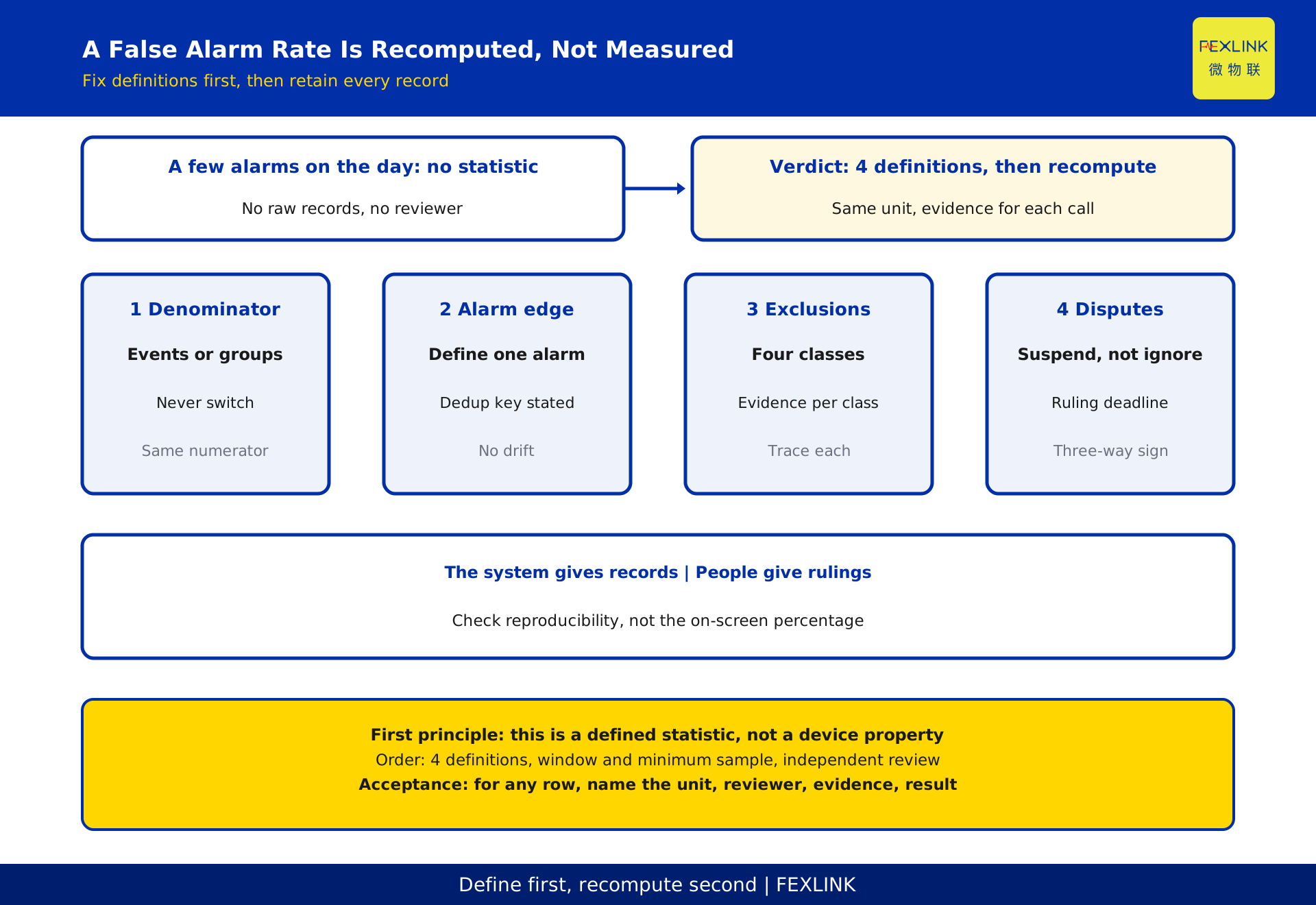
A false alarm rate is not measured on acceptance day with an instrument. It is a ratio defined first and recomputed afterwards: alarms judged invalid divided by all alarms in the observation window, times 100%. What stalls acceptance is never the division. It is whether "alarm" means a raw event or a merged group, what counts as invalid, how long to observe, which alarms are excluded, and how disputes are treated. Leave one open and the same 30 days yields several defensible numbers. The method: write definitions, window, minimum sample, exclusions, dispute ruling and review responsibility into one register signed by both sides; retain every raw record during the agreed window; then have an independent reviewer judge each item and recompute. "False alarm rate <=3%" in a proposal is a vendor-disclosed or contractual target. This article covers only how it is recomputed: it judges no value, sets no universal pass line, and treats the figure as no national standard limit.
1. A Contracted Value, Not a Measured Property
Temperature and voltage can be read from a sensor; a false alarm rate cannot. Its numerator comes from "someone judged this alarm invalid", its denominator from "how many alarms were raised", which depends on thresholds, grouping rules and conditions. Treating it as a device parameter produces unexecutable lines such as "spot-check the rate on site", with no sample, no rule and no signatory. The acceptance documents define a statistic: the system supplies raw records, people supply definitions and judgements. What is checked is not a percentage on a screen but whether records are complete, judgements have evidence, and a third party can rerun the calculation. A system offering only a summary number is not measurable, however attractive it looks.
2. Four Definition Gaps to Close Before the Test
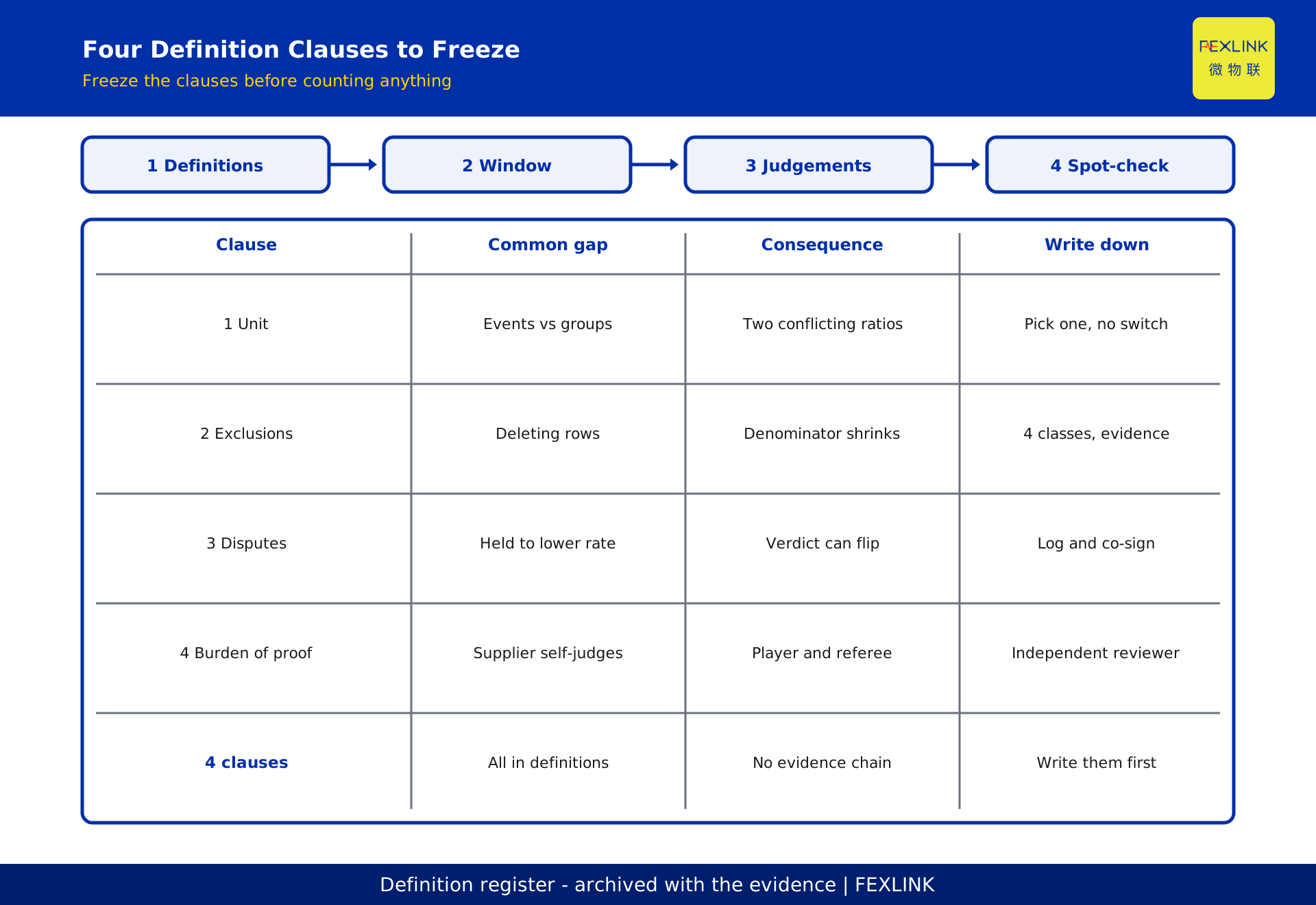
The table lists the four places where parties talk past each other. These are preconditions, not fine print; leave one blank and the recomputation reads in more than one way.
| Gap | Two common readings | If undefined | Minimum requirement |
|---|---|---|---|
| Denominator unit | Raw alarm events / merged alarm groups | Two ratios from one dataset | Choose one; never switch mid-window |
| Alarm boundary | One trigger, one alarm / one per rule | Denominator inflated or shrunk | Define "one alarm" and the dedup key |
| Exclusions | Drills only / also maintenance and outages | Denominator drifts by interpreter | List each class with its evidence |
| Disputes | Counted / suspended | Suspension suppresses the ratio | Suspension rule, deadline, signatories |
The denominator unit is easiest to miss. Grouping collapses many raw events into one actionable group: acquisition sees hundreds of rows, operations sees a dozen groups needing action. Both are true and mean different things; pairing an acquisition denominator with an operations numerator is the hardest mismatch to spot. One more clause: rules, thresholds, grouping logic and point configuration stay frozen and versioned for the window; any change restarts the clock, so data before and after never share one denominator.
3. What Counts as a False Alarm
Set one boundary first. An early-warning alarm points forward, so validity cannot be inferred from whether a fault later occurred; otherwise every promptly handled warning becomes a false alarm, and a lower rate means a less useful system. The rule should read: at the moment of triggering, using frozen rules and available evidence, did this indicate an electrical anomaly requiring action? Common invalid alarms fall into four classes, each with its evidence and corrective path.
| Class | Typical case | Evidence to show | Corrective path |
|---|---|---|---|
| Rule too tight | Normal load ripple triggers | Trend curve, rule version | Threshold calibration log |
| Sensor fault | Disconnection, drift, bad contact | Inspection record, channel self-test | Acquisition and devices |
| Operating-mode mismatch | Maintenance window not suppressed | Work order, time record | Operating-mode configuration |
| Duplicate groups | One event opened twice | Grouping key and group ID | Grouping logic |
Two things never enter the numerator: an unhandled alarm is a closure-management problem, not proof of invalidity; an anomaly confirmed real but recovered is a valid alarm with a closed outcome. More important is the burden of proof: the supplier cannot label its own alarms false and pass on that basis. Judgements belong to the owner, supervisor or an independent reviewer named in advance; disputes are suspended and ruled by three-party sign-off, and each conclusion points back to a raw-record index.
4. Why This Metric Alone Rewards Silence
Raising thresholds, disabling notifications, choosing the calmest window or merging every alarm into one group all improve the ratio without improving hazard detection. Alone as a verdict, the metric pays a bonus for silence. It must be paired with missed-detection and capability checks: whether simulated injection triggers the agreed levels, whether a real alarm travels from notification to dispatch to closure, and whether invalid groups feed back into the rule log monthly. Two constraints belong in the file: no single metric improvement constitutes a pass, and no threshold or grouping change is allowed without restarting the count. Adjacent topics such as three-stage early-warning acceptance and threshold calibration are outside this article.
5. Observation Window and Minimum Sample
A window is not about accumulating days but covering real conditions. Four items must be agreed in advance: start and end timestamps with time zone, clock source and sync records, conditions to include (load changes, maintenance windows), and the freeze-and-restart rule. Statistics from a calm stretch cannot be extrapolated.
The minimum sample is also a prior agreement. With a small denominator, one changed judgement swings the percentage sharply. The file should state that if alarms in scope fall below the agreed floor, the metric is "not statistically assessable" and follows the pre-selected path: extend the window, or replace it with item-by-item capability evidence. Only that path may be used: no topping up data, no shrinking the denominator, no forcing an under-sampled result into pass or fail. No universal window or floor is given here; both belong in the contract.
6. What "3%" Actually Is
A number in a proposal or contract is usually a vendor-disclosed target or an agreed baseline. Three properties are misread. First, it is neither a national standard limit nor an industry-wide pass line; this article cites no standard numbers or clauses. Second, acceptance checks whether the recomputation holds, not whether the value was well chosen; the latter is a pre-contract judgement. Third, its version and effective text are verified by the responsible party; this article endorses nothing, evaluates nothing and infers no field performance.
Practical test: if the contract states only a percentage, fix the definition before discussing compliance; if the parties cannot, the metric is not determinable and must not be interpreted on the spot. A definition change needs a written supplement signed by both sides, then a fresh count and fresh records. Turning "definition undefined" into "target met" is the common start of post-acceptance disputes.
7. A De-Identified Example: The Same Data, Four Results
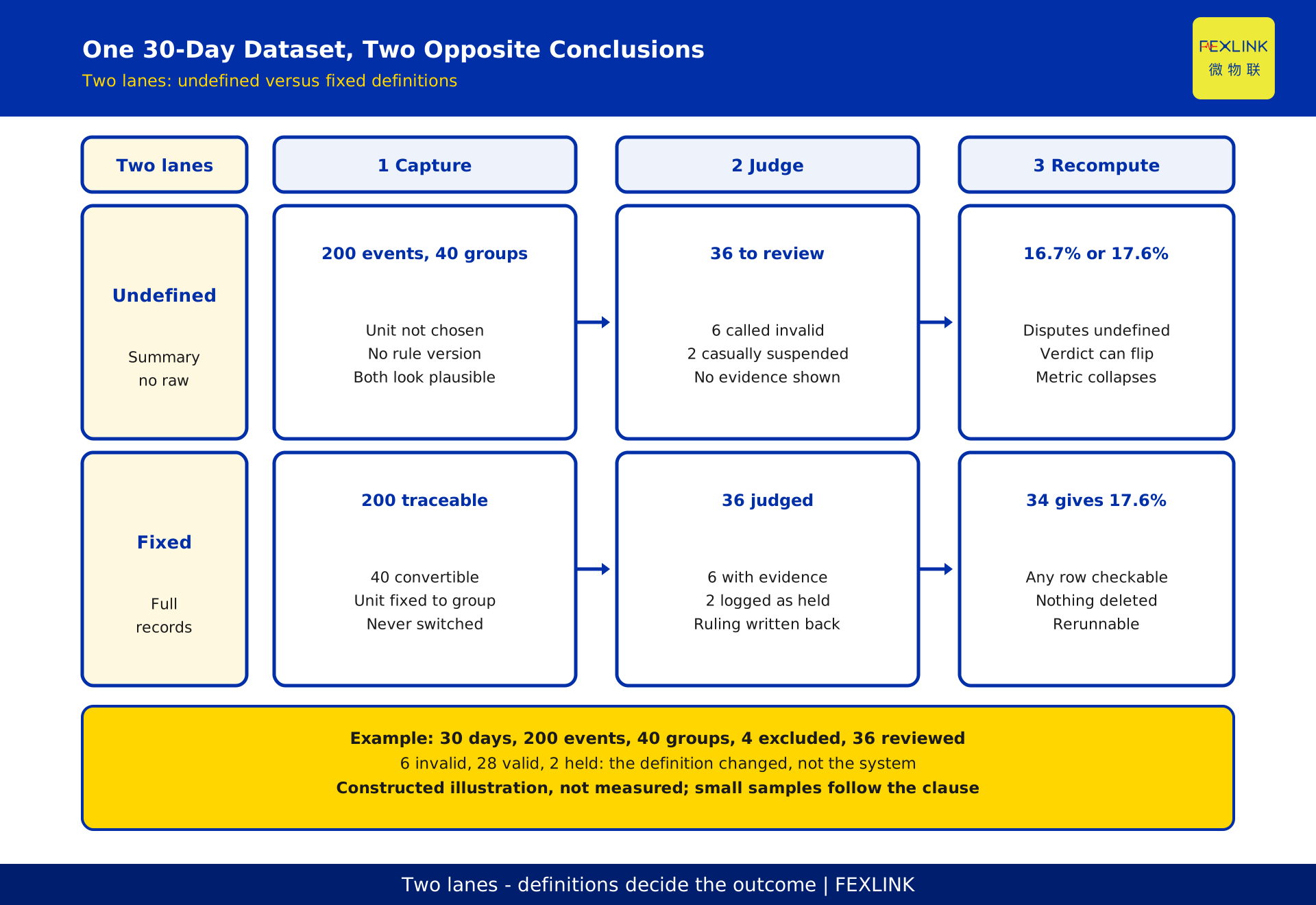
All figures are a constructed illustration, not measurements or a pass line. Over an agreed 30-day window, 200 raw alarms collapsed into 40 groups under the frozen rule. 4 groups came from simulated injection and planned maintenance and were excluded. An independent reviewer judged the remaining 36 groups: 6 invalid, 28 valid, 2 disputed and suspended.
| Recomputation | Numerator | Denominator | Result |
|---|---|---|---|
| Disputes included | 6 groups | 36 groups | 16.7% |
| Disputes suspended | 6 groups | 34 groups | 17.6% |
| Switched to raw events | No item-level judgement | 200 events | Not recomputable |
| Calm hours only | Denominator shrunk | Undefined | Invalid |
The first two results are self-consistent and differ only by a prior agreement on disputes. The third changes the denominator without item-level judgements, so the metric collapses; the fourth breaks exclusion and coverage rules, so a low number is still unusable. What must be delivered is a working register a third party can rerun, not a percentage. Also, if the window contains only 5 alarms, 1 invalid gives 20% and 2 invalid gives 40%; one judgement flips the verdict, which should trigger the "not statistically assessable" clause.
8. Exclusions and Disputes: Never Delete Your Way to a Pass
Exclusions must be listed class by class with evidence: simulated injection and drills, suppressed maintenance windows, communication outages and device self-diagnostics, and legacy items predating the window. Each needs a trace: who proposed it, under which rule, with which evidence, and who reviewed it. Without all four, "exclusion" becomes a way to delete an inconvenient row.
Suspension has boundaries: it is "excluded from the current recomputation", with a reason, ruling deadline, signatories and destination; after a ruling the outcome is written back with a version. Three red lines belong in the file: never delete raw records, never alter frozen judgements, never conclude compliance while disputes are unresolved. Any threshold or rule change follows the restart rule in section 5.
9. How to Lay Out the Acceptance Register
The header carries metadata: window boundaries, clock source, rule and grouping versions, chosen unit (events or groups), minimum sample, reviewer and signature fields. The detail needs at least eight columns, each answering "can a third party redo this?".
| Column | What it holds | Why it is required |
|---|---|---|
| Alarm ID | Raw-record index and group ID | Points back to full data |
| Timestamp | Time with zone | Judgement at the time, not after |
| Triggering rule | Rule ID and version | Frozen definition is checkable |
| Condition tag | Load, maintenance, drill | Exclusions are verifiable |
| Grouping | Raw count and parent group | Events and groups convert |
| Review outcome | Valid / invalid / suspended | Sole source of the numerator |
| Evidence | Curves, work orders, inspections | Conclusion is demonstrable |
| Responsibility | Reviewer, signatory, date | No owner means no validity |
One spot-check rule: pick any row and say which denominator class it belongs to, who judged it under which rule, and which evidence supports it; if not, the whole register needs reassessment. A summary row lists total events, groups, exclusions, suspensions, valid and invalid items so numerator and denominator can be recomputed by hand. The register is archived with the raw records as evidence.
10. Solution-Side Roles and Division of Responsibility
The registry associates this article with an electrical hazard early-warning system and a predictive maintenance solution, described only by role: the first produces rules and alarms, the second produces forecast outputs also needing capture by the definition, and the platform retains records and archives evidence. No model numbers, parameters, capability assessment, field performance or purchasing commitment is given; none replaces the contract, design documents or qualified third-party findings. Responsibility runs in three segments: the supplier provides raw records and frozen configuration versions, the independent reviewer judges each item, and the owner with the supervisor confirms definitions, signs the register and rules disputes. A conclusion from the generator acting as both player and referee is not reviewable.
Frequently Asked Questions (FAQ)
Q: Can we demonstrate a few alarms on acceptance day and call the rate measured?
No. A demonstration verifies the trigger chain and screen, not a statistic. The rate needs complete records over the agreed window and item-level judgements by an independent reviewer; a handful on the day has neither representativeness nor an accountable judgement.
Q: If nobody handled an alarm, does it count as a false alarm?
No. An unhandled alarm is a closure-management problem, unrelated to validity. Counting it as false uses an operations gap to polish a metric; the path is back to dispatch records and closure evidence.
Q: Should the denominator be raw events or merged groups?
Either works if chosen in advance, never switched, and used for the numerator too. Event-level counting needs item-level judgements; group-level counting needs the link between each group and its raw records so a third party can convert and spot-check.
Q: What if there are too few alarms and the percentage swings wildly?
Invoke the pre-agreed "not statistically assessable" clause: extend the window or switch to item-by-item capability evidence. Do not top up data, shrink the denominator, or force a small sample into a verdict.
Q: The proposal says "<=3%". Can we adjust the definition ourselves to pass?
A definition change is a contract change: it needs a written supplement signed by both sides, then a fresh count and records. Unilateral changes to exclusions, denominator unit or dispute handling do not stand even if the number passes. If the definition is undefined, fix it first; if not, the metric is not determinable.
Scope and Limitations
This applies to acceptance of electrical monitoring and early-warning projects with explicit alarms, complete raw records and an independent reviewer; not to systems offering only summary numbers, nor to treating one metric as a whole verdict. The rate must be paired with missed-detection and capability checks. The standards list is empty: no standard numbers, clauses or compliance tables are cited, and no universal pass line, window length, minimum sample, threshold or performance commitment is set. The "3%" figure is a vendor-disclosed or contractual target discussed only as a definition problem; its reasonableness and effective text are verified by the responsible party. Examples in sections 5 and 7 are constructed and de-identified, not measurements or recommended ratios. Solution names indicate roles only, carry no purchasing commitment, and do not replace the contract or third-party findings.
Frequently Asked Questions
"False Alarm Rate ≤3%"—How Do You Actually Measure That on Site at Acceptance?
A false alarm rate is not measured on acceptance day with an instrument. It is a ratio defined first and recomputed afterwards: alarms judged invalid divided by all alarms in the observation window, times 100%. What stalls acceptance is never the division