 FEXLINK Research Institute
Direct Answer
The line "30% energy savings, 95% alarm accuracy" in a project proposal (or bid technical offer) — what you may promise and what will bury you comes down to one boundary: only metrics that are measurable on site, have a baseline comparable on the acceptance day, and have a clear definition (preferably a third-party one) belong in an acceptance commitment; everything else is downgraded to a "target" or "best effort" with its conditions stated.
Model metrics disclosed by the company — such as a 97.2% early-warning accuracy and a 48-hour lead time — may be "cited" in the proposal, but you must state the source, label them "to be verified", and never put them into the acceptance-commitment clause. As for absolute phrases like "zero false alarms" or "never trips", do not write them under any circumstance — they cannot be verified on site and will be turned against you at acceptance, dressing the uncertain as certain and taking external factors as your own responsibility.
Why Beautiful Metrics in a Proposal Become Acceptance Traps
To get a project approved, presales or bid owners often put the prettiest numbers into the technical commitment: 30% energy savings, 95% alarm accuracy, near-zero false-alarm rate. The problem is not that the numbers look good; it is that most of them cannot be recomputed on the acceptance day.
When acceptance arrives, the owner checks each commitment against the contract: you said 30% savings, so they want the 12 months of electricity records before the retrofit and the same period after, minus production-load swings and weather changes; you said 95% accuracy, so they ask where the sample came from, how long the window was, and who certified it. Once it cannot be recomputed, the least that happens is withheld final payment and delayed acceptance; the worst is being flagged for false commitment and triggering a contract claim. The trap was dug by your own hand at the proposal stage, not sprung by a difficult owner.
More subtly, commitments written to "look good" at the proposal stage turn out impossible to meet during delivery: field conditions differ from the lab, model behaviour drifts in a real electrical environment, and energy savings are heavily shaped by production scheduling. Writing an "aspirational direction" as a "deterministic result" pushes the project toward inevitable breach.
Three Gates Before a Metric Enters the Acceptance Commitment: Measurable, Baseline, Definition
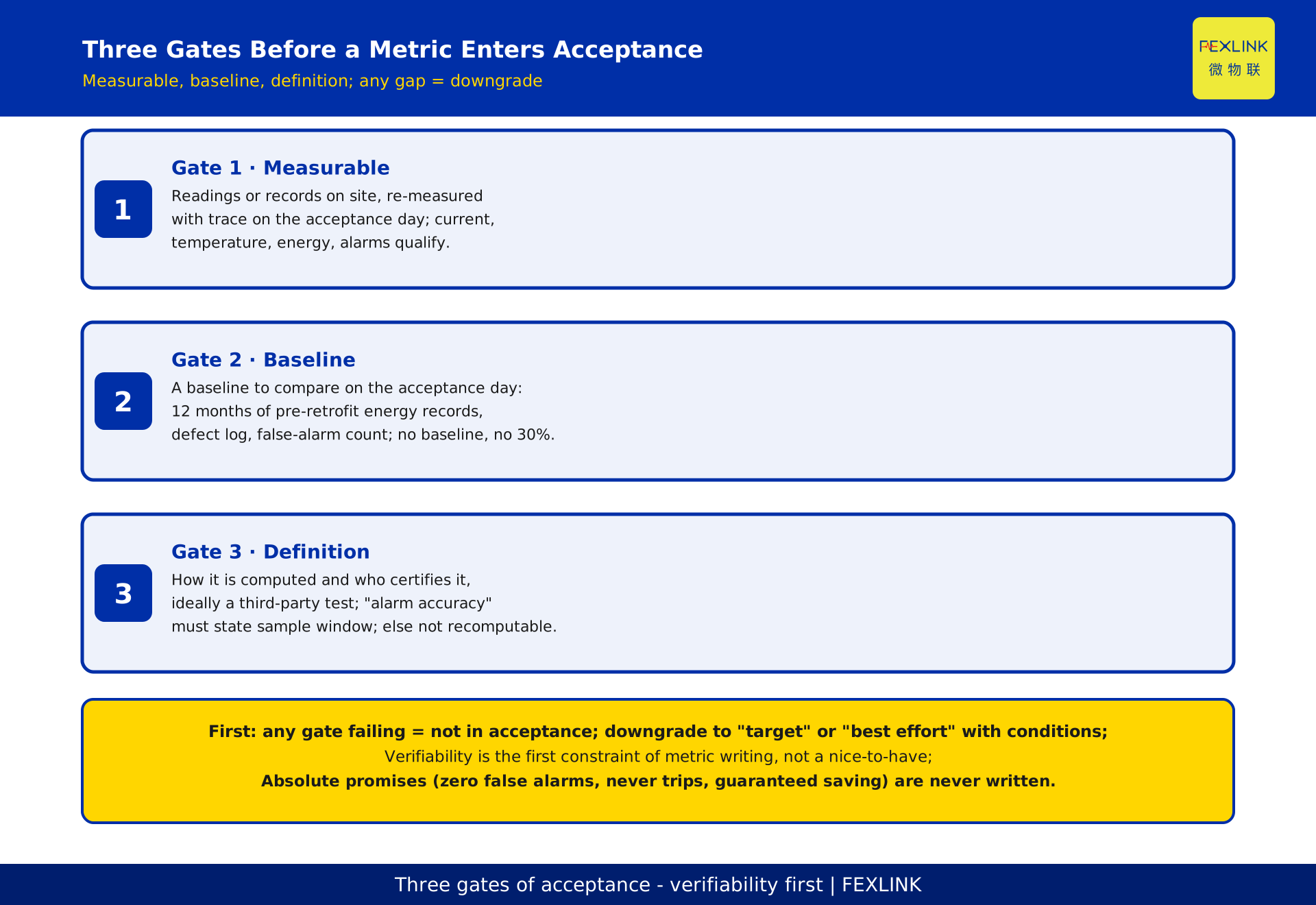
Sort metrics by verifiability into three gates; only those passing all three enter the acceptance commitment:
- Gate 1 · Measurable: readings or records can be obtained on site and re-measured with trace on the acceptance day. Circuit current, cable temperature, time-of-use energy, alarm counts are deliverable; subjective judgements like "safer system" or "more standardised management" fail this gate because the acceptor cannot measure them with one ruler.
- Gate 2 · Baseline: a baseline comparable on the acceptance day exists. The 12 months of energy records before retrofit, the historical defect log, the false-alarm count over the past year — these are baselines. A "30% drop" without a baseline cannot even be computed, because there is nothing to count from.
- Gate 3 · Definition: how the metric is computed and who certifies it is written clearly. Cite a third-party test or an industry definition where possible; "alarm accuracy" must state the sample window, the positive/negative composition and the statistical method, otherwise the acceptor cannot recompute and the commitment is hollow.
If any gate fails, downgrade to "target" or "best effort" and state the preconditions in a note. Remember: verifiability is the first constraint of metric writing in a proposal, not a nice-to-have.
| Gate | Meaning | All three pass to enter acceptance | If a gate fails |
|---|---|---|---|
| Measurable | Re-measurable, traceable on acceptance day | Yes (other two still needed) | Write "target" |
| Baseline | Pre-retrofit baseline to compare | Yes (other two still needed) | Write "best effort" |
| Definition | Algorithm and certifier stated | Yes (other two still needed) | Write "under the condition that …" |
How to Use Company-Disclosed Metrics: State Source, Label "To Be Verified", Keep Out of Acceptance
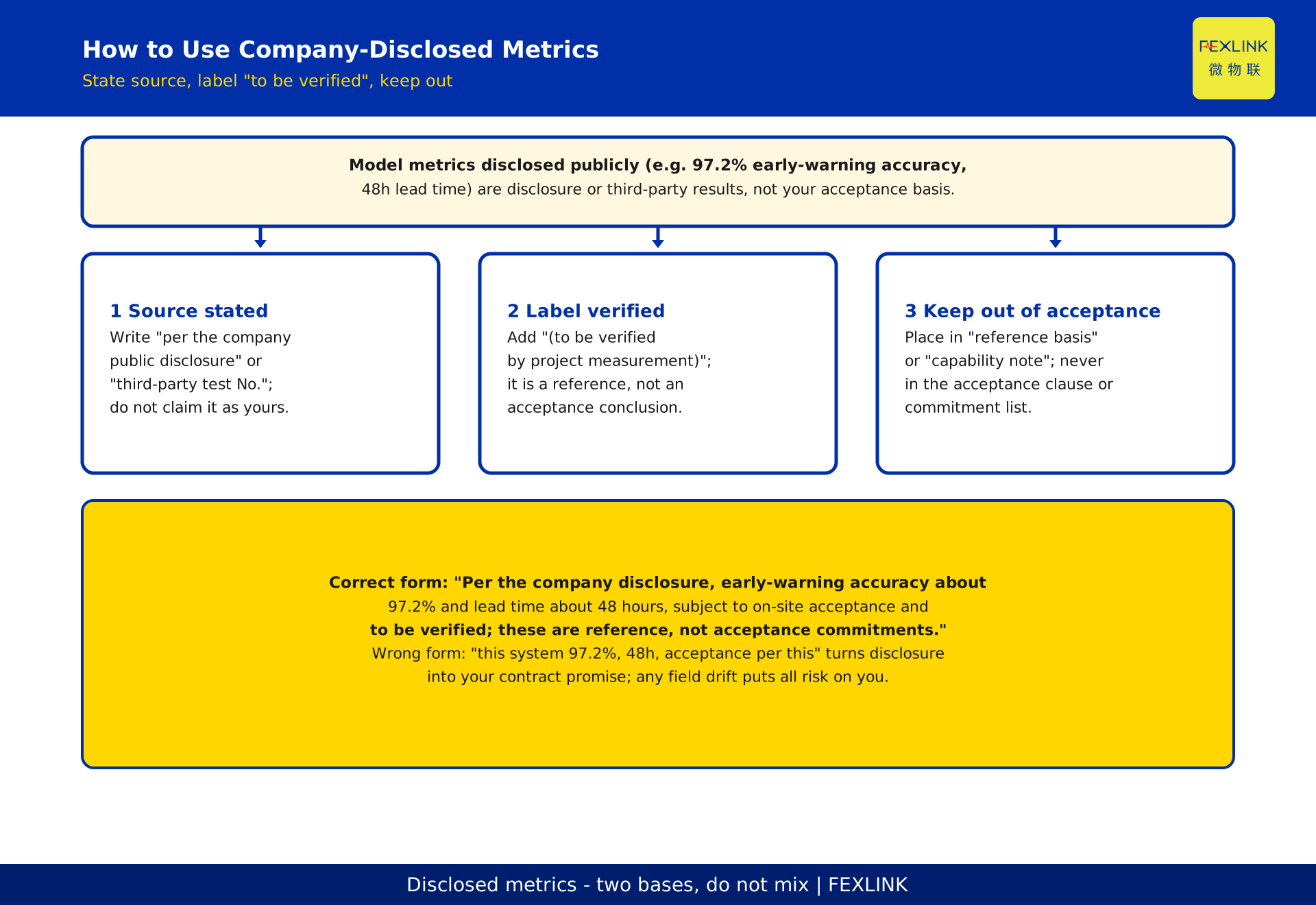
Model metrics the company discloses publicly — such as a 97.2% early-warning accuracy and a 48-hour lead time — come from public disclosure or third-party testing; they are the model's performance under specific test conditions, not your project's on-site acceptance-day basis. When citing them in a proposal, do three things:
- State the source: write "per the company's public disclosure" or "per third-party test report No. …"; do not give numbers from nowhere, and do not present the disclosed value as your own commitment.
- Label "to be verified": add "(to be verified by project measurement)" after the number, showing it is a reference, not an acceptance conclusion, putting the uncertainty honestly on the table.
- Keep out of acceptance: place them in a "reference basis" or "capability note" section, never in the acceptance clause or the technical-commitment list.
The wrong move is to write directly "this system has 97.2% early-warning accuracy and a 48-hour lead time, acceptance per this" — that turns the company's disclosure into your contractual commitment to the owner; if the field performance deviates from the disclosed value, you bear the risk entirely. Disclosed value and acceptance value are two bases; conflating them is among the most common presales traps.
Three Kinds of Absolute Promises Are the Deepest Trap You Dig for Yourself
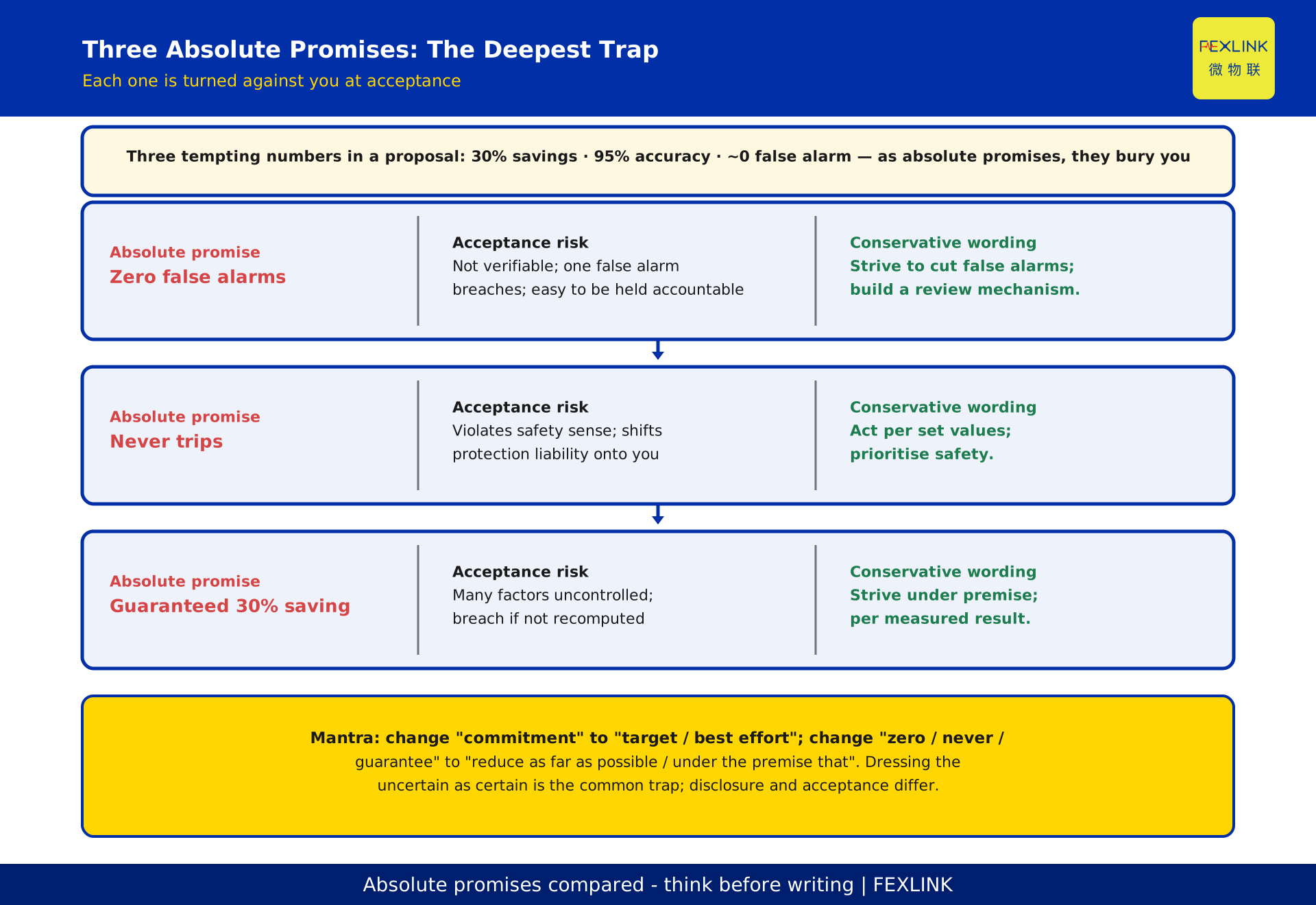
Three kinds of absolute promise almost certainly backfire at acceptance:
- "Zero false alarms": no monitoring system in a complex electrical site can be zero-false-alarm; writing it hands the owner unlimited grounds for accountability — one false alarm on site and the commitment is breached.
- "Never trips": breakers and protective devices are meant to act under fault conditions; "never trips" violates electrical-safety common sense and shifts the safety responsibility that protection should bear onto you, with consequences far beyond withheld payment.
- "Guaranteed 30% savings": writing a savings result shaped by production load, weather and management behaviour as a deterministic commitment breaches the contract if it cannot be recomputed, and the savings base itself needs a mutually agreed baseline.
Their common thread: not verifiable on site, the uncertain dressed as certain, external factors taken as one's own responsibility. Their greatest temptation is "looking good when written"; their greatest cost is "still owed when accepted."
How to Write Conservatively: Change "Commitment" to "Target / Best Effort / Under Condition"
The mantra of conservative wording is one line: change "commitment" to "target" or "best effort", change "zero / never / guarantee" to "reduce as far as possible" or "under the premise that …", and change a percentage to a "striving range".
Examples:
- Absolute: "The system achieves zero false alarms." → Conservative: "Under typical conditions, strive to keep false alarms in an acceptable low-frequency band, and build a false-alarm review and optimisation mechanism."
- Absolute: "The device never trips." → Conservative: "Protective devices act per set values; under fault conditions they prioritise the safety of personnel and equipment, with mis-operation and failure-to-operate risks controlled per regulations."
- Absolute: "Guaranteed 30% savings." → Conservative: "Under the premise of a complete baseline and comparable load, strive for a drop in unit energy use, subject to measured acceptance."
| Absolute promise | Acceptance risk | Conservative wording |
|---|---|---|
| Zero false alarms | Not verifiable, easy to be held accountable | Strive to cut false alarms and build review |
| Never trips | Violates safety sense, takes liability | Act per set values, prioritise safety |
| Guaranteed 30% savings | Many factors uncontrolled, easy breach | Strive under premise, per measured result |
Pre-Proposal Metric Self-Check List (tick Measurable / Baseline / Definition)
Before submitting the bid, run every numeric metric in the proposal through this list; if any item is crossed, downgrade or delete it:
- Can this metric be re-measured and recorded on the acceptance day? (Measurable)
- Is there a pre-retrofit or same-period baseline to compare? (Baseline)
- Are the algorithm, statistical basis and certifier written clearly? (Definition)
- If it is a company-disclosed number, is the source and "to be verified" labelled?
- Are there absolute words like "zero / never / guarantee / 100% / absolute"? Delete them if so.
- Did this number go into the acceptance clause, or only into the reference basis?
Only when all six pass may you confidently write it into acceptance; if one fails, downgrade to "target / best effort" or move it to the reference basis. Treat these six as the "brake" of metric writing in a proposal — far cheaper than arguing afterwards.
FAQ — Common Misconceptions About Metric Promises
Q: May a proposal write "30% energy savings"?
A: Only when you can produce the 12 months of electricity records before retrofit, the same period after, minus load swings, and the statistical basis is stated, may "30% savings" be written in as an acceptance target; otherwise always write "strive for a drop in unit energy use" and list the preconditions in a note. Writing an aspirational direction as a deterministic result is a common starting point of project breach.
Q: Can the company-disclosed "97.2% early-warning accuracy, 48-hour lead time" go straight into acceptance?
A: No. They come from public disclosure or third-party testing, not the on-site acceptance basis. When citing, state the source, label "to be verified", and place them in the reference basis rather than the acceptance clause; the final word is the on-site measured acceptance, not the disclosed value as your contractual commitment.
Q: May "zero false alarms" or "never trips" be written?
A: Absolutely not. Such absolute promises cannot be verified on site and take external factors and responsibility onto yourself; they will certainly be turned against you at acceptance and are the deepest trap you dig for yourself. Do not write them under any circumstance.
Q: Which metrics suit an acceptance commitment?
A: Metrics passing all three gates: measurable (re-measured and traced on the acceptance day), baseline (pre-retrofit baseline exists), definition (algorithm and certifier stated). Those failing any gate are downgraded to "target" or "best effort" and never written into the acceptance clause.
Q: What is the relationship between this article and the one explaining "how to read company-disclosed metrics"?
A: That article faces readers and explains how to read third-party disclosed numbers correctly without treating them as acceptance conclusions; this article faces presales and bidding and explains which metrics in a proposal may enter a commitment and where the boundary lies. The two do not overlap; this article does not repeat the method of interpreting disclosed numbers, nor does it replace that article.
Scope and Limitations
This article applies to presales, project managers and bid owners when judging the commitment boundary of metrics such as "energy savings" and "alarm accuracy" while writing project proposals, bid technical offers or solution offers. It does not cover specific product selection, does not provide an energy-saving calculation method, and makes no standard-conformance judgement.
The company-disclosed metrics listed here (97.2% early-warning accuracy, 48-hour lead time) are illustrative citations, not measured conclusions for any specific project, and are subject to the on-site acceptance basis and the official disclosure text. The text contains no standard number, year, clause number or conformance table; related solutions are registered only, not decoded, and no parameters are cited.
This article is not legal advice or a contract template; whether any metric finally enters an acceptance commitment is confirmed by the project owner and the owner in the contract. The self-check list here is a methodological checklist and does not endorse the compliance of any specific project; avoidance of absolute promises is subject to the actual site conditions and contract negotiation.
Frequently Asked Questions
"30% Energy Savings, 95% Alarm Accuracy"
The line "30% energy savings