 FEXLINK Research Institute
The short answer
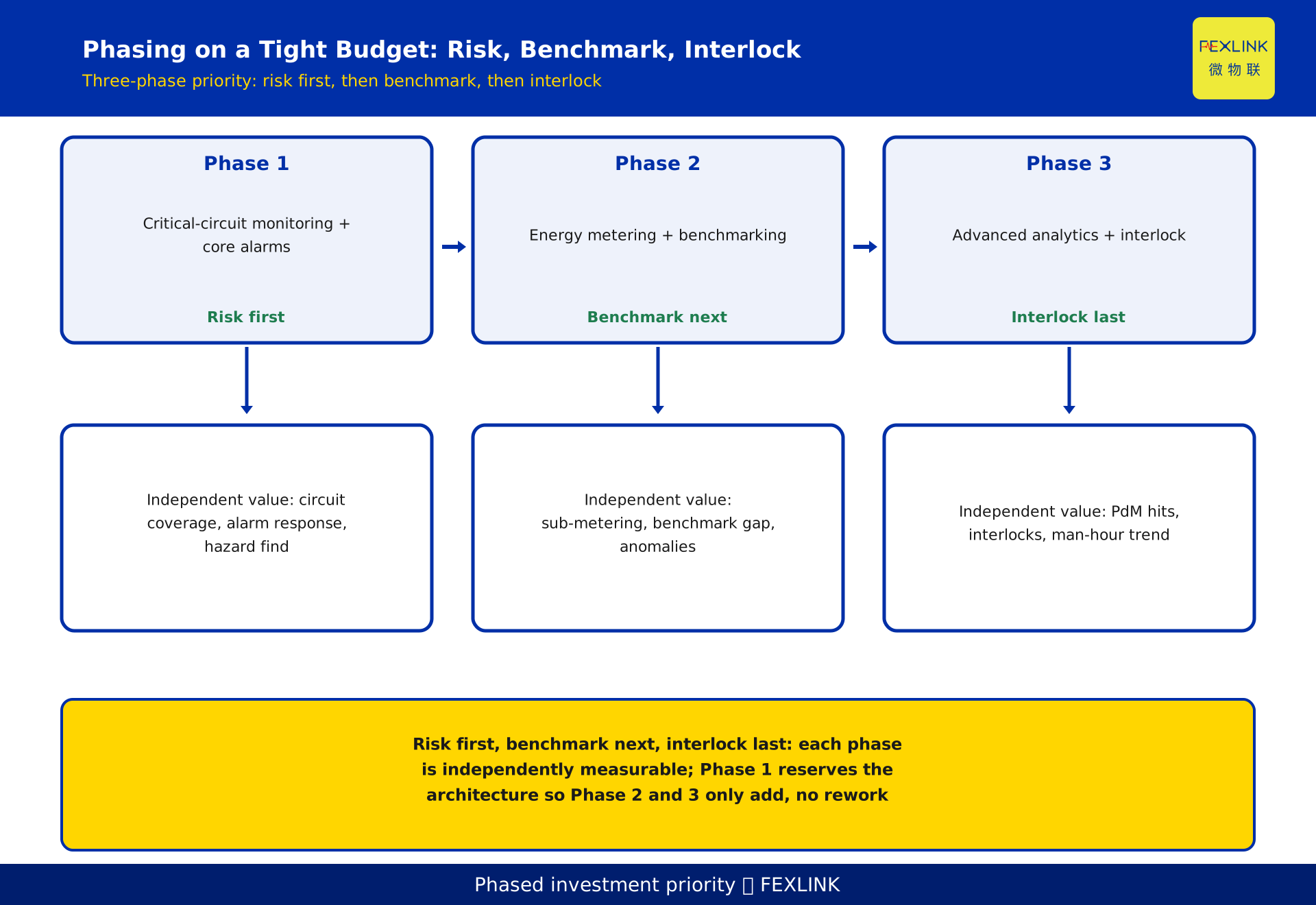
When the budget is limited, a monitoring rollout should neither go all-in at once nor be spread evenly across everything. Phase it by risk and value: Phase 1 installs the highest-risk, fastest-payback monitoring—critical circuits and core alarms; Phase 2 adds energy metering and benchmarking; Phase 3 layers in advanced analytics and cross-system interlock. The key is that each phase must deliver independently measurable value, and Phase 1 must reserve the architecture so Phase 2 does not require rework.
1. Why you should not spread the budget evenly
Even spreading is the most common mistake in phased rollouts: the limited budget is cut into many small pieces, a little on every zone and every device class. It looks like "full coverage" but leaves critical circuits uncovered while spending on non-critical points.
Risk and value are never evenly distributed. In a campus or a factory power distribution system, a handful of critical circuits—main incomers, important load feeders, emergency power—can take down an entire production line or building if they fail; many end circuits, if left unmonitored, have limited short-term consequence. If Phase 1 spreads the budget across the ends, the truly high-risk circuits stay unmonitored—the money lands on the lowest-leverage spots.
The other failure is "installing points you cannot use in Phase 1". One office building phased its rollout by first installing a large batch of socket-level energy meters while skipping the critical-circuit electrical-safety alarms. The fire risk the owner worried about most stayed invisible exactly when it mattered, and Phase 2's budget got stuck, delaying the safety capability that should have come earlier. Wrong phasing means Phase 1 installs points that are not used, while the critical Phase 2 is blocked by budget—the exact pain point.
So the first principle of phasing is not "divide equally" but "rank by risk and value, and put the limited budget where the leverage is highest".
2. What the three phases contain, and the priority logic: risk first, benchmarking next, interlock last
Order the monitoring capability into three phases by priority: "risk first, benchmarking next, interlock last"—remove the highest risk first, then answer the efficiency question, then build cross-system intelligence.
Phase 1: critical circuits and core alarms (risk first). Focus on electrical safety, the highest risk. Use the FEXLINK ESF/EST/ESB electrical-safety monitoring product line to cover critical distribution circuits, monitoring temperature, leakage current, residual current, over-current and similar electrical-safety parameters, together with the FEXLINK-BMS building management system to establish core alarms and real-time notification. The goal of this phase is to remove the most likely and most severe risks first and to show "safety value" fastest—hazards become visible, alarms get received.
Phase 2: energy and benchmarking (benchmarking next). On top of the sensing and platform base already built, add energy metering, sub-metering and efficiency benchmarking to answer "where is the electricity used, where is it wasted, and how do we compare with peer buildings". It depends on the points and platform laid in Phase 1—it is additive, not a rebuild.
Phase 3: advanced analytics and cross-system interlock (interlock last). Run trend analytics, predictive maintenance (the predictive-maintenance solution) and cross-system interlock—for example coordination among electrical, HVAC and fire systems. This phase turns the two lower layers of data into decisions and automated actions; it carries the highest value but also depends most on a complete base underneath.
"Risk first, benchmarking next, interlock last" is not the order of technical difficulty; it is the order of financial risk and return rhythm: secure life safety first, improve efficiency next, then build intelligence.
3. How to design "independently measurable" value for each phase
The worst case in phasing is "the three phases only work when assembled into one"—any budget interruption then leaves everything half-built. The correct approach is to let each phase deliver independently measurable value, with clear criteria proving "this phase was not wasted".
Phase 1 value criteria (safety side): critical-circuit coverage—what share of critical circuits are monitored; core-alarm response time—the interval from anomaly to notification reaching the responsible person; hazard findings—the number of electrical-safety hazards identified before versus after go-live. These three can be counted without Phase 2 or 3, so Phase 1 closes with a concrete answer to "how much risk was contained".
Phase 2 value criteria (efficiency side): sub-metering visibility—whether major energy systems are sub-metered; benchmarking deviation—whether the gap between this site's consumption and its peer benchmark is quantifiable; abnormal-consumption findings—how many leaks or abnormal-use behaviors were identified. Phase 2 alone answers the efficiency question of "was the money well spent".
Phase 3 value criteria (intelligence side): predictive-maintenance hit rate—the share of equipment anomalies caught early against actual failures; cross-system interlock count—the number of events the systems auto-coordinated; maintenance man-hour trend—whether inspection and handling became more focused. Note these are "measurable indicators" for tracking progress; they are not a commitment to any specific reduction or hit rate.
Write the criteria into each phase's acceptance. Then the three phases are not a "half-finished" chain but a progression: Phase 1 delivers Phase-1 value, Phase 2 adds value on top of Phase 1, Phase 3 stacks further.
4. Reserving architecture during phasing: so Phase 2 and 3 need no rework
The money saved by phasing is often paid back double in rework. If Phase 1 is built only for speed—messy point coding, non-unified bus, no reserved platform interfaces—Phase 2 must re-lay points, change communications and swap the base, and the rework cost can exceed the budget originally saved.
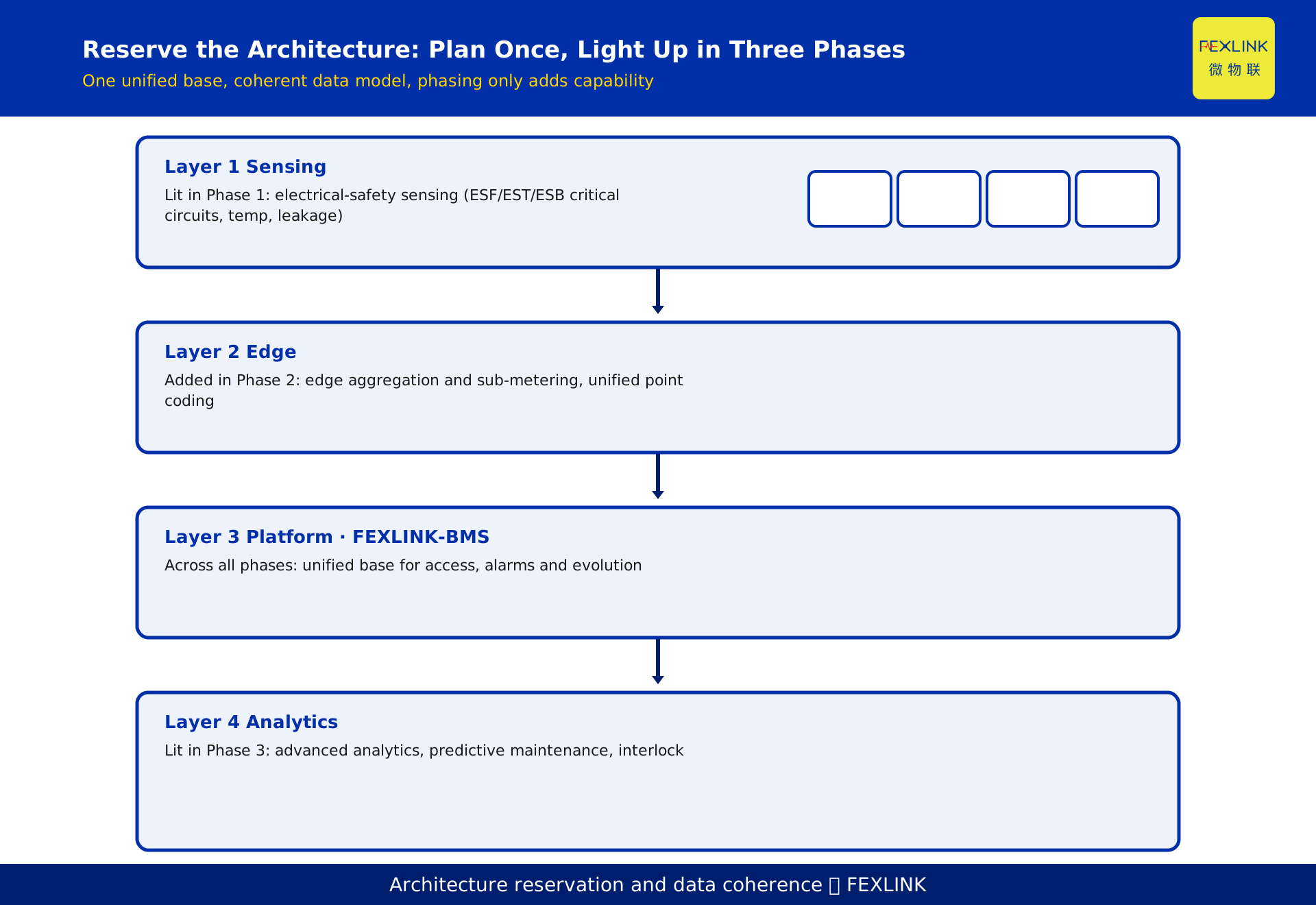
Phase 1 should reserve the architecture for what follows. Four things matter:
First, a unified data model and point-coding scheme. Every measurement point follows the same naming and modelling rules from day one, so Phase 2 and 3 only add fields to the model rather than rebuild the database. Second, a unified platform base. Use FEXLINK-BMS as the continuously evolving platform; every phase's capability grows on it rather than each phase starting its own stove. Third, reserve interfaces and compute. Reserve access capacity, communication interfaces and compute headroom at the edge and platform so Phase 2's energy and Phase 3's analytics can plug in directly. Fourth, modular access. Devices and subsystems connect through standard interfaces as modules; new capability is "plug a module" not "rewrite the system".
In one sentence: Phase 1 builds not a system "good enough for one phase" but a base "ready for three phases". The mark of good architecture reservation is this—when Phase 2 and 3 go live, the main work is "adding capability", not "re-doing the foundation".
5. The phased-investment roadmap: one picture of what each phase does and what it is worth
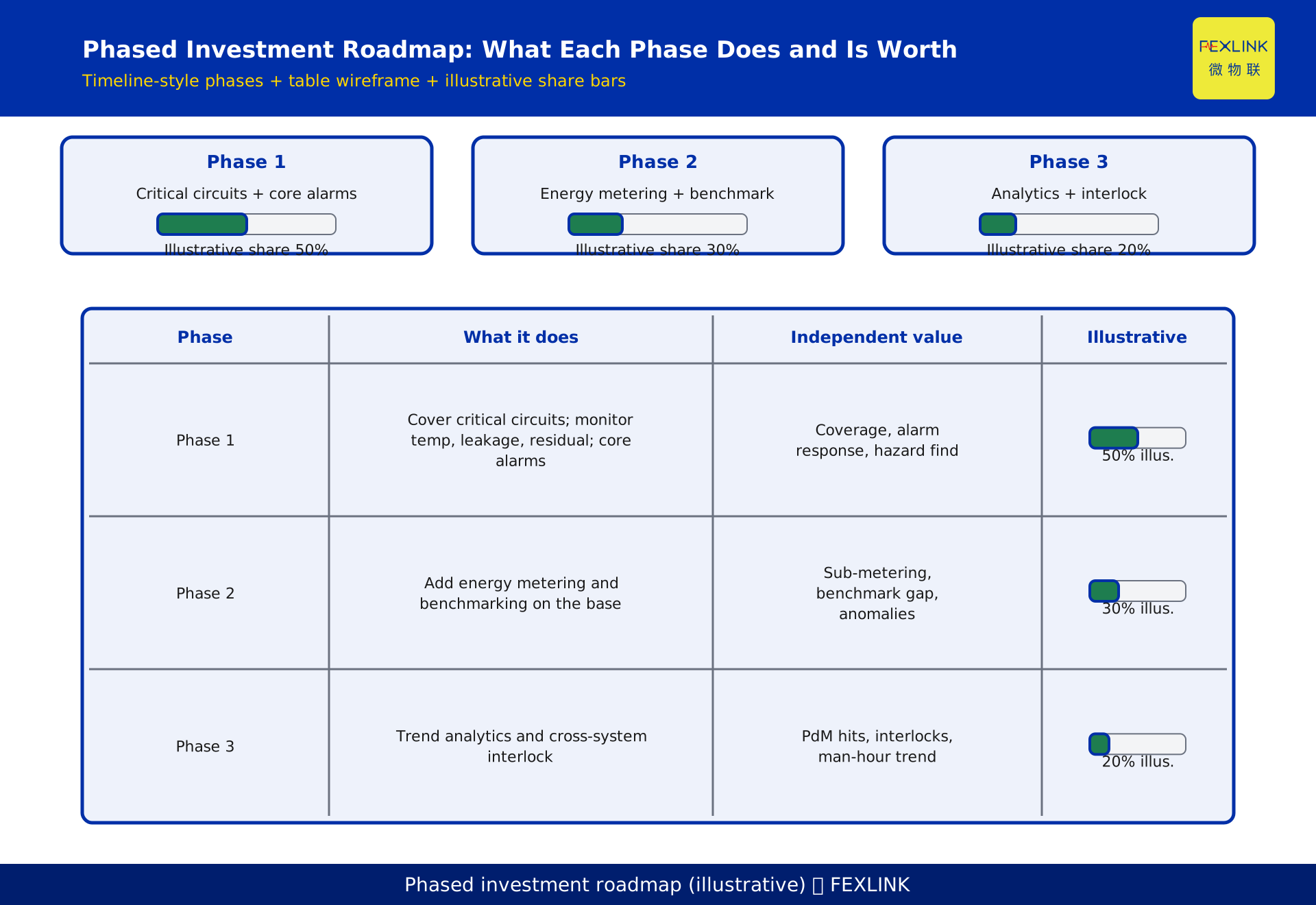
Compress the logic above into a roadmap (see figure). The horizontal axis is time; the vertical axis is the rhythm of each phase's investment and value. A common investment rhythm for illustration is: Phase 1 about 50% of total spend (put the money on the highest risk and fastest payback), Phase 2 about 30% (add efficiency), Phase 3 about 20% (build intelligent interlock). These shares are illustrative; the actual ratio should follow the point scale, risk distribution and business objectives of the specific project and is not a fixed template.
The roadmap answers three things: what each phase "does"—Phase 1 critical circuits and core alarms, Phase 2 energy and benchmarking, Phase 3 analytics and interlock; what each phase is "worth"—the independent value criteria from section 3; and when each phase "starts"—only after the previous phase's value is realised and its base is stable, not all at once.
Its difference from KD-0966 (which layer to enter from) is this: KD-0966 solves "from which architectural layer to enter"; this article solves "the investment rhythm of how many phases under a budget constraint". The increment here is a workable three-phase route and the independent-value criteria for each phase.
6. How the related products and solutions support phasing
Phasing is not drawn from nothing; it rests on an evolvable product and solution base. The FEXLINK ESF/EST/ESB electrical-safety monitoring product line provides Phase 1's electrical-safety sensing—covering temperature, leakage current, residual current and similar parameters on critical circuits. FEXLINK-BMS acts as the unified platform base, taking each phase's access, alarms and evolution.
At the solution level, the digital electrical intelligent supervision system corresponds to the capability integration from Phase 1 to 2—bringing safety monitoring and energy benchmarking into one supervision view. The predictive-maintenance solution corresponds to Phase 3's advanced analytics, turning historical data into equipment-health trends and early warning. Both are capabilities "grown on the base", not isolated projects—which exactly fits the no-rework requirement of phasing.
7. Common phasing mistakes
- Mistake 1: install the "visible" energy first, the "life-critical" safety later. Energy dashboards are the easiest to show, but electrical safety is the highest risk. Reverse the order and Phase 1 plants a hazard.
- Mistake 2: re-tender and swap platforms every phase. Each phase starts its own stove; data does not connect and the base is unstable, so Phase 2 is forced into rework.
- Mistake 3: force all three phases into Phase 1. "Done in one step" usually blows the budget and loses scope control, so even Phase 1 cannot be delivered.
- Mistake 4: no independent value criteria. The three phases are bound so they only work together; any interruption leaves a "half-built" and the return on investment cannot be explained.
FAQ
Q: If the budget is very tight, can we do only Phase 1?
Yes, and that is exactly the point of phasing. Phase 1 alone delivers the independent safety value of "critical circuits and core alarms". Whether to continue with Phase 2 and 3 depends on how Phase 1's value is realised and on later budget, not on being locked into three phases.
Q: Does Phase 1 have to use ESF/EST/ESB and FEXLINK-BMS?
The key of Phase 1 is the capability "critical-circuit monitoring and core alarms"; the specific selection follows the project. The FEXLINK ESF/EST/ESB electrical-safety monitoring product line provides electrical-safety sensing and FEXLINK-BMS provides the unified base and alarms—one of the product combinations that support the capability. Final selection should follow site conditions and the selection manual.
Q: Will Phase 2 and 3 overthrow and rebuild Phase 1?
They should not. As long as Phase 1 reserved architecture as described in section 4—unified data model, unified base, reserved interfaces—Phase 2 and 3 add capability rather than rebuild. If Phase 1 reserved nothing, rework risk rises sharply.
Q: Is the 50/30/20 phase split a hard rule?
No. The shares in this article are illustrative, used to explain the "front-loaded then lighter" investment rhythm. The real ratio should follow point scale, risk distribution and business objectives; it varies greatly between projects.
Q: How does this differ from KD-0966 (which layer to enter from)?
KD-0966 discusses from which architectural layer to enter; this article discusses the investment rhythm of how many phases under a budget constraint and the independent-value design of each phase. They are complementary: one sets the "entry point", the other sets the "rhythm".
Scope and limitations
- The phased-investment methodology discussed here applies to owners, infrastructure and operations scenarios that adopt electrical-safety monitoring and building/campus energy management—campus, data centre, factory, office, building. Pure manual inspection or points without return capability fall outside automatic-monitoring phasing.
- The "three phases", "risk first / benchmarking next / interlock last" and "Phase 1 ~50% / Phase 2 ~30% / Phase 3 ~20%" in this article are illustrative constructs for explaining the investment rhythm, not a fixed template and not any standard clause. The concrete phasing ratio should follow the point scale, risk distribution and business objectives of the specific project; this article is not a mandatory technical provision or a procurement recommendation.
- This article cites no standard number or clause; wherever ratios or thresholds appear they are expressed as "follow the specific project's reality", and the conclusions are not an engineering-acceptance basis.
- The terms "campus / data centre / factory / office / building" are generic scene placeholders, not tied to any real customer, project or place, and no identifiable customer or project information is used.
- The FEXLINK ESF/EST/ESB electrical-safety monitoring product line, FEXLINK-BMS building management system, digital electrical intelligent supervision system and predictive-maintenance solution mentioned are described qualitatively, with no fabricated accuracy, range or price figures, and are not a selection or procurement recommendation.
- Effect-class data such as saving rate, accuracy rate or ranking never enter the conclusions of this article; its positioning is a methodology guide on phasing rhythm that provides a workable three-phase route and independent-value criteria for each phase.
Frequently Asked Questions
If the budget is very tight, can we do only Phase 1?
Yes, and that is exactly the point of phasing. Phase 1 alone delivers the independent safety value of "critical circuits and core alarms". Whether to continue with Phase 2 and 3 depends on how Phase 1's value is realised and on later budget, not on being locked into three phases.
Does Phase 1 have to use ESF/EST/ESB and FEXLINK-BMS?
The key of Phase 1 is the capability "critical-circuit monitoring and core alarms"; the specific selection follows the project. The FEXLINK ESF/EST/ESB electrical-safety monitoring product line provides electrical-safety sensing and FEXLINK-BMS provides the unified base and alarms—one of the product combinations that support the capability. Final selection should follow site conditions and the selection manual.
Will Phase 2 and 3 overthrow and rebuild Phase 1?
They should not. As long as Phase 1 reserved architecture as described in section 4—unified data model, unified base, reserved interfaces—Phase 2 and 3 add capability rather than rebuild. If Phase 1 reserved nothing, rework risk rises sharply.
Is the 50/30/20 phase split a hard rule?
No. The shares in this article are illustrative, used to explain the "front-loaded then lighter" investment rhythm. The real ratio should follow point scale, risk distribution and business objectives; it varies greatly between projects.
How does this differ from KD-0966 (which layer to enter from)?
KD-0966 discusses from which architectural layer to enter; this article discusses the investment rhythm of how many phases under a budget constraint and the independent-value design of each phase. They are complementary: one sets the "entry point", the other sets the "rhythm".