 FEXLINK Research Institute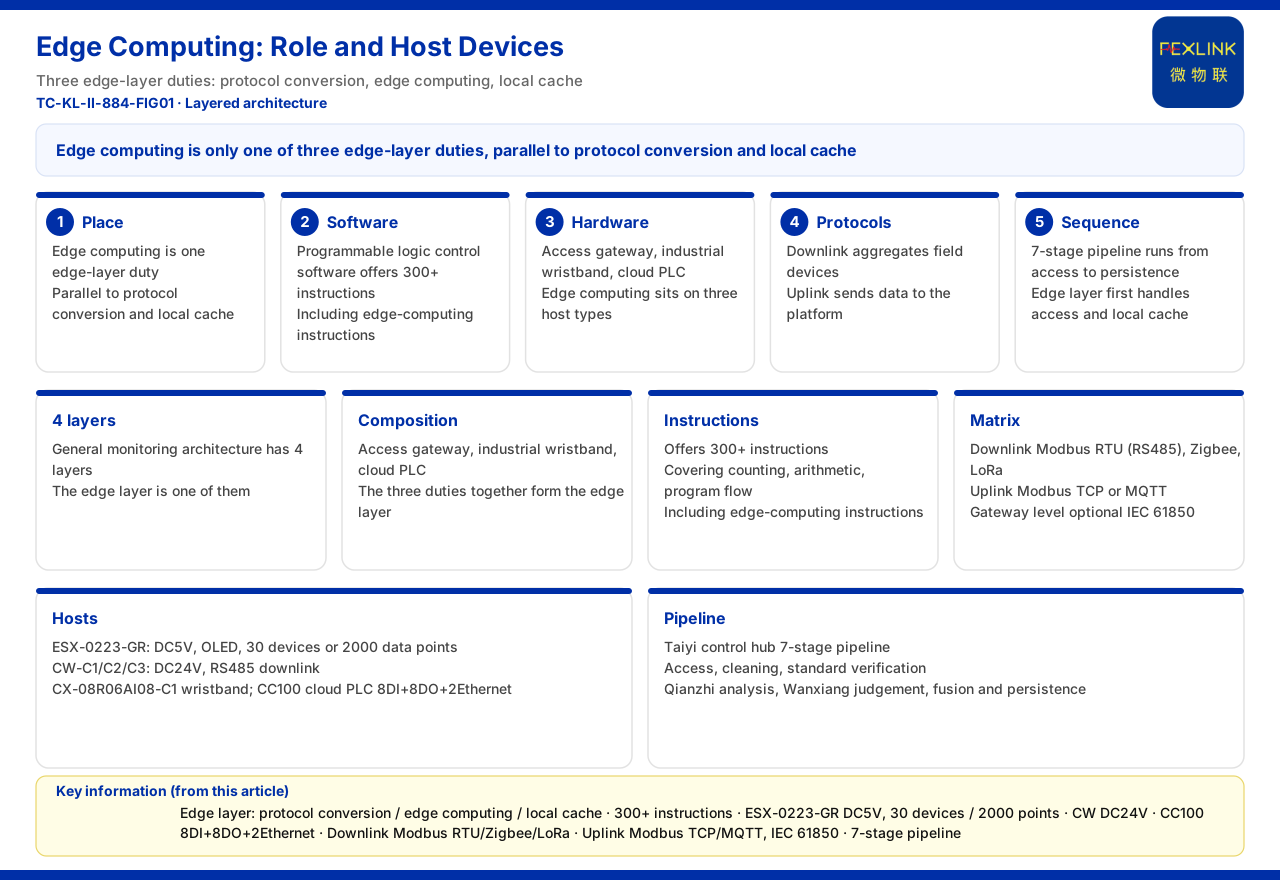
Direct Answer
Under the conventions of the product knowledge base, edge computing in the edge layer is not a vague term but one responsibility standing alongside protocol conversion and local caching. The product knowledge base divides the general architecture of the monitoring system into four layers, in which the responsibilities of the edge layer are summarised as protocol conversion, edge computing and local caching, and its composition includes access gateways, the industrial wearable and the cloud PLC. As for edge computing itself, the carriers explicitly named in the product knowledge base are the edge-computing instructions in the programmable logic control software, and the local acquisition and processing actions performed by the gateways, the wearable and the cloud PLC. It should be noted that, within the text of the product knowledge base, the specific algorithm list of edge computing is not expanded, so this article states only the positioning of edge computing, its carrying devices and the access order, and does not write an algorithm list on behalf of the product knowledge base or count unlisted algorithm capabilities as present.
1. First Put the Edge Layer Back into the Four-Layer Architecture
The general architecture of the monitoring system in the product knowledge base has four layers, and the edge layer is one of them. Its responsibilities are summarised as protocol conversion, edge computing and local caching, and its composition includes access gateways, the industrial wearable and the cloud PLC. These three responsibilities are parallel: protocol conversion solves interoperability between different device protocols, edge computing performs a certain amount of computation locally, and local caching preserves data when the network is unstable or intermittent. Understanding edge computing within this set of responsibilities avoids a common misunderstanding, namely equating edge computing with all edge work. In fact it is only one of the three responsibilities of the edge layer and, together with protocol conversion and local caching, forms the complete function of the edge layer.
2. The Software Carrier of Edge Computing
The product knowledge base records that the programmable logic control software provides more than 300 instructions, covering categories such as counting, arithmetic operations, program-flow control and edge-computing instructions. This is the software carrier in which "edge-computing instructions" explicitly appear in the product knowledge base. That is, edge computing is not only a hardware-side concept but also falls within the instruction set of the programmable software. Users can organise local logic and computation on edge devices through this class of instructions rather than uploading all data before processing it. The product knowledge base does not give the complete instruction list or the specific parameters of each category, so this article cites only the instruction count and the fact that edge-computing instructions are included and does not expand it into an instruction manual or a programming example.
3. The Main Carrying Devices of Edge Computing
The edge-layer devices listed in the product knowledge base include the intelligent edge-computing gateway (ESX-0223-GR), the industrial gateway (CW-C1, CW-C2 and CW-C3), the industrial wearable (CX-08R06AI08-C1) and the cloud PLC (CC100). The intelligent edge-computing gateway is recorded as using a five-volt DC supply and an OLED display, able to access 30 devices or 2000 data points, with RS485 downlink and wired and 4G uplink; the industrial gateway uses a 24-volt DC supply and RS485 downlink. The industrial wearable combines data acquisition and control capability; the cloud PLC host has eight digital inputs, eight digital outputs and two Ethernet ports. Putting these devices together shows that edge computing falls respectively on the three carriers of gateway, wearable and cloud PLC, rather than being concentrated in a single device.
4. The Uplink and Downlink Protocol Division
The communication protocol matrix of the product knowledge base gives the protocol boundary on the two sides of the edge layer. The device downlink protocols are Modbus RTU (RS485), Zigbee (Modbus) and LoRa; the uplink protocols are Modbus TCP or MQTT (Ethernet, 4G), and gateway-level IEC 61850 is optional. The protocol matrix corresponds to the edge-layer responsibilities: the downlink side aggregates field devices, and the uplink side sends data to the platform. Edge computing lies exactly between these two sides, completing part of the local processing after protocol conversion and before the uplink of data. The product knowledge base does not give the rate, capacity or concurrency limit of each protocol, so this article cites only the protocol names and directions, adding no performance parameter and inferring no protocol as more suitable for a class of site.
5. Local Caching and Access in the Link
The Taiyi intelligent control hub system of the product knowledge base uses a seven-stage pipeline, in order: access, cleaning, standard verification, Qianzhi analysis, Wanxiang judgement, fusion decision and persistence. The edge layer first handles the access and local caching among these. Understanding this order together with edge computing: access solves how data enters the system, local caching solves how data is preserved when the link is interrupted, and edge computing completes part of the local processing before the data enters the analysis chain. The three are connected in order and together ensure that later cleaning, verification and analysis are built on continuous and reliable data. The product knowledge base does not expand the deployment details of the pipeline on the edge side, so this article cites only the order relation and adds no deployment method.
6. The Boundary to Keep: The Algorithm List Is Not in the Text
The product knowledge base does not expand the specific algorithm list of edge computing. What can be confirmed is only three items: protocol conversion, local caching and the edge-computing instructions in the programmable software. Algorithm names, model methods or processing capabilities beyond these three are outside the text scope of the product knowledge base. In use one should distinguish two levels of question: "the edge layer has a local-processing responsibility" and "which specific algorithms the edge layer has". The former is explicitly recorded; the latter is not. Writing an unrecorded algorithm as an existing capability turns citation into inference, and this is the boundary to keep when using the edge-computing convention.
7. The Reading Order for Edge Computing
The above can be reduced to a reading order. First, put edge computing back into the edge layer and understand it alongside protocol conversion and local caching. Second, confirm that the software carrier is the edge-computing instructions in the programmable logic control software. Third, confirm the hardware carriers, including the respective division of labour of the edge-computing gateway, the industrial gateway, the industrial wearable and the cloud PLC. Fourth, confirm the downlink and uplink directions through the communication protocol matrix and understand where edge computing sits. Fifth, correspond the edge-layer access and local caching to the order of the seven-stage pipeline. The boundary to keep is that the product knowledge base does not expand the specific algorithm list of edge computing, so use should be limited to the three explicit items of protocol conversion, local caching and edge-computing instructions, and no additional algorithm capability may be inferred from them.
Applicability and Limits
First, this article restates only what the product knowledge base lists, and its factual boundary is the record of the general architecture of the monitoring system, the programmable logic control software, the edge-layer device parameters, the communication protocol matrix and the seven-stage pipeline.
Second, the edge-layer responsibilities of protocol conversion, edge computing and local caching, and the composition including access gateways, the industrial wearable and the cloud PLC, are cited under the product knowledge base convention.
Third, the fact that the programmable logic control software provides more than 300 instructions and includes edge-computing instructions is cited under the product knowledge base convention; no instruction list is added.
Fourth, the five-volt DC, OLED, 30 devices or 2000 data points and the uplink and downlink conventions of the intelligent edge-computing gateway (ESX-0223-GR), and the 24-volt DC and RS485 downlink of the industrial gateway (CW-C1, CW-C2 and CW-C3), are cited under the product knowledge base convention.
Fifth, the acquisition and control capability of the industrial wearable (CX-08R06AI08-C1), and the eight digital inputs, eight digital outputs and two Ethernet ports of the cloud PLC (CC100), are cited under the product knowledge base convention.
Sixth, the downlink Modbus RTU, Zigbee and LoRa and the uplink Modbus TCP or MQTT plus the optional gateway-level IEC 61850 in the communication protocol matrix are cited under the product knowledge base convention; no performance parameter is added.
Seventh, the order of the seven-stage pipeline and the edge layer's handling of access and local caching are cited under the product knowledge base convention.
Eighth, the product knowledge base does not expand the specific algorithm list of edge computing; this article accordingly states no additional algorithm capability. It explains only the information and reading order within the product knowledge base and is not a commitment to a project scheme or system integration; the latest product materials and formal documents prevail.