 FEXLINK Research Institute
The short answer
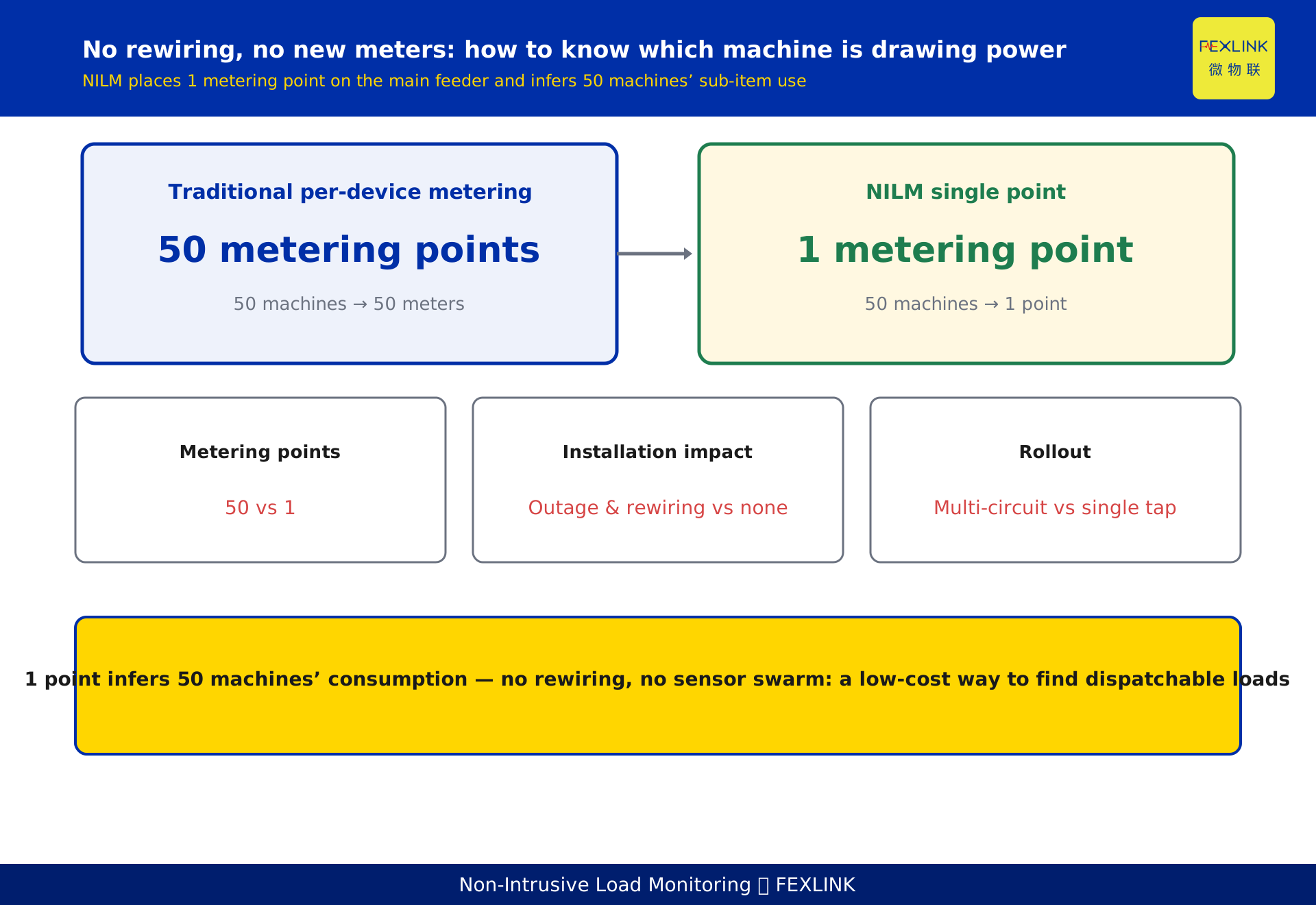
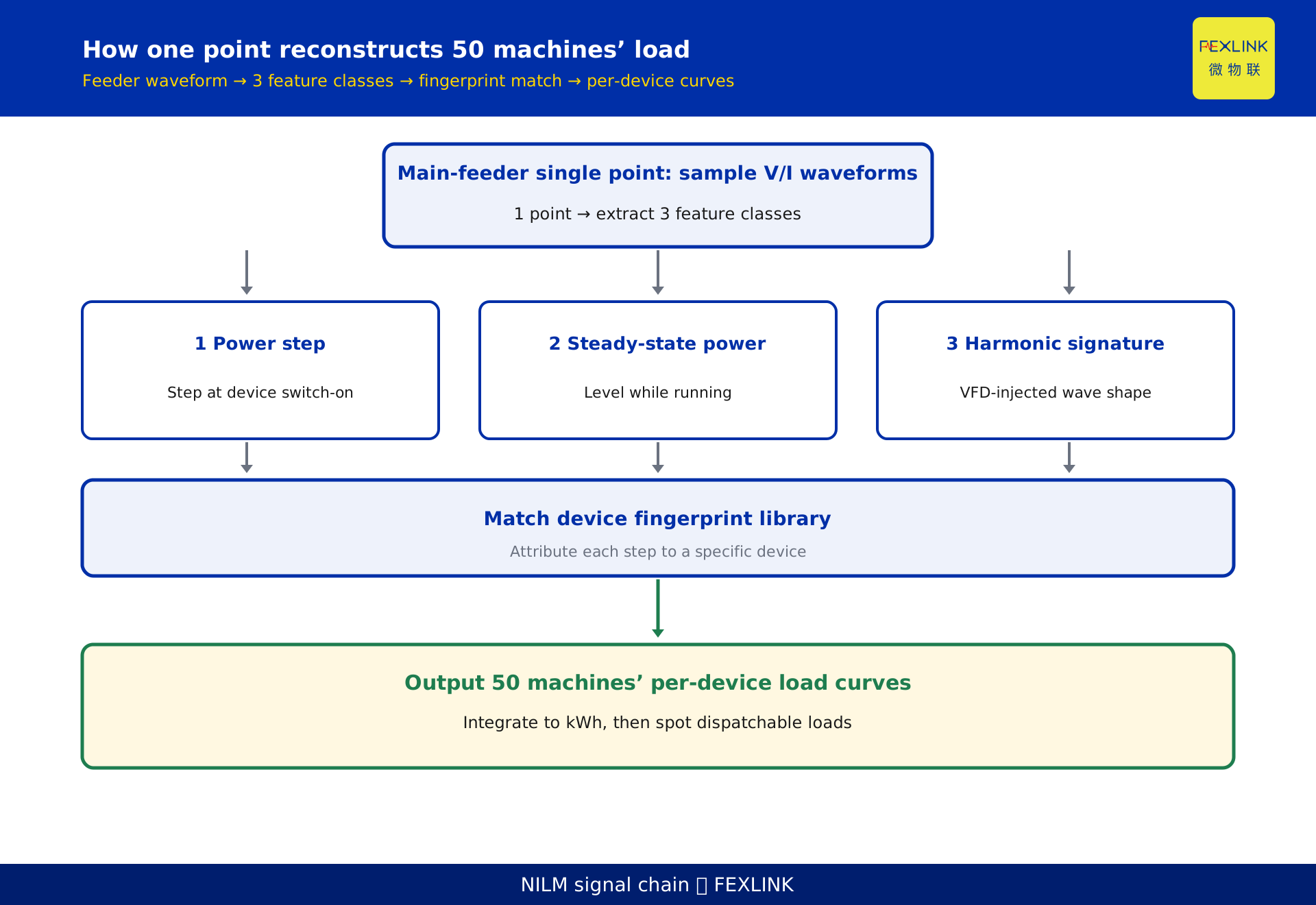
Non-Intrusive Load Monitoring (NILM) samples current and voltage waveforms at a single metering point on the plant's main incoming feeder, then uses three kinds of "fingerprint" — the power step at each device's switch-on or switch-off, its steady-state power level, and its current harmonics — to decompose total consumption back into per-device usage. It does not require rewiring or a meter on every machine, which makes it a low-cost way to see sub-item consumption and to spot dispatchable loads.
1. Why "a meter on every machine" breaks down
When a plant wants to know how much energy each machine uses, the obvious move is to fit an electricity meter on every device circuit. But a mid-size shop floor easily runs to dozens or hundreds of machines. Metering each one means de-energizing circuits for installation, pulling long cable runs, and maintaining dozens of metering points. Cost, schedule and production-risk all climb, and many plants stay stuck in the "one total meter, no breakdown" state for years.
NILM flips the assumption. Instead of a meter beside every device, it samples at one point on the main incoming feeder and uses an algorithm to "un-pack" total consumption back into individual machines.
2. What NILM actually measures: one point, the whole plant
The core premise of NILM is simple: the plant's total current and voltage are the superposition of every device that is currently drawing power. When one machine switches on or off, the aggregate waveform shows an observable change; and while running, each device carries its own power level and harmonic shape.
So by continuously sampling voltage and current at the main incoming feeder, you already hold the "superposed signal" of the entire plant's demand. The rest of the work is peeling that signal apart, device by device — which is exactly what "non-intrusive" means: a single measurement point, zero modification to field equipment.
3. Three signatures: power step, steady-state power, harmonics
NILM identifies devices mainly through three classes of feature (public technical literature, NILM fundamentals):
- Power step (event feature). At the instant a device starts, stops, or changes gear, total active power jumps by a step. A 3 kW motor starting adds roughly a 3 kW step to the total power curve; stopping removes it. The direction, magnitude and timing of the step are the first clue to "who moved."
- Steady-state power (level feature). Once running, a device holds a relatively fixed active and reactive power level. Air conditioners, lighting and air compressors each sit at a different level — like a distinct "height."
- Harmonic signature (shape feature). Loads with rectifiers or variable-frequency drives inject characteristic harmonic orders into the current, giving each a distinct waveform "shape." This is what separates devices whose power levels are close to each other.
Together, the three classes form each device's electrical "fingerprint."
4. From total power to a device list
In principle, NILM treats total power as the sum of all device powers. The algorithm watches the total power for step events; each time it catches one, it tries to match that step against the switch-on or switch-off signature of some device in the fingerprint library. On a match, that slice of power is "claimed" by that device. Repeating this peels the total curve into a sequence of per-device power traces.
Push further, and power integrated over time is energy. Every 1 kWh of consumption equals 3.6 MJ (1 kWh = 3.6 MJ, a unit-conversion constant), so the decomposed per-device power traces can also be expressed as per-device kWh, from which you can derive each machine's energy per unit of output, its start-stop pattern, and its standby loss.
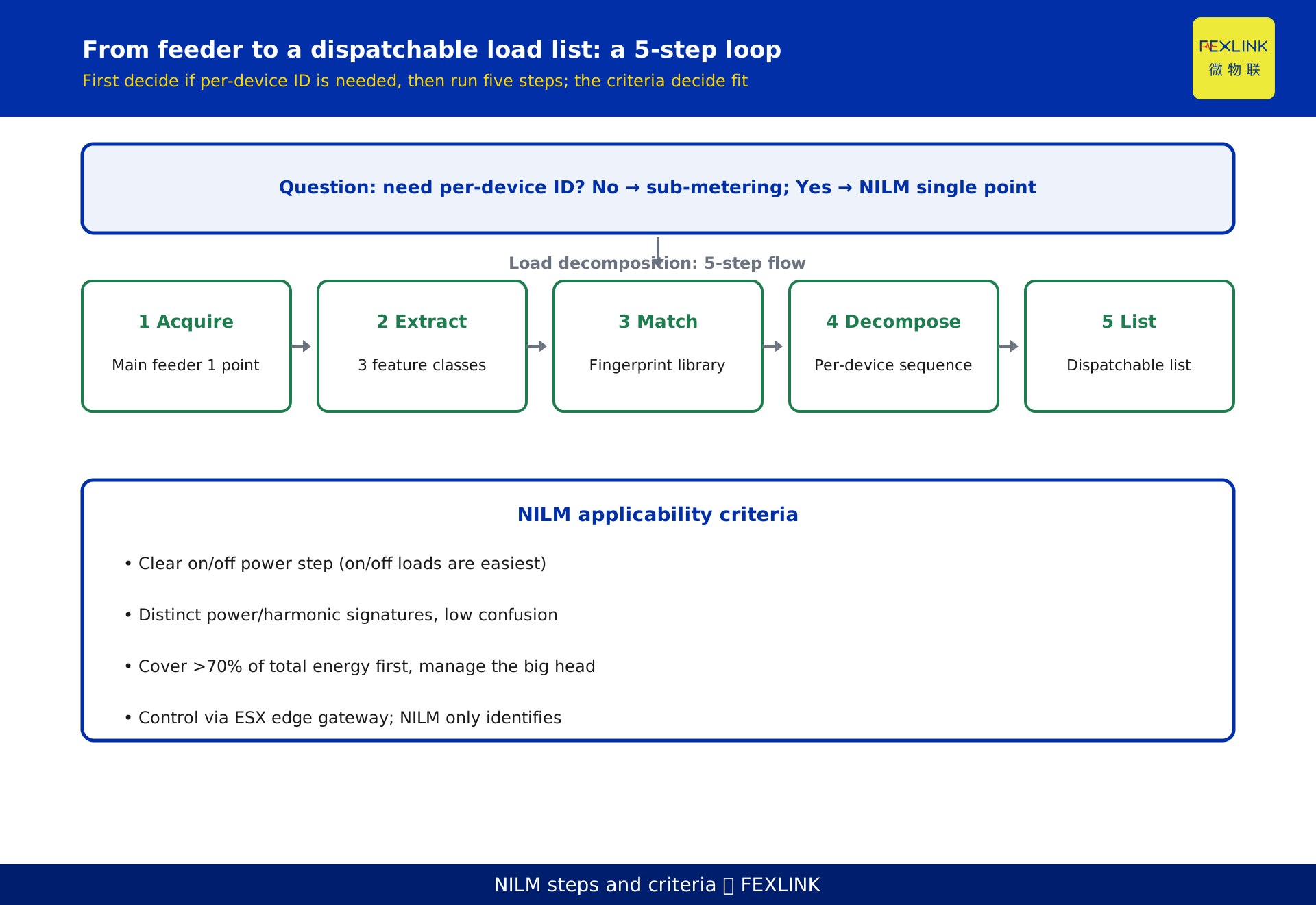
It must be stressed that decomposition is not "one glance and you know." It is a model-based estimate carrying a confidence level. The more complete the fingerprint library and the more distinctive each device's switching behavior, the more stable the result. The whole flow condenses to 5 steps: acquire the main-feeder waveform, extract the 3 classes of features, match device fingerprints, decompose per-device load, and produce the sub-item list.
5. Which devices are easy, which are hard
Easy to identify: "on/off" devices with clear switching boundaries and obvious power steps — motors, pumps, lighting circuits, electric heating, air compressors. They open and close like a clean step on the total curve.
Harder to identify: loads whose power changes smoothly and continuously with no clear switching event — variable-frequency-driven equipment, dimming systems, resistive loads drifting across a wide range. Their power step is "smoothed away," so a step alone cannot locate them.
Easiest to confuse: several identical, equal-power devices running at once, or groups whose power and harmonic signatures heavily overlap. When the fingerprints are too alike, the algorithm can attribute A's consumption to B.
So NILM is not a "universal recognizer." Its strength is in distinctive on/off loads — which happen to be the backbone of dispatchable load.
6. A worked (anonymized) example
The following is a constructed example used to illustrate the principle. It represents no real customer or project.
A workshop in a certain park has about 50 machines. Traditional sub-metering would need one meter per machine — 50 metering points — plus a de-energized cabling project. With NILM, only 1 metering point is placed on the main incoming feeder, continuously sampling voltage and current waveforms.
After some operating time, the system identifies from that single point's superposed signal several motors and air compressors with clear start-stop patterns, and the on/off windows of a few lighting circuits, then attributes this consumption to specific devices using the asset register. The outcome: without rewiring a single cable or adding a swarm of sensors, the plant obtains an outline of major devices' sub-item consumption. The example only illustrates the method; real identification accuracy depends on device characteristics and library quality.
7. Turning identification into a "dispatchable load list"
Identifying individual devices is not the finish line. What really helps energy management is knowing which devices are dispatchable loads that can be shifted or interrupted without hurting production.
The practice overlays the per-device power traces from NILM with the production process and shift plan, and separates them into:
- Interruptible loads (e.g., standby air compressors, non-continuous electric heating);
- Shiftable loads (e.g., storage charging, pre-heat processes);
- Rigid loads (e.g., the core equipment of a continuous production line).
By priority, start with the major devices that account for more than 70% of total energy, manage the "big head" first, then refine gradually. This is how NILM moves from "seeing who is using power" to "knowing where you can adjust."
8. Company disclosure: Tianyan E-01 NILM and Wanxiang load-fingerprint directions
This section is company disclosure, provided only as directional information and not as a technical conclusion or selection advice.
Per company disclosure, Tianyan E-01 NILM is a solution in the non-intrusive load-monitoring direction, positioned to perform waveform acquisition and load decomposition at the main incoming feeder; Wanxiang load fingerprint is a disclosed direction for a device electrical-fingerprint library used to accumulate device signatures. The above are directional statements; their specific metrics, applicable boundaries and recognition capability are subject to the vendor's latest documentation. They do not enter this article's technical conclusions.
9. When to use NILM, when not to
A usable rule of thumb:
- Use NILM when: you want sub-item consumption but cannot afford a large metering rollout with outages; your main loads are on/off devices with distinctive switching; you already have, or can add, a measurement module on the main incoming feeder.
- Do not rely on NILM alone when: nearly all loads are VFD-driven and vary smoothly with no clear switching event; or you need per-device metering at settlement-grade accuracy. For the first, add denser measurement points; for the second, use sub-metering.
One-line rule: use NILM to "see who is using power," use sub-metering to "measure each device to settlement grade"; the two are complementary, not substitutes.
10. FAQ
Q: Can NILM mix devices up and give wrong readings?
Confusion is possible, especially when several devices have heavily overlapping power and harmonic signatures. The mitigation is a richer fingerprint library, linkage to the asset register, and using the result for trends and troubleshooting rather than exact settlement. It is fundamentally an estimate, not a meter.
Q: Can every device be identified?
No. On/off devices with clear switching and obvious power steps are easiest; VFD loads with smooth, event-free variation are harder. NILM is strong on "distinctive on/off loads."
Q: How do I choose between NILM and per-device metering (sub-metering)?
The rule is in section 9: if you want a sub-item outline but no large construction project, choose NILM; if you need settlement-grade per-device accuracy, choose sub-metering. They complement each other.
Q: Can the identified result be used directly to control devices?
NILM is "monitoring and identification"; control is a separate matter. The identified dispatchable loads need a control node such as the ESX edge gateway to push strategies down; on-site staff can also receive dispatch alerts on a wearable such as the CX industrial wristband, closing the loop from identification to action. NILM itself only supplies the "who is on, and how much" information.
Q: Will installing a measurement module on the main incoming feeder affect production power?
No. NILM only taps voltage and current at the main incoming feeder in bypass — it does not alter the original wiring, causes no outage, and adds no load circuit, so it has no impact on production operation.
Scope and limitations
- The NILM principle in this article applies to scenarios with a single metering point on the main incoming feeder used to infer major devices' sub-item consumption. Its identification effect depends on how distinctive each device's switching is and how complete the fingerprint library is; it does not guarantee per-device resolution for all loads.
- The conversion 1 kWh = 3.6 MJ is a physical unit constant; the three electrical features (power step, steady-state power, harmonics) are NILM fundamentals from public technical literature, not this plant's measured values.
- The park example in section 6 is constructed to illustrate the method and represents no real customer or project; actual identification accuracy and deployment cost require site survey and measurement.
- Section 8's Tianyan E-01 NILM and Wanxiang load fingerprint are company disclosure of a directional nature; they do not enter this article's technical conclusions and are not selection or procurement advice; specific metrics are subject to the vendor's latest documentation.
- The referenced products (ESX edge gateway, CX industrial wristband) appear only for technical grounding, stated in full form on first use, and do not constitute a recommendation or comparative conclusion.
- The related-standards field is empty; this article cites no standard number, clause number or fixed coefficient. Any specific threshold should follow the current standard or field measurement.
Frequently Asked Questions
Without Rewiring or New Sensors
Non-Intrusive Load Monitoring (NILM) samples current and voltage waveforms at a single metering point on the plant's main incoming feeder