 FEXLINK Research Institute
The short answer
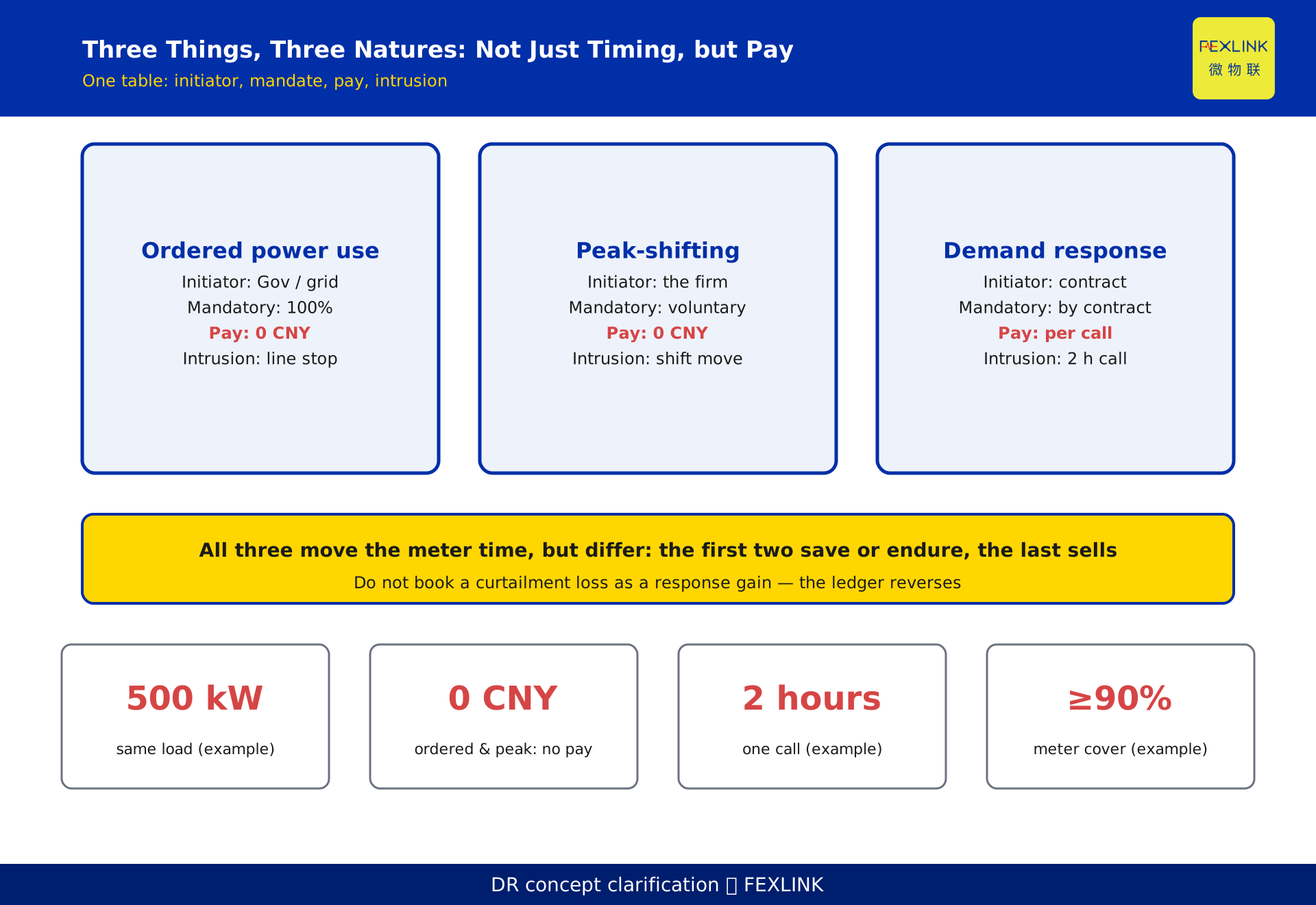
No, they are not the same thing. Ordered power use is an administrative, mandatory, and usually uncompensated curtailment arrangement. Peak-shifting production is a self-initiated production schedule inside the factory. Demand response is a market-based "compensated when called" resource behavior. The three differ completely in who initiates them, how mandatory they are, how compensation is handled, and how deeply they intrude on the production plan. The three boundaries are explained once and for all below.
1. First, put each of the three names in its place
- Ordered power use: during peak-load or supply-gap periods, the government authority or the grid company organizes users to shift, avoid, or curtail load according to a pre-approved plan. Its underlying nature is "involuntary, instructed."
- Peak-shifting production: to avoid peak tariffs, balance its own capacity, or match the supply chain, a factory proactively moves energy-intensive processes from peak to off-peak hours, or adjusts shifts. Its nature is "voluntary, internal."
- Demand response: a user signs an agreement with the grid or an aggregator, registers adjustable or interruptible load as a "resource," and cuts or shifts consumption on instruction when the system needs it; once called, compensation is settled per the agreement. Its nature is "market-based, settleable."
All three "move the time of electricity use," but their natures are worlds apart.
2. Who initiates it, and is it mandatory?
This is the first dividing line.
Ordered power use is initiated by the government or the grid, executed under a public policy framework such as the *Measures for the Administration of Ordered Power Use*. If a user is on the plan list, there is essentially no room to refuse a curtailment notice — it is an administrative mandate, which can be understood as "100% compliance with the instruction."
Peak-shifting production is initiated by the factory itself. The production department looks at tariffs, orders, and equipment-maintenance windows, and decides which line to run on which day. No external force commands you, and there is no breach-of-contract risk.
Demand response is initiated by "the contract relationship." You first sign a response agreement with an aggregator or the grid; only afterward do you execute when called. Without signing, there is no response obligation. Its compulsoriness comes from the contract, not from an administrative order.
In one sentence: ordered power use is "assigned to you," peak-shifting is "arranged by yourself," and demand response is "activated only after you agree."
3. Is there compensation, and how is it settled?
This is the second dividing line, and the one factories care about most.
Ordered power use: usually no compensation. The losses from shutdowns and reduced output caused by curtailment are generally borne by the enterprise itself; a few regions have special arrangements for some interruptible loads, but that is the exception, not the norm. State the conclusion up front — in most cases the compensation is 0 CNY.
Peak-shifting production: by moving production to off-peak hours, what you save is your own electricity bill (the price-spread gain); there is no external "compensation" paid to you. The external compensation is likewise 0 CNY, but the motive is internal cost reduction, not collecting a subsidy.
Demand response: compensation on being called is exactly what distinguishes it from the other two. "Called means compensated" — each call is settled once, by the agreed capacity or energy. The exact compensation unit price, capacity price, and energy price follow local rules or the aggregator's terms; they vary greatly across provinces and years, so this article gives no fixed number.
Putting the three lines side by side: ordered power use 0 CNY, peak-shifting 0 CNY of external compensation, demand response settled per call — the first two rely on "saving" or "enduring," the last on "selling."
4. How deeply does it cut into the production plan?
The third dividing line decides how hard it is to implement.
Ordered power use is the "hardest." The curtailment window and load target are given; the enterprise can only maneuver within the execution envelope, and production equipment may shut down entirely — for continuous-process industries (such as kilns and chemicals) the intrusion is extremely deep.
Peak-shifting production is "soft." Shifts and processes are adjustable internally; the line need not stop, only the timing changes. The intrusion is moderate, mainly testing production-scheduling capability.
Demand response is "on demand." Production runs normally; only during the called 2-hour window (a constructed example) does it cut or shift the designated load, and it restores immediately after the call ends. The intrusion on the plan is the lowest, but it requires beforehand clearly identifying the "cuttable load" and wiring up the metering.
5. A factory's real confusion: three things tangled together
The following is a constructed example used to illustrate the boundary; it represents no real customer or project.
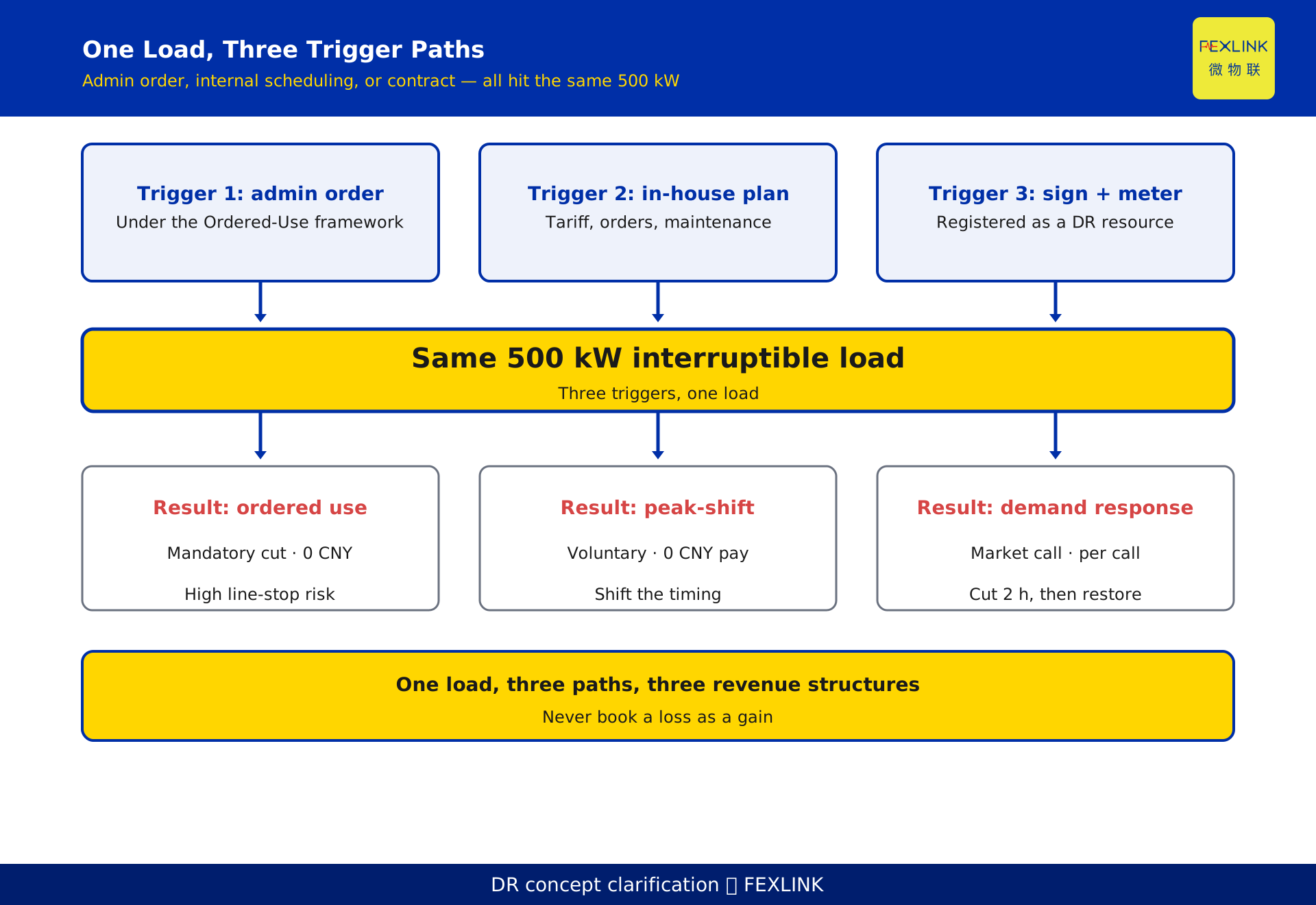
A factory in peak season is notified "from next Monday, curtail 500 kW every day 10:00–12:00" (ordered power use); at the same time, the energy manager moves the injection-molding workshop from day shift to night shift to capture off-peak tariffs (peak-shifting production); at year end, the same factory signs with an aggregator and registers the same 500 kW interruptible load as a demand-response resource, which the grid calls for 2 hours at system peak and settles.
The same factory, the same 500 kW, three arrangements stacked together — yet their natures are completely different: the first is an administrative order (0 CNY, mandatory), the second is internal scheduling (0 CNY external compensation, voluntary), the third is a market resource (settled only when called). If you cannot tell them apart, you may mistake "the loss from being curtailed" for "the gain from participating in response," and the accounting is reversed.
6. Productizing everyday peak-shifting into a settleable resource
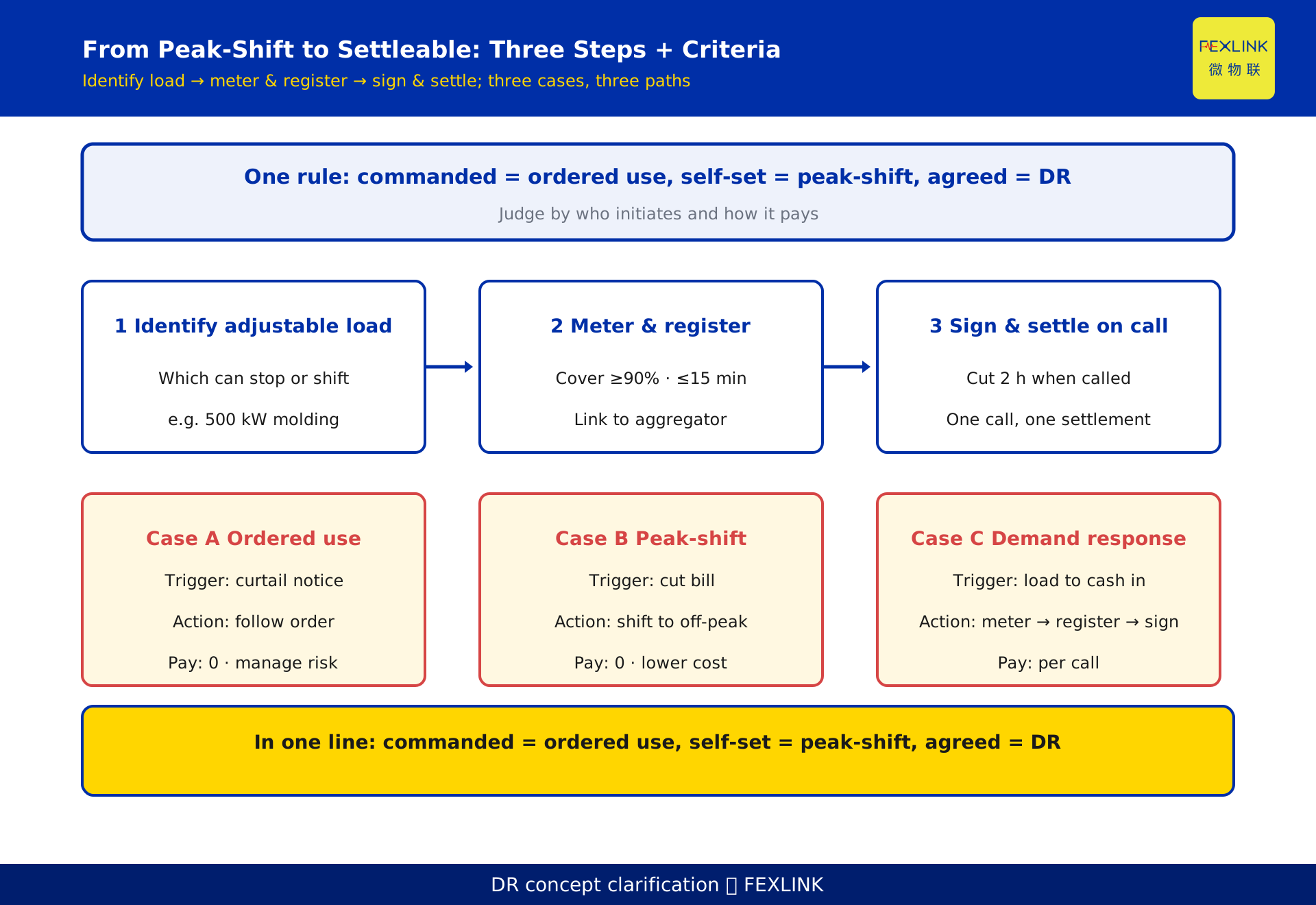
Factories already do peak-shifting every day. If this capability can be metered, registered, and callable, it can be upgraded from "internal cost reduction" to "an externally settleable resource." The path has three steps:
Step one, identify adjustable load. List which equipment and which processes can stop or shift, in which windows — for example, the 500 kW injection-molding load above.
Step two, circuit-level metering and registration. Use a metering device to quantify this capability and connect to an aggregator platform to register it as a response resource. Note: demand-response resources generally require circuit-level metering coverage to reach a certain level; below we use a circuit metering coverage of ≥90% as an illustration, subject to the aggregator's admission rules. The sampling interval and similar parameters are also set by the platform; a common industry requirement is no coarser than 15 minutes.
Step three, sign and settle on call. After registration and signing, when the system needs it, an instruction is issued; you cut the load as agreed, and each call is settled once.
Peak-shifting is "capability"; demand response is "turning that capability into a settleable product" — what sits in between is exactly the three steps of metering, registration, and signing.
This is also where a circuit-level meter such as the ESA all-element smart meter (ESA-22131-R, 3×400A, 3×220/380V, RS485 Modbus) earns its place: it supplies the per-circuit, per-interval measurement that makes a load "registerable and callable" rather than merely "shifted."
7. Entry barriers for demand-response resources (overview)
Demand response is not "report and you are in." Aggregator platforms generally impose admission requirements along several dimensions; the following is an overview of the common public-information framing, subject to local rules or the platform:
- Metering condition: circuit-level metering and communication, usually with high coverage requirements (illustratively ≥90%), and a sampling interval meeting the platform (commonly ≤15 minutes).
- Response capability: the cuttable or interruptible load must reach the platform's minimum scale; the exact capacity threshold varies by region and industry.
- Reliability: when called, it must execute as scheduled; a low execution rate affects settlement or even leads to removal.
- Agreement: a response agreement must be signed, clarifying the call method, settlement rules, and breach handling.
These thresholds have no nationwide uniform number; this article uniformly expresses them as "subject to local rules or the aggregator platform" and fabricates no capacity or compensation standard.
8. This article draws behavioral boundaries; the aggregator is KD-0538
The incremental value must be stated clearly: this article analyzes "the boundary of the three energy-use behaviors themselves" — who initiates, mandatory or not, compensated or not, how deep the intrusion. It does not address "who aggregates these resources and how to operate a virtual power plant."
Pooling scattered demand-response resources into scale and participating in the market uniformly is the job of the aggregator / virtual power plant (VPP), covered by the neighboring article KD-0538 (What is a virtual power plant). If you read this far and want to know "how my 500 kW gets bundled into a larger pool, and who operates it," see KD-0538; this article only draws the boundary line "demand response ≠ peak-shifting ≠ ordered power use."
9. How to decide which path to take (decision criteria)
A concrete, operable criterion — not "it depends":
- If you receive a curtailment notice from the government or the grid and are within the ordered-power-use plan — this is ordered power use; execute per instruction, focus on managing the loss and safety-production risk, and do not expect compensation.
- If you simply want to cut the electricity bill — do peak-shifting production first: zero threshold, zero external compensation, capture the off-peak price spread through internal scheduling, doable immediately.
- If you already have adjustable load and want to monetize this capability — bring metering coverage to ≥90%, connect to the platform, sign the response agreement, and convert it into a demand-response resource, settled only when called.
The criterion in one sentence: what is commanded is ordered power use, what you schedule yourself is peak-shifting, and what you agree to sell is demand response.
FAQ
Q: Factories are often told to "shift peak load" — is that the same as joining demand response for a subsidy?
No. The "peak shifting" you are told to do is mostly administrative curtailment under the ordered-power-use plan, usually uncompensated; demand response is a market behavior where "compensation only follows the call" after voluntary signing. The initiator, compulsoriness, and revenue of the two are different.
Q: We have been shifting peak load all along — does that already count as doing demand response?
No. Peak-shifting is internal production scheduling; there is no external registration, no contract, no settlement on call. To turn it into demand response you must add the three steps of metering, registration, and signing; otherwise you only save your own electricity bill and collect no external compensation.
Q: What is the compensation unit price for demand response? Can you promise a fixed number?
No. The compensation unit price, capacity price, and energy price are decided by local rules or the aggregator platform, and vary greatly across provinces and years. This article gives no fixed number; everything follows local rules or the platform's agreement.
Q: Our factory is small with a small load — can we still join demand response?
It depends on the platform's minimum-capacity threshold; there is no nationwide uniform standard. First confirm whether your adjustable load meets the platform's requirement before deciding whether to invest in metering and registration; if not, use peak-shifting production first to cut costs.
Q: Can ordered power use turn into demand response?
It will not turn automatically. Ordered power use is an administrative mandate; demand response is a market contract; their legal nature and revenue structure differ. Only after the enterprise voluntarily registers and signs its adjustable load does that load enter the demand-response channel.
Scope and limitations
- This article analyzes the nature boundary among ordered power use, peak-shifting production, and demand response; it applies to factory energy and production managers for concept distinction and path judgment, with specific execution subject to the rules of local authorities and grid enterprises.
- Regarding the administrative nature and execution framework of ordered power use, it is based on public policy frameworks such as the *Measures for the Administration of Ordered Power Use*; specific plans, curtailment order, and whether compensation is included follow the local current documents — this article gives no fixed standard.
- The compensation unit price, capacity threshold, and settlement rules of demand response are all "subject to local rules or the aggregator platform"; this article fabricates no compensation amount, subsidy standard, or ranking.
- The figures "a certain factory 500 kW, single response 2 hours, circuit metering coverage ≥90%, sampling interval ≤15 minutes" in this article are constructed examples to illustrate the boundary, representing no real customer or project; actual thresholds follow the aggregator's admission rules.
- The model and parameters of the associated product ESA all-element smart meter (ESA-22131-R, 3×400A, 3×220/380V, RS485 Modbus) follow the latest selection manual and product knowledge base; this article does not constitute a selection or procurement recommendation.
- This article only analyzes the boundary of energy-use behaviors; the aggregation operator (virtual power plant) is covered by the neighboring article KD-0538; any standard number and quantified conclusion follows the currently valid version.
Frequently Asked Questions
Factories are often told to "shift peak load" — is that the same as joining demand response for a subsidy?
No. The "peak shifting" you are told to do is mostly administrative curtailment under the ordered-power-use plan, usually uncompensated; demand response is a market behavior where "compensation only follows the call" after voluntary signing. The initiator, compulsoriness, and revenue of the two are different.
We have been shifting peak load all along — does that already count as doing demand response?
No. Peak-shifting is internal production scheduling; there is no external registration, no contract, no settlement on call. To turn it into demand response you must add the three steps of metering, registration, and signing; otherwise you only save your own electricity bill and collect no external compensation.
What is the compensation unit price for demand response? Can you promise a fixed number?
No. The compensation unit price, capacity price, and energy price are decided by local rules or the aggregator platform, and vary greatly across provinces and years. This article gives no fixed number; everything follows local rules or the platform's agreement.
Our factory is small with a small load — can we still join demand response?
It depends on the platform's minimum-capacity threshold; there is no nationwide uniform standard. First confirm whether your adjustable load meets the platform's requirement before deciding whether to invest in metering and registration; if not, use peak-shifting production first to cut costs.
Can ordered power use turn into demand response?
It will not turn automatically. Ordered power use is an administrative mandate; demand response is a market contract; their legal nature and revenue structure differ. Only after the enterprise voluntarily registers and signs its adjustable load does that load enter the demand-response channel.