 FEXLINK Research Institute
The short answer
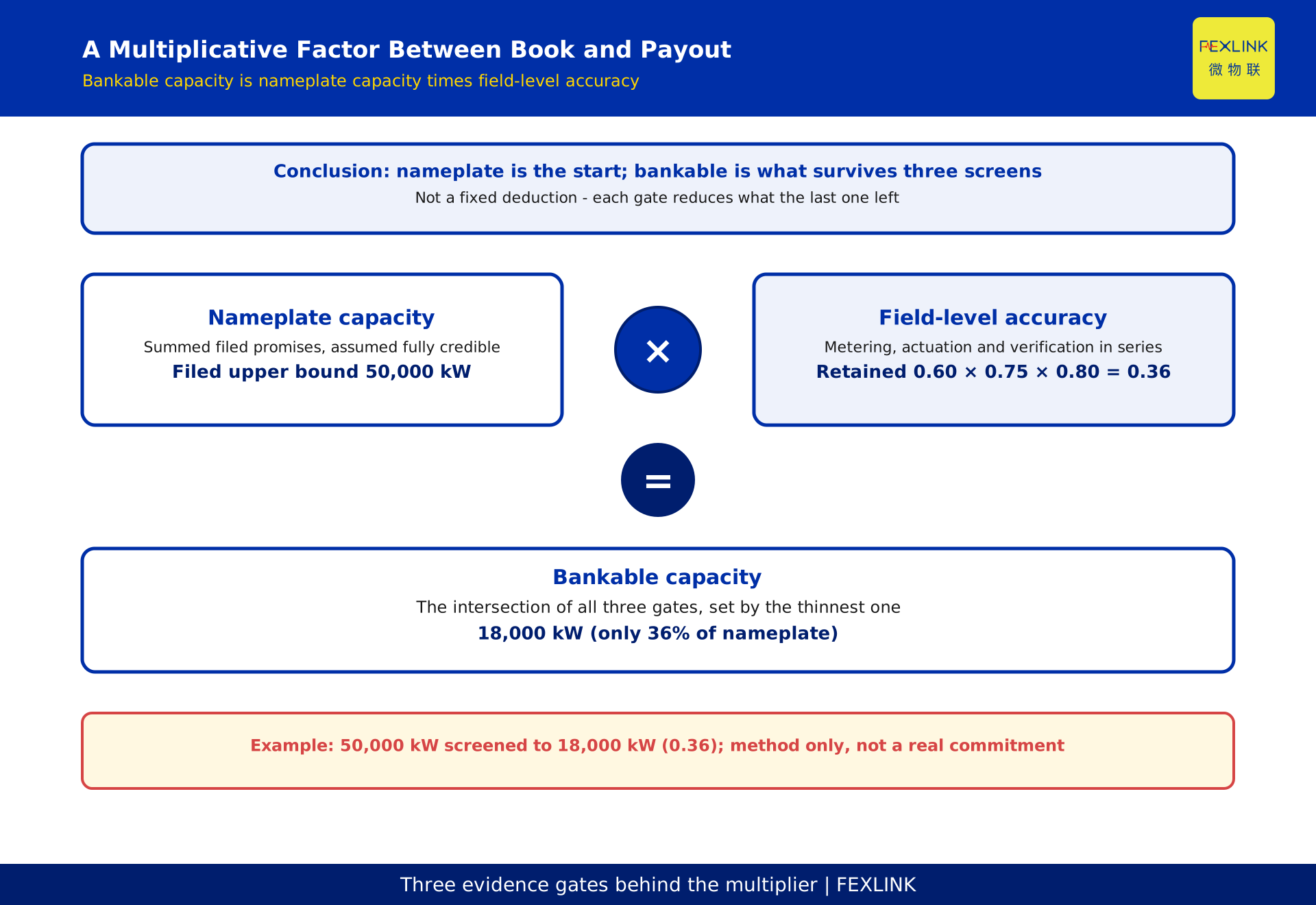
The capacity an aggregator files is nameplate capacity: the sum of what every field device says it is willing to give up when called. What actually reaches settlement is what remains after that sum has been screened by field-level accuracy. The gap between the two is not a fixed deduction but a multiplicative factor: bankable capacity equals nameplate capacity times field-level accuracy. Field-level accuracy is not the accuracy class of a meter. It is the degree to which three things hold at once - whether the power change at that device can be read independently, whether the dispatch instruction really became an action in the field, and whether the response can be reconciled with the baseline and the instruction as verifiable evidence.
Those three form a serial evidence chain: if any one is missing, that promise cannot be accepted as a whole, and the reduction applies to the trusted capacity left by the previous stage - so the factors multiply rather than subtract. Summing treats every device as fully credible; settlement recognises only what can be proved stage by stage.
This article opens up that chain: how error attenuates across aggregation layers, why verifiable data decides revenue more than device count, and where effort buys most. It cites no standard numbers or clauses and makes no compliance judgments; it gives no binding capacity, duration, frequency, ratio or granularity values for settlement, but uses one constructed example - a 50,000 kW nameplate screened at 60% / 75% / 80% to 18,000 kW bankable - purely to show the method, representing no real customer or settlement commitment; project documents and local settlement rules govern.
Nameplate capacity: summing is only the starting point
The arithmetic of nameplate capacity is plain: register how much each device is willing to yield when called, then add it up. It sets an upper bound for filing volume, building combinations and ordering dispatches. The trouble is that summing assumes every promise can be proved afterwards to the same degree.
In practice it fails. Some devices have meters but discontinuous readings; some accept remote instructions with nobody confirming the action; some actions happen yet are buried in other load movement. Summation treats them all as fully credible. Nameplate capacity is therefore a starting point in the denominator sense, not a revenue result; treating it as bankable is treating evidence gaps as zero.
Field-level accuracy: three things that must be verifiable
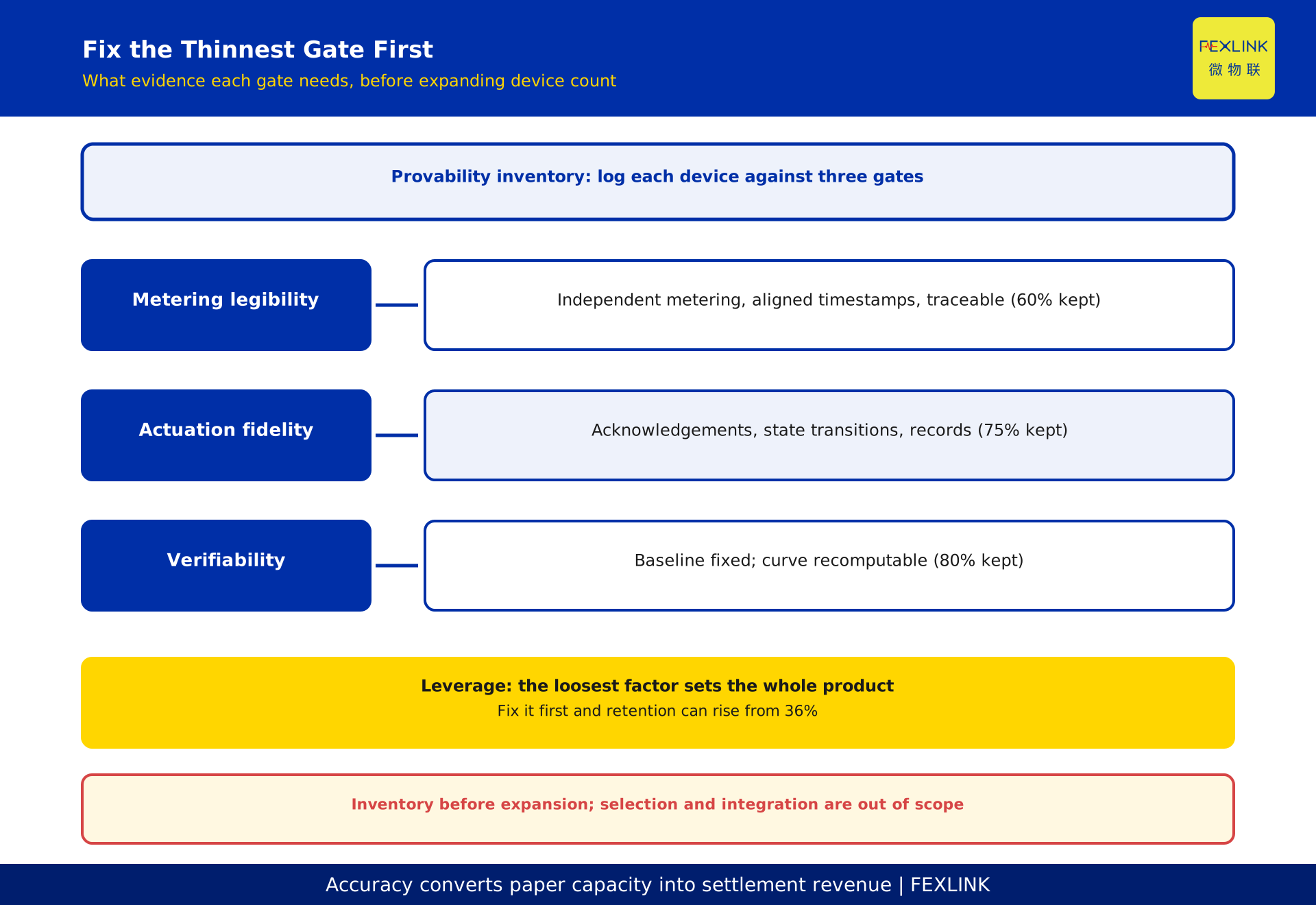
Field-level accuracy is set jointly by three verifiable quantities. Metering legibility: the power change can be measured independently at the granularity the settlement rules specify, with timestamps, a baseline-consistent boundary and no reconstructed values. Actuation fidelity: the instruction reaches the device and becomes an action, timing and magnitude match the promise, and failures, bypasses and manual overrides are identifiable. Verifiability: the curve reconciles with baseline, instruction log and raw readings without being contaminated by other loads behind the same meter to the point where attribution fails.
These are serial gates, not parallel bonus points. Incomplete readings leave a precise action without evidence; no action leaves clean readings proving only that nothing responded; with both present but attribution unresolved, the change still cannot be credited to this dispatch. The thinnest gate sets the overall accuracy.
Why it multiplies instead of subtracting
Reading the reduction as "a slice is deducted from the total" is the most common misreading. In a deduction model the gap is a fixed amount that adding more devices can refill. In a multiplicative model the gap is a ratio applied to what has already been screened once.
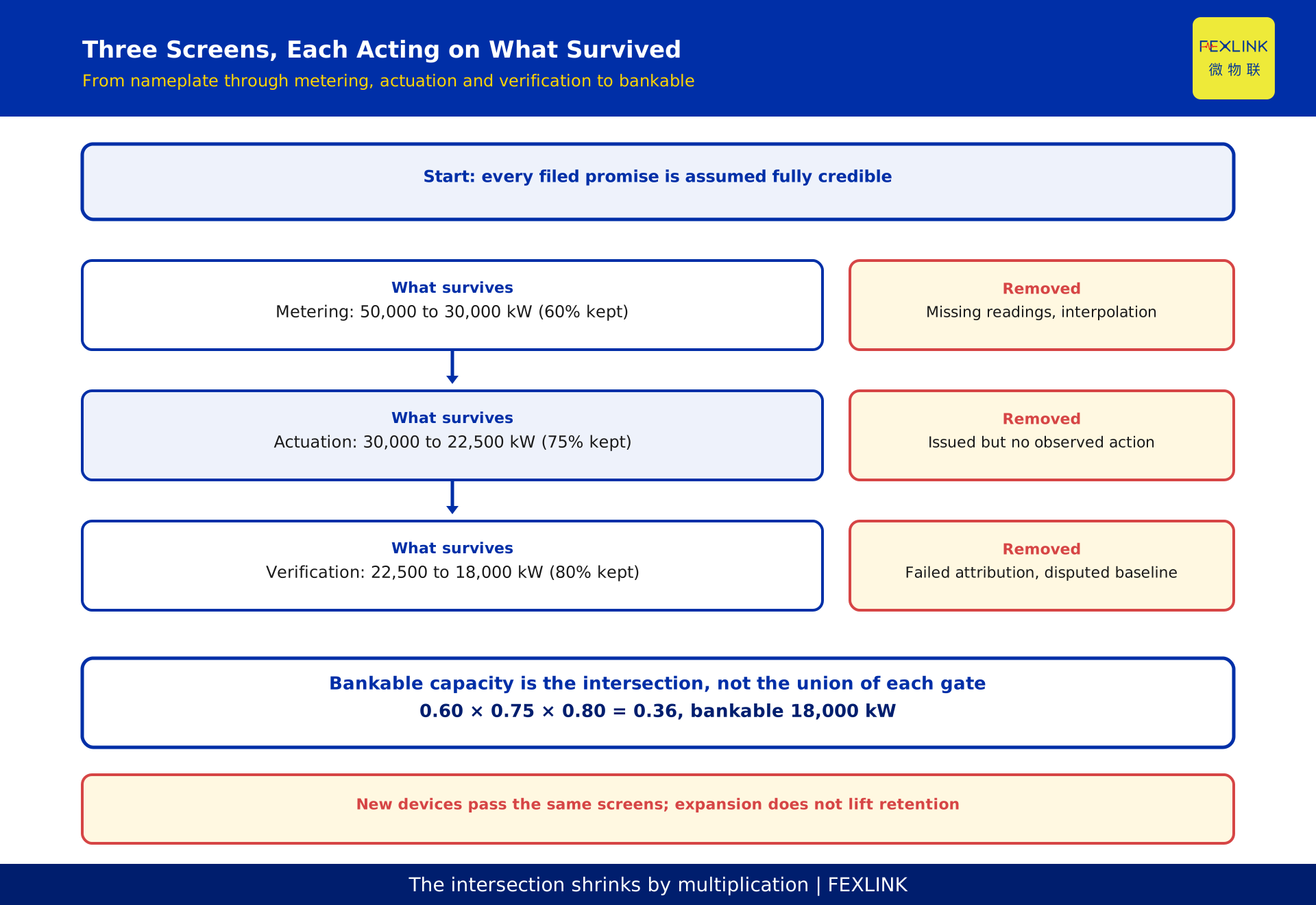
Take devices that cannot produce a complete curve at the metering gate. They are not docked a fixed number; their whole segments stay out. What remains passes the actuation gate, where another portion is excluded, and the verification gate removes a further portion. Every gate filters the intersection left by the previous one, so the survivors shrink by multiplication. As a constructed illustration only - not a real project or settlement commitment - a 50,000 kW nameplate capacity might keep 30,000 kW at the metering gate (60% retained), 22,500 kW at the actuation gate (75%) and 18,000 kW at the verification gate (80%); 0.60 × 0.75 × 0.80 = 0.36, so bankable capacity = 50,000 × 0.36 = 18,000 kW.
So "file a few more devices" cannot offset weak accuracy: new devices pass the same gates, and equally thin evidence merely scales up nameplate capacity without improving retention.
The metering gate: nothing settles unless it can be read
The point is not "is the meter accurate" but "can this change be reproduced independently". When several devices share a metering point, the aggregate curve shows only that the total moved, not which device answered. To list a device separately, its movement must be separable in the readings.
Timestamps must line up too: if instruction, action and sampling times disagree, the response start cannot be fixed and the baseline split loses its basis. A quieter failure is discontinuous readings patched by interpolation - interpolation supports analysis but is not a raw reading and cannot serve as evidence. The output here is not an attractive curve but a record traceable to original samples and recomputable by a third party under one convention.
The actuation gate: an instruction sent is not an action taken
"Instruction issued" and "the device actually changed its consumption" are different facts. Communications, controller state, local manual priority and protection interlocks can all intervene; the action may also miss the promised magnitude. This gate answers whether the device acted at all, at the right time, by enough, and without bypass or manual takeover.
Without an actuation-side record, the aggregator can only infer backwards from the overall curve, which cannot rule out other loads moving at the same moment; the response then becomes unprovable. The evidence here is modest - acknowledgements, state transitions, operating-mode records - yet it decides whether the readings can be read as "the result of this call". At the edge, the ESX intelligent edge computing gateway turns dispatch instructions into local actions and returns execution traces, while the FECB2SP smart circuit breaker performs switching and state transitions at circuit level, making "instruction reachable, action provable" concrete; selection and integration are out of scope.
The verification gate: the curve must prove itself
Verification brings three things together: the baseline convention agreed before the call, the instruction and actuation logs, and the measured curve. If they reconcile, the segment is bankable; if not, even a well-shaped curve stays unverified.
The baseline is the fragile part: how it is derived, which conditions are excluded and how anomalies are handled must be fixed before the call, or every party can afterwards pick a favourable convention and the same curve yields different answers. Attribution needs the same restraint - other loads starting or stopping, schedule changes and weather-driven cooling all stack onto the curve, so net movement cannot simply be credited as response. This gate produces a yes-or-no decision: can the volume be counted, and can the basis be recomputed under one convention.
How error attenuates up the aggregation layers
The higher the layer, the harder a loss is to recover: evidence not captured below does not appear above, and whole-bundle settlement lets the thinnest segment drag its neighbours down.
| Layer | Typical loss | Effect on bankable capacity |
|---|---|---|
| Single device | No independent metering, no action acknowledgement | The whole segment stays out of the trusted pool |
| Circuit and metering point | Several devices share a meter; movement inseparable | Only an aggregate reading exists; device promises cannot be listed |
| Site and campus | Timestamps from different sources, inconsistent baselines | Response windows cannot align across devices; comparable segments shrink |
| Resource bundle | Thin evidence chains filed as one bundle | The thinnest segment pulls down the bundle under whole-bundle accounting |
| Aggregator filing | Gaps reported as zero | Nameplate capacity inflated, retention ratio diluted further |
The table shows the direction of propagation, not a reduction coefficient per layer; actual retention is decided by field evidence.
From nameplate to bankable: the chain of successive screens
Read in reverse, that table becomes the chain from nameplate to bankable capacity. Each step removes what cannot be proved under one convention.
| Stage | What survives | What is removed |
|---|---|---|
| Nameplate summing | Every filed promise | Nothing; this is the starting point |
| Metering screen | Devices with complete readings and alignable time conventions | Segments without independent metering or patched by interpolation |
| Actuation screen | Parts with acknowledgements and action logs matching magnitude | Parts where only the issue, not the action, can be seen |
| Verification screen | Segments reconciling baseline, instruction and readings with attribution | Parts where attribution fails or the convention is arguable |
| Whole-bundle conversion | The intersection of provable parts across devices | Adjacent segments questioned under whole-bundle accounting |
The key word is intersection: however many devices are filed, what counts is the portion surviving every gate, not the union of each gate's achievements. Written into a ledger, the chain removes arguments from impression about where the money went.
Accuracy as a lever: invest in the loosest gate
Multiplication has one corollary: improving the loosest gate yields the largest marginal gain. If verification is thinnest, better meters and extra acknowledgements barely move bankable capacity, because volume is stuck on failed attribution. Fix verification and the evidence accumulated upstream is released at once.
So invest in a provability inventory before adding device count: log each device against the three gates, find the one thin across the board, fix it, then talk about expansion. The evidence chain must also share one convention and be recomputable, so a third party using the same raw readings and baseline rules reaches the same result; otherwise additions remain self-assertion. Accuracy here is not a technical indicator but the exchange rate at which paper capacity converts into settlement revenue.
Frequently asked questions (FAQ)
Q: If nameplate capacity is filed too high, does settlement just deduct a little for actual performance?
No - the rule is "unprovable means not counted", not "dock a little". A deduction model assumes a fixed gap that other devices refill; in a multiplicative model the segment leaves the pool and later gates keep filtering the remaining intersection. That is why the gap is far larger than expected.
Q: Does a high-accuracy meter at the device guarantee high field-level accuracy?
No. A meter addresses metering legibility only; whether the instruction became an action and whether the change reconciles and can be attributed are two other gates. They are serial, so the thinnest sets the whole.
Q: Can missing sampling periods be filled by interpolation and used as settlement evidence?
No. Interpolation supports analysis but is not a raw reading and cannot be recomputed under one convention. Settlement needs a record traceable to the sampling instant; missing periods are removed, not manufactured.
Q: With enough devices connected, will the errors cancel each other out?
No. Multiplicative screening produces no cancellation: new devices pass the same gates, and equally thin evidence merely scales up nameplate capacity. Worse, whole-bundle settlement lets the thinnest segment drag down its neighbours, so connecting more spreads exposure wider.
Q: On a limited budget, should we expand device count or fix accuracy first?
Fix the thinnest gate first. The loosest factor sets the whole, so repairing it releases evidence already accumulated; expanding while it stays thin means most new promises are screened out anyway. Start with a three-column provability inventory.
Scope and limitations
This article is for virtual power plant operators, aggregators and campus energy managers. It sets out the multiplicative chain from nameplate capacity through field-level accuracy to bankable capacity, the three evidence gates, the direction of error attenuation across aggregation layers, and the order in which accuracy investments pay back. It is not a checklist of untrustworthy resources, not an interpretation of acceptance values, not a guide to access conditions or equipment selection, and not an explanation of workflows or settlement rules.
It provides no capacity, duration, frequency, ratio, time-granularity, reduction-coefficient or revenue figures usable for actual settlement; the nameplate capacity, the three retention ratios and the bankable capacity in this article are a constructed example built to explain the multiplicative chain, representing no real customer and constituting no settlement commitment. Both tables illustrate stages and directions of loss only; retention must be established from field evidence, project documents and local settlement rules. No standard numbers or clauses are cited and no compliance judgment is made. The edge gateway and actuation devices in registration material appear only as roles that turn promises into actions and make changes readable; selection, integration and acceptance are out of scope. Filing, metering and settlement must be carried out by qualified personnel under project documents and local rules and reviewed independently. All deliverables remain pending review; the generator does not self-approve.
Frequently Asked Questions
Why Bankable Capacity Equals Nameplate Capacity Times
The capacity an aggregator files is nameplate capacity: the sum of what every field device says it is willing to give up when called