 FEXLINK Research Institute
The short answer
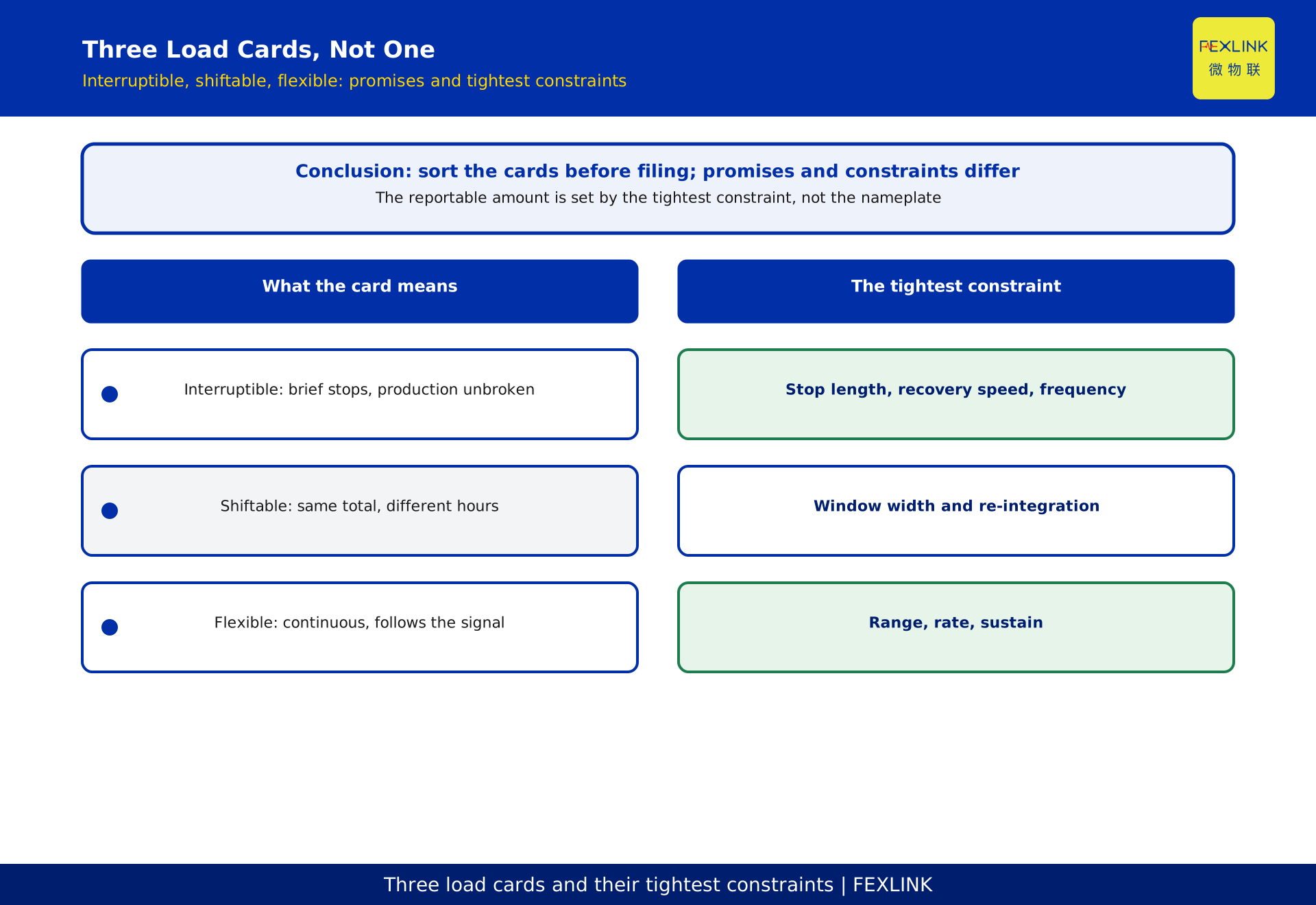
"Flexible load" in a resource filing is really three different cards. Interruptible loads can be switched off directly for a short period without hurting continuous production—an air compressor with receiver headroom, for example. Shiftable loads keep total consumption unchanged but move it in time—storage charging, load-shiftable process steps. Flexible (continuously adjustable) loads modulate smoothly against a signal—such as a small adjustment of air-conditioning setpoints.
The three cards carry different constraints and are assessed differently. Mixing them leads to one of two outcomes: over-reporting, where the dispatch instruction cannot actually be followed and the response is judged non-compliant; or under-reporting, where real resources sit unused and every settlement pays less. So the first step of filing is not estimating capacity—it is telling the three cards apart.
This article defines the conceptual boundaries and filing logic of the three load types, for facility and plant energy managers and demand-response participants. It cites no standard numbers or clause numbers, makes no compliance judgments, and gives no figures for capacity, duration, frequency or ratios; process verification and project documents govern.
Why the cards must not be mixed
One example makes the difference concrete. Take air conditioning: nudging the temperature setpoint is continuous, smooth modulation; switching the whole circuit off briefly is interruption; pre-cooling to move consumption into off-peak hours is shifting. The same piece of equipment holds different cards under different control schemes, and each card supports a different promise—being able to modulate does not mean being able to black out, and being shiftable does not mean being switchable at will.
The costs of mixing are asymmetric. Over-reporting (filing modulation as interruption) fails when dispatch calls and the promised response cannot be delivered—credibility and future invitations suffer. Under-reporting (treating buffered loads as rigid) shrinks the filed resource and loses revenue in every settlement round. Both errors share one root: replacing the question "which card is this, and what are its constraints" with the impression "this device seems flexible."
Interruptible: switched off briefly, production unbroken
An interruptible load can be switched off directly for a short period without affecting continuous production or product quality, and the process resumes automatically when power returns. The classic case is an air compressor with receiver headroom—stopped for a few minutes, the network pressure stays within its safe band. Similar candidates include certain fans, pumps and pausable auxiliary equipment.
The constraints concentrate in three places: how long one interruption can last (set by the buffer), how quickly the load can recover, and how many times it can stop within one response. One line is never crossed: anything touching process or personnel safety is not interruptible, no matter how large the buffer. When filing, the tightest constraint—not the nameplate rating—determines the reportable amount.
Shiftable: same total, different hours
A shiftable load keeps its total energy unchanged but can move its consumption window. Storage charging is the clean example—when it charges is purely an operating decision. Thermal storage pre-runs and carries cooling or heat into peak hours; shiftable process steps move batches out of the peak window.
Constraints concentrate on window width and re-integration: how large a time window can be bridged, how the capacity gap in the original hours is filled, and how many shifts per day are realistic. The essential promise of shifting is "made up afterwards"—what moves is time, not energy. That is the fundamental difference from interruption, taken up next.
Flexible: continuous, smooth, following the signal
A flexible load can modulate its power continuously and smoothly within a band, following small up-and-down instructions without stopping or starting equipment. The typical case is setpoint modulation in air-conditioning group control: the setpoint moves a little, the power follows, and the workshop barely notices. Continuous adjustment of variable-frequency drives within their allowed band belongs here as well.
Constraints concentrate on range, rate and sustain: how wide the adjustable band is, how fast the load follows the signal, and how long the state can be held. The value of flexibility is smoothness—aggregated, it fills in the sawtooth of other resources and makes the whole portfolio's output curve believable.
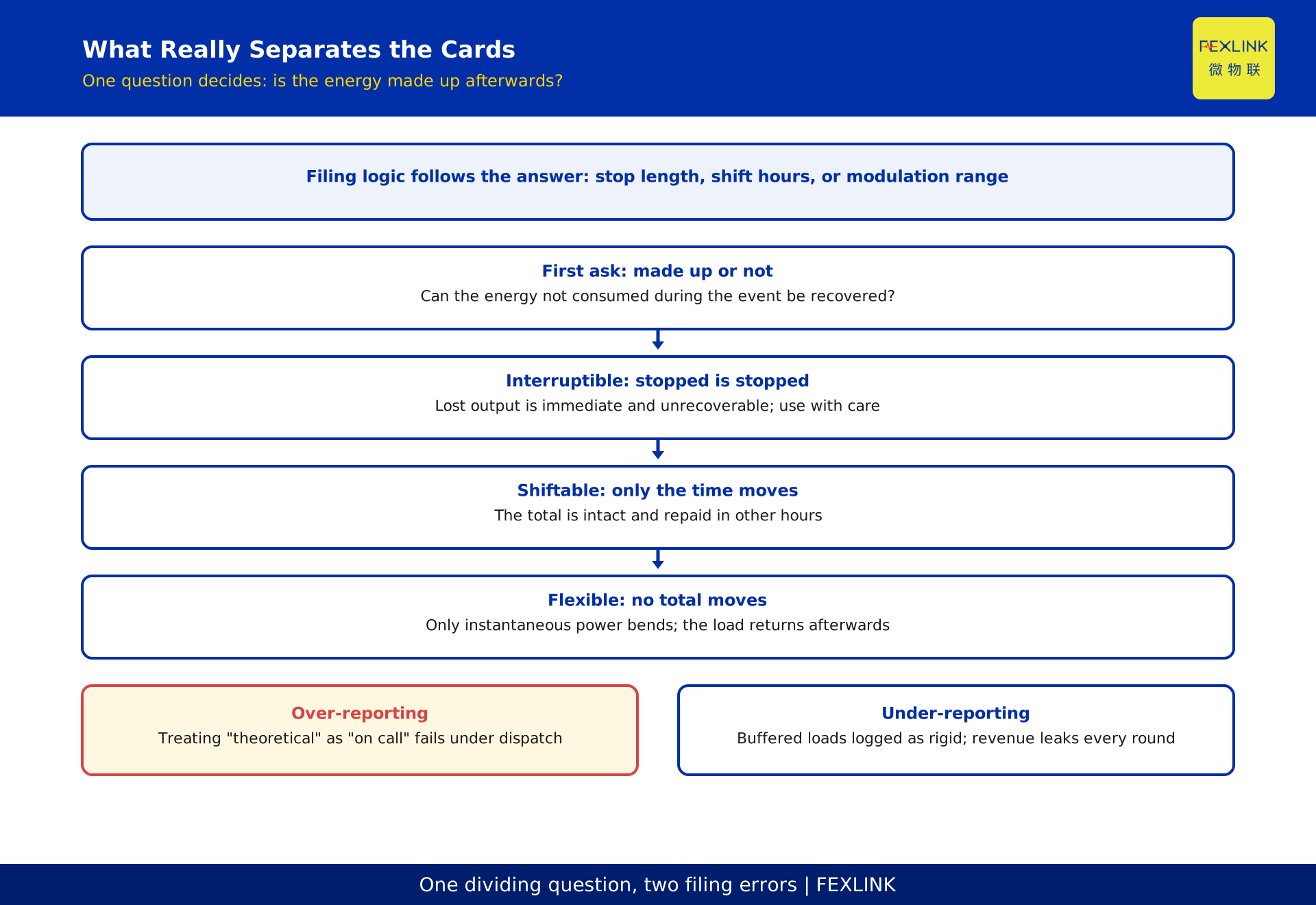
The essential difference: is the energy made up?
The three cards split on a single question: can the energy not consumed during the event be made up afterwards? Interruption is "stopped is stopped"—the lost output is immediate and unrecoverable, which is why it is the most expensive and most cautiously used card. Shifting is "only the time moves"—the total is intact and repaid in other hours. Modulation moves no total at all: only the instantaneous power bends, and the load returns to its original state when the event ends.
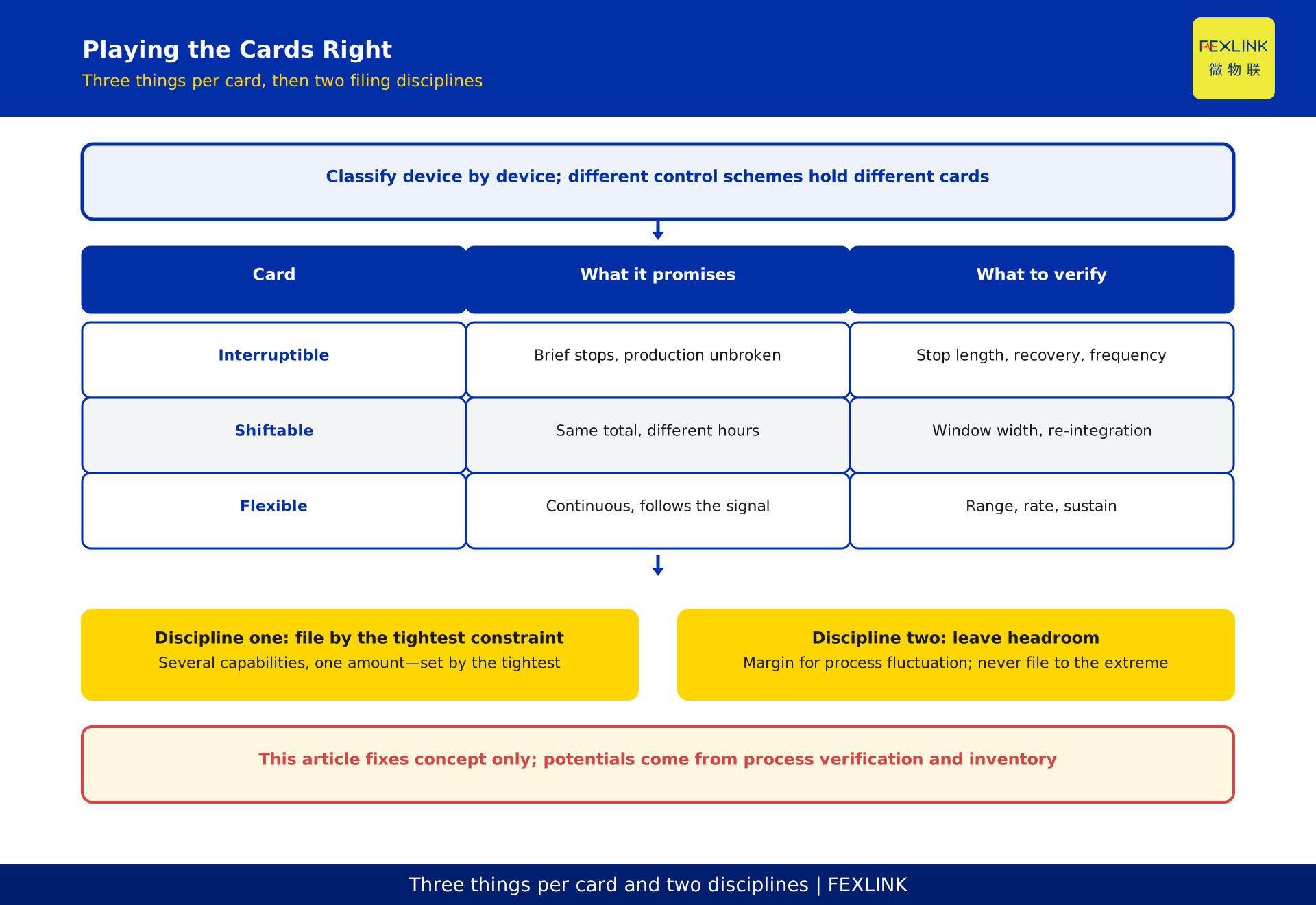
The filing logic follows directly: interruptible is verified by "how long can it stop and what does it cost," shiftable by "how many hours can it move and how is it repaid," flexible by "how wide, how fast, how long." Reporting all three on one form with one indicator set is exactly where mixed filings go wrong.
Impact on production continuity: three grades
From the production side, the three cards map to three grades of impact. Grade one, imperceptible: flexible modulation and well-buffered shifting pass unnoticed on the line. Grade two, schedulable: interruption and wide-window shifts must be planned into production scheduling—a batch moved out of the peak, a device stopped in a non-critical period. Grade three, costly: interruption beyond the buffer produces real losses in output or quality.
The grades exist to draw the filing line: report grade one and grade two (once built into the schedule); never put grade three on the resource list. Holding this line is what builds dispatchers' and aggregators' trust in the resource.
Which loads hold which card: a mapping table
Positioning common plant loads on the three cards (the same device may fall in different cells under different control schemes):
| Common load | Typical card | Why |
|---|---|---|
| Storage charging | Shiftable | Charging time is purely an operating decision |
| Thermal storage | Shiftable | Pre-runs and carries cooling or heat into peaks |
| Shiftable process steps | Shiftable | Batches can move out of the peak window |
| A/C (setpoint modulation) | Flexible | Power follows the setpoint continuously |
| Air compressor (with headroom) | Interruptible | Brief stops do not break network pressure |
| Dispatchable EV charging | Shiftable | Session time and power can be arranged |
| Continuous process core | Mostly inflexible | Stops are losses; buffer is minimal |
The table answers only "which card conceptually." How much each category can actually flex, and for how long, depends on the specific process and equipment state—that is the job of a resource inventory, covered in a dedicated article; this article gives no potential figures.
Over- and under-reporting: the 2 most common filing errors
Over-reporting: treating "theoretically flexible" as "available on call"—ignoring buffer, recovery time and frequency limits, and filing by nameplate rating. When the dispatch instruction arrives, the response cannot be delivered; the round is judged non-compliant and future invitations are at risk.
Under-reporting: treating buffered loads as rigid—systems that could pre-cool are logged as must-run-on-demand; compressors with receiver headroom are left off the list. Revenue leaks in every settlement round.
Two filing disciplines follow. File by the tightest constraint: when one device holds several capabilities, the reportable amount is set by the tightest one—be conservative. Leave headroom in duration and frequency: do not file to the extreme state; leave margin for process fluctuation.
From classification to filing: three steps to play the cards right
Step one, classify device by device: assign each candidate to a card by definition, register different control schemes of the same device separately, and never lump them together. Step two, verify three things: adjustable power, sustainable duration and recovery time—the base numbers behind any filing; how they are measured and accepted belongs to a dedicated article. Step three, keep records and re-verify: the basis of classification, the verification process and the filing version must be documented, and re-verified after equipment or process changes.
Actuation equipment plays the "can actually stop, can actually modulate" role in this chain—smart breakers and similar devices turn paper flexibility into executable instructions; selection and integration are out of scope here. Complete the three steps and the three cards are truly in hand—the filed quantities will stand up to dispatch.
Frequently asked questions (FAQ)
Q: Is air conditioning interruptible or flexible?
It depends on the control scheme: setpoint modulation is flexible; switching the whole circuit off briefly is interruptible. One unit may hold both—file by the tighter constraint and do not stack the amounts.
Q: Is "curtailable" the same as flexible?
No. Curtailment is a one-off reduction or stop; flexibility is continuous, smooth following of a signal. The curtailment card has its own dedicated treatment and is not covered here.
Q: What happens if interruptible loads are filed as shiftable?
Shiftable promises "made up afterwards"; interruption cannot keep that promise. When dispatch treats it as shiftable, the recovery commitment fails—the round is non-compliant at best, and the credibility of the whole portfolio suffers at worst.
Q: Does a continuous production line hold no cards at all?
The core process mostly cannot move, but auxiliary steps often do: compressed air, chilling and pumping frequently carry buffer and qualify as interruptible or shiftable. Cards are found device by device, not by verdict on the whole line.
Q: Can the three types be bundled into one filing?
Aggregation can combine them, but only after each item is classified on its own. Mixed filings let the most uncertain item drag down the credibility of the whole bundle—and settlement and assessment apply to the bundle as a whole.
Scope and limitations
This article is written for facility and plant energy managers and demand-response participants. It provides the conceptual boundaries of interruptible, shiftable and flexible loads and the filing logic that follows; it is not a resource-inventory method, a dispatch-modeling note, or an interpretation of filing acceptance indicators—each belongs to dedicated articles.
It contains no flexibility-potential figures for specific load categories, and gives no values for adjustable power, duration, frequency or recovery time; process verification, equipment manuals and project documents govern. The mapping table is a conceptual illustration only; actual classification must be verified device by device. The article cites no standard numbers or clause numbers and makes no compliance judgments. Actual filing and execution must be carried out by qualified personnel under project documents and local rules; selection, integration and acceptance of actuation equipment belong to dedicated articles.
Frequently Asked Questions
Interruptible, Shiftable, and Flexible Loads
"Flexible load" in a resource filing is really three different cards