 FEXLINK Research Institute
The short answer
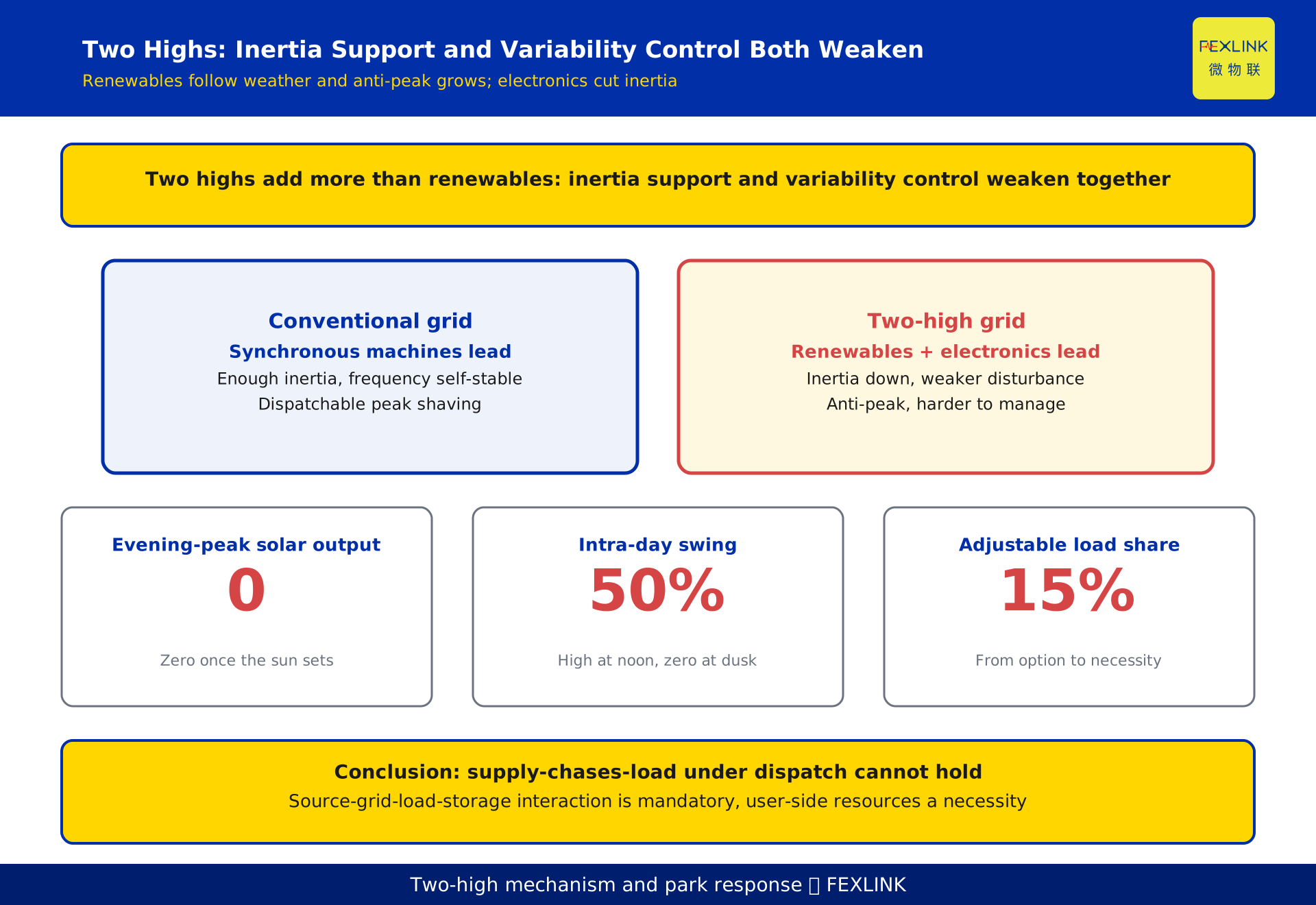
The "two highs" repeated in every discussion of the new power system are high renewable penetration and high power-electronics penetration. A conventional grid leans on synchronous machines for inertia and on dispatchable units for peak shaving; under the two highs both props fail at once. Renewable output follows the weather, so variability and anti-peak behaviour intensify, while power-electronic interfaces add no mechanical inertia and weaken disturbance resistance. The conclusion is blunt: the old model where supply chases load under central dispatch can no longer hold. The fix is source-grid-load-storage interaction, with user-side adjustable resources promoted from an option to a necessity.
1. What the "two highs" actually means
"Two highs" is shorthand for two structural features of the new power system. The first high is a high share of renewable energy: wind and solar, the uncontrollable sources, keep climbing as a portion of the generation mix. The second high is a high share of power-electronic equipment: renewable inverters, flexible DC links, storage converters and the many rectifiers on the consumption side increasingly replace the rotating-machine interfaces of the past. The two highs do not change a single metric; they change the most fundamental physical support of the system.
2. High renewable share: output now depends on the weather
In a conventional fleet, coal, gas and hydro units adjust output on demand and are called dispatchable. Renewables are the opposite: wind speed and irradiance are set by the weather, not by the plant operator. The system net load, total demand minus renewable output, therefore shifts from a predictable human-shaped curve to a random curve with weather noise folded in. The same forecasting and reserve methods now face uncertainty that must be covered either by extra reserves, which is expensive, or by larger real-time deviations, which is risky.
3. Anti-peak: renewables peak when demand is low
The harder problem is anti-peak behaviour. Load has a midday peak and an evening peak, yet solar output peaks at noon and falls to zero at sunset, while wind is often strongest at night, exactly when demand is slack. The result is inverted: when demand needs power most, renewables supply least; when demand is quietest, renewables push hardest. This reverses the old peak-shaving logic. Where dispatchable units used to fill valleys and trim peaks, a large uncontrollable component that is strong at noon and zero at dusk now eats into the peak-shaving margin.
4. High power-electronics share: where inertia comes from and how it is lost
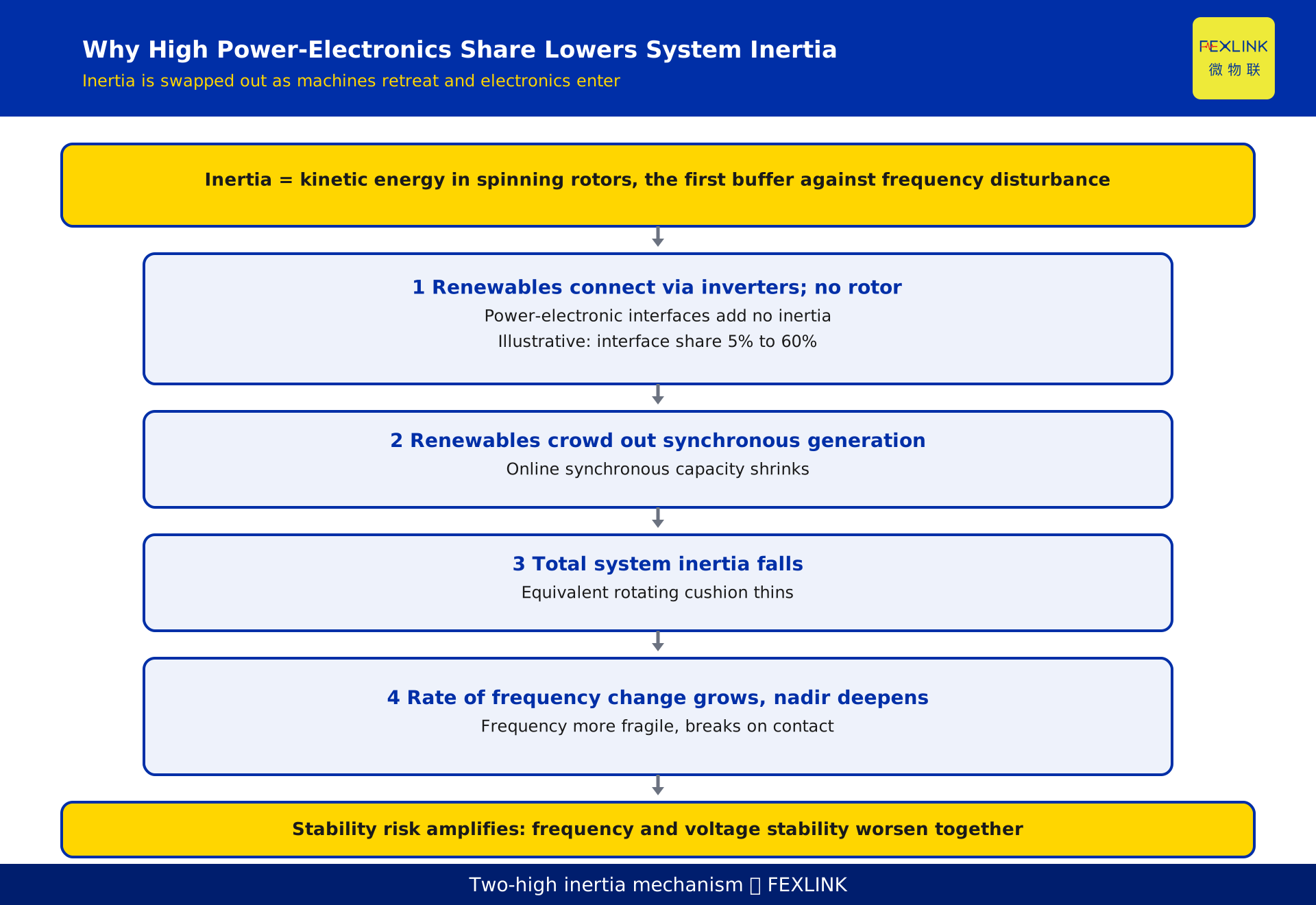
Rotating inertia is the kinetic energy stored in the spinning rotors of synchronous generators; it is the first buffer against frequency disturbances. In a conventional grid many synchronous machines spin together, and any power deficit is first absorbed by this rotating flywheel before frequency can plunge. Under the two highs, renewables connect through inverters that have no mechanical rotor and contribute no rotating inertia, while at the same time renewables crowd out synchronous generation and shrink the online synchronous capacity. The two effects stack, and total system inertia falls while the equivalent mechanical cushion thins.
As an illustration for one regional grid, the share of power-electronic interface power in total installed capacity might rise from below 5% in the conventional era to around 60% in scale. This is only to show the trend and represents no real grid. Nothing broke; the system simply had its weight swapped out.
5. Why lower inertia makes frequency and voltage more fragile
The direct consequence of lower inertia is a larger rate of change of frequency after a disturbance, a deeper frequency nadir and a slower return to steady state. Scenarios where primary frequency response once coped comfortably can now break down on contact. Voltage behaves the same way: power-electronic interfaces support fault current far less strongly than synchronous machines, so voltage support during a fault is weaker and the risk of low-voltage disconnection rises. Both frequency stability and voltage stability are amplified together under the two highs. The exact safety margin follows current standards and on-site measurement; this article gives no fixed limit.
6. Why the old dispatch logic breaks under the two highs
Put the two highs together and the old dispatch logic fails in at least three places. First, forecasting fails: weather noise folded into net load turns forecast error from a statistical tail into a structural one. Second, balancing fails: the old one-way balance of supply chasing load becomes a two-sided fluctuation of both source and load that demands two-way regulation. Third, stability fails: once inertia thins, the few seconds once covered by inertia must now be won by fast control strategies. The common thread is that the system moved from slow and controllable to fast and uncertain, while the control rhythm was designed for the former.
7. Why user-side flexible resources moved from nice-to-have to must-have
User-side interruptible load, storage and flexible load used to be bonus items for peak shaving and subsidies. Under the two highs they become genuine buffers for system balance. The reasoning is direct: when the supply side itself starts to fluctuate and system inertia thins, the fastest relief is not another power station but the adjustable slice on the demand side, charged more in valleys, used less in peaks, and dropped instantly under disturbance. User-side resources sit closest to the load and respond fastest, making them the most cost-effective form of virtual inertia and virtual reserve. The move from bonus to necessity is imposed by the physical constraint of the two highs.
8. What the two highs mean for a park's daily energy behaviour
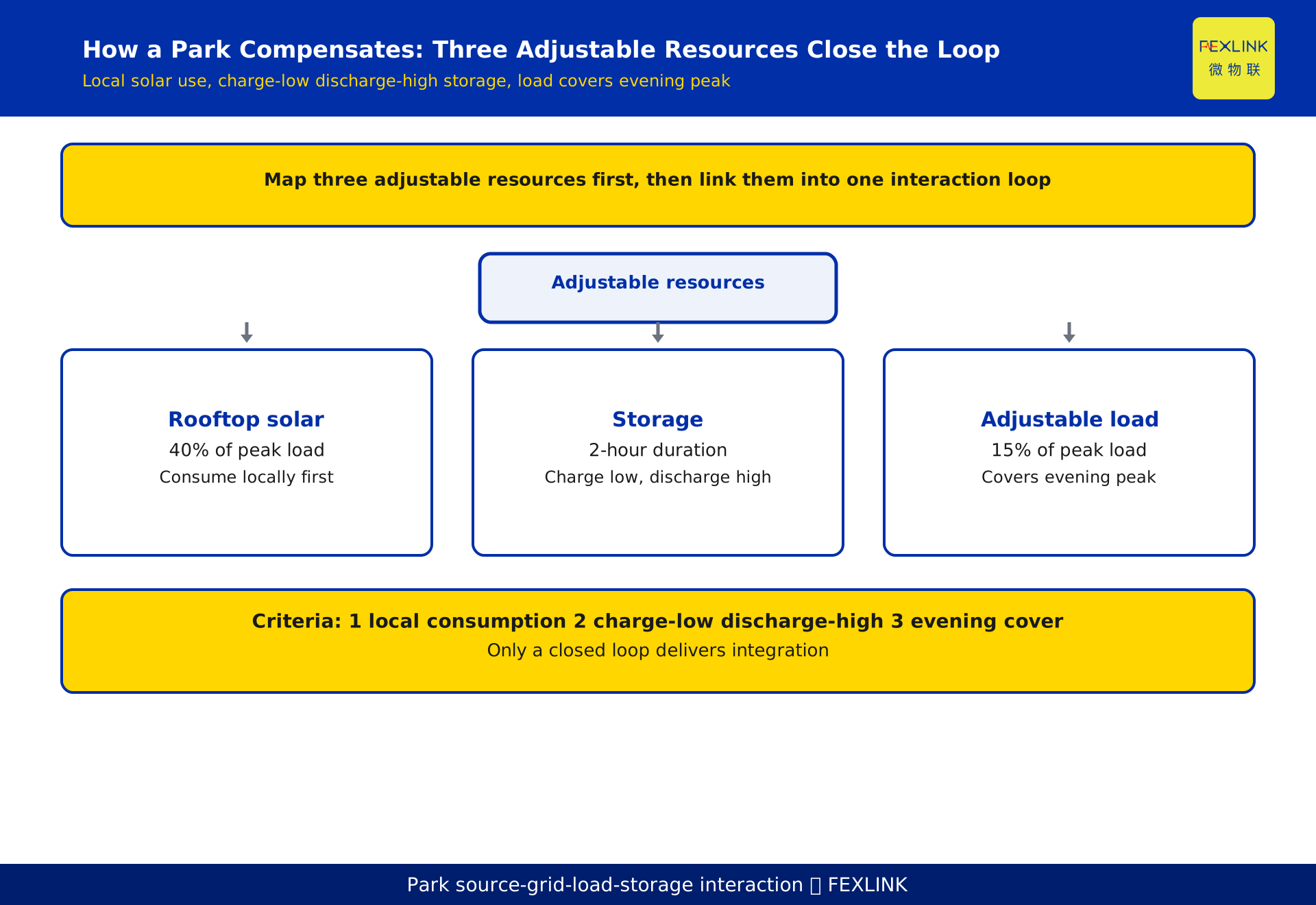
At the level of an industrial park the two highs are not abstract; they translate into concrete actions. First, rooftop solar should be consumed locally first, shifting air conditioning, charging piles and production scheduling toward midday when output is strongest, so that every avoided grid purchase counts. Second, storage should charge low and discharge high, turning the uncontrollable anti-peak swing into a dispatchable resource. Third, interruptible and shiftable load should enter unified dispatch so the demand side covers the evening peak once solar falls to zero. These three types of adjustable resource are each simple on their own; the hard part is linking them into one source-grid-load-storage interaction loop instead of running them in isolation. The first prerequisite for closing that loop is that the system can actually "see" every dispatchable resource—measuring the energy, voltage and current of key circuits, for example with the FEXLINK ESA full-element smart meter—so coordinated dispatch has a reliable data foundation.
9. An anonymised illustrative scenario: a park's two-high balance sheet
The following is a constructed scenario for explaining the mechanism and represents no real customer or project. A park has a peak load of 10 MW and rooftop distributed solar of 4 MW, or 40% of peak load. On a typical sunny day the solar output rises from zero at dawn, peaks near nameplate at midday and returns to zero at dusk, with a daily swing of about 50%, while the evening peak sees solar contributing close to 0. The park has about 1.5 MW of load that can be interrupted or shifted, or 15% of peak load, plus a 2-hour storage system. Before the upgrade the evening peak was covered by the grid; after it, midday solar is consumed locally, storage charges low and discharges high, and adjustable load covers about 15% of the evening peak. These figures only show why interaction is mandatory under the two highs; all capacities, shares and configurations are illustrative and must be replaced by site survey and measurement.
10. Frequently Asked Questions (FAQ)
Q: What exactly changes under the two highs, and how is it different from a conventional grid?
The difference is that the physical support of the system is weakened. A conventional grid relies on synchronous machines for inertia and dispatchable peak shaving; under the two highs renewable output follows the weather and power-electronic interfaces add no mechanical inertia, so variability, anti-peak behaviour and insufficient inertia appear together. No single device failed; the underlying balance changed.
Q: Does falling inertia mean blackouts are inevitable?
No. Lower inertia makes frequency and voltage more fragile and lets frequency fall faster and deeper after a disturbance, but it does not mean immediate instability. The system still has primary and secondary frequency response and voltage support to fall back on; only the old safety margin is thinner. How much it can actually withstand follows current standards and on-site measurement, and this article gives no fixed limit.
Q: Can user-side resources really make up for lost inertia?
Strictly speaking they supply equivalent buffering, not mechanical inertia itself. Storage and controllable load can inject or shed power in an instant during a disturbance, acting as the same first buffer inertia would, which is why they are often called virtual inertia. They respond fast and sit close to the load, making them the most cost-effective buffer, but they do not fully replace synchronous machines.
Q: Does installing solar and storage automatically deliver source-grid-load-storage integration?
No. Solar and storage are hardware; integration is the closed loop that coordinates source, grid, load and storage under one dispatch logic. Equipment that runs in isolation, with midday consumption, evening cover and storage cycling uncoordinated, still fails to solve anti-peak and inertia shortage. The key is the dispatch logic, not the equipment list.
Q: Where should our park start?
Start with two visible steps: first give rooftop solar local consumption priority in midday energy use, and second map out interruptible and shiftable load and bring it into evening-peak dispatch. Neither needs heavy investment; get the adjustable slice on the demand side working first, then consider storage expansion. Specific criteria and configuration follow site survey and measurement.
Scope and limitations
- The two-high mechanisms discussed here, renewable variability, anti-peak behaviour, inertia loss from power-electronic interfaces and frequency or voltage stability risk, apply to discussions of the new power system on an AC synchronous grid. Inertia and stability on DC islands or off-grid microgrids are out of scope.
- All capacities, shares and configurations in this article, peak load 10 MW, solar 4 MW at 40%, daily swing 50%, adjustable load 15%, 2-hour storage, power-electronic interface 5% to 60%, are illustrative figures constructed to explain the mechanism, represent no real customer, project or grid, and must be replaced by site survey and measurement.
- Quantitative indicators such as frequency deviation limits, inertia constants and voltage support capability follow current effective standards and on-site measurement. This article gives no fixed limit and cites no standard number for conformity judgement.
- The associated product, the ESA all-element smart meter, is used for circuit-level metering in parks and appears in full name on first mention; its model, accuracy class and parameters follow the latest selection manual and product knowledge base, and this article is not a selection or procurement recommendation.
- This article is technical-mechanism exposition, not engineering design or acceptance basis; any source-grid-load-storage configuration or dispatch strategy must be calculated on site by qualified organisations and personnel.
Frequently Asked Questions
What Actually Changes in a "Two-High" Power System
The "two highs" repeated in every discussion of the new power system are high renewable penetration and high power-electronics penetration