 FEXLINK Research Institute
The short answer
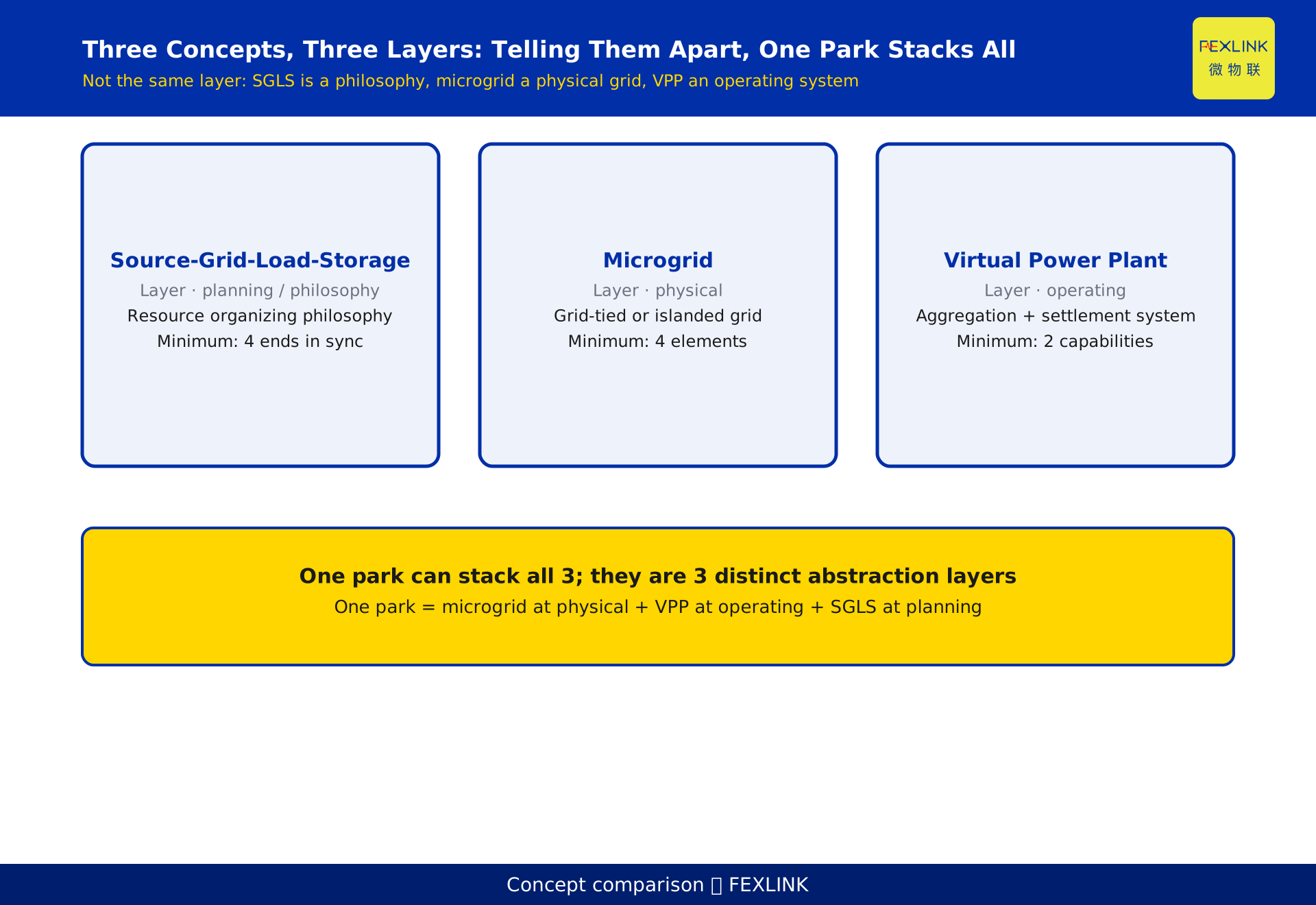
In proposal decks the three terms "Source-Grid-Load-Storage (SGLS), Microgrid, and Virtual Power Plant (VPP)" are used interchangeably because they live on three different abstraction layers. SGLS is a *resource-organizing philosophy*; a microgrid is a *physical grid that can run grid-connected or islanded*; a VPP is an *operating system that aggregates distributed resources to respond and trade externally*. One park can stack all three at once — build the microgrid at the physical layer, join the VPP at the operating layer, and organize resources under SGLS at the planning layer. Pick by goal: choose a microgrid for reliability, a VPP for extra revenue, SGLS for renewable absorption.
1. Why the three terms keep getting mixed up
The owner's pain is real. On the same plot of land, with the same solar and storage, one deck calls it an "SGLS demonstration", another a "microgrid", and a third a "virtual power plant" — and the owner cannot tell which one they are actually being asked to build. The root cause is that the three terms sit on different abstraction layers yet are repackaged by different vendors as if they were rivals.
They are not rivals. SGLS is a philosophy of *how to organize resources*; a microgrid is a *self-governing physical grid*; a VPP is an *operating system for earning or guaranteeing supply externally*. Putting them on one comparison sheet and ranking them is like asking "should I buy a car, get a driver's license, or join a fleet" — the answer is not one-of-three, it is three things you can own together.
2. Three definitions first: they are not on the same layer
Lay them out on an abstraction axis:
- Planning / philosophy layer — SGLS: answers "how should resources be organized". A methodology, with no physical boundary.
- Physical layer — Microgrid: answers "where does power come from and go, and what happens on outage". A real, local grid that can run connected or islanded.
- Operating layer — VPP: answers "how do these resources become one tradable external entity". An aggregation-and-settlement operating system.
All three can stack vertically in one park: planning sets direction, the physical layer secures reliability, the operating layer monetizes or guarantees supply on the market. The sections below spell out the minimum conditions for each.
3. SGLS: a resource-organizing philosophy (not an entity)
SGLS stresses coordination across four ends — source, grid, load, storage. The source side is local generation such as distributed PV and wind; the grid side is the distribution or microgrid pathway; the load side is the adjustable demand; the storage side is energy storage. Its essence is managing these four resource types under one coordinated objective, not building one specific facility.
Its minimum condition is: the park has both "source-side resources" and "adjustable load-side resources", and is willing to schedule them toward a coordinated goal. Note that SGLS is not a physical engineering entity with a boundary — you would never point at a switch room and say "that is SGLS". It is more like an organizing logic on a planning drawing: when renewables over-generate, consume locally; when load peaks, let storage and controllable load step in to lift self-consumption.
This statement follows the general framing in public materials and the new power-system planning context; it is industry consensus at the methodology level.
4. Microgrid: a physical grid that runs grid-connected or islanded
A microgrid is a real, local grid. Its minimum condition has four elements: a local controllable source (e.g. PV, diesel/gas unit), storage, critical load, and a local energy-management controller. Only when all four are present does a microgrid "stand up".
Its defining physical boundary is "grid-connected / islanded". The same local source and storage can run tied to the main grid, and can switch to islanded operation after a main-grid outage to keep critical loads supplied. This switching ability — two operating states, grid-tied and islanded — is what separates a microgrid from an ordinary distributed plant. A plain distributed plant stops when the grid stops; a microgrid cuts to island and keeps running its critical load on its own.
One caveat: the specific switching-time target (seconds or milliseconds) depends on load class and design intent; this article gives no fixed threshold and defers to site design and current codes. The "dual grid-tied / islanded operating state" boundary itself rests on the common definition of a microgrid, which is public material and industry consensus.
5. VPP: an aggregation-plus-settlement operating system
A VPP does not touch the physical grid; it is an operating system. It has two hard capability gates:
- Aggregation: pull geographically scattered distributed sources, storage, and adjustable loads into one externally dispatchable whole;
- Settlement: that whole can deliver externally a metered, verifiable, settleable power product (energy or capacity) and genuinely earn in the market or ancillary services.
Drop either gate and it is not a real VPP. Aggregation without settlement is just a monitoring screen; settlement without aggregation is just a power-sales contract. The value of a VPP is turning a pile of "fragmented, uncontrollable" resources into one "externally tidy, deliverable" market entity.
This gate follows the general market rule that resources must first be aggregated and must deliver in a metered, settleable way — public material and industry consensus.
6. One topology: how the boundaries converge on one park
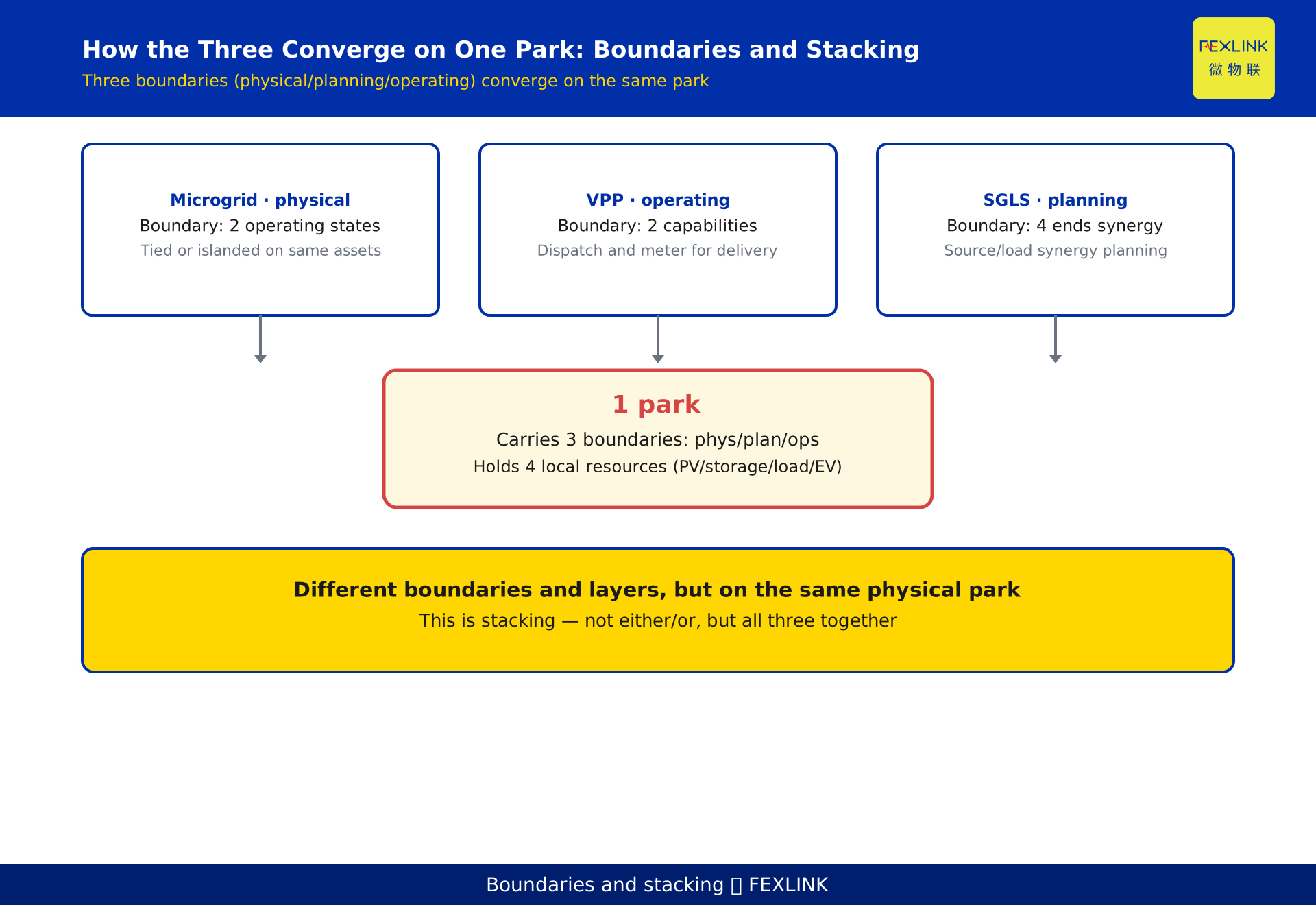
Stack the three onto one park and the logic becomes clear. A constructed example (figures chosen to show stacking, not a real customer): a park has 4 MW PV, 2 MW storage, and 12 MW adjustable load.
- Physical layer: the assets are wired by one microgrid — normally grid-tied, islanded on fault, keeping the park powered.
- Operating layer: the same PV, storage, and adjustable load are aggregated by a VPP — normally in demand response or the market, and on fault they become a settleable reliability resource.
- Planning layer: organized under SGLS — absorb PV locally when it over-generates, let storage and controllable load cover peaks, raising renewable self-use.
Same assets, three viewpoints. That is "stacking": not building three separate things, but one physical asset used simultaneously by three layers of logic — physical, operating, planning. The increment of this article is exactly this — clarifying the boundaries of the three concepts and how they stack — rather than deep-diving any single one.
7. When they stack, how does the edge land
When microgrid, VPP, and SGLS stack in one park, the edge must be able to "decide for itself". This is where the ESX Intelligent Edge Computing Gateway fits naturally:
- Local cache: on communication loss, data lands locally first, expandable on demand, normally 15 days, then back-fills when the link returns, so the VPP's settlement data is never lost;
- Programmable alarm and interlock logic: via Mistudio ladder diagrams with 300+ instructions, safety interlocks such as "grid-tied / islanded switching" and "critical-load priority supply" are written to the edge, so the site self-governs even if the master station drops;
- Store-and-forward completion: it back-fills the communication gap, keeping aggregation and settlement ledgers reconciled.
It closes the edge loop together with the CX Industrial Wristband and the Mistudio Programmable Logic Control Software. The gateway's dimensions, current, and price are not detailed here; refer to the latest selection manual. The point: the edge owns "autonomy and fidelity", the upper layer owns "aggregation and settlement" — that division of labor is the technical foundation that lets the three stack safely.
8. Choose by goal: reliability to microgrid, revenue to VPP, absorption to SGLS
Give clear criteria, no hedging:
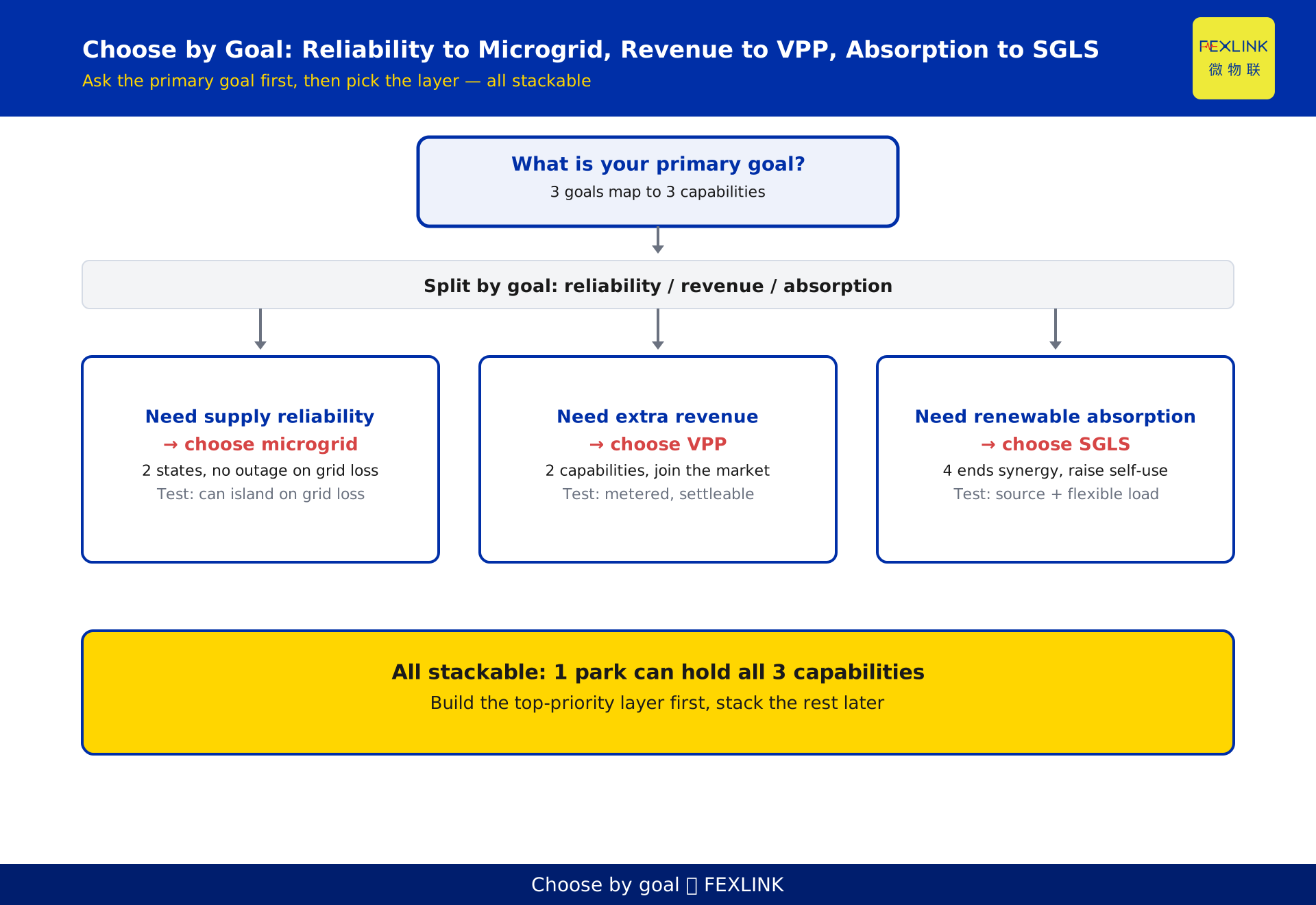
- Primary goal is supply reliability → choose a microgrid. Test: on main-grid fault, can the park run islanded and keep critical load supplied? If yes, build the microgrid.
- Primary goal is extra revenue or market-based reliability → choose a VPP. Test: do you have resources that can be aggregated and metered/settled externally (adjustable load, storage, distributed generation)? If yes, join the VPP.
- Primary goal is high renewable absorption and lower imported power → choose SGLS. Test: do you have source-side generation and adjustable load, and will you organize them under a coordinated goal? If yes, plan under SGLS.
Most parks want all three; only the build priority differs: reliability is the floor (microgrid first), revenue is the increment (VPP next), absorption is the long-run optimization (SGLS last). Stacked, one park holds all three capabilities.
9. Common misconceptions (and how this differs from KD-0538)
- Myth 1: the three are either/or. Wrong. One park can stack all three; only the layers differ.
- Myth 2: a microgrid is a small power plant. Wrong. A microgrid's essence is the boundary ability of "grid-tied / islanded autonomy", not its generation size.
- Myth 3: a VPP equals a microgrid. Wrong. A microgrid is a physical grid; a VPP is an operating system — one governs "how power flows", the other "how resources deliver externally".
- Myth 4: SGLS is a device. Wrong. It is a resource-organizing philosophy; its footprint is planning and dispatch logic.
Distinction from KD-0538 (What is a Virtual Power Plant, numeric id 538): KD-0538 focuses on the VPP operating loop (aggregate → dispatch → settle → review). This article is its horizontal complement — the increment is the *boundaries of the three concepts* and their *stacking on one park*, not a repeated deep-dive into the VPP loop.
Frequently asked questions (FAQ)
Q: Which one should my park build first?
Rank by primary goal: for reliability build the microgrid first, for revenue join the VPP next, for absorption organize under SGLS last. All three end up stacked; only the order differs.
Q: Can I take just one of microgrid and VPP?
Yes, but capability is incomplete. Microgrid alone gives strong reliability but no external monetization; VPP alone monetizes but still depends on the grid for physical reliability. To cover both, stack them.
Q: Does SGLS require building a new power station?
No. SGLS is a resource-organizing philosophy, usually built on the park's existing PV, storage, and adjustable load; it does not force a specific new facility. Its footprint is planning and dispatch logic.
Q: What does a VPP's "settleable" actually mean?
It means the aggregated resources can deliver externally a metered, verifiable, settleable power product and earn in the market or ancillary services. Aggregation without settlement is not a real VPP.
Q: When the three stack, what if the data does not reconcile?
The edge covers it: the ESX Intelligent Edge Computing Gateway does local caching and store-and-forward, so on communication loss no data is dropped and the ledgers reconcile after recovery.
Scope and limitations
- This article is a concept clarification. The boundaries and minimum conditions of the three concepts follow public material and industry consensus; no specific standard number or fixed limit is cited, and relevant standards apply in their current effective versions.
- The park example in section 6 (4 MW PV, 2 MW storage, 12 MW adjustable load) is constructed to illustrate the "stacking" relationship and represents no real customer or project.
- The ESX Intelligent Edge Computing Gateway's normal 15-day local cache and the 300+ Mistudio ladder instructions are verified capabilities; its dimensions, current, price, and other specifics follow the latest selection manual and product knowledge base. This article is not a selection or procurement recommendation.
- Statements such as "dual grid-tied / islanded operating states" and "aggregation plus settlement" are methodology- and consensus-level; the specific switching-time target, aggregation scale, and settlement rules of any project follow site design, contract, and current market rules.
- This article does not replace engineering survey and design; a site assessment and professional consultation should precede any actual build.
Frequently Asked Questions
Source-Grid-Load-Storage, Microgrid
In proposal decks the three terms "Source-Grid-Load-Storage (SGLS), Microgrid