 FEXLINK Research Institute
The short answer
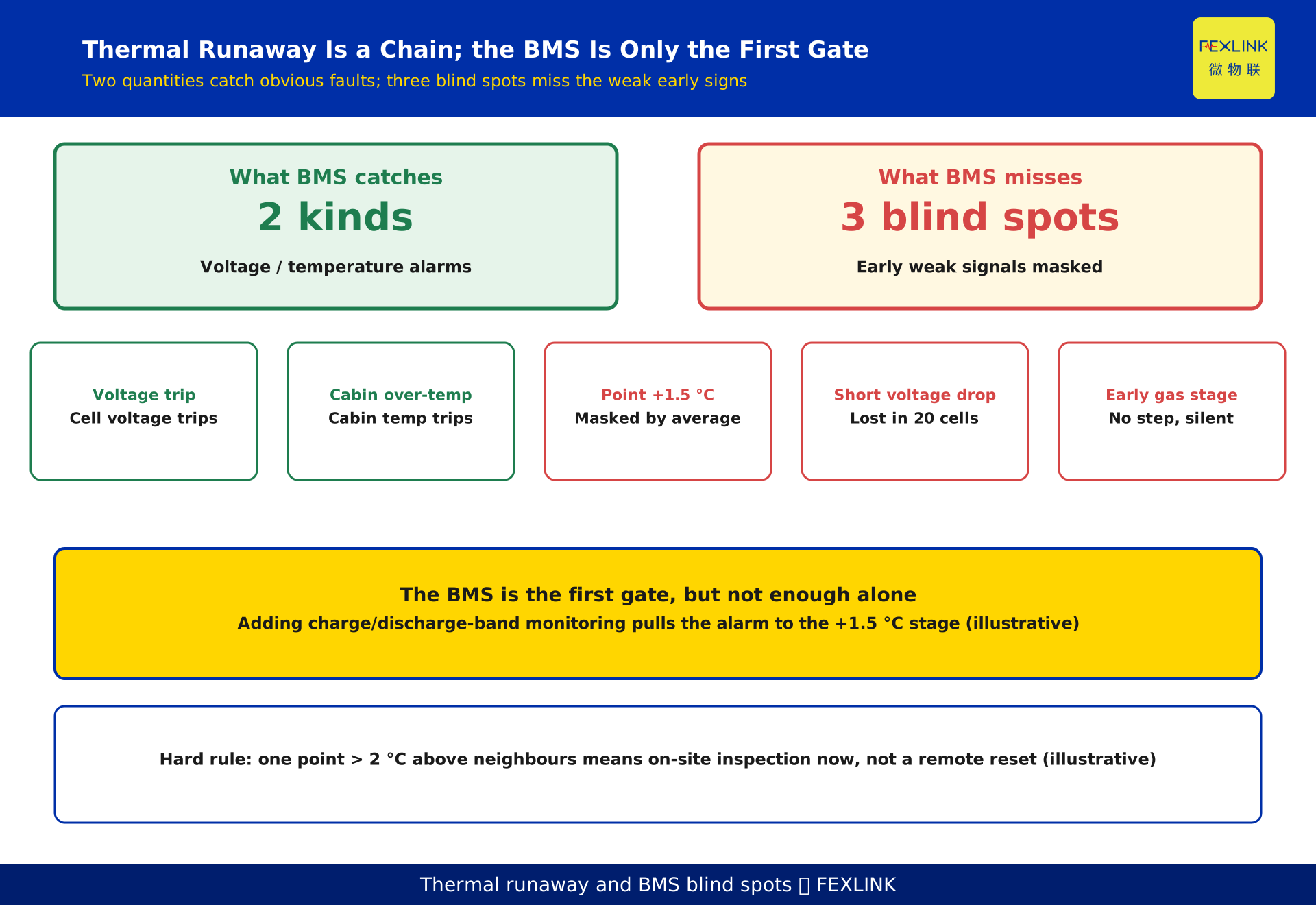
Most storage fires start with an internal short in a single cell and then escalate through a chain: temperature rise, gas generation, and finally cascading fire. A battery management system (BMS) watches every cell's voltage and temperature and raises an alarm when a value crosses a threshold. It catches obvious faults well, but it routinely misses the weak early signals. The conclusion is blunt: the BMS is a necessary first line of defense, but it is not enough on its own. To catch trouble earlier you have to add online monitoring of the battery's electrical signatures during charge and discharge, on top of the BMS, so that faint warnings are pulled out of the noise.
1. How thermal runaway actually unfolds
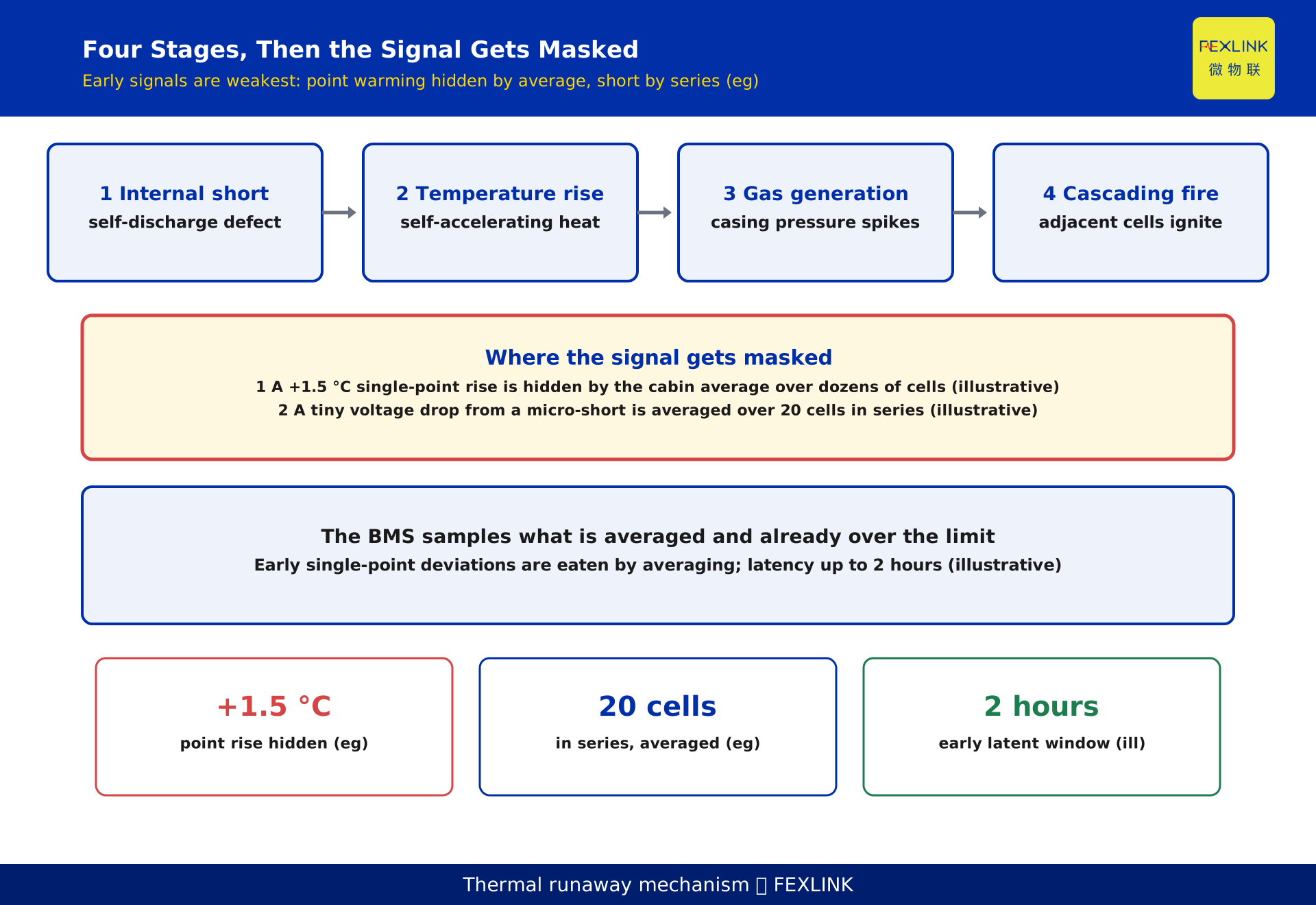
Thermal runaway is not a sudden fire. It is a four-stage chain (a conceptual, mechanism-level description rather than a set of fixed numbers):
- Internal short. A micro-short appears inside the cell — from dendrite growth, separator damage, or contamination — and the cell begins to self-discharge and release heat.
- Temperature rise. The accumulated heat raises the cell temperature; the higher the temperature, the faster the exothermic reaction, which accelerates itself.
- Gas generation. The electrolyte and active materials decompose as they warm, producing large volumes of gas and a sharp rise in casing pressure.
- Cascading fire. The pressure ruptures the casing, the gas ignites, and neighbouring cells are drawn in, spreading the fire through the container.
The point of understanding this chain is simple: the earlier the stage, the weaker the signal and the harder it is for a fixed threshold to notice. Once you are in the gas-generation or fire stage, the window for action is already short.
2. What the BMS actually watches, and how it alarms
The BMS is the most basic safety layer in a storage plant. In its conventional form it monitors only two kinds of quantity (a generic product-architecture description, drawn from public material):
- Voltage. It samples cell or module voltage; it alarms when voltage drops abruptly, rises abruptly, or consistency degrades.
- Temperature. It places sensors on modules, liquid-cooling plates, and air ducts; it alarms when temperature exceeds a set threshold.
The BMS works on the principle of an "out-of-limit threshold": the moment a number crosses the red line, it sounds. That is effective against faults that are already obvious — a cell whose voltage collapses toward zero, or a cabin whose temperature spikes across the board, will certainly trip the BMS. The trouble begins much earlier.
3. The blind spots: early weak signals get averaged away
The dangerous part of thermal runaway is the early phase. The signal is weak there, and it is eaten by the system's statistical averaging. Three blind spots stand out:
- Early weak warming is hidden by the cabin average. One cell creeps up by 1.5 °C while the average temperature of dozens of cells in the cabin barely moves, so the BMS sees a "normal" mean value.
- The small voltage drop from a micro-short is averaged across the series string. A micro-short in one cell pulls its voltage down slightly, but in a string of 20 cells in series that cell's deviation is smoothed out by the other 19, and the pack voltage stays in range.
- The early gas stage has no voltage or temperature step. As gas accumulates inside the casing, neither voltage nor temperature has crossed a threshold yet, so the conventional alarm stays silent.
In other words, the BMS samples and alarms on quantities that are "after averaging" and "after crossing a limit," while the earliest sign of runaway is precisely a deviation that is "single-point, weak, and not yet over the limit."
4. Why the BMS alone is not enough: a desensitized scenario
The following is a constructed illustrative scenario used to show that the BMS catches obvious anomalies yet struggles with early weak signals. It does not represent any real customer, project, or measured data:
A campus operates a 100 MW / 200 MWh storage plant built from 40 battery cabins of 5 MWh each (each cabin holding several modules, each module a string of 20 cells; the counts are illustrative). One day a micro-short develops in one cell inside a module. For the first two hours its local temperature rises only about +1.5 °C, masked by the cabin average, and the BMS does not alarm. Two hours later the warming accelerates, the cabin temperature crosses its set threshold, and only then does the BMS trip a temperature alarm — by which point the most comfortable window for action is gone.
Had that plant added online monitoring of "battery charge/discharge band electrical signatures" (a vendor-disclosed capability), it could have recognized the abnormal electrical signature while the warming rate was still only 0.5 °C/h, pulling the alarm forward into that +1.5 °C latent window.
5. Early electrical-signature monitoring you can layer on
Because "averaged voltage and temperature" miss the early signal, the way to close the gap is to watch the features that exist "before averaging" and "before cancellation" — the electrical signatures of the battery during charge and discharge:
- Voltage and current signatures in the charge/discharge band. An internal short changes a cell's equivalent internal resistance and the shape of its charge/discharge curve; these changes surface earlier in frequency-domain features than in a simple voltage mean.
- Micro-deviation of cell-to-cell consistency. Instead of relying on the cabin average, watch each cell's tiny deviation from its neighbours and how fast that deviation moves.
- Warming rate rather than absolute temperature. Track "how much it rose per unit time" — that catches problems earlier than staring at "what is the temperature now."
The related solution here, "early thermal-runaway warning for storage batteries (vendor-disclosed:assessment of charge/discharge band electrical signatures)," belongs to this class. To be clear: this capability is vendor-disclosed — a description provided by the supplier, not a conclusion verified by an independent national standard or industry certification. This article does not treat it as a selection criterion.
6. Tiered warning and response actions
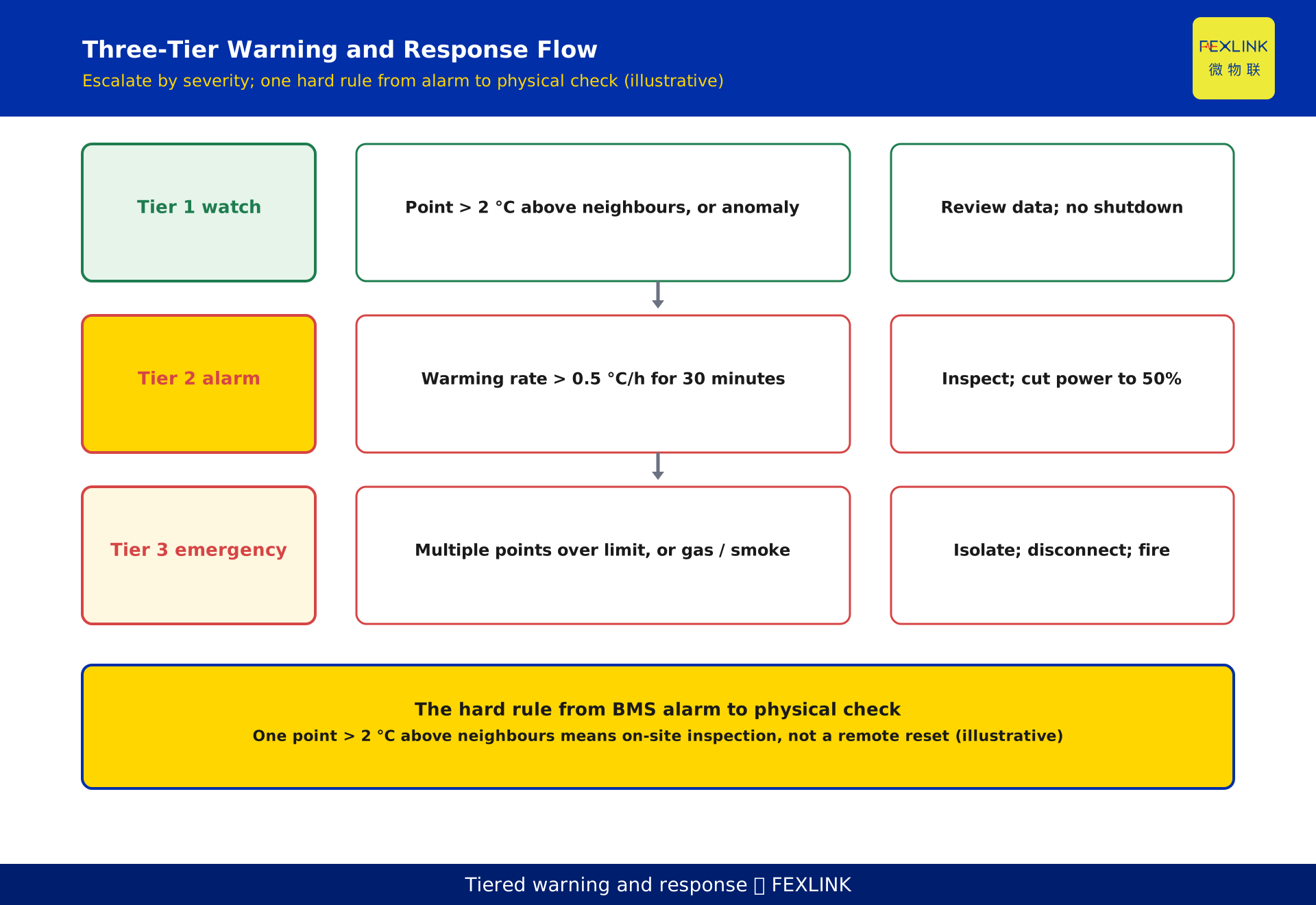
Once BMS alarms and electrical-signature monitoring are combined, response can be tiered by severity instead of either shutting everything down on the first alarm or doing nothing. The set below is a constructed example of criteria (actual thresholds are set per project design; this article gives no universal numbers):
- Tier 1 (watch): one point's temperature stays more than 2 °C above its neighbours, or the charge/discharge band electrical signature moves anomalously. → Action: review the data and curves; do not remotely shut down yet.
- Tier 2 (alarm): warming rate exceeds 0.5 °C/h and persists for 30 minutes. → Action: dispatch an on-site inspection and cut that cabin's charge/discharge power to 50%.
- Tier 3 (emergency): multiple points exceed limits, or gas or smoke appears. → Action: isolate the cabin, disconnect the DC side, and trigger fire-protection interlock.
One hard escalation rule deserves emphasis: when a BMS temperature alarm appears and a single point in the same cabin stays more than 2 °C above its neighbours, an on-site inspection must be scheduled immediately rather than simply resetting remotely — that is the hard threshold for "escalating from a BMS alarm to a physical check."
7. How this differs from SOH online estimation (KD-0556)
This article is often mentioned alongside KD-0556 (SOH online estimation), but the increment is different:
- KD-0556 is about "health." It estimates State of Health indicators such as capacity fade and internal-resistance growth, answering "how much longer will this battery last, and how much has it degraded."
- This article is about "safety." It focuses on the thermal-runaway accident, answering "what can the BMS prevent, what can it not, and how do we close the blind spots in the early weak signals."
One sentence to tell them apart: SOH estimation cares about lifespan; this article cares about not catching fire. They are complementary — SOH looks at long-term degradation, this article at acute safety risk — but this article does not replace KD-0556's degradation estimation.
8. Where the products fit
Closing the blind spots starts at the data edge.
Cabin-level high-density temperature sensing uses the EST multi-channel temperature controller (a multi-channel temperature acquisition and control device), which samples and judges a large number of temperature points inside the battery cabin at high density, strengthening the areas where single-point BMS temperature sampling is too sparse. Edge-side real-time computation uses the ESX smart edge computing gateway, which aggregates BMS, temperature, and electrical data from multiple cabins at the plant edge and runs local, real-timeassessment of charge/discharge band electrical signatures, pushing alarm latency down to seconds rather than waiting for the cloud.
What must be stressed: products solve "capturing and computing the early signal." Real safety still depends on a tiered response process and on people being in place.
FAQ
Q: Does installing a BMS make the plant safe?
Not by itself. The BMS is a necessary first line of defense and catches obvious anomalies well, but it has blind spots for early weak signals (single-point micro-warming, micro-shorts). It lowers risk; it does not remove it. It needs to be paired with early monitoring and tiered response.
Q: Does GB/T 36276 guarantee thermal runaway will not happen?
No. GB/T 36276, "Lithium-ion batteries for electrochemical energy storage," is the national standard for lithium-ion batteries used in electrochemical storage; it sets the safety and performance requirements for the cells themselves. Specific clauses and limits depend on the currently effective version. It is the threshold for "qualified cells," not a promise that operation will always be safe.
Q: Can the "electrical-signatureassessment" in the early-warning solution be trusted?
That capability is vendor-disclosed — a description from the supplier, not a conclusion verified by an independent national standard or certification. Treating it as a direction for closing blind spots is reasonable, but selection and acceptance should not rest on marketing alone; they need on-site measurement and third-party verification.
Q: What is the first thing to do after a BMS alarm?
Grade it by severity first. If it is only one point slightly warm with no sustained trend, review the data. If one point stays more than 2 °C above its neighbours or the warming rate is anomalous, inspect on site and cut power immediately. If multiple points exceed limits or gas/smoke appears, isolate and disconnect at once. Do not merely reset remotely.
Q: Does this article duplicate KD-0556 (SOH estimation)?
No. KD-0556 estimates health indicators such as capacity fade (a lifespan question); this article diagnoses the thermal-runaway safety hazard (a safety question). One asks "how long can it be used," the other "will it catch fire." The increment is in the BMS blind spots and early electrical-signature closure.
Scope and limitations
- The thermal-runaway chain described here (internal short → temperature rise → gas generation → cascading fire) is an industry-accepted mechanism-level description and a conceptual framework. The specific trigger conditions and parameters vary with cell chemistry, structural design, and operating conditions, and no universal numbers are given.
- The BMS monitoring objects (voltage, temperature) and the "out-of-limit threshold alarm" mechanism are generic architectural descriptions. Per-project thresholds follow design specifications; this article gives no universal numbers and treats no specific temperature or voltage threshold as a general fact.
- The 100 MW / 200 MWh plant, the 40 cabins of 5 MWh, the +1.5 °C single-point rise, the 2-hour latency, and the 0.5 °C/h warming rate in Section 4 are constructed examples for illustrating the mechanism. They represent no real customer, project, or measured data; actual plant scale, thresholds, and response procedures must be set from site survey and measured data.
- The escalation criteria in Section 6 (single-point deviation > 2 °C, warming rate > 0.5 °C/h for 30 minutes, power cut to 50%, etc.) are constructed example criteria illustrating the tiering idea. Each project should follow its own design documents and operating procedures; this article does not constitute a response standard.
- The "early thermal-runaway warning for storage batteries (assessment of charge/discharge band electrical signatures)" is a vendor-disclosed capability, not a conclusion verified by an independent national standard or industry certification, and this article does not use it as a conclusion or selection basis.
- GB/T 36276 applies in its currently effective version; if the standard is revised, the quantitative conclusions here require re-checking.
- The specific models, channel counts, and interfaces of the ESX smart edge computing gateway and the EST multi-channel temperature controller follow the latest product knowledge base; this article is not a selection or procurement recommendation.
- This article and KD-0556 (SOH online estimation) are complementary: this article focuses on thermal-runaway safety diagnosis, while KD-0556 focuses on capacity-fade estimation; neither replaces the other.
Frequently Asked Questions
Does installing a BMS make the plant safe?
Not by itself. The BMS is a necessary first line of defense and catches obvious anomalies well, but it has blind spots for early weak signals (single-point micro-warming, micro-shorts). It lowers risk; it does not remove it. It needs to be paired with early monitoring and tiered response.
Does GB/T 36276 guarantee thermal runaway will not happen?
No. GB/T 36276, "Lithium-ion batteries for electrochemical energy storage," is the national standard for lithium-ion batteries used in electrochemical storage; it sets the safety and performance requirements for the cells themselves. Specific clauses and limits depend on the currently effective version. It is the threshold for "qualified cells," not a promise that operation will always be safe.
Can the "electrical-signatureassessment" in the early-warning solution be trusted?
That capability is vendor-disclosed — a description from the supplier, not a conclusion verified by an independent national standard or certification. Treating it as a direction for closing blind spots is reasonable, but selection and acceptance should not rest on marketing alone; they need on-site measurement and third-party verification.
What is the first thing to do after a BMS alarm?
Grade it by severity first. If it is only one point slightly warm with no sustained trend, review the data. If one point stays more than 2 °C above its neighbours or the warming rate is anomalous, inspect on site and cut power immediately. If multiple points exceed limits or gas/smoke appears, isolate and disconnect at once. Do not merely reset remotely.
Does this article duplicate KD-0556 (SOH estimation)?
No. KD-0556 estimates health indicators such as capacity fade (a lifespan question); this article diagnoses the thermal-runaway safety hazard (a safety question). One asks "how long can it be used," the other "will it catch fire." The increment is in the BMS blind spots and early electrical-signature closure.