 FEXLINK Research Institute
The short answer
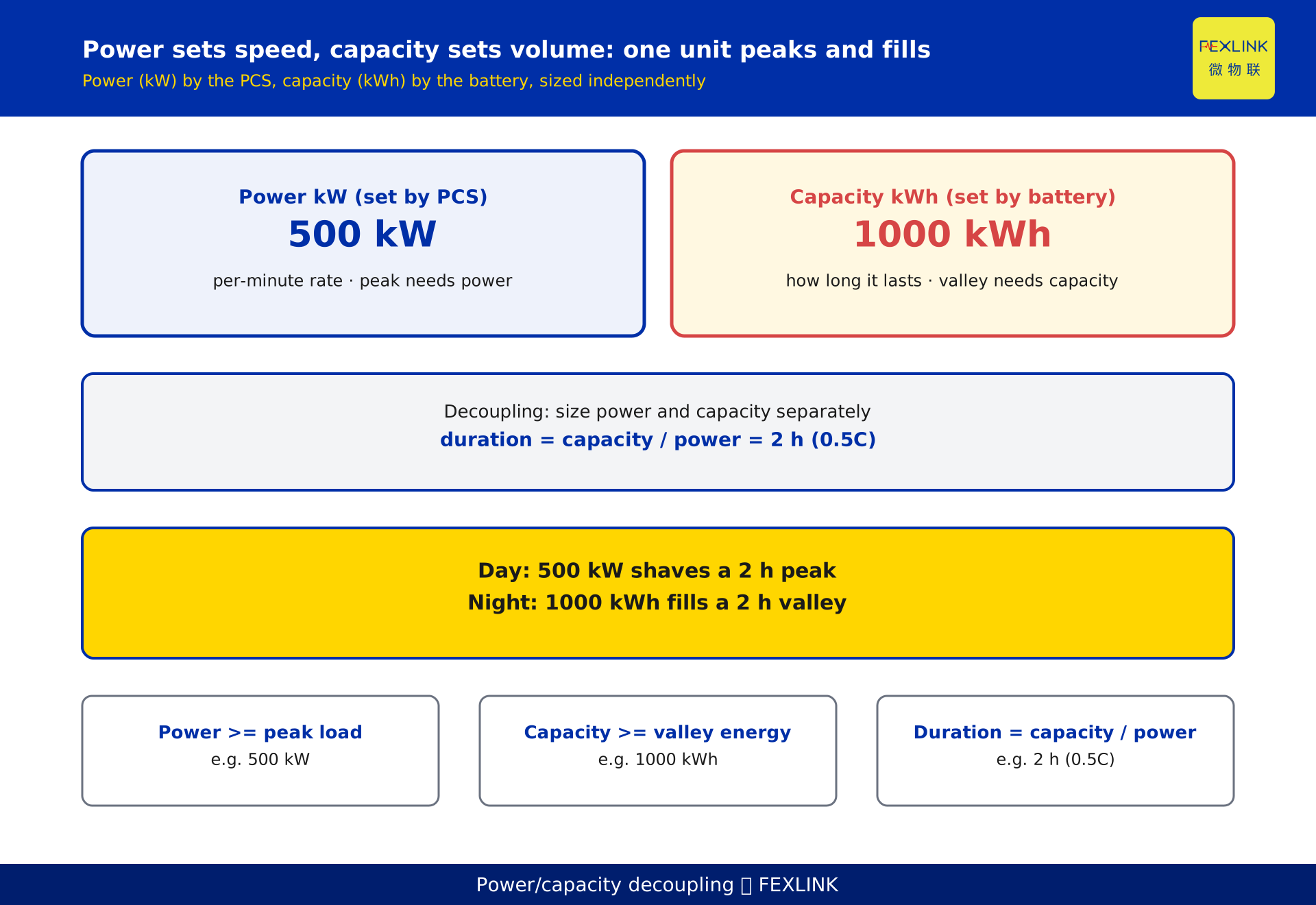
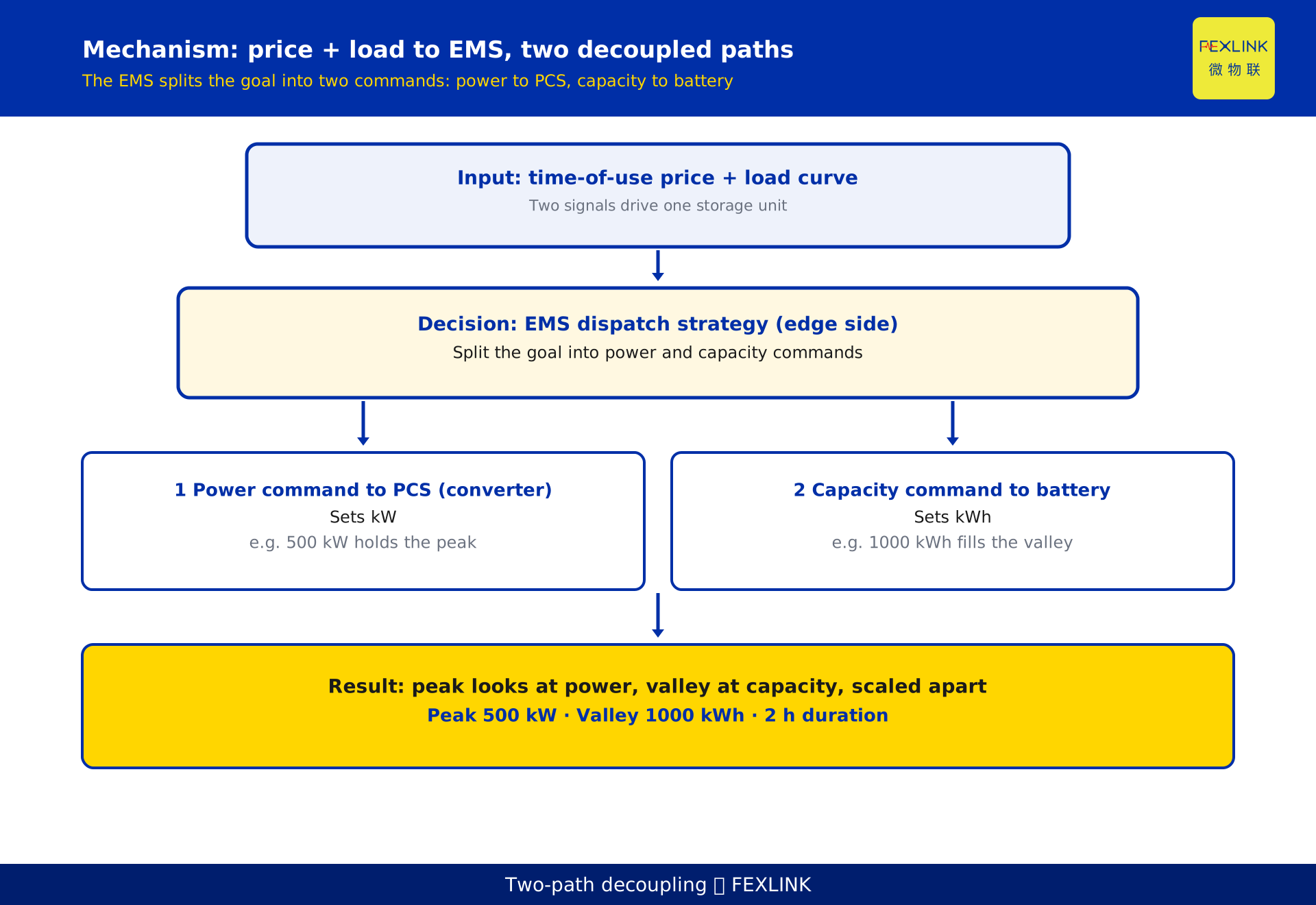
In a storage system the power rating (kW) is set by the power conversion system (PCS), while the energy capacity (kWh) is set by the battery. The two are selected independently. Power decides how much energy can be moved per minute; capacity decides how long it can keep moving. This decoupling is exactly why one unit can both shave the peak (fast, high-power discharge) and fill the valley (slow, long-duration charging). Mixing the two numbers up is the most common reason a project ends up unable to do either.
1. Two numbers first: kW is power, kWh is energy
kW (kilowatt) is a unit of power: it describes how much energy is moved at this instant, i.e. a rate. kWh (kilowatt-hour) is a unit of energy: it describes how much energy is moved in total, i.e. an amount. A 1 kW load running for 1 hour consumes 1 kWh. Physically, 1 kWh = 3.6 MJ (megajoules). The two quantities have different dimensions and cannot substitute for each other. The most common sizing mistake is to treat "how many kW" and "how many kWh" as the same question, which yields a system that can neither shave the peak nor fill the valley.
2. What sets the power: the PCS is the tap
The power ceiling is fixed by the rated power of the PCS. The PCS handles AC/DC conversion and grid-interconnection control; it behaves like a tap — however far you open it, that is how much power flows at this instant. A 500 kW PCS, no matter how large the battery behind it, caps the instantaneous discharge at 500 kW. So whether you can shave a 500 kW spike within 2 hours depends only on the PCS, not on the battery. If power is insufficient, even a huge battery discharges too slowly and misses the peak. The PCS is also the ceiling on charging power, so size it against both the discharge and the charge side.
3. What sets the capacity: the battery is the tank
The capacity ceiling is fixed by the usable energy of the battery pack. The battery behaves like a tank — the bigger it is, the more energy it holds. A 1000 kWh battery, no matter how large the PCS, can only ever deliver 1000 kWh in total. So whether you can store all the cheap night-time energy and still have enough for the day depends only on battery capacity. If capacity is insufficient, even a large PCS has no energy to move. Caveat: the nameplate 1000 kWh is total energy; the usable amount subtracts the SOC safety window (using only 20%–90% leaves about 700 kWh usable). Size against the usable figure or you will find "enough on paper, not enough in reality".
4. Why one unit can both peak-shave and valley-fill
Peak shaving wants speed — during the 1–2 most expensive hours it must push the spike down at maximum power. Valley filling wants duration — during the low-tariff night window it must store as much cheap energy as possible. Because power and capacity are decided by the PCS and the battery respectively, they are decoupled and can be tuned to different needs: use 500 kW of power to shave the peak and 1000 kWh of capacity to fill the valley, with neither constraining the other. The discharge duration = capacity ÷ power = 1000 kWh ÷ 500 kW = 2 hours, so each discharge run lasts 2 hours.
5. Four typical consequences of mismatched power and capacity
- Low power, high capacity: plenty of stored energy, but discharge is too slow to push the spike down, so the peak tariff is still paid.
- High power, low capacity: discharge is fast, but the battery empties quickly; valley filling stops halfway and the cheap energy is wasted.
- Enough power, insufficient capacity for two-charge-two-discharge: after shaving the daytime peak you want a second night-time fill but the capacity is exhausted, so the second cycle never starts.
- Enough capacity, insufficient power: the valley charge is full, but the peak cannot be met because power is short, so the demand charge is not reduced.
All four trace back to one cause: power and capacity were not selected separately by task. A mismatch drags both sides down, so sizing is not "bigger is better" but turning each knob to the right place.
6. Two-charge-two-discharge: the hard constraint on the ratio
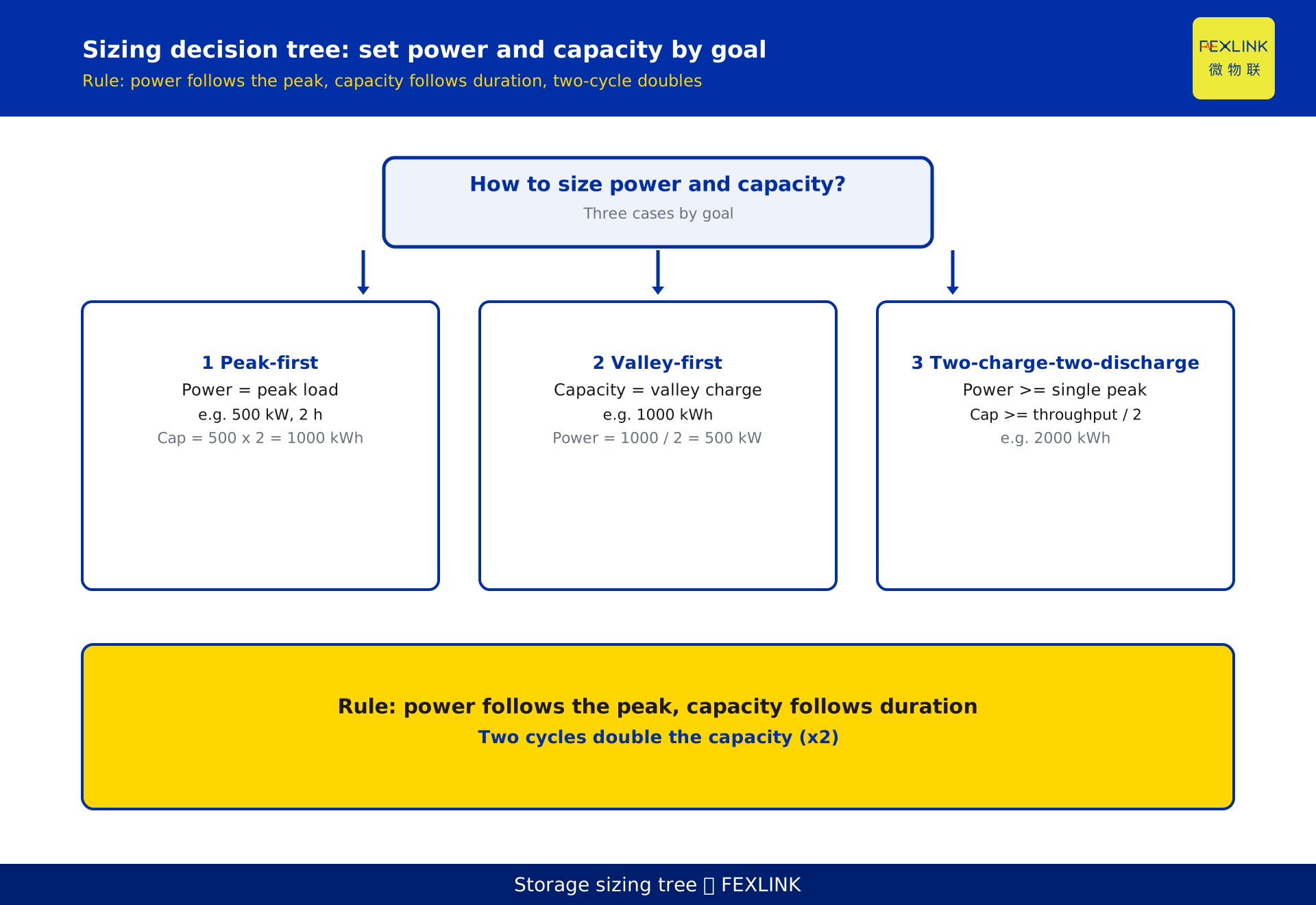
"Two-charge-two-discharge" means two charging and two discharging sessions per day; it is the most common mode for commercial and industrial peak-valley arbitrage. It imposes a hard constraint: if each discharge lasts 2 hours, one cycle moves 1000 kWh and two cycles move 2000 kWh per day. To sustain this, the battery capacity must cover the energy per single cycle and the PCS power must cover the single-cycle discharge power. Take 500 kW / 1000 kWh: each cycle moves 1000 kWh over 2 hours, giving 4 hours of discharge and 4 hours of charge per day, a throughput of 2000 kWh — exactly two-charge-two-discharge. Cut the capacity to 500 kWh and each cycle lasts only 1 hour; the arbitrage headroom is halved.
7. A worked scenario: sizing 500 kW / 1000 kWh for one park
The following is a desensitized scenario built to illustrate the principle; it does not represent any real customer or project. A park has two 10 kV feeders and a 2 MVA transformer, is on the large-industry two-part tariff, faces two daily price peaks (about 2 hours each) with a peak-valley spread of about 0.7 yuan/kWh and an 8-hour night valley. Its load exceeds the demand limit by about 500 kW at peak and it wants to move valley energy into the peak window. With 500 kW PCS + 1000 kWh battery: each peak is shaved at 500 kW for 2 hours (1000 kWh out per round, 2000 kWh daily discharge); the valley is charged in two segments at 500 kW for 2 hours each (2000 kWh daily charge), giving 2000 kWh/day — exactly two-charge-two-discharge. A 250 kW PCS would shave only 250 kW per round and miss the peak; a 500 kWh battery would last only 1 hour per round and leave nothing for the second peak. This is precisely why power and capacity must be selected separately.
8. Flywheels, supercapacitors and batteries: a different decoupling
The decoupling logic of mechanical and power-type storage differs. A flywheel or supercapacitor is essentially a power device: its rated energy is tiny but its power density is extremely high, so it almost only provides power and hardly provides capacity. A battery is an energy device: you scale capacity by adding cells and scale power by paralleling PCS, so power and capacity can be scaled independently. So although both are "decoupled", a flywheel/supercapacitor only decouples out the power, whereas a battery independently selects both. When choosing, first decide whether the task leans toward power or toward capacity. Quantitatively, a flywheel responds in milliseconds and a supercapacitor in microseconds to milliseconds, with cycle life exceeding one million cycles — far beyond a battery's few thousand; but their rated duration is usually seconds to minutes, so they suit "fast in, fast out" power tasks such as frequency regulation, while a battery with hour-scale duration (2 hours here) suits energy movement.
9. How to size power and capacity: three tests
Test 1 — set the power: power = peak load − grid-connection / demand limit; size the PCS to the spike you want to remove. Test 2 — set the capacity: capacity = daily throughput target ÷ number of cycles; decide how much energy per day and how many cycles, then back-calculate the battery. Test 3 — verify the duration: capacity ÷ power must cover the window you need (2 hours here). Only when all three pass does the configuration stand. Size against usable capacity, not nameplate: with only the 20%–90% SOC window open, the 1000 kWh nameplate is about 700 kWh usable, so leave a 20%–30% margin rather than running at the boundary.
10. How it lands as a product
For a decoupled configuration to actually run, you need local control that is both visible and actionable. On site, the ESX smart edge computing gateway collects PCS and battery data (power, SOC, temperature, charge/discharge state) and executes the peak-shave/valley-fill strategy by time window at the edge: at peak it commands the PCS to discharge at rated power, at valley it commands charging, and it reports SOC and remaining power headroom to the platform to avoid over-discharge or over-charge. The ESX local computing capability keeps the strategy running on its preset windows even when the network is down. This edge layer is the key link that turns "power/capacity decoupling" into a daily two-charge-two-discharge routine — but the gateway executes the already-decoupled plan; it does not do the sizing, which still comes back to the three tests above.
11. Frequently asked questions (FAQ)
Q: A system rated 500 kW / 1000 kWh — can it really discharge at 500 kW for 2 hours straight?
Yes. 500 kW is the power ceiling and 1000 kWh is the capacity ceiling; dividing the two gives exactly 2 hours. As long as the SOC is sufficient it can sustain 500 kW for 2 hours. Note this is the rated full-power duration; in practice a 20%–90% safety window is reserved, so usable duration is slightly shorter, but the nameplate is understood as 2 hours.
Q: Can I save money with a small battery and a large PCS?
That does not solve the capacity problem. A large PCS only makes you discharge faster; a small battery still empties quickly, so valley filling and two-charge-two-discharge both fail. That is the typical "high power, low capacity" mismatch. If you only need short peak shaving, the right move is a small capacity with a small PCS, not a small battery with a large PCS.
Q: Why can't peak shaving and valley filling share one power-capacity pair?
Their demands point in opposite directions: peak shaving wants high instantaneous power for a short time; valley filling wants large capacity for a long time. Precisely because power and capacity are decoupled, they must be selected separately rather than sharing one inflated metric, or neither side reaches optimum.
Q: What does GB/T 34133 govern?
GB/T 34133 is the national testing technical standard for the energy storage converter (PCS); it specifies PCS performance and testing requirements. Specific clauses and limits follow the current standard text and the manufacturer's specification sheet; this article cites no concrete values.
Q: Is two-charge-two-discharge always more profitable than one cycle?
Not necessarily. It raises daily throughput but requires both capacity and power to support two cycles, and the local peak-valley spread must cover cycle loss and battery depreciation. Before sizing, apply Test 3 to verify duration and return; also note two cycles consume cell life faster, so compute the full-cycle levelized cost of storage (LCOS), not just arbitrage revenue.
Scope and limitations
- The power/capacity decoupling principle applies to commercial and industrial peak-valley arbitrage and demand management using battery storage (lithium-ion, lead-carbon, etc.); the decoupling logic of power-type storage such as flywheels and supercapacitors differs — see Section 8.
- The example figures (500 kW PCS, 1000 kWh battery, 2-hour discharge, 2000 kWh/day two-charge-two-discharge throughput, SOC window 20%–90%, about 700 kWh usable) are constructed to illustrate matching and do not represent any real customer or project; actual configuration must follow the on-site load profile, grid limits, peak-valley tariff and measured battery degradation.
- GB/T 34133 is mentioned only at a framework level (currently in force); no clause numbers, tolerance limits or test values are cited. Technical parameters follow the current standard text and the manufacturer's specification sheet.
- The ESX smart edge computing gateway and its parameters follow the latest selection manual and product knowledge base; this article is not a selection or procurement recommendation.
- The relation "1 kWh = 3.6 MJ" (1 kWh = 3.6×10⁶ J) is an energy-unit conversion and may be cited directly; electricity conversion coefficients (e.g. 0.1229 kgce/kWh) are outside this article's scope.
- Cited standard numbers follow their currently valid versions; after revision, related quantitative conclusions must be re-verified.
Frequently Asked Questions
Why Storage Can Both Peak-Shave and Valley-Fill
In a storage system the power rating (kW) is set by the power conversion system (PCS), while the energy capacity (kWh) is set by the battery