 FEXLINK Research Institute
The short answer
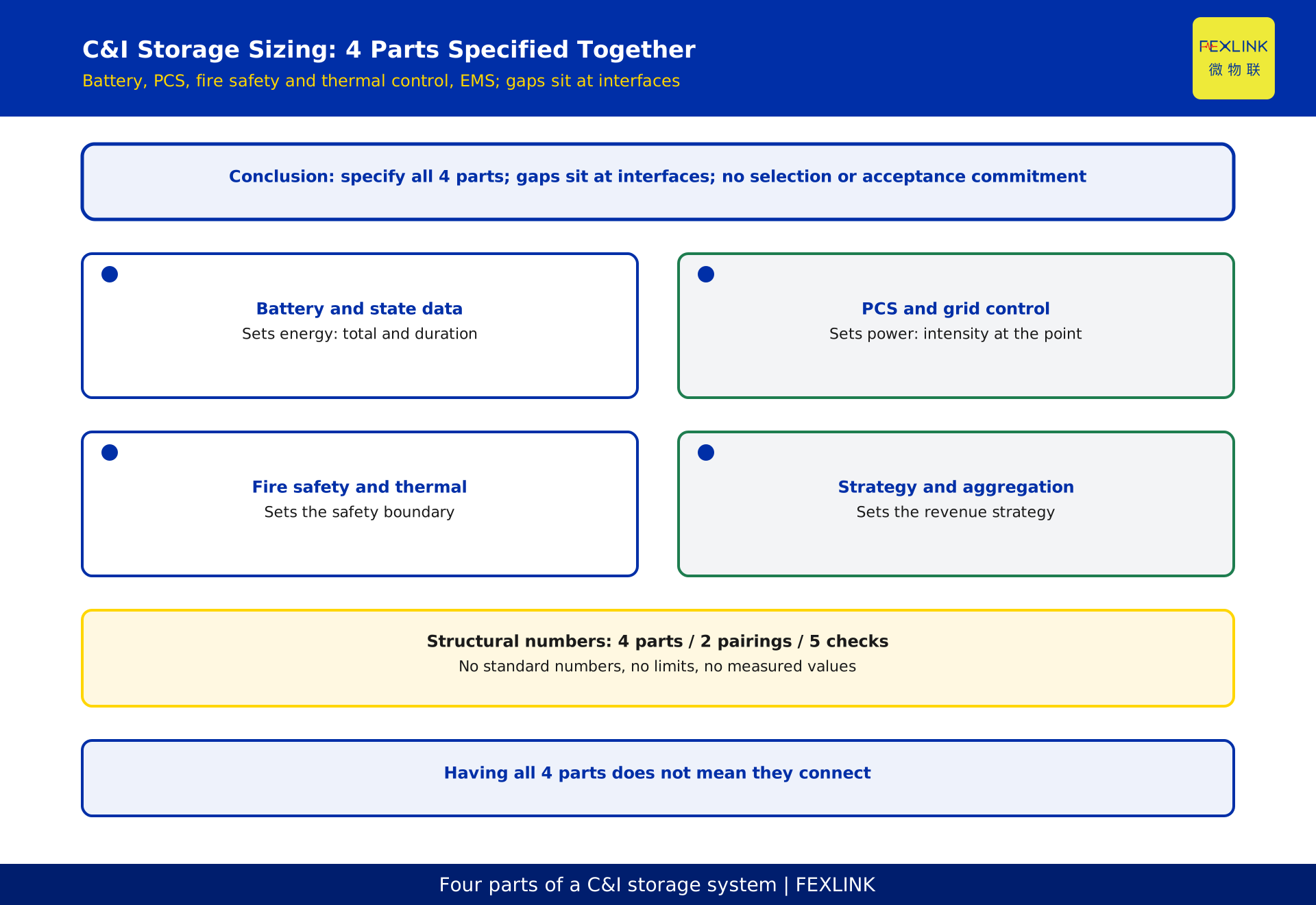
A commercial and industrial (C&I) storage system is not a battery purchase; it is 4 parts specified together. The battery enclosure sets energy, the PCS sets power and control at the connection point, fire safety and thermal control set the safety boundary, and the EMS sets the revenue strategy. Comparing batteries alone leaves power too narrow, a safety boundary that blocks acceptance, and fixed actions where a strategy should be. This article gives the 4 parts, 2 kinds of pairing relationship and a 5-step checklist. It cites only the names, numbers, current status and a brief scope description of two current national standards, with no clause numbers, limits or compliance determinations. The table and checklist are statements of method; every conclusion constitutes no selection or acceptance commitment.
Why buying a battery is not buying a storage system
A quotation sorted by capacity shows only how much energy can be stored. How fast it is released, whether an abnormal condition can be isolated, and what rule governs charging and discharging stay outside the comparison, and become additional purchases after the contract is signed.
These items do not live on one drawing: the battery belongs to the equipment package, the PCS to the electrical interface, fire safety and thermal control to civil and auxiliary works, and strategy and monitoring to controls and information systems. Write down what the system must do, then work backwards to who owns each stage; grouping requirements by the question they answer turns an omission into a checkable item.
The battery sets energy: how much and how long
The battery answers how much usable energy remains after a charge and how long it can support a load. Answering only the first leaves a plant with sufficient total energy that cannot carry through to the end of the intended window.
Capacity depends on depth of discharge, the usable state window, ageing and operating temperature; the nameplate gives only a nominal value. The battery management system observes capacity and does not set PCS power. Ratios and durations come from the load profile, tariff periods and on-site measurement; this article gives no fixed multiple.
The PCS sets power: how fast it can charge and discharge
The battery holds direct current while the grid and the load use alternating current; the PCS converts in both directions and executes the power and direction commanded at the connection point. However ample the capacity, a narrow channel cannot deliver when output is needed.
The common confusion is treating enough capacity as enough power. Peak shaving, demand control and arbitrage point in different directions; enlarging capacity cannot offset them. The PCS executes conversion and local protection, not long-horizon optimisation; merging strategy into it leaves a blank on the selection sheet. Specific power rests on project documents, local grid requirements and supplier evidence; this article states no value and constitutes no selection or acceptance commitment.
Fire safety and thermal control set the safety boundary
Fire safety and thermal control generate no revenue, yet decide whether the system may be commissioned. They run parallel to the energy chain: thermal control maintains declared working conditions, and a thermal abnormality triggers detection, alarm, isolation and suppression. Those signals come neither from a power command nor from a revenue target, so they are not subordinate to the strategy layer. A missing safety boundary blocks commissioning and acceptance, and rework reaches the enclosure and civil works. Without a named owner or handover point, joint commissioning produces detection with no receiver; follow the signal path, not equipment counts.
Two current national standards are commonly cited here: GB/T 36276-2023, Lithium ion battery for electrical energy storage, and GB/T 36558-2023, General technical requirements for electrochemical energy storage system of power system (source: the national standard full-text public system information pages). One addresses the battery product, the other the storage system. The registry field listing related standards omits the year suffix; this article completes the current version in its own deliverables without changing the registry. Only names, numbers, current status and a brief scope description are given, with no clause number, limit, permissible value, test method, compliance determination or inferred technical requirement. Interpretation rests on the current standard texts and project documents.
The EMS sets the revenue strategy
The EMS answers what objective governs charging and discharging. With the same battery and PCS, fixed schedules, dynamic tariff scheduling and added demand control or PV self-consumption produce different results. The difference lies in whether the strategy layer can combine tariff signals, load forecasts, PV output, battery state and connection-point constraints and pass a target power to the PCS.
Merging strategy and execution under the label control system drops an intermediate layer: the basis for a decision, the command issued, the result returned and abnormal handover. This article treats the EMS only as the part of the 4 parts that sets revenue strategy; it does not judge whether a separate EMS pays back or give a size threshold. This constitutes no selection or acceptance commitment.
2 pairing relationships: energy-power and safety-strategy
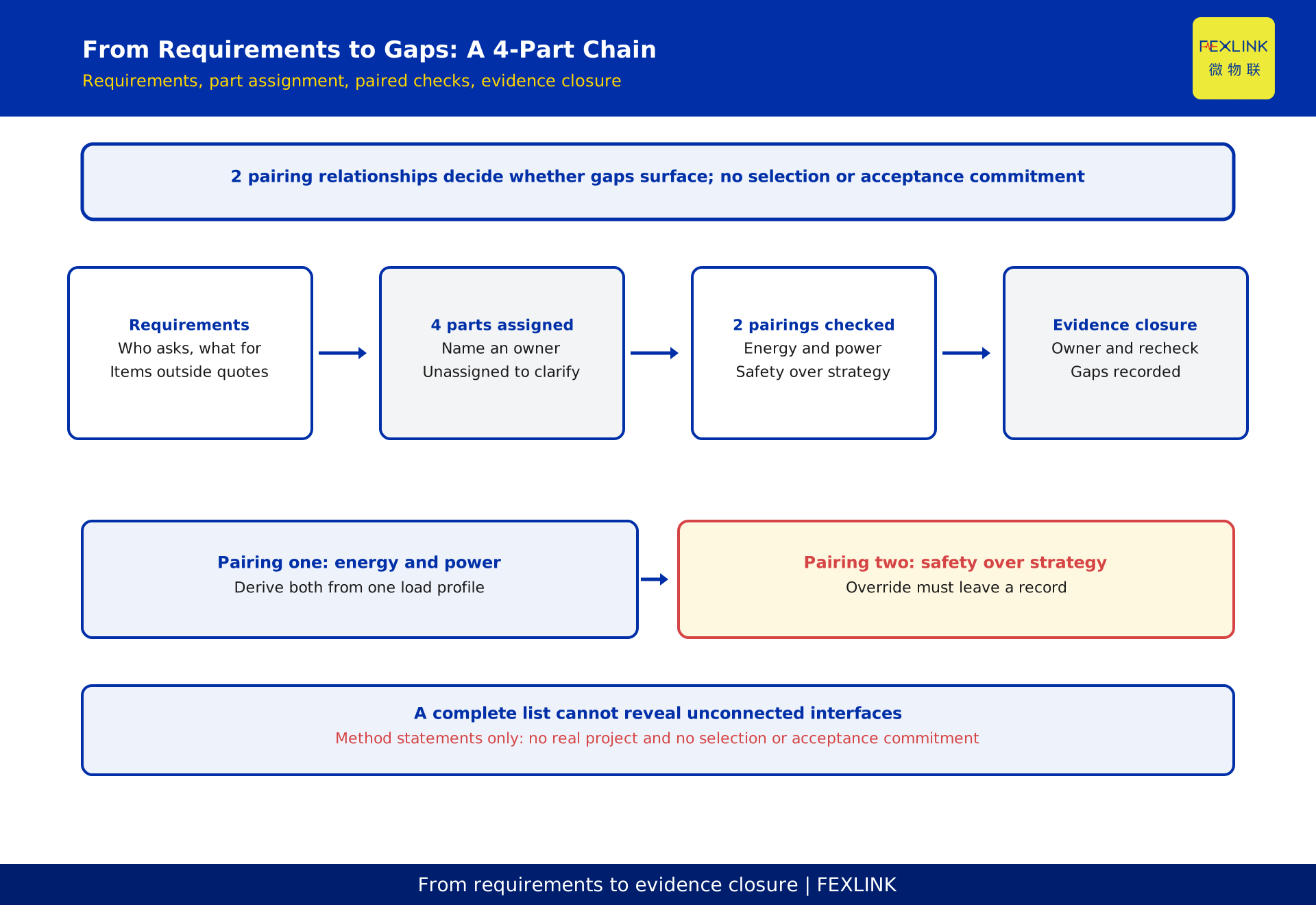
Laying the 4 parts out as a flat list hides where omissions occur. The gaps sit at interfaces between pairs, and group into 2 kinds of pairing relationship.
The first, energy-power, is two dimensions of one energy chain: capacity sets total and duration, power sets instantaneous intensity and behaviour at the connection point, and each depends on an assumption about the other. Derive both from the same load profile. The second, safety-strategy, constrains two parallel chains: commands must stay inside the safety boundary, and an abnormal signal has to override the optimisation target, with priority visible in design documents and traceable in commissioning records. What matters is who may override whom and whether the override leaves a record.
Having all 4 parts does not mean they connect; the sheet should name who closes each pair and which record proves it. The ESX intelligent edge computing gateway takes the role of signal aggregation and time alignment here; it does not replace the battery management system, the PCS or the EMS.
Mapping the 4 parts and the cost of omissions
Read the table by column: evidence is what acceptance requires, not equipment parameters.
| Part | Question it answers | Where an omission surfaces | Evidence to check | Who owns the interface |
|---|---|---|---|---|
| Battery enclosure and state observation | How much and how long | Total or duration falls short | Capacity convention and state records | Who supplies the battery and state data |
| PCS and connection-point control | How fast, and how the point is controlled | Output cannot rise when needed | Power derivation, command and return records | Who closes conversion and grid interface |
| Fire safety and thermal control | Whether abnormality is detected and isolated | Commissioning blocked, civil rework | Signal-chain walk-through and logs | Who leads auxiliary packages and joint tests |
| Strategy and monitoring aggregation | Which objective, and whether results can be traced | Only fixed actions remain | Strategy basis, return records, time marks | Who joins strategy and aggregation layers |
The rows correspond to the 4 parts; read by column, every empty evidence or interface cell is a missing item. The table is a statement of method and constitutes no selection or acceptance commitment.
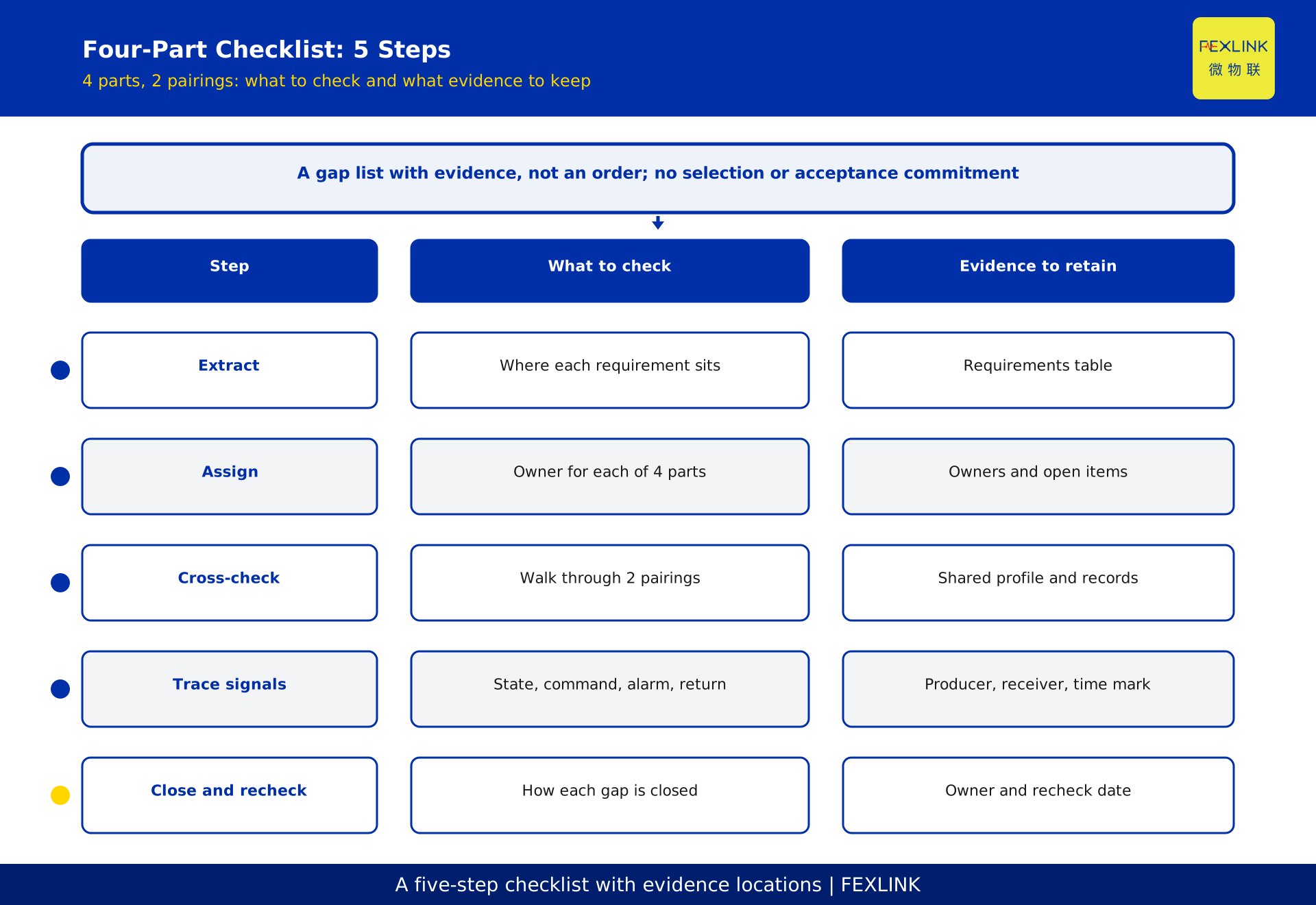
A 5-step checklist for the 4 parts
The output is a gap list with evidence locations, not a purchase order. Step one, extract storage requirements from project documents, contract annexes and local fire and grid requirements into a table. Step two, assign each to one of the 4 parts with an owner; anything unassigned goes to a clarification list. Step three, work through the 2 kinds of pairing relationship: were capacity and power derived from the same load profile, and can a safety constraint override a strategy target and leave a record? A missing basis is a gap. Step four, follow state quantities, power commands, alarms and returns, confirming a producer, a receiver and a time mark for each segment and that same-instant signals can be cross-referenced. Step five, write gaps into a closure table with owner, remedy and recheck date, and sign after the recheck passes.
The decisive stage is step three: a list finds a missing part, while joint derivation finds two parts never connected.
Carrying the checklist into commissioning and operation
Signing the checklist is not closure. After commissioning the signal groups remain distributed: state quantities from the battery management system, power and direction from the PCS, abnormal events and interlock records from auxiliary systems, and strategy targets and results from the control layer. With inconsistent time references, a strategy command cannot be read alongside the alarm and power response from the same instant.
The ESX intelligent edge computing gateway aggregates and forwards at this layer, bringing the groups onto one time axis and one set of measurement identifiers while preserving raw readings unchanged. Linking evidence into acceptance gives the 5-step checklist something to recheck. Design, configuration and acceptance must be performed by qualified personnel against the current standard texts, project documents and on-site measurement, and confirmed by an independent party. This constitutes no selection or acceptance commitment.
Frequently asked questions (FAQ)
Q: If battery capacity is sufficient, why check PCS power separately?
Capacity and power are separate dimensions: one answers total energy and duration, the other instantaneous intensity and behaviour at the connection point, and enlarging either cannot replace the other. Derive both from the same load profile; values rest on project documents and measurement.
Q: Can fire safety and thermal control be added after commissioning?
They should not be a later addition. They run parallel to the energy chain and decide whether the system can be commissioned and accepted; rework reaches the enclosure and civil works, making correction especially costly. Owners, the signal chain and interfaces belong in the selection stage.
Q: Is the controller supplied with the equipment the same as an EMS?
No. A lower-level controller handles conversion, execution and local protection, not long-horizon optimisation. Building a plan from tariff spreads, demand and PV self-consumption and passing a target power downstream belongs to the strategy layer. Check the basis for a decision, the command issued, the execution return and abnormal handover.
Q: If all 4 parts are bought at once, can nothing be omitted?
Not necessarily. A complete list shows the parts are present, not that the pairs connect. Capacity and power must be solved together, and a safety constraint must override a strategy target and leave a record; those interfaces need a walk-through of the 2 kinds of pairing relationship. Gaps usually sit at subcontractor boundaries.
Q: Can a single equipment list reveal whether the selection has gaps?
No. A list gives objects; a gap is a break between a requirement, an owner and the evidence. Only the 5-step checklist - extracting a requirements table, assigning parts, joint derivation, walking the signal chain and writing a closure table with owners and recheck dates - locates the gap. Every conclusion constitutes no selection or acceptance commitment.
Scope and limitations
This article is for storage procurement and technical leads and for project owners. It explains the 4 parts of a C&I storage system - the battery enclosure and state observation, the PCS and connection-point control, fire safety and thermal control, and strategy and monitoring aggregation - what each answers, where an omission surfaces, and how the 2 kinds of pairing relationship and the 5-step checklist locate gaps. It is not a reading of battery parameters, converter topologies, fire design codes or an EMS investment analysis.
It cites only the names, numbers, current status and a brief scope description of GB/T 36276-2023, Lithium ion battery for electrical energy storage, and GB/T 36558-2023, General technical requirements for electrochemical energy storage system of power system. No clause number, limit, permissible value, test method or compliance determination is provided. The registry field listing related standards omits the year suffix; the current version is completed here for this article's deliverables only and the registry is not modified. The comparison table and checklist are statements of method, and every conclusion constitutes no selection or acceptance commitment. The ESX intelligent edge computing gateway appears only as a role comparison for aggregation and time alignment. Practical design and acceptance must be carried out by qualified personnel against the current standard texts, project documents, supplier evidence and on-site measurement, and confirmed by an independent party. All deliverables remain pending review; the generator does not self-approve.
Frequently Asked Questions
C&I Storage Sizing
A commercial and industrial (C&I) storage system is not a battery purchase; it is 4 parts specified together