 FEXLINK Research Institute
The short answer
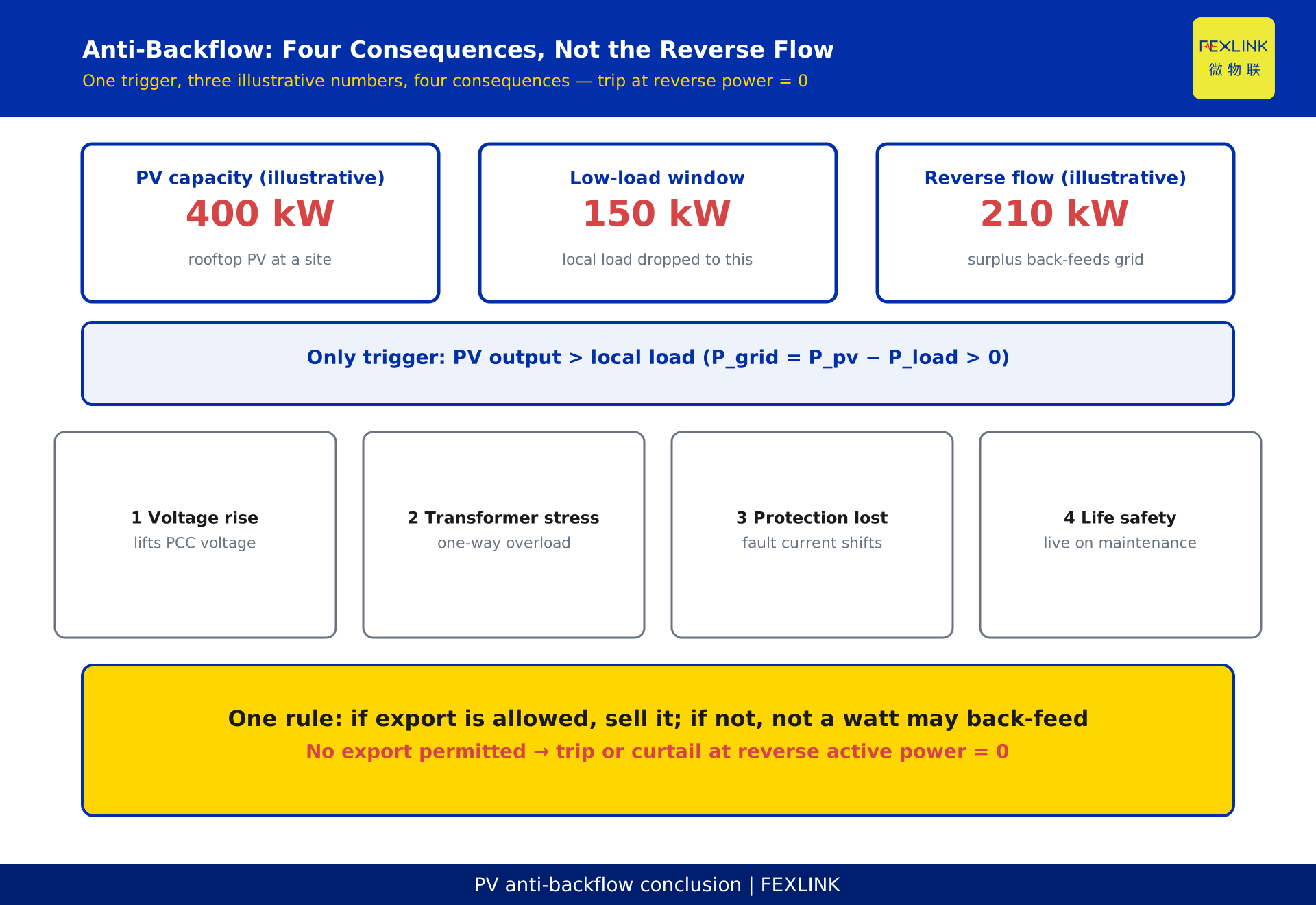
"Anti-reverse-flow" protection on a PV system is not about being afraid of electricity running backwards; it is about what that backwards power does once it reaches the grid. When a rooftop or distributed array generates more than the local load can absorb, the surplus active power flows back toward the utility network. That reverse flow lifts the point-of-common-coupling (PCC) voltage, disturbs the distribution transformer and the protection coordination, and can leave a line energized that crews believe is dead. The national standard GB/T 19964 sets the grid-connection and protection requirements for PV stations. In practice you either trip the PV inverter the moment reverse power appears, or actively curtail generation to zero export. The bottom line: in any grid-connection scenario that does not permit export, as soon as reverse active power is detected at the PCC (the trip threshold is set at reverse power = 0), the system should trip or curtail immediately.
What reverse power flow actually means
Reverse power flow is a physical fact: the PV plant produces more energy than the local load consumes, so the remainder is pushed back into the public network. It is purely a question of power direction, independent of whether export is permitted or metered.
Export (selling surplus to the grid) is a contractual and settlement arrangement: only when the utility allows export and the customer has signed a power-purchase agreement does the surplus get sold and settled by exported energy.
The whole distinction is one sentence: reverse flow is "is power being sent backwards?", while export is "is that backwards power allowed and paid for?". Anti-backflow protection targets exactly the class of sites that are not allowed to export — those without a feed-in contract, or where local rules forbid reverse injection. There the surplus must not back-feed at all, or it triggers the chain of problems below.
The single trigger condition: generation exceeds local load
Reverse flow has exactly one trigger, written cleanly as a power-balance equation:
P_grid = P_pv − P_load
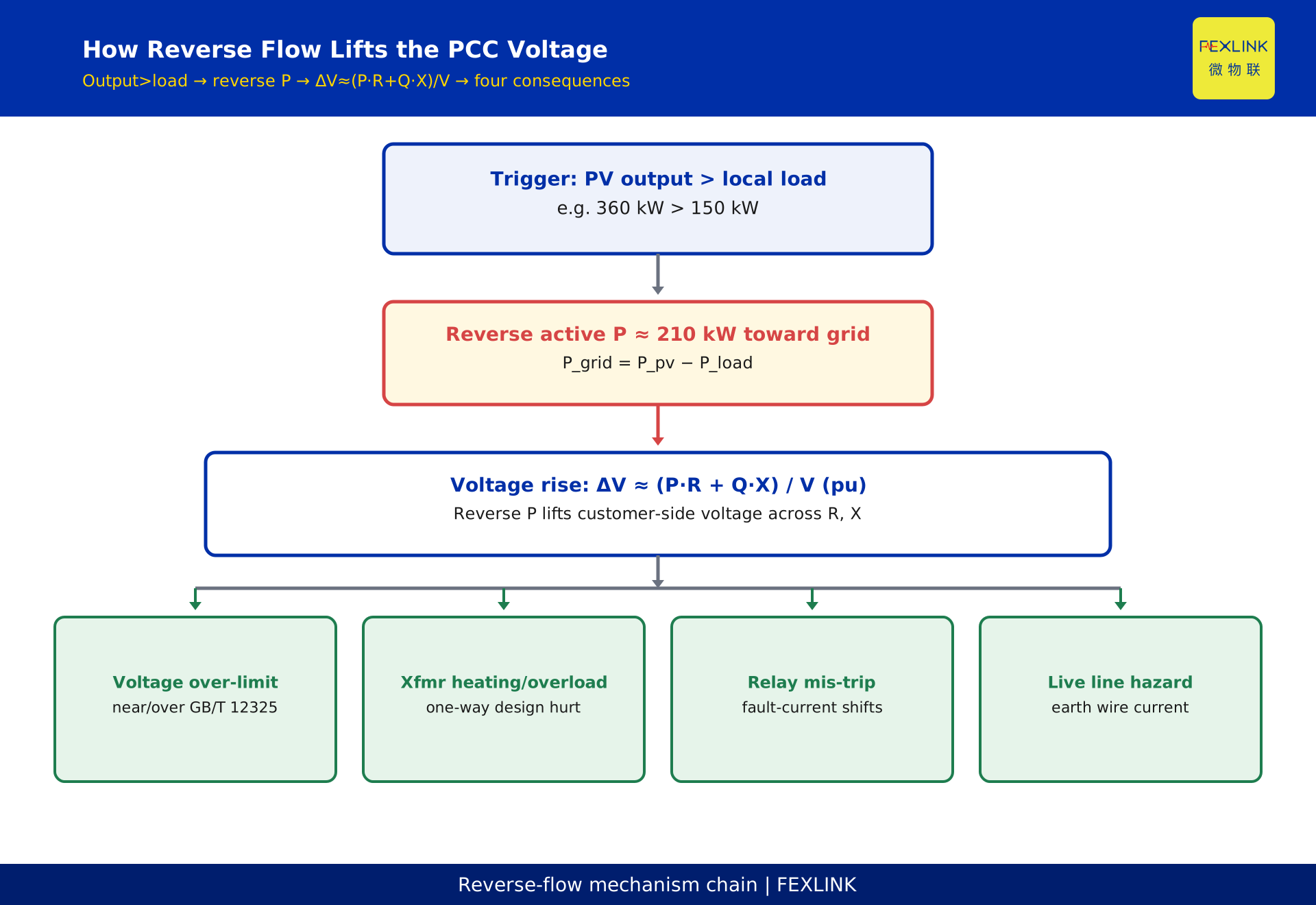
P_grid is the active power flowing from the PCC into the network. Whenever the local load P_load is smaller than the PV output P_pv, P_grid becomes positive and points toward the grid — that is reverse flow. In other words, as soon as instantaneous PV output exceeds the sum of all local loads downstream of the PCC, export is guaranteed; the moment load rises and absorbs the PV, export drops to zero.
The following figures are a constructed illustrative scenario used only to convey scale (not representing any real customer): a site installs 400 kW of rooftop PV behind an 800 kVA distribution transformer. During an overnight or low-load window the local load is only 150 kW, while midday PV output reaches 360 kW, so roughly 210 kW flows back to the grid. Note "roughly": load and output both fluctuate continuously, so the back-feed is an instantaneous quantity, not a fixed number.
Why reverse flow lifts the PCC voltage
This is the core mechanism of anti-backflow, and it must be explained qualitatively, without inventing a fixed percentage.
The change in PCC voltage in steady-state power flow is approximated (in per-unit) by:
ΔV ≈ (P·R + Q·X) / V
where P and Q are the active and reactive power flowing through the line, R and X are the line resistance and reactance, and V is the PCC voltage base. The key point: when PV reverses the flow, the active power P runs from the customer side toward the grid, and the voltage drop it creates across the line impedance pushes the customer-side (PCC) voltage up — the larger the reverse active power, the larger the lift.
Three amplifiers matter. First, longer lines with larger R and X produce a larger lift for the same reverse power, so long-spur, end-of-line low-voltage PV is the most sensitive. Second, lower local load leaves less forward drop to offset the lift, so the net rise is larger. Third, the direction of reactive power Q also contributes — inductive Q adds to the lift. Stack these together and reverse flow can push the PCC voltage toward or past the permitted supply-voltage ceiling. The limit itself comes from GB/T 12325 (Power quality — Deviation of supply voltage); this article gives no single fixed percentage because the value depends on site impedance and operating mode.
Impact on the distribution transformer
The distribution transformer is designed for one-way flow: power from high voltage to low voltage. Sustained or frequent reverse power breaks that assumption.
First, reverse power reshapes the transformer's internal loss and temperature distribution. Under reverse excitation the heating pattern of windings and core differs from forward operation, yet the rated apparent power was sized for one-way flow, so the reverse-overload risk is routinely overlooked.
Second, once voltage is pushed to its upper limit, the transformer's tap-changer logic — or the inverter's voltage/reactive control — may be forced to act or even trip off-line, which in turn causes a load-side voltage dip. In short: reverse flow lifts voltage, voltage violation triggers disconnection, disconnection causes a voltage sag — a chain reaction.
Disrupting protection coordination
This is the most overlooked yet most dangerous consequence. The existing distribution overcurrent protection was engineered on the assumption that the source sits on the substation side and fault current flows from high to low voltage. Reverse flow effectively injects a distributed source on the low-voltage side, directly changing the direction and magnitude of fault current:
- When a downstream (customer-side) fault occurs, the PV reverse current adds to or cancels the upstream source current, possibly causing a breaker that should trip to fail to operate, or one that should not to operate wrongly;
- If the protection lacks a directional element, its settings were tuned for one-way flow and lose coordination the moment reverse flow appears.
One sentence summarizes it: reverse flow invalidates the basic assumption — where the fault current comes from and how large it is — on which protection setting depends. GB/T 19964 sets grid-connection and protection-coordination requirements for PV stations precisely to bound this uncertainty.
The life-safety hazard during maintenance
This last item has nothing to do with equipment and everything to do with keeping people alive.
Once a PV array back-feeds the low-voltage side of the transformer, a line that crews expect to be dead during maintenance is in fact still live. A worker who, following "de-energized" procedure, applies a ground and begins work, will have that ground subjected to reverse current if the PV is still feeding — a direct threat to life. Electrical safety rules require verification of absence of voltage, disconnection of the distributed source, and lock-out/tag-out before any work. Anti-backflow tripping can reduce the risk from back-feed, but it is no substitute for de-energize, test, and ground procedures — equipment can fail to trip, and human life cannot be gambled on it.
Two remedies: trip the inverter vs. active curtailment
Knowing the hazards, how is reverse flow actually blocked? Two mainstream approaches, opposite in philosophy.
Approach 1: trip the PV (inverter trip). When reverse power is detected at the PCC, the inverter's AC or DC side is opened immediately, disconnecting the PV from the system. The advantage is simplicity, reliability, and zero export; the disadvantage is wasted generation and, with frequent tripping, wear on the PV asset and lost yield.
Approach 2: active curtailment. The PCC is sampled continuously for power direction, and a controller dynamically reduces the inverter's active output so that the power flowing to the grid stays at or near zero — the PV only produces what the local load can absorb. The advantage is no wasted energy and smooth operation; the disadvantage is the need for a closed-loop control and communication path, raising complexity and cost.
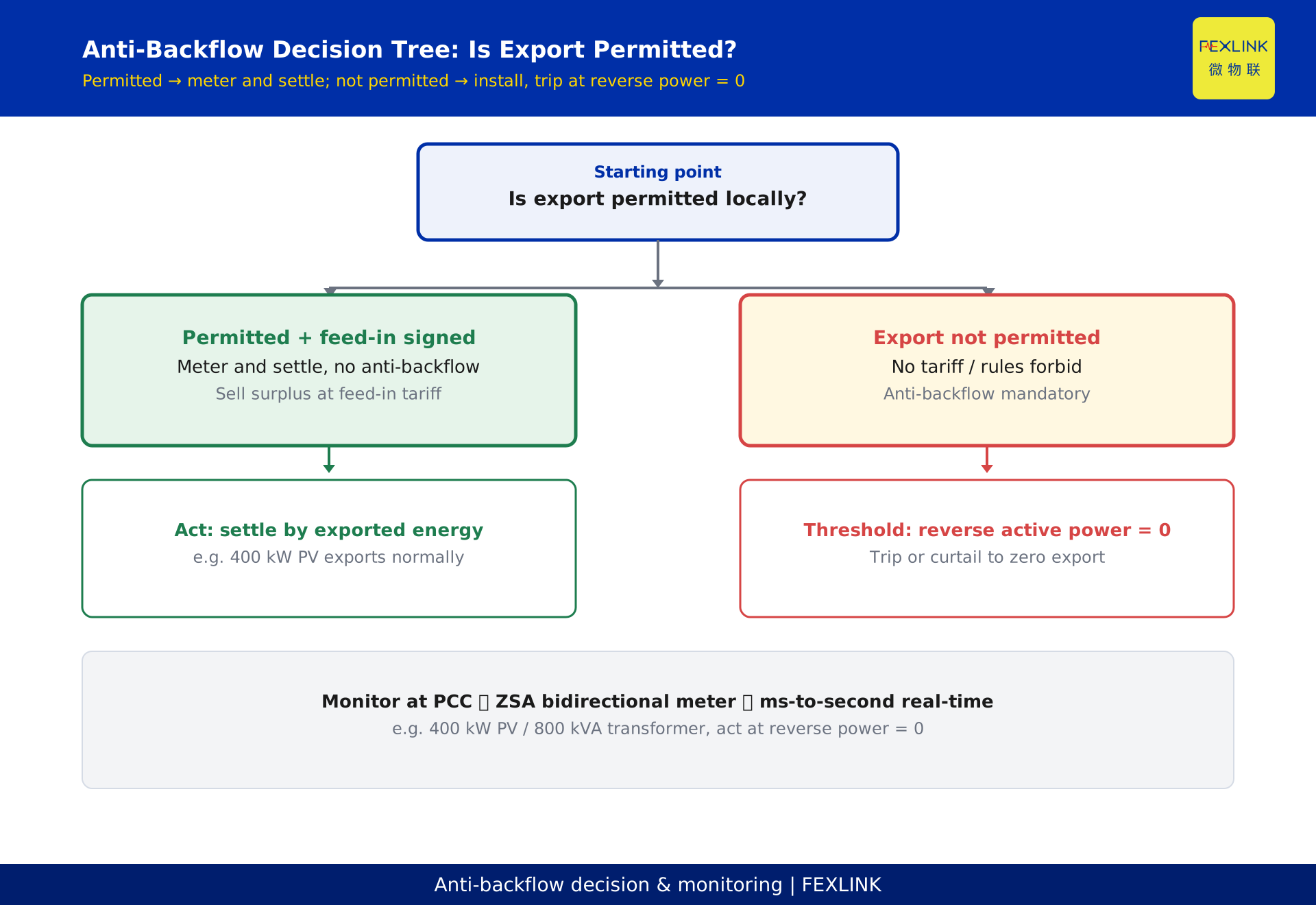
How to choose? The criterion is clear: if the connection contract permits no export at all, then whether you trip or curtail, the goal is to drive export to zero; if short-time export is permitted under a signed feed-in contract, no anti-backflow is needed at all — just meter and settle the export normally.
Where and how to monitor power direction
Anti-backflow must "see the direction" to act, so the monitoring point is decisive.
Monitoring belongs at the point of common coupling (PCC) — typically the low-voltage busbar of the distribution transformer, or the metering boundary between customer and utility — in any case the gate between local load and the grid. The meter at that point must perform bidirectional active and reactive metering and discriminate power direction; an ordinary uni-directional meter that records only forward energy is useless here.
This is where the ZSA Embedded Multi-function Smart Meter is used: it supports bidirectional active/reactive metering and power-direction discrimination, and together with an anti-backflow controller, the moment reverse active power exceeds the set threshold it issues a curtail or trip command to the inverter. The sampling and reporting interval must meet real-time needs — anti-backflow is a millisecond-to-second action, and the data link cannot introduce large delay.
One decision rule: should you even need anti-backflow?
Distilled into a single decision, stated as a criterion rather than "it depends":
Rule: look at whether export is permitted. - The utility permits export AND a power-purchase (feed-in tariff) contract is signed → no anti-backflow needed; settle exported energy normally. - Export is not permitted (no feed-in tariff, or local rules explicitly forbid it) → anti-backflow must be installed, with the trip threshold set at reverse active power = 0 (with a minimal directional margin), so that the instant reverse flow appears at the PCC, the system trips or curtails to zero export.
Remember: if export is allowed, let it earn money; if not, not a single watt may back-feed. This rule turns "can we export?" from a technical argument into a contract clause.
FAQ
Q: Why does the utility ask even a small home PV system to prevent reverse flow?
Because a residential array without a feed-in contract, or where export is forbidden, will lift end-of-line voltage when it back-feeds, degrading supply quality for you and your neighbors and, in the worst case, tripping protection off-line. Systems with a signed feed-in contract and permitted export simply meter and settle normally and need no anti-backflow.
Q: After anti-backflow trips the inverter, does the PV stop generating during the day?
Not entirely. Under curtailment the inverter only reduces output below the local load; the sun keeps generating and the site keeps consuming. Even in trip mode, action occurs only at the instant export appears; as soon as load recovers and export vanishes, grid connection is restored immediately. What is lost is only the part that could not be sold, not the whole output.
Q: With anti-backflow installed, can we skip de-energizing for maintenance?
Absolutely not. Anti-backflow only reduces back-feed; the equipment may fail to trip, so it cannot replace de-energize, verify-absence-of-voltage, apply-ground, and lock-out/tag-out. Rules require the distributed source to be disconnected and confirmed dead before work.
Q: How much does reverse flow actually raise the voltage — is there a fixed number?
There is no single fixed number. The voltage rise depends on reverse power and line impedance, estimated by ΔV ≈ (P·R + Q·X) / V — the longer the line, the lower the load, the larger the export, the larger the rise. The actual limit must follow GB/T 12325 and be calculated against the site impedance; do not invent a percentage.
Q: Is an ordinary meter at the PCC enough for anti-backflow?
No. A uni-directional meter records only forward consumption and cannot recognize reverse flow at all. You need a meter with bidirectional metering and power-direction discrimination — for example the ZSA Embedded Multi-function Smart Meter with bidirectional active/reactive metering — to give the controller a correct directional signal.
Scope and limitations
- This article discusses the technical mechanism and engineering practice of anti-reverse-flow protection for distributed PV, applicable to low-voltage and medium-voltage distributed grid-connection scenarios.
- The voltage-rise magnitude is described qualitatively; no fixed percentage is given. Actual limits follow GB/T 12325 and a site-impedance calculation; this article invents no fixed voltage-rise value.
- The illustrative figures (PV 400 kW, transformer 800 kVA, low load 150 kW, midday output 360 kW, reverse flow about 210 kW) are constructed to explain the issue, labeled as illustrative / typical magnitude, and represent no real customer or project.
- The anti-backflow trip threshold "reverse active power = 0" is an illustrative criterion; actual setpoints and directional margins are determined by the grid-connection agreement and protection settings.
- GB/T 19964 is cited only as the reference standard for distributed PV grid connection; no specific clause numbers or numeric values are quoted. Quantitative conclusions follow the current effective version of the standards.
- Parameters and selection of the ZSA Embedded Multi-function Smart Meter follow the latest product selection manual and knowledge base; this article is not a selection or procurement recommendation.
Frequently Asked Questions
Why does the utility ask even a small home PV system to prevent reverse flow?
Because a residential array without a feed-in contract, or where export is forbidden, will lift end-of-line voltage when it back-feeds, degrading supply quality for you and your neighbors and, in the worst case, tripping protection off-line. Systems with a signed feed-in contract and permitted export simply meter and settle normally and need no anti-backflow.
After anti-backflow trips the inverter, does the PV stop generating during the day?
Not entirely. Under curtailment the inverter only reduces output below the local load; the sun keeps generating and the site keeps consuming. Even in trip mode, action occurs only at the instant export appears; as soon as load recovers and export vanishes, grid connection is restored immediately. What is lost is only the part that could not be sold, not the whole output.
With anti-backflow installed, can we skip de-energizing for maintenance?
Absolutely not. Anti-backflow only reduces back-feed; the equipment may fail to trip, so it cannot replace de-energize, verify-absence-of-voltage, apply-ground, and lock-out/tag-out. Rules require the distributed source to be disconnected and confirmed dead before work.
How much does reverse flow actually raise the voltage — is there a fixed number?
There is no single fixed number. The voltage rise depends on reverse power and line impedance, estimated by ΔV ≈ (P·R + Q·X) / V — the longer the line, the lower the load, the larger the export, the larger the rise. The actual limit must follow GB/T 12325 and be calculated against the site impedance; do not invent a percentage.
Is an ordinary meter at the PCC enough for anti-backflow?
No. A uni-directional meter records only forward consumption and cannot recognize reverse flow at all. You need a meter with bidirectional metering and power-direction discrimination — for example the ZSA Embedded Multi-function Smart Meter with bidirectional active/reactive metering — to give the controller a correct directional signal.