 FEXLINK Research Institute
The short answer
A factory with rooftop PV is usually stuck on two things: it cannot see its generation, and it does not know when excess power flows back and overruns the limit. The fix is an integrated monitoring-plus-anti-reverse-flow scheme that connects sensing, judgement and action into one loop rather than adding meters. The sensing layer installs bidirectional metering and power-quality monitoring at the grid point; the edge layer runs local power-direction judgement on a gateway and cuts reverse flow within seconds; the platform layer turns generation, self-consumption and savings into dashboards with alarms. First compute the self-consumption rate, then decide whether storage is worth adding.
1. Why "seeing it" and "blocking it" belong in one scheme
Many factories treat PV as "install-and-forget": the inverter shows daily kWh, but no one knows how much was used, exported, or whether a limit was exceeded. The problem is not a missing meter but that the meters are islands: the generation meter sits on the roof, the grid meter in the switch room, and the two data streams never meet, leaving generation estimated, self-consumption guessed and reverse flow left to luck.
Splitting the two creates another trap. Monitoring detects reverse flow and raises a phone alarm, but by the time someone lowers inverter output the export has overrun the approved limit for several minutes. Grid safety needs local, timely action, not after-the-fact awareness — so monitoring supplies the judgement, anti-reverse-flow executes locally, and the platform keeps the record.
2. The architecture: sensing, edge, platform
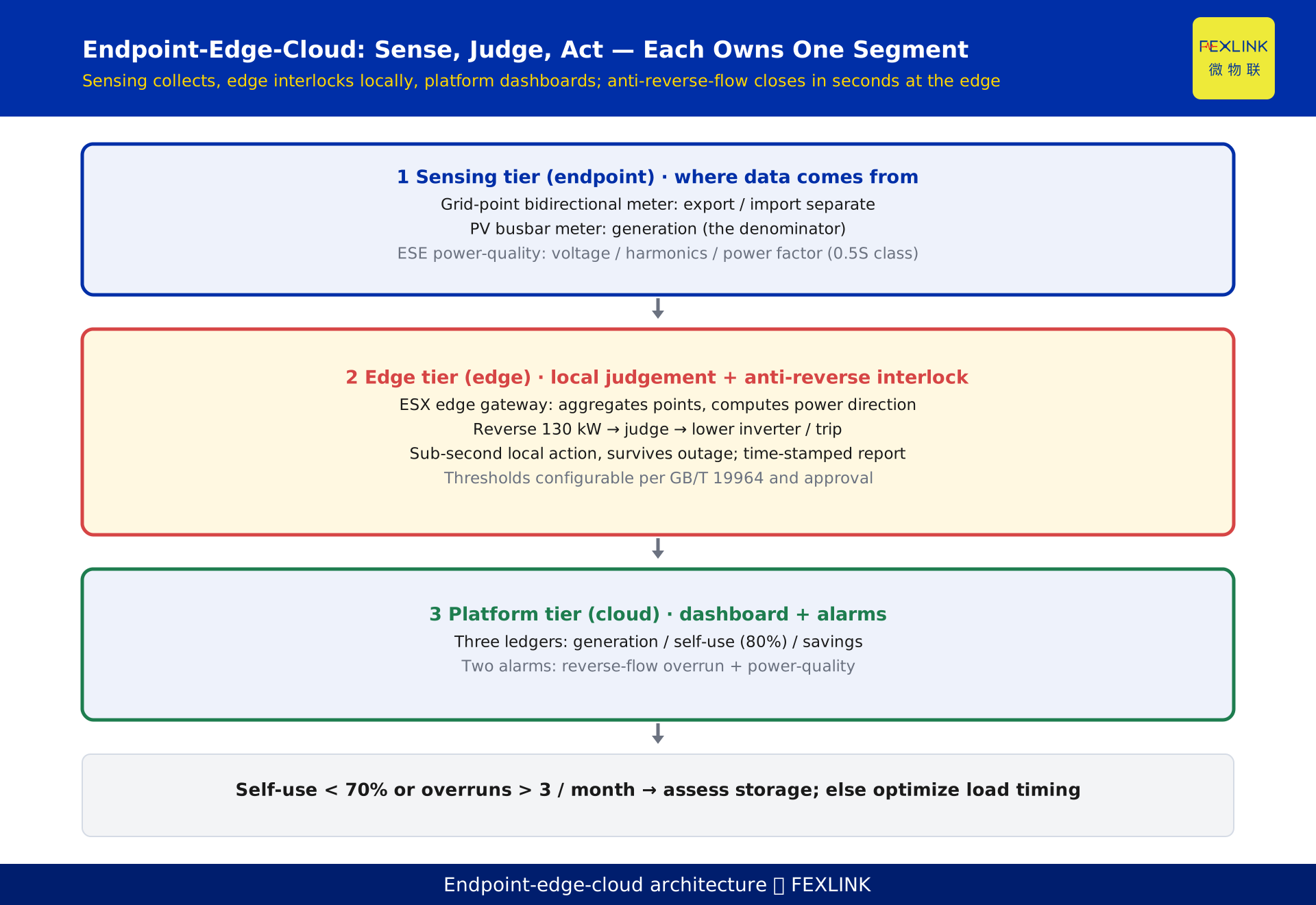
The whole scheme is organized in three tiers — endpoint, edge, cloud — each owning one segment with no overlap.
Sensing tier (endpoint). Metering and monitoring points at the grid connection point, key outgoing feeders and the PV busbar answer "where does the data come from". The core is bidirectional metering that accumulates exported and imported energy separately, plus power-quality monitoring of voltage deviation, harmonics and power factor.
Edge tier (edge). An edge gateway near the switch room aggregates the measuring points, computes power direction in real time, and the moment reverse power is detected — PV output exceeding local load — it sends a reduce-power or trip command to the inverter or the grid-switching breaker. This segment must run locally, independent of the network and the platform.
Platform tier (cloud). It turns the edge-uploaded data into dashboards of generation, self-consumption and savings, and configures reverse-flow and power-quality alarms to answer "who sees it and how it is reviewed".
The tiers talk over standard protocols such as Modbus and MQTT; the edge tier is the pivot — the platform's data source and the anti-reverse-flow executor, the biggest increment over "just install meters".
3. Where to place the measuring points
Correct point placement makes every later metric trustworthy. Three locations have the highest priority.
Grid connection point (boundary side). This is the boundary between the public grid and the plant. A bidirectional meter is mandatory here, accumulating export upward and import downward. It is the primary basis for reverse-power judgement and the basis for billing settlement.
PV busbar / inverter AC output side. This meters actual PV generation and is the denominator: self-consumption rate = locally consumed energy ÷ total PV generation. The denominator comes from this circuit.
Key outgoing feeders. Sub-meters on the main load incomers let the edge tier infer the real-time local load. Cover the major energy circuits; there is no need to meter everything.
A common mistake is to put all meters on the main incomer and infer load from the total, which is imprecise and cannot locate problems. Prioritize accuracy on the two circuits that matter: the grid-point bidirectional meter and the PV-busbar meter, and complete the rest by load criticality. The metering accuracy class should be no lower than 0.5S; otherwise small reverse flows are drowned by meter error.
4. Anti-reverse-flow interlock: local, sub-second action
Anti-reverse-flow is essentially a power-direction interlock. When the grid point detects reverse power (PV output greater than local load), the edge gateway acts locally within seconds to keep export inside the approved threshold. The logic has three steps.
Step one, judge direction. The edge gateway continuously compares PV output against local load; the instant the difference turns from negative to positive, reverse flow begins.
Step two, act locally. Once reverse power exceeds a soft setpoint (below the hard limit, with a buffer), the gateway first lowers inverter active output through communication; if it still exceeds after reduction, it trips the grid-switching breaker. The whole process does not depend on a platform command and still runs when the network is down.
Step three, recover and report. When load recovers and reverse power disappears, grid connection resumes automatically, and every action is time-stamped and reported to the platform for later review.
It must be stressed that the specific reverse-power limit, action time and whether short overruns are allowed are all governed by the grid-connection approval and the current effective text of GB/T 19964. This article gives no specific values. What the scheme must build is the capability of "local action plus platform record"; the limit is only a configurable parameter.
5. Designing the self-consumption and savings dashboards
The platform dashboard needs only three core metrics.
Generation. From the PV-busbar meter, accumulated by day, month and year, with equivalent operating hours flagged.
Self-consumption rate = locally consumed energy ÷ total PV generation. This is the main metric for the self-use mode; the higher it is, the less it depends on the export tariff.
Savings. Keep two ledgers: the self-use portion saves purchased electricity (converted at the local time-of-use tariff), and the export portion is settled at the feed-in tariff, so it is clear "how much was saved and how much was sold".
The dashboard must also raise two alarms: a reverse-flow overrun alarm (platform notification plus edge-action log) and a power-quality overrun alarm (voltage, harmonics, power factor), with configurable thresholds — run one month on loose values, then tighten from the actual distribution.
6. When to add storage
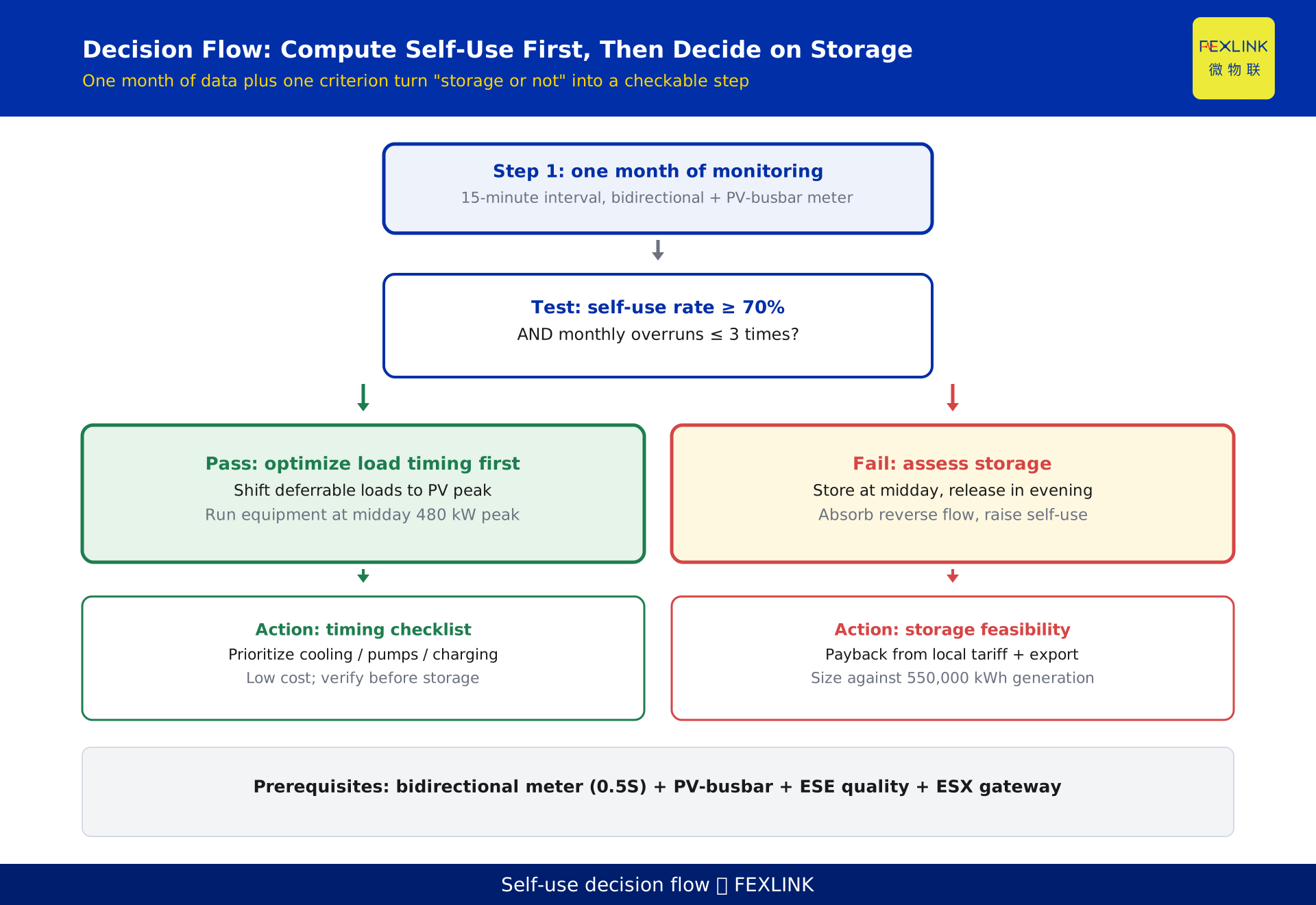
Once monitoring runs, the self-consumption-rate curve is the most valuable output; it directly answers "should we add storage".
Here is a clear criterion: when the self-consumption rate stays below 70%, or the average monthly reverse-flow overrun count exceeds 3 times, it is worth launching a storage assessment. Conversely, a rate stable above 80% with almost no overruns means the local load already absorbs most PV and storage's marginal benefit is limited; shifting deferrable loads into the PV peak is more cost-effective.
Storage's role is peak shaving plus absorbing reverse flow: store midday surplus PV and release it in the evening, raising self-consumption. It is not mandatory — prove the self-use rate is genuinely low before investing, or it becomes storage for storage's sake.
7. A worked example: a 500 kWp rooftop PV factory (constructed data)
The following is a constructed example to illustrate the architecture and the arithmetic. It does not represent any real customer or project; all parameters are for demonstration.
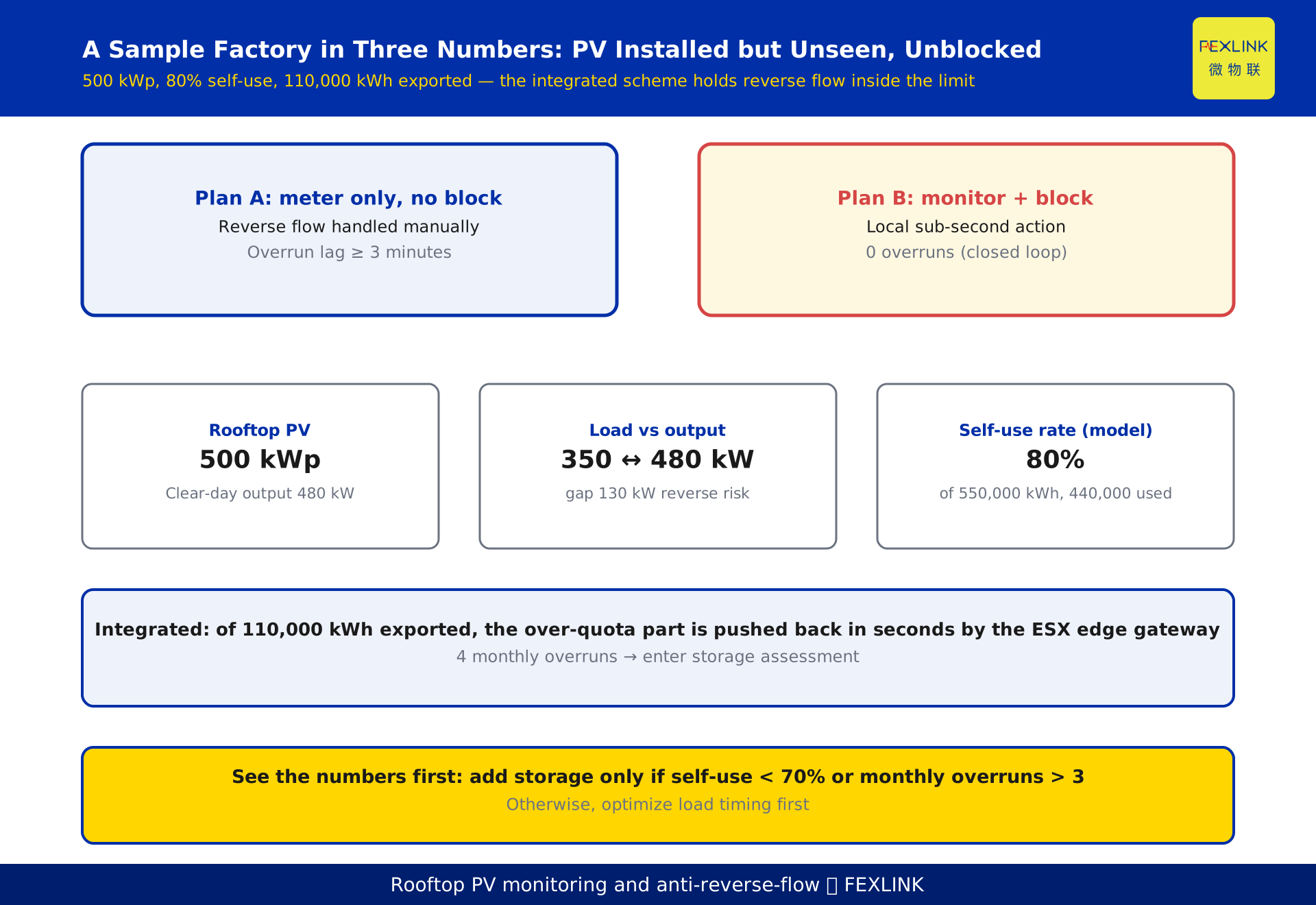
A factory has rooftop PV of 500 kWp and a stable load of about 400 kW. At midday on a clear day PV output can reach 480 kW, but with some lines on rotation break the load trough drops to 350 kW, leaving about 130 kW of potential reverse power.
At about 1,100 utilization hours, annual generation is about 550,000 kWh; assuming 80% self-consumption with no controls, local use is about 440,000 kWh and export about 110,000 kWh, and if that exceeds the approved export allowance a reverse-flow overrun triggers.
After the integrated scheme is deployed, the edge gateway lowers inverter output the instant reverse power appears and holds export inside the threshold, while the platform shows the self-consumption rate and the two ledgers. After one month the rate is only 78% with 4 overruns, which — by the section 6 criterion — triggers the assess-storage workflow. That is data-driven decision making.
8. What this adds over KD-0539 and KD-0543
The neighbouring articles cover "mode selection" (KD-0539) and "device selection" (KD-0543). The increment here is landing both into one complete system architecture rather than stopping at "which mode, which device". The first two answer "what is it, what to pick"; this one answers "how to wire it so it truly does not reverse".
Two concrete increments. First, the endpoint-edge-cloud responsibility split: the sensing tier only collects, the edge tier judges and acts locally, and the platform tier runs dashboards and alarms, with the three decoupled so a failure in one is swapped without touching the others. Second, the local anti-reverse-flow interlock: "judge direction — act locally — recover and report" becomes a second-scale local loop instead of throwing a reverse-flow alarm at a human.
9. Deployment checklist: selection and wiring
Turn the scheme into a site by following this checklist.
- Grid-point bidirectional metering: choose the ZSA smart meter, installed at the boundary between the public grid and the plant for bidirectional metering of export and import.
- Power-quality monitoring: add the ESE power quality monitor at the grid point to watch voltage deviation, harmonics and power factor, meeting the observability requirement of grid-connected operation.
- Edge gateway: choose the ESX edge gateway, placed near the switch room, aggregating the points, running power-direction judgement and executing the anti-reverse-flow interlock, with local action surviving a network outage.
- Platform interface: the edge tier uploads over a standard protocol; the platform configures the three ledgers (generation, self-consumption, savings) and the two alarm classes.
- Limit configuration: reverse-flow threshold, action time and alarm threshold all follow the grid-connection approval and the current text of GB/T 19964, implemented as configurable parameters rather than hard-coded in logic.
After deployment, run one month of baseline, then use the self-consumption curve to decide on storage. Do not promise returns before there is data.
10. FAQ
Q: Can I just install one bidirectional meter and skip the anti-reverse-flow device?
A meter lets you see reverse flow but cannot stop it. After monitoring detects an overrun, handling it manually often means the export has already exceeded the approved limit for several minutes, and the grid-safety risk remains. The meter is sensing; the interlock is action. They must be paired.
Q: Will the anti-reverse-flow action affect normal generation?
No. During normal self-use the power direction is forward and the interlock does nothing. It only intervenes when reverse power appears (PV output greater than load), and it prefers lowering inverter output over tripping, minimizing impact on generation continuity.
Q: What self-consumption rate counts as "good enough"?
There is no single hard line, but the criterion in section 6 is a guide: steady above 80% usually means the local load can absorb it, while below 70% or over 3 overruns per month is when storage is worth considering. The target must combine the local tariff and export policy.
Q: If the edge gateway loses the network, does anti-reverse-flow still work?
Yes. All judgement and action of the interlock run locally on the edge tier, independent of the platform and the network. The dashboard stops updating during the outage, but local protection still executes and the data back-fills on recovery.
Q: How do I pick the specific GB/T 19964 limits?
This article gives no specific numbers. GB/T 19964 is the technical code for PV stations connecting to the power system; its voltage-deviation, harmonic, power-factor and anti-islanding limits are governed by the current effective text and your grid-connection approval. Build them as configurable parameters in the scheme.
Scope and limitations
- The "monitoring plus anti-reverse-flow" integrated scheme discussed here applies to industrial and commercial sites that have installed or plan to install rooftop distributed PV under a "self-use with surplus export" model. A full-export model has no reverse-flow concern and takes only the monitoring part.
- All factory data in section 7 (500 kWp capacity, 400 kW load, 480 kW output, 130 kW potential reverse power, 80% self-consumption rate, 550,000 kWh annual generation, 440,000 kWh self-consumed, 110,000 kWh exported, 1,100 utilization hours, 4 monthly overruns) are constructed examples to illustrate the architecture and arithmetic, are labelled as a worked example, and do not represent any real customer or project. Actual parameters require site survey and measured data.
- Specific GB/T 19964 limits (voltage deviation, harmonics, power factor, anti-islanding action time and so on) are not cited with numeric values here; they follow the current effective text and the grid-connection approval, and the scheme treats them as configurable parameters rather than hard-coded.
- GB/T 28750 is the national standard for measurement and verification of energy savings. The savings and self-consumption quantification here may follow its "measurement-led, baseline-to-report-period calibration" methodology, but no specific numeric values are cited.
- The statement "consider storage when self-consumption rate is below 70% or monthly overruns exceed 3 times" is a decision criterion proposed in this article as methodological advice; whether to actually add storage must combine the local tariff, export policy and payback calculation.
- Model numbers and specifications for the ZSA smart meter, the ESE power quality monitor and the ESX edge gateway are subject to the latest selection manual and product knowledge base. This article is not a selection or procurement recommendation.
- Standard numbers cited are current as of writing; if a standard is revised, the quantitative conclusions here require rechecking.
Frequently Asked Questions
Designing an Integrated Monitoring and Anti-Reverse-Flow
A factory with rooftop PV is usually stuck on two things: it cannot see its generation