 FEXLINK Research Institute
The short answer
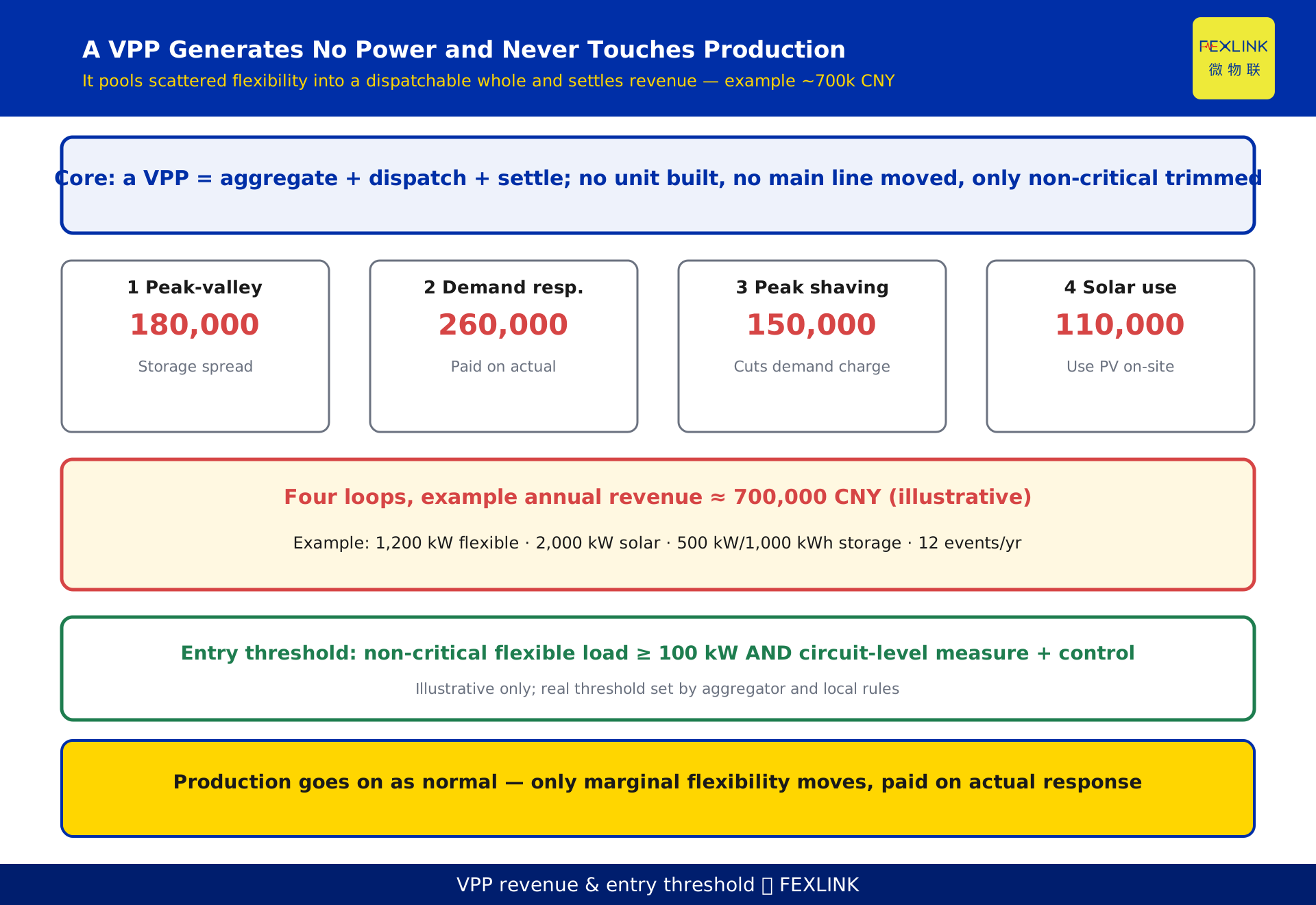
When a factory is invited to "connect to a virtual power plant," the first thing to get straight is that a VPP does not mean building a real power station on your site. It is an "aggregate, dispatch, settle" system that pools the flexible load, rooftop solar and storage you already have — with hundreds of similar sites — into one "dispatchable whole" that joins grid demand response or energy markets. It generates no power and never touches your main production line. It only trims non-critical load when needed and pays you for the actual response you deliver. One rule covers it: after connecting, production goes on as normal, only the marginal flexibility moves, and you earn from "giving up a bit of load on demand."
1. Unpack the name: a virtual power plant is not a plant
The words "virtual power plant" most easily mislead people into picturing "another station inside the park." That is the biggest misconception and must go first.
A real VPP has no steam turbine, no boiler, no chimney. It burns no fuel and adds no generation capacity. Its "plant" is virtual — a software and communications layer that logically stitches physically scattered resources into one adjustable unit. To the outside world, the grid and market see a single entity that can raise or lower power on schedule.
So an invitation to "connect to a VPP" means "connect the flexible resources you already have to a larger dispatch network," not "build a plant." You are the resource provider, not the power producer.
2. What it aggregates: flexible load, distributed solar, storage
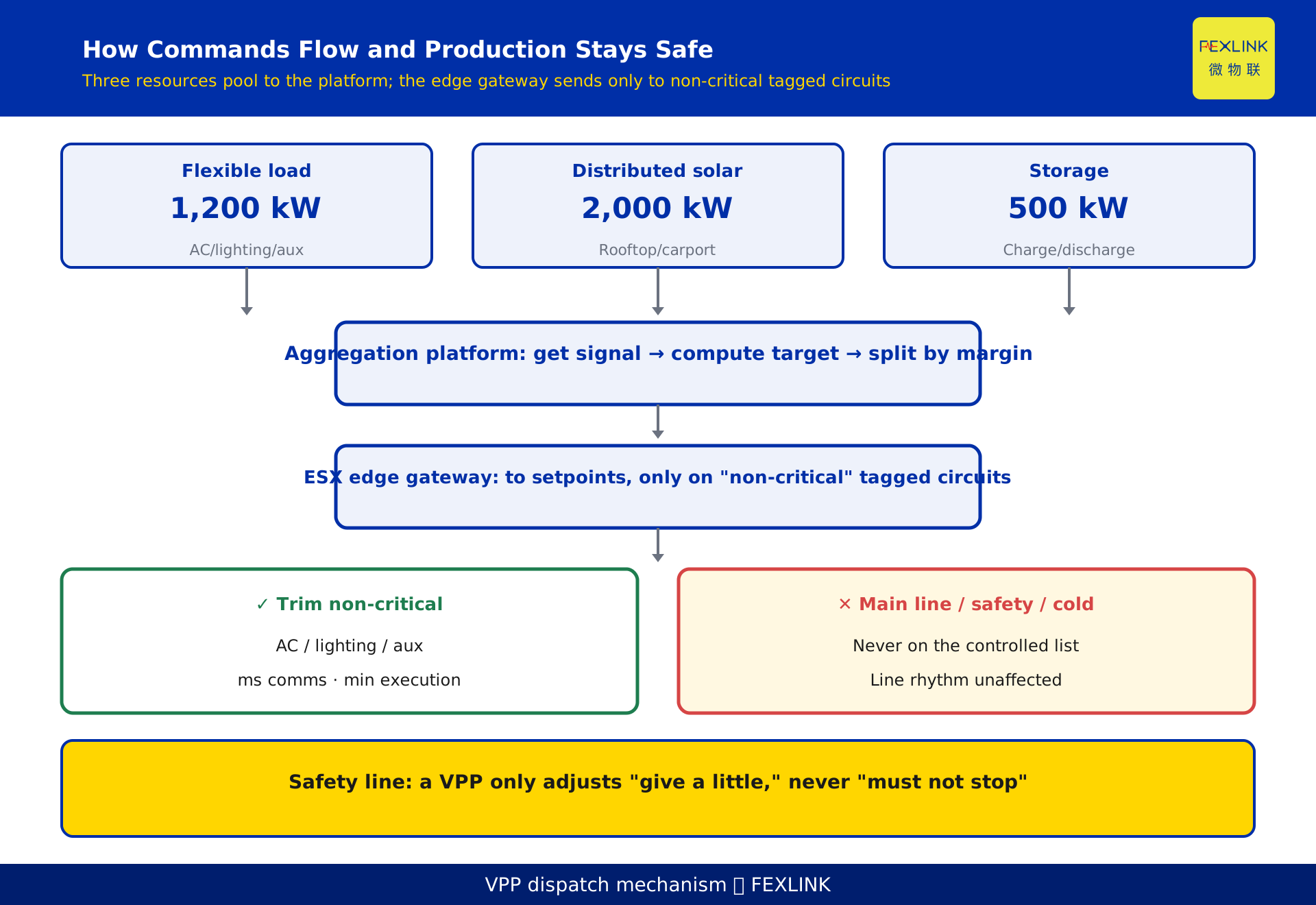
A VPP acts like one unit because three resource classes stack together:
Flexible load, also called adjustable load — consumption that can be briefly reduced or shifted without hurting the core business: central AC, ventilation, lighting, non-continuous auxiliaries, interruptible chargers. Its defining feature is "negative power": use a little less when asked, and it is as if you generated a little more.
Distributed solar. Rooftop and carport solar is already generation, only scattered and variable; the platform consolidates many sites' output forecasts into one predictable curve for the market or local use.
Storage. Batteries can both charge and discharge — the only class that can both "generate" and "absorb," which makes them the best fit for peak shaving and demand control.
Each class alone is small, but pooled to a few or tens of megawatts they give the grid a regulation capacity like a mid-sized unit, turning many small flexibilities into one tradable capacity.
3. How dispatch commands are sent, and how production stays safe
Owners' top concern: when the command comes, will it hit my main line? A well-designed system relies on "tagged priority plus edge execution" to touch only non-critical load.
The flow: the aggregation platform receives a grid invitation or price signal, computes "how much total power must drop now," decomposes the total by each site's flexibility margin, and pushes it through the on-site ESX smart edge computing gateway (FEXLINK edge gateway, for local protocol parsing and command delivery) to end devices. The gateway translates the platform's "total power target" into device setpoints and acts only on circuits tagged "non-critical." Main line, critical process, safety and cold-chain loads are never controlled.
For example, an invitation asks a park to lower 1,200 kW overall. The system does not cut any main equipment; it trims AC, delays non-urgent auxiliaries, and discharges storage to cover the gap. Communication is millisecond-level, execution minute-level; the line rhythm is unaffected. The safety boundary in one sentence: a VPP only adjusts "give a little," never touches "must not stop."
4. Four revenue loops: how resources become money
Once connected, flexible resources earn through four loops:
Loop one, peak-valley arbitrage. Storage charges at low off-peak prices and discharges at high on-peak prices, capturing the spread. Most intuitive, and it needs storage plus a wide enough time-of-use spread.
Loop two, demand response. When the grid is tight it issues an invitation; you lower load as agreed and are compensated afterward for actual response. The classic VPP revenue source — selling idle flexibility to the grid as insurance.
Loop three, storage-assisted peak shaving. Storage and load management flatten the monthly peak demand or capacity-charge peak, directly cutting the demand or capacity part of the bill — earning "the peak bite," not energy money.
Loop four, solar self-consumption. Use as much rooftop solar on-site as possible, buy less grid power, and export the surplus at the feed-in tariff; the platform can also coordinate "solar plus storage" so more green power stays inside the park.
The loops are not mutually exclusive: the same storage does solar self-consumption by day, arbitrage by night, demand response at critical moments — one asset, multiple streams; but every loop depends on "measurable and controllable."
5. A worked example: what happens after a park connects
The following is an illustrative scenario constructed to show the arithmetic. It does not represent any real customer or project.
A park was assessed to have: non-critical flexible load of 1,200 kW (central AC plus lighting plus interruptible auxiliaries), rooftop distributed solar of 2,000 kW, and storage of 500 kW / 1,000 kWh. The retrofit only added end-side metering and control devices and deployed the ESX smart edge computing gateway for local aggregation. No generation capacity was added.
In the first year, the park joined demand response 12 times and ran daily peak-valley arbitrage and peak shaving. On the constructed basis, the four loops settled at roughly: 180,000 CNY from arbitrage, 260,000 CNY from demand-response compensation, 150,000 CNY from storage peak shaving, and 110,000 CNY from extra solar self-consumption — about 700,000 CNY in total.
Note this 700,000 CNY is not "bills saved." It is revenue settled for providing regulation services, paid on actual response. It does not change the park's own total consumption; it only gives up flexibility when the grid needs it and collects the consideration.
6. The minimum to connect: measurement and control
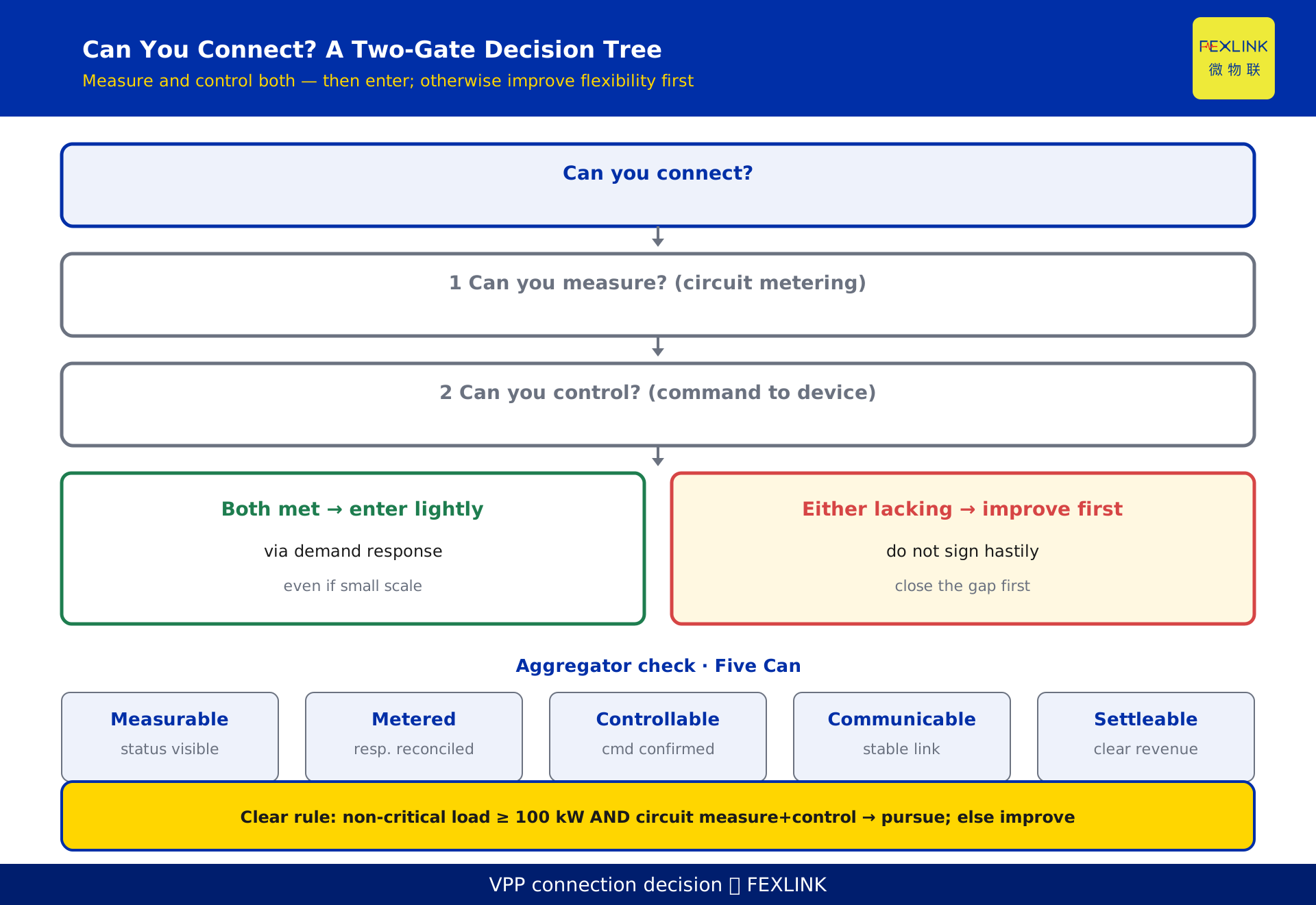
To connect, two hard thresholds — miss either and you cannot:
First, can you measure? The platform must know, in real time, how much each flexible circuit draws, how much solar generates, and how much storage charges or discharges. Without circuit-level metering, the platform is blind: it cannot decompose commands or later prove "you really responded." The minimum is high coverage of major flexible circuits and fine sampling interval.
Second, can you control? Seeing is not enough; you must act. Controllable means the command actually reaches the device — AC can be set, auxiliaries delayed, storage charged or discharged. If equipment is manual or its protocol closed, all the flexibility is only "paper-flexible."
These are hard thresholds, not nice-to-haves. Many projects talk long but never connect because of a measurement or control gap; once both exist, even a small resource can enter lightly through demand response.
7. The "five can" framework: how aggregators accept resources
Aggregators usually apply a "five can" test; walk it once and you get an objective readiness score:
- Measurable: status visible in real time, the platform sees it.
- Metered: every response independently measured and reconciled.
- Controllable: commands sent, executed and confirmed.
- Communicable: the device–platform link is stable with manageable latency.
- Settleable: response volume maps to a concrete revenue line, reconciliation clear.
The first two are the foundation, the last three are capabilities; the most common failure is "metered" and "controllable" not closing the loop — you see but cannot control, or control but cannot settle.
8. Five questions to clear before connecting
Clear these before signing and avoid most pitfalls:
- What are the trigger conditions and advance-notice window for an invitation? They decide whether you can respond without hurting production.
- Is settlement based on "committed" or "actual" response? Actual volume is fair and audit-proof.
- Exactly which circuits are on the controlled list? Main production, safety and cold chain must be explicitly excluded.
- How compatible is the edge gateway's protocol? Whether legacy equipment can connect decides retrofit cost.
- How are revenue sharing and the settlement cycle agreed? Too long a cycle cripples cash flow.
One clear criterion: when your non-critical flexible load is at least 100 kW and you have circuit-level measurement and control, the revenue path of connecting is clear and worth pursuing; if either is lacking, improve flexibility first rather than signing hastily. This quantifies the two hard thresholds — "is there something to pool, and once pooled can it be settled" — instead of a vague "it depends."
9. Common myths: it will not save your bill, and it is not free lunch
Three myths to correct:
Myth one, a VPP will cut my bill. It does not cut the bill directly; it monetizes your flexible resources externally. The park's own total consumption does not fall because of connecting; what changes is the book entry of revenue from giving up flexibility outward. Bill-cutting is the efficiency retrofit's job.
Myth two, connecting means moving equipment and disrupting production. A compliant system only moves non-critical flexibility; main production is untouched. What really moves is the small end-side metering and control retrofit, not the line.
Myth three, the policy arrives and the money rolls in. NDRC Energy [2025] No. 357 sets the direction of building VPPs faster and aggregating scattered resources into demand-side management and market trading, but the specific compensation standards and trading rules follow the official documents and local implementation. The revenue is real, but earned through operation, not collected passively.
10. Frequently asked questions (FAQ)
Q: After connecting to a VPP, will my production be interrupted?
No. A compliant VPP only issues fine-tuning commands to flexibility tagged "non-critical" — air conditioning, lighting, interruptible auxiliaries. The main line, critical process, safety and cold-chain loads are not on the controlled list. A typical response is only a slight wiggle in the energy curve; the line rhythm is unaffected.
Q: Is a VPP the same as an efficiency retrofit?
No. A retrofit aims to use less energy and lower total consumption; a VPP aims to aggregate "the flexibility you can give up" and provide regulation services externally, settled on actual response. They can run in parallel but their logic is completely different — one is subtraction, the other turns subtraction into a tradable asset.
Q: I have no storage, only flexible load and solar. Can I still connect?
Yes. Storage is only one of three resource classes and is not mandatory. As long as you have enough flexible load or distributed solar and meet the two minimum requirements of measurement and control, you can enter lightly through demand response. Storage only enriches the revenue loops.
Q: How is the revenue calculated, and could it be undercounted?
Settlement on actual response, not committed volume, is the key. The platform relies on circuit-level metering to reconcile independently afterward, and every kilowatt-hour of response is traceable. Before signing, confirm the settlement basis is "actual volume" and write it into the contract — the single most protective clause for you.
Q: Is the VPP mentioned in the policy the same one I am invited to join?
Same direction. NDRC Energy [2025] No. 357 encourages building VPPs and aggregating scattered resources into demand-side management and market trading; the invitation you received is exactly the concrete aggregation under that direction. But the specific quotas, compensation standards and trading rules follow the official release, and this article does not replace the official document.
Scope and limitations
- The VPP operation loop and user revenue discussed here apply to user-side connection under the "aggregate, dispatch, settle" model. Islanded solar that self-consumes and joins no external market is out of scope.
- The worked example (non-critical flexible load 1,200 kW, distributed solar 2,000 kW, storage 500 kW / 1,000 kWh, 12 demand-response events per year, about 700,000 CNY across four loops) is constructed to illustrate the arithmetic and does not represent any real customer or project. Actual revenue depends on local tariffs, invitation frequency and settlement rules, and must be verified against site survey and measured data.
- The "non-critical flexible load of at least 100 kW" is an illustrative threshold used to quantify the decision criterion, not a uniform standard; the real threshold is set by the aggregator and local rules.
- The "minute-level" response latency is an industry target example; concrete figures follow the platform and communication equipment specifications.
- The reference to NDRC Energy [2025] No. 357 states only the policy direction; specific clauses, quotas and compensation standards follow the official release and local implementation, and this article is not a complete interpretation.
- Model numbers, protocols and interfaces of the ESX smart edge computing gateway follow the latest selection manual and product knowledge base; this article is not a selection or procurement recommendation. Product content is below 20% of the article's knowledge content.
- Standard and policy numbers cited are current as of writing; if a document is revised, related conclusions require rechecking.
Frequently Asked Questions
A Virtual Power Plant Is Not a Plant
When a factory is invited to "connect to a virtual power plant," the first thing to get straight is that a VPP does not mean building a real power station