 FEXLINK Research Institute
The short answer
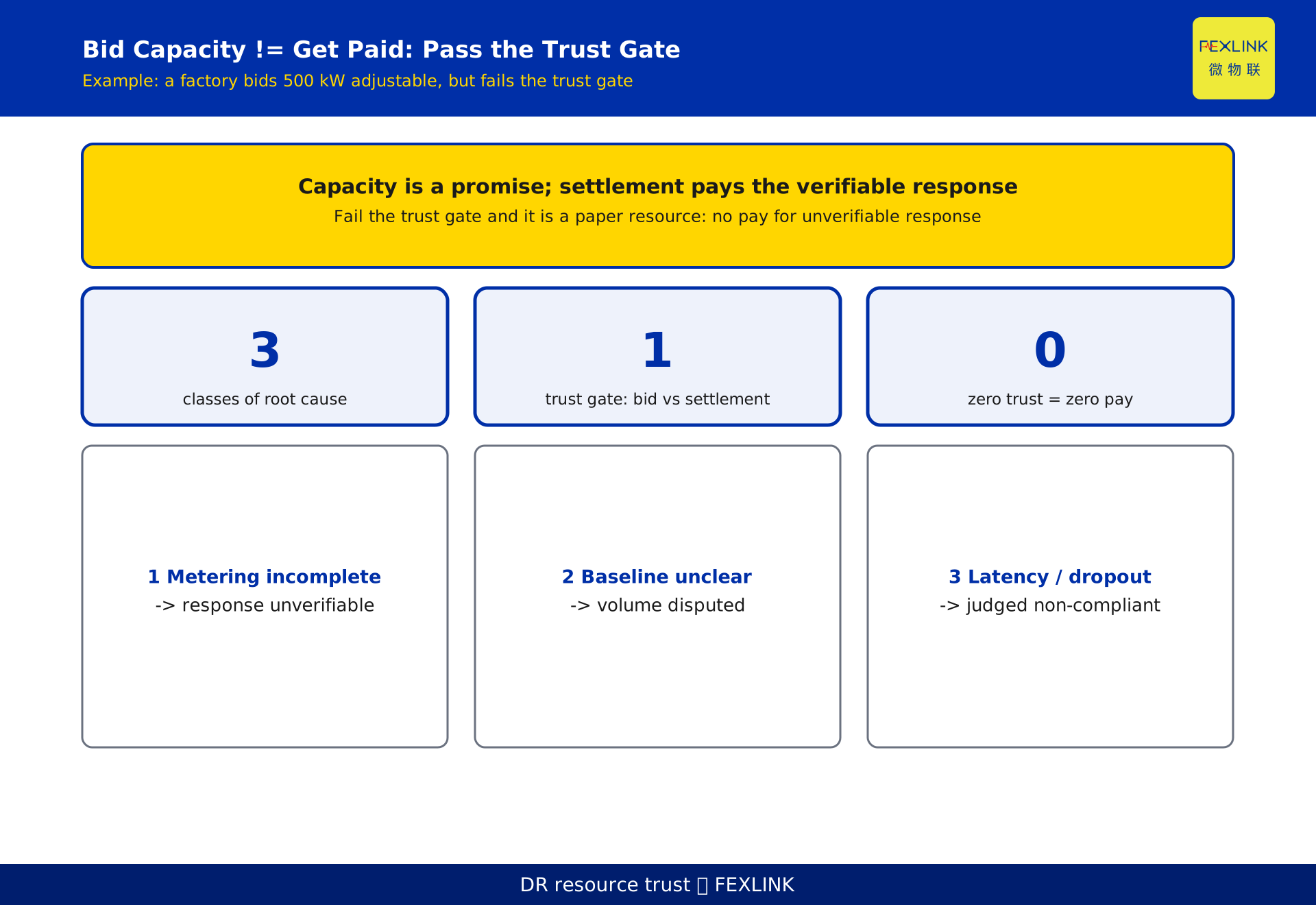
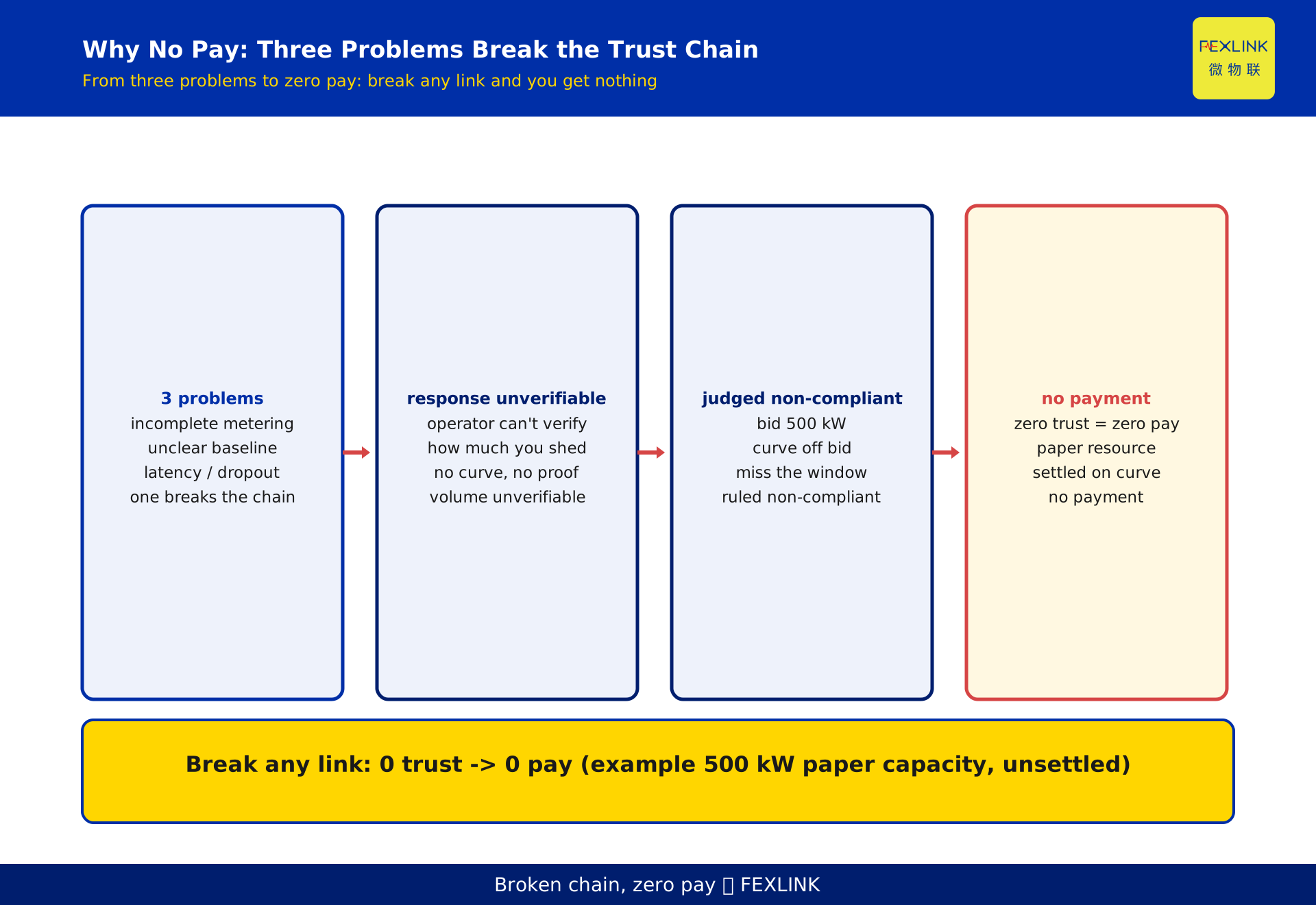
You report adjustable capacity, yet when the actual response comes, the operator judges it "non-compliant, untrustworthy" and pays you nothing. The root cause is almost never the capacity itself — it is that the "trust" gate was not passed. Three classes of reasons get a resource flagged untrustworthy: metering data that is incomplete or unsynced (the operator cannot verify how much you actually responded); a baseline that cannot be pinned down (the response volume does not reconcile); and command-to-action latency that is too long or drops out (you did not shed load when you should have). To turn the capacity you bid into money you actually collect, close the three gaps first — verifiable metering, an accurate baseline, and reliable execution — then bid.
1. Why "bidding capacity" and "getting paid" are separated by a trust gate
Many participants treat demand response as "report a number, then use less power when the time comes." But settlement does not pay for what you reported; it pays for what you can prove you did not use, independently verifiable. The bid capacity is a promise; the settlement basis is the response volume — the difference between the baseline load and the measured load. The layer in between — "can be verified" — is the trust gate. If that gate fails, no matter how large the capacity, it is a paper resource, and the operator will not pay for a response it cannot verify. So "getting on the list" and "getting paid" are two different things: the first is a promise, the second a verification.
2. Class 1 — untrustworthy: metering data incomplete or unsynced
The response volume is computed from metering data, and once metering is incomplete or unsynced, the response volume cannot be verified. Three common failures.
First, incomplete coverage: you only watch total consumption at the main meter and never cover the actual branches or equipment that perform the response. When the operator computes response from the main meter, what you "actually shed" and what the books "show shed" do not match. Second, timestamps not unified: each meter and system keeps its own clock and is never aligned to the operator's time window, so which interval the shaving actually occurred in cannot be stated. Third, data gaps: communication drops, collection misses, and the curve has holes in the critical window, so the operator can only judge "data incomplete, cannot verify."
The test is a single line: metering used for settlement must cover the responding entity, carry a unified timestamp, be synchronized to the operator clock, have zero gaps in the critical window, and leave a traceable record of every upload. Miss any of these and the response volume collapses at the root.
3. Class 2 — untrustworthy: a baseline that cannot be pinned down
Even with complete metering, the response volume must be compared against a baseline. The baseline is "what you would have used had you not participated," and the response volume equals baseline load minus measured load (peak shaving), or the reverse (valley filling). Once the baseline cannot be pinned down, the response volume is guaranteed to be disputed.
Common baseline problems: the baseline algorithm is not fixed — this time a workday, next time a holiday similar-day, and the number moves every time the basis changes; the baseline modeling data is not archived, so at reconciliation you cannot produce "how we computed it"; and some report "total energy" as if it were a "power difference," which is the wrong unit entirely. Direction must not be reversed — peak shaving is baseline minus measured, valley filling is measured minus baseline; reversed, it counts "no response" as "over-response."
The test: lock and archive the baseline algorithm in advance, keep the modeling data traceable, and nail the peak-shaving / valley-filling direction before bidding — no after-the-fact recomputation.
4. Class 3 — untrustworthy: command-to-action latency too long or dropping out
Even with accurate metering and a clear baseline, if execution drops the ball, the response is still judged non-compliant. Demand response is a closed loop of "operator sends command, equipment acts," with two latency segments in between: communication latency (command from operator to your site) and equipment response time (from receipt to actually shedding). If the two stacked are too long, the actual response curve deviates from the bid curve, the "shed energy" in the critical window falls short, and settlement against the actual curve naturally judges you non-compliant.
Worse is dropping out: no receipt of the command, no action by the equipment, the link broken midway — the operator simply does not know whether you "executed at all." The test: commands have receipts, actions have records, and critical links have redundancy, so on site you can see in real time "did the command arrive, did it shed enough."
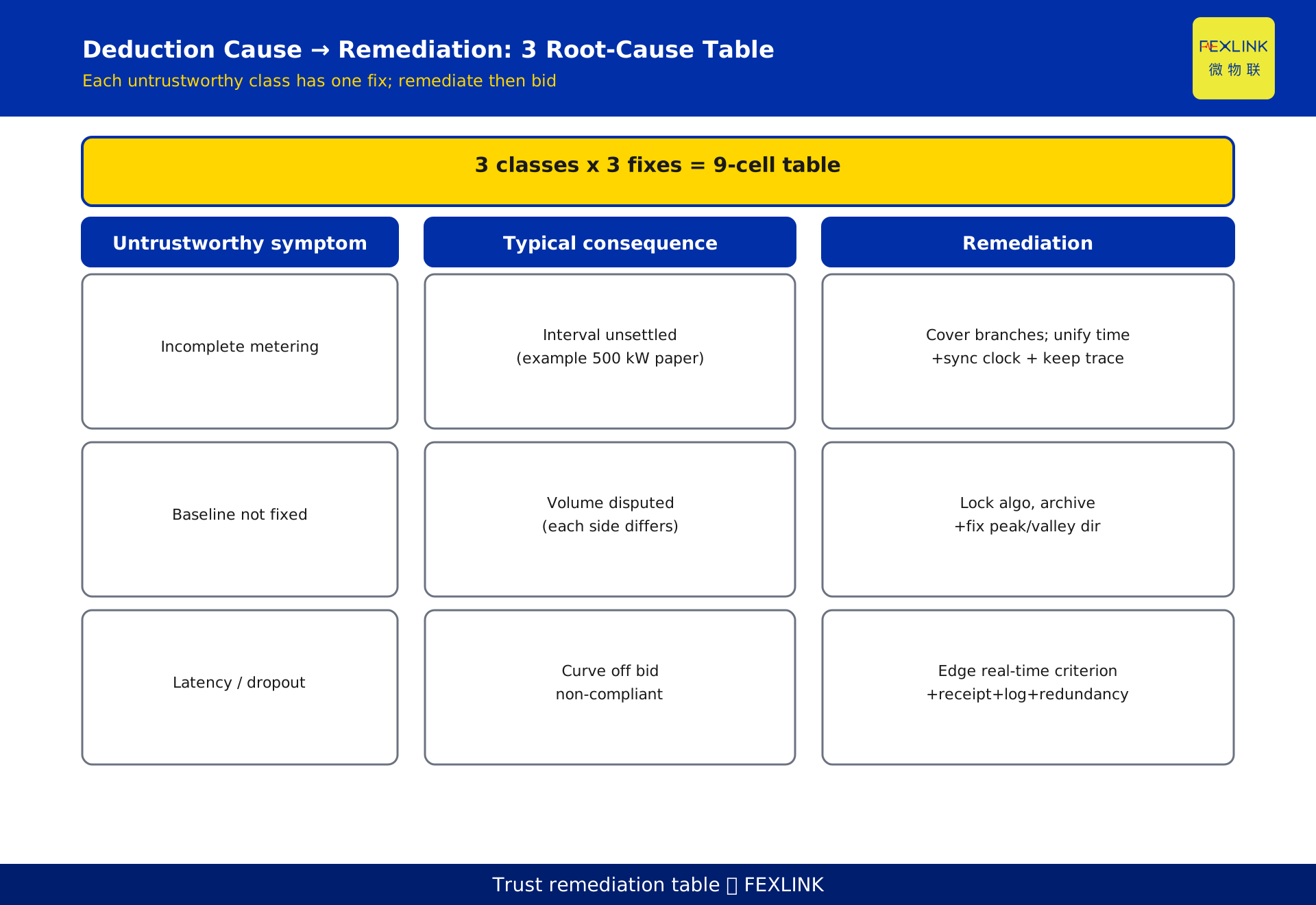
5. "Deduction cause — remediation" table
| Untrustworthy symptom | Typical consequence (example) | Remediation |
|---|---|---|
| Metering coverage incomplete, unsynced | Operator judges response unverifiable, entire interval unsettled | Cover responding branches, unify timestamps, sync to operator clock, trace uploads |
| Baseline basis inconsistent, no archive | Response volumes do not reconcile, repeated disputes | Lock baseline algorithm early, archive modeling data, nail peak/valley direction |
| Command latency too long, drops out | Actual curve deviates from bid, judged non-compliant | Edge-side real-time criterion, command receipt, action log, link redundancy |
The phrases "entire interval unsettled" and "repeated disputes" above are qualitative illustrations; the specific deduction and settlement rules follow the platform rules and the contract.
6. How to self-verify before bidding
Do not wait until settlement is cut to find the problem. Run a self-check before bidding: first, metering self-check — coverage, timestamp, sync, and gaps, item by item; second, baseline self-check — algorithm locked, data archived, direction correct; third, execution self-check — run one simulated dispatch through the full "command, action, receipt, log" chain and watch the latency and drop-outs. Bid only after all three gates pass. Run the self-check as a formal dry run before the bid; the initiative stays with the participant, which beats arguing an unsatisfactory verdict after settlement.
7. How this differs from the neighbor article: a failure diagnosis, not an acceptance standard
This article and the neighbor article KD-0562 (the four-indicator acceptance of demand response) are neighbors but distinct. The neighbor article explains "what the qualified standards are for the four indicators — capacity, duration, ramp rate, accuracy" — it is an acceptance line. This article explains "why you bid capacity but get no money, and what the failure root causes are" — it is a failure diagnosis. The increment: the neighbor article answers "what counts as compliant"; this article answers "why it was not compliant and how to fix it." Read together they give "know the standard and avoid the pit."
8. How the products land: ESA and ESX in the trustworthiness retrofit
These three remediation actions cannot be ticked off by a person with a clipboard; they need edge sensing to turn "invisible trust" into "visible evidence."
For metering coverage, timestamp, and trace: ESA all-element smart meter takes it on — it does bidirectional metering at the point of common coupling and the key branches, carries a unified timestamp, and records load curves and events, so the "response volume" is verifiable and traceable at the root.
For the command-to-action real-time loop and receipts: ESX edge gateway (smart edge computing gateway) takes it on — it aggregates PCS, metering, and platform data on site, applies a real-time command-to-action criterion with receipts, action logs, and link redundancy, upgrading "execution by conscience" to "edge-side observable, traceable, re-checkable," so the latency and drop-outs of the fourth class have data to inspect.
Upstream, it connects to the demand-response resource trustworthiness retrofit solution, where the three-gate self-check records are consolidated into a submittable evidence chain.
9. FAQ
Q: Does bidding capacity guarantee payment?
No. Capacity is a promise; payment follows the "verifiable response volume." If the trust gate fails, no matter how large the capacity, it is a paper resource, and the operator will not pay for a response it cannot verify.
Q: Metering is fully covered, so why is it still called unsynced?
Full coverage is only the first step. If the meters' timestamps are not aligned to the operator's time window, the peak-shaving interval cannot be matched, and the operator still judges "unverifiable." You must unify timestamps, sync clocks, and have zero gaps.
Q: Why can the baseline not be recomputed after the fact?
The baseline determines the sign and direction of the response volume. Recomputing after the fact lets the basis drift and leaves no archived data, so at reconciliation there is no basis to produce and disputes follow. The baseline algorithm should be locked and archived in advance.
Q: How long a latency counts as "too long"?
The specific limit follows the platform rules and the bid curve; this article gives no fixed threshold. The principle: the actual response curve must shed enough within the critical window the bid specifies, and the end-to-end command-to-action latency must be controllable and inspectable.
Q: The neighbor article already covers the acceptance standard. Is this article still necessary?
Yes. The neighbor article is the acceptance line (compliance view); this article is the failure diagnosis (pit-avoidance view). Watching only the standard without root-causing the trust gaps leads to "knows all the indicators, yet gets cut at settlement." Together they give "know the standard and avoid the pit."
Scope and limitations
- The three classes of "untrustworthy resource" root causes and remediation actions discussed here apply to demand-response programs where industrial, commercial, and campus load aggregations participate. Specific settlement basis, deduction rules, and bid curves follow platform rules, the contract, and currently effective policy; this article is not a policy interpretation or engineering basis.
- The related_standards field for this article is empty; the text cites no GB/T number, policy document number, clause number, or year. Any statement involving standards, time limits, ratios, amounts, or compensation criteria is qualitative; specific values follow the current published text, platform rules, and the contract.
- The examples in this article (a factory bidding 500 kW of adjustable capacity, key-branch coverage, unified timestamps, a simulated dispatch running the full chain) are constructed to illustrate the logic and represent no real customer, project, or region. Actual capacity, coverage scope, latency, and settlement rules must follow on-site survey, platform rules, and the contract.
- The model numbers, parameters, and connection methods of the ESA all-element smart meter and ESX smart edge computing gateway mentioned here follow the latest selection manual and product knowledge base; this article is not a selection or procurement recommendation.
- After a standard revision or platform-rule change, the quantitative conclusions should be re-checked; this article does not guarantee the long-term validity of the stated basis.
Frequently Asked Questions
You Bid Capacity but Get Paid Nothing
You report adjustable capacity, yet when the actual response comes, the operator judges it "non-compliant, untrustworthy" and pays you nothing