 FEXLINK Research Institute
The short answer
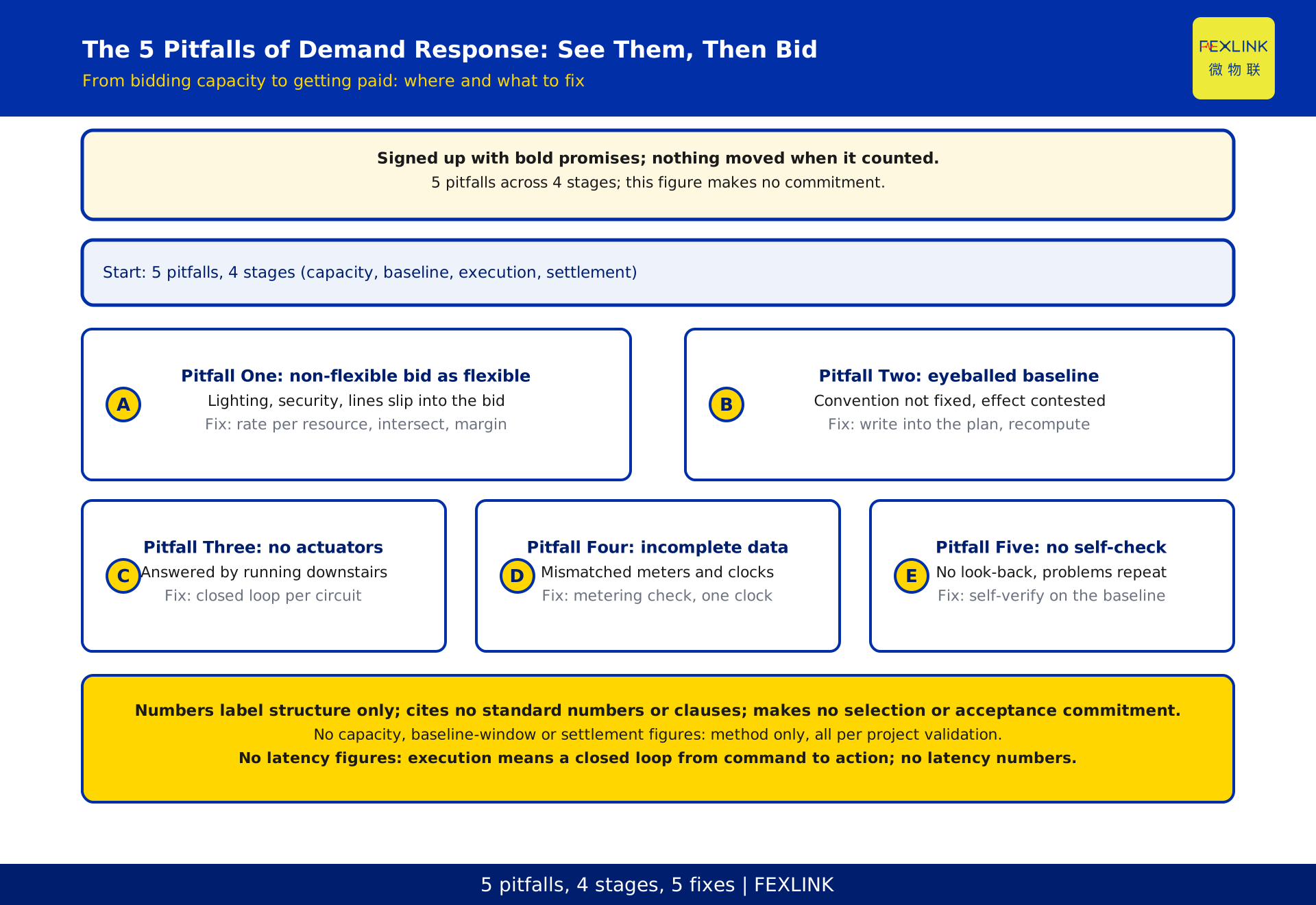
Signing up for demand response with bold promises, then finding nothing can actually move when the event comes — that is the most common first round of pain for a factory new to it. The pitfalls cluster into 5: bidding non-flexible loads as flexible, eyeballing the baseline, promising flexibility without remote actuators, incomplete data that blocks verification and settlement, and reporting up without self-verification. The five sit on 4 stages — capacity, baseline, execution, settlement — and share one root: treating "bidding it in" as "getting it done". The fix is also one routine: walk the 4 stages before bidding — assure capacity from constraints, not nameplate sums; fix the baseline convention in writing, not on the fly; confirm a remote actuator for every circuit; check metering completeness so curves can be assembled; self-verify against the same convention before reporting. This article cites no standard numbers or clauses and makes no conformance claims; no capacity figures, no baseline windows and no settlement figures are given — all follow project validation and the latest rule documents; it constitutes no selection or acceptance commitment.
Pitfall One: Bidding non-flexible loads as flexible
The classic move: sum up nameplate capacities into one big number, then discover at event time that lighting, security and continuous production lines — loads that cannot move — are all inside the bid, and the truly flexible space is far smaller than what was reported. Two sources of overestimation: taking installed capacity for flexible capacity — ratings are equipment ceilings, while flexible capacity is clamped by process constraints, comfort and production rhythm; and taking single-point flexibility for all-hours flexibility — what can be shaved in one window may not in another. The cost lands directly: assessments hit "promise not delivered", and the reputation loss outweighs one settlement. The fix comes before bidding: fix each resource's guaranteed reduction with tightened constraints, take time-window intersections, keep margin, and bid the conservative value; non-flexible loads and emergency backup circuits are removed first — under-bid rather than over-promise.
Pitfall Two: Eyeballing the baseline
The baseline gets improvised: the convention is never written into the response plan, a rough average is computed on the fly, and the computed effect convinces nobody. The baseline is not a formality — it is the denominator of the effect; drift the convention a little and the measured reduction drifts with it. Three common mistakes: the convention never enters the plan, so each side argues with its own version; day types are not separated, production days and non-production days get averaged together; metering points are not fixed, and after the fact there is no data to support any alternative. The fix, again before bidding: write the baseline algorithm, metering points, window slicing and day-type handling into the response plan; during drills, recompute with the same convention and confirm the baseline holds under real actions. Once fixed, the convention does not drift; any change goes through review and reaches every participant — most settlement disputes start with baseline drift.
Pitfall Three: Promising flexibility without actuators
The load is on the list, but no remote actuator exists on site — when the command arrives, someone has to run to the switch room. Responses run in a window; manual running cannot make it, and the promise turns into an undelivered one. The trap's charm is that "the load does exist" — the list is real; what is missing is the "executable" link: remote open/close and power adjustment must land at circuit level, not at the room's main switch. The fix: before bidding, confirm the actuation path circuit by circuit — every bid load needs a closed loop from command to action: the command arrives automatically, the action completes automatically, the status reports back automatically. A load without an actuator either gets one installed first or is removed from the bid. A circuit-level executor such as the FECB2SP smart breaker is exactly the role that closes this link (its device capability list is covered in the dedicated executor article; this article only contrasts roles).
Pitfall Four: Incomplete data that blocks verification and settlement
The response is done, settlement asks for verification, and only then the gaps surface: main and branch meters do not match, clocks are not one source, sampling periods differ — the curves cannot assemble into one complete response record. Incomplete data means unverifiable effects; unverifiable effects mean settlement waits. The pit hides in daily life — routine meter reading works fine — and surfaces under the settlement convention: one branch meter missing, timestamps stamped by different clocks, data gaps during outages. The fix: a metering check before bidding — main and branch meters completed, all metering points on one clock, sampling periods unified, outage backfill planned; curves and event records of the response window are kept under one convention, so that anyone can recompute the same result from the raw records. The ESA smart meter carries the metering-completeness role here: unified meter conventions and one-source timestamps are the premise of a verifiable effect.
Pitfall Five: Reporting up without self-verification
The action ends, nobody looks back at the curves, nobody recomputes against the baseline — the report goes up and the problems wait for someone else to find. Self-verification is not extra work — it is the last gate that keeps problems before settlement: how much was actually cut, how well the promise held, which constraint almost broke — all readable from the aligned curves. Skipping it repeats the pain: conventions that cannot be delivered get bid again, circuits that nearly crossed constraints fail again. The fix: make self-verification a fixed routine — after every response, recompute against the baseline on aligned curves, revise down any convention that did not hold, tighten any constraint that nearly broke before the next bid; keep the self-verification records and let the bid convention follow them. The ESX smart edge computing gateway carries this role: with curves aligned and conventions fixed, self-verification finally has one ruler.
The mechanism: treating "bidding it in" as "getting it done"
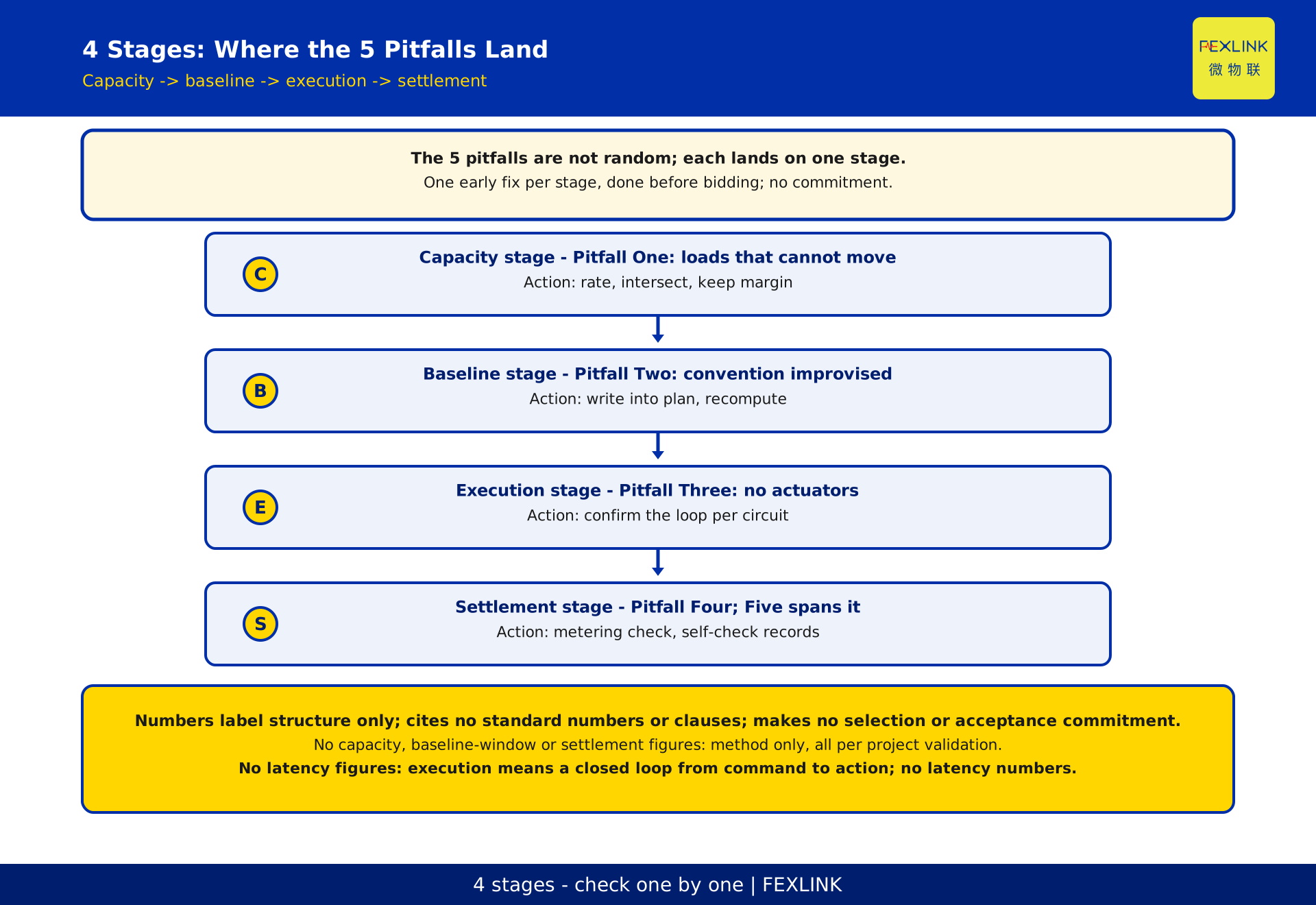
The 5 pitfalls sit on 4 stages: Pitfall One on capacity, Two on baseline, Three on execution, Four on settlement, Five across execution and settlement. One root: "bidding it in" is treated as "getting it done". At bidding, only the list's length and the capacity's size matter, forgetting capacity must be delivered; the baseline is a cell in a form, forgetting it is the denominator of the effect; execution is taken for granted, forgetting commands must land on circuits; data is back-office stuff, forgetting it is the evidence of settlement; self-verification is optional, forgetting it is the input to the next bid. The 4 stages form a chain: a padded capacity forces the baseline to cover it; an eyeballed baseline makes even good execution unmeasurable; an unclosed execution loop turns complete data into records of not doing; incomplete data leaves self-verification and settlement without footing. When any stage goes soft, everything lands on one result: settlement never arrives.
The plug-the-leak list: one early action per pitfall
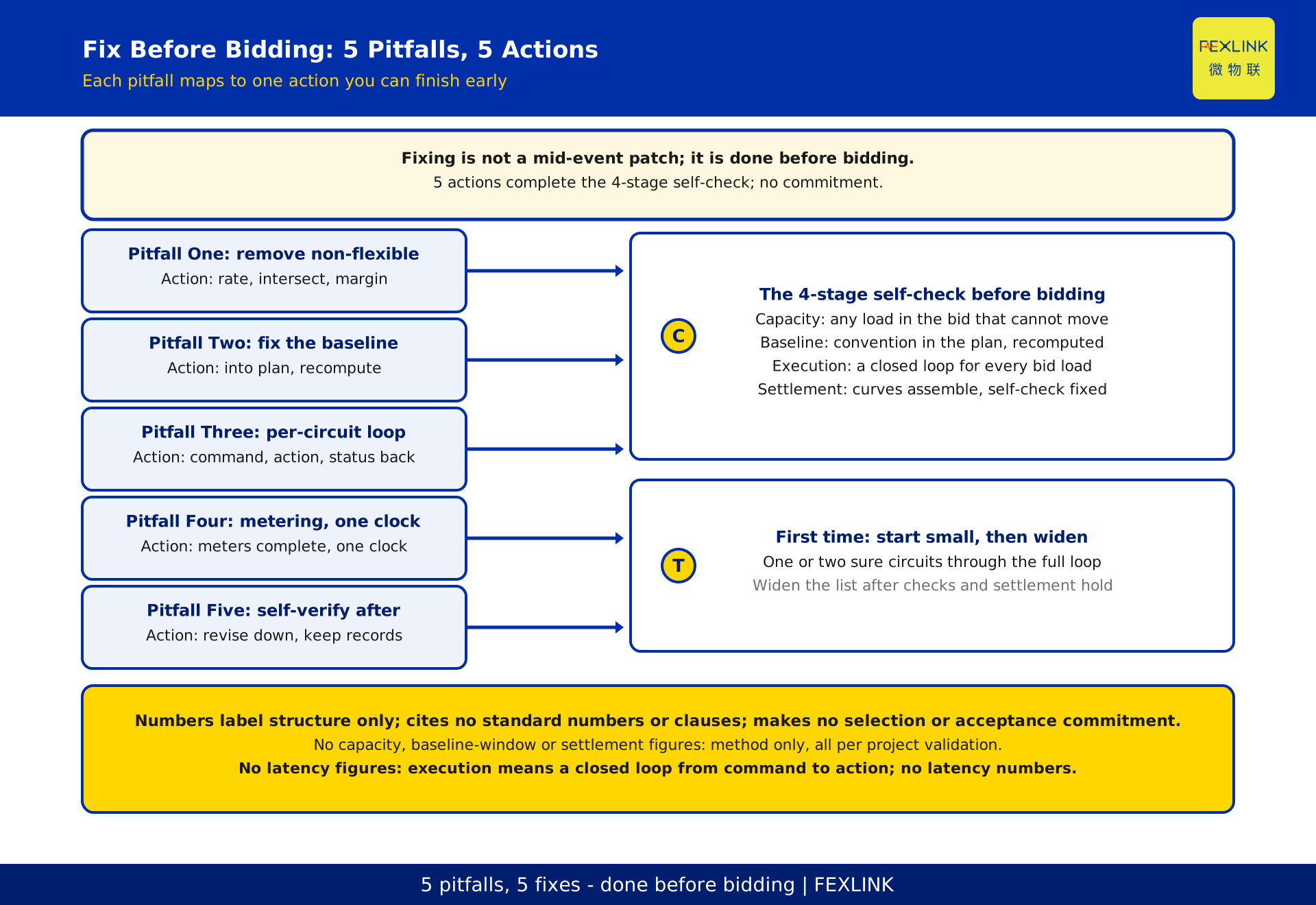
5 pitfalls, 5 actions, each finishable before bidding; the table below lines up the signs, costs, actions and verification points in one view:
| Pitfall | Typical sign | Direct cost | Action before bidding | What to verify |
|---|---|---|---|---|
| One | Capacity summed from nameplates | Cannot deliver; assessment hit | Fix per resource, intersect, keep margin | Actual reduction vs bid |
| Two | Baseline improvised | Effect contested | Write the convention into the plan; recompute in drills | Baseline recomputable under one convention |
| Three | Loads listed, actuators missing | Commands unanswered | Confirm remote actuation circuit by circuit | Closed-loop command-to-action records |
| Four | Mismatched meters and clocks | Settlement blocked | Metering check: meters complete, one clock | Completeness and timestamps traceable |
| Five | No look-back after actions | Problems repeat | Self-verify against the baseline every time | Self-verification records and downward revisions |
| Backup circuits | Not bundled, not dispatched | Backup outranks response | Removed and marked before bidding | Never enters the response list |
| Convention changes | Plan and site diverge | Settlement convention drifts | Changes go through review to all parties | Change records match plan versions |
The table lists management actions and verification conventions, not parameter values; actual conventions follow the response plan and project validation. This article constitutes no selection or acceptance commitment.
The 4-stage self-check before bidding
String the actions into a pre-bidding self-check along the 4 stages. Capacity — ask: any load in the bid that cannot move? Is the flexible amount assured from constraints or summed from nameplates? Baseline — ask: is the convention in the plan? Has a drill recomputed it? Execution — ask: does every bid load have a closed loop from command to action? Settlement — ask: can the curves assemble? Is the self-verification routine fixed? Bid only when all 4 have answers; whichever question fails, patch that stage first. For a first participation, start small: walk one or two well-grasped circuits through the full loop of assuring, drilling, responding, self-verifying and settling, then widen the list — trial-and-error on a small scope costs far less than a big package failing on day one.
How products support pitfall avoidance
Back to the five: products fill the matching gaps, they do not write the plan for you. The ESA smart meter matches Pitfalls Two and Four — unified meter conventions and one-source timestamps give the baseline its data and settlement its evidence; the ESX smart edge computing gateway matches Pitfalls One and Five — with aligned curves it derives the guaranteed amount and recomputes self-verification under one convention, so bidding stops being guesswork; the FECB2SP smart breaker matches Pitfall Three — circuit-level remote execution turns "on the list" into "reachable by command". Products do not replace the conventions and constraints in the response plan — how the baseline is computed, which loads are removed, who signs the self-verification remain management actions; what products do is give every convention data to stand on and every action a record to check. Concrete models, interfaces and access follow the latest selection manual and project design files; this article constitutes no selection or acceptance commitment.
FAQ
Q: How do I estimate flexible capacity without overbidding? A: Not by summing nameplates — assure from constraints: fix each resource's guaranteed reduction under tightened constraints, take time-window intersections, keep margin, review with drills. Remove lighting, security and core-process loads first; under-bid rather than over-promise.
Q: Who fixes the baseline convention, and where does it live? A: In the response plan: algorithm, metering points, window slicing, day-type handling — all written beforehand; drills recompute with the same convention. Changes go through review and reach all participants; never rewrite the convention on the fly.
Q: Which loads must be removed from the bid? A: Emergency backup circuits, loads interlocked with production safety, and core process loads that cannot move — remove them before discussing capacity. The cleaner the removal, the steadier the delivery of what was bid.
Q: What if execution misses the response window? A: Usually no actuator or an unclosed loop — confirm remote actuation circuit by circuit before bidding: command arrives automatically, action completes automatically, status reports back automatically. Loads that cannot make the window should not be bid. This article gives no latency figures; link latency follows site measurement and project validation.
Q: How does a first-timer lower the trial cost? A: Start small: walk one or two well-grasped circuits through the full loop of assuring, drilling, responding, self-verifying and settling, then widen the list; self-verify after every response and feed the results into the next bid.
Scope and limitations
This article targets factory energy managers and first-time demand-response participants; it lines up the five most common pitfalls from bidding to settlement — non-flexible loads bid as flexible, an eyeballed baseline, promises without actuators, incomplete data blocking verification, and reporting without self-verification — each with one action finishable before bidding. It does not cover case-by-case settlement-failure diagnosis (a dedicated article exists), execution-breakdown troubleshooting, connection specs or rule-document reading, or a whole-plant architecture. It cites no standard numbers or clauses and makes no conformance claims; no capacity figures, no baseline windows, no settlement figures and no latency figures are given — conventions depend on the site's resource mix and the response plan, all following project validation and the latest rule documents. It constitutes no selection or acceptance commitment, the generator does not self-approve, and publication requires independent verification; implementation is carried out by licensed electrical and professional personnel under site procedures, and this article replaces neither electrical design nor site safety rules.
Frequently Asked Questions
How do I estimate flexible capacity without overbidding?
Not by summing nameplates — assure from constraints: fix each resource's guaranteed reduction under tightened constraints, take time-window intersections, keep margin, review with drills. Remove lighting, security and core-process loads first; under-bid rather than over-promise.
Who fixes the baseline convention, and where does it live?
In the response plan: algorithm, metering points, window slicing, day-type handling — all written beforehand; drills recompute with the same convention. Changes go through review and reach all participants; never rewrite the convention on the fly.
Which loads must be removed from the bid?
Emergency backup circuits, loads interlocked with production safety, and core process loads that cannot move — remove them before discussing capacity. The cleaner the removal, the steadier the delivery of what was bid.
What if execution misses the response window?
Usually no actuator or an unclosed loop — confirm remote actuation circuit by circuit before bidding: command arrives automatically, action completes automatically, status reports back automatically. Loads that cannot make the window should not be bid. This article gives no latency figures; link latency follows site measurement and project validation.
How does a first-timer lower the trial cost?
Start small: walk one or two well-grasped circuits through the full loop of assuring, drilling, responding, self-verifying and settling, then widen the list; self-verify after every response and feed the results into the next bid.