 FEXLINK Research Institute
The short answer
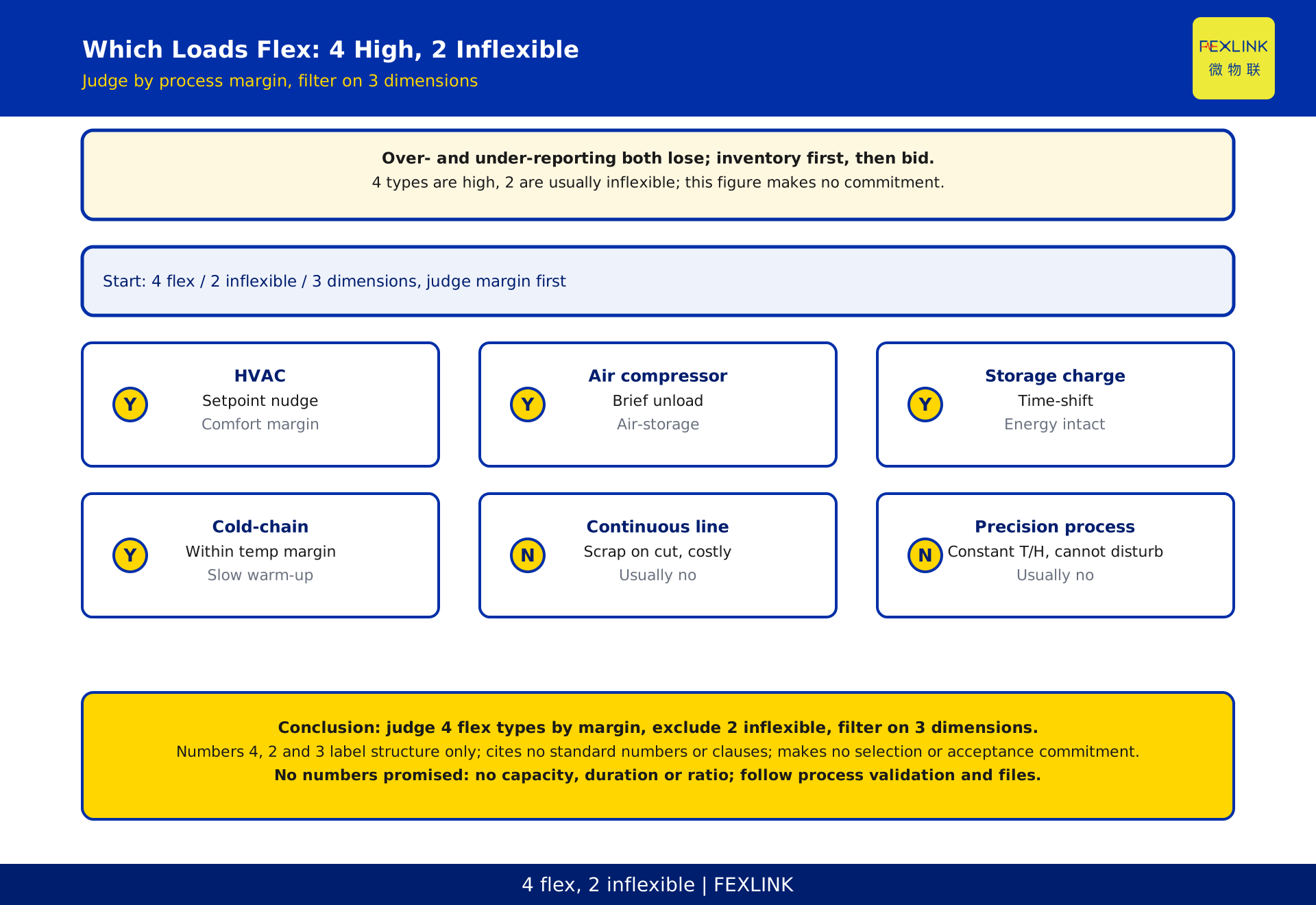
Before bidding any capacity into demand response, build a load-flexibility inventory first. Whether a piece of equipment can flex comes down to one question: does a short disturbance to it affect product quality or occupant comfort? Small impact means high potential; large impact usually means no. By this rule, 4 load types have high potential — HVAC (thermostat nudges), air compressors (brief unload), storage charging (time-shift), and cold-chain (within temperature margin); continuous production lines and precision processes are the 2 usually-inflexible classes. This article gives the method, a 4-flexible-plus-2-inflexible inventory table, and how FSA/FSB/FSE multi-element control devices and the FECB2SP smart breaker turn "can flex" into "measurable and controllable". It cites no standard numbers or clauses and makes no conformance claims; no capacity, duration, or ratio figures are given — all are subject to on-site process validation; it constitutes no selection or acceptance commitment. The inventory is not a one-off; it should roll with process retrofits and equipment changes — one wrong inventory repeats the same error in every later settlement round.
1. Why inventory before bidding
The first reflex is often "report everything we can switch off", which loses on both ends. Over-report and the equipment cannot actually move when dispatch sends the signal, so execution fails and future invitations suffer; under-report and you leave money on the table with resources you already had. The root cause is the same: replacing "which flexible class, with what constraint" with a vague impression of "this thing looks flex". Inventory is not about inflating the number — it is about writing down the constraint behind every flexible resource so the bid and the settlement agree. The inventory is not a report for management; it is the reconciliation draft between bid and settlement. Without it, capacity reported upward has no constraint evidence at settlement, and disputes default to guesswork.
2. The core method: does a short disturbance affect product or comfort
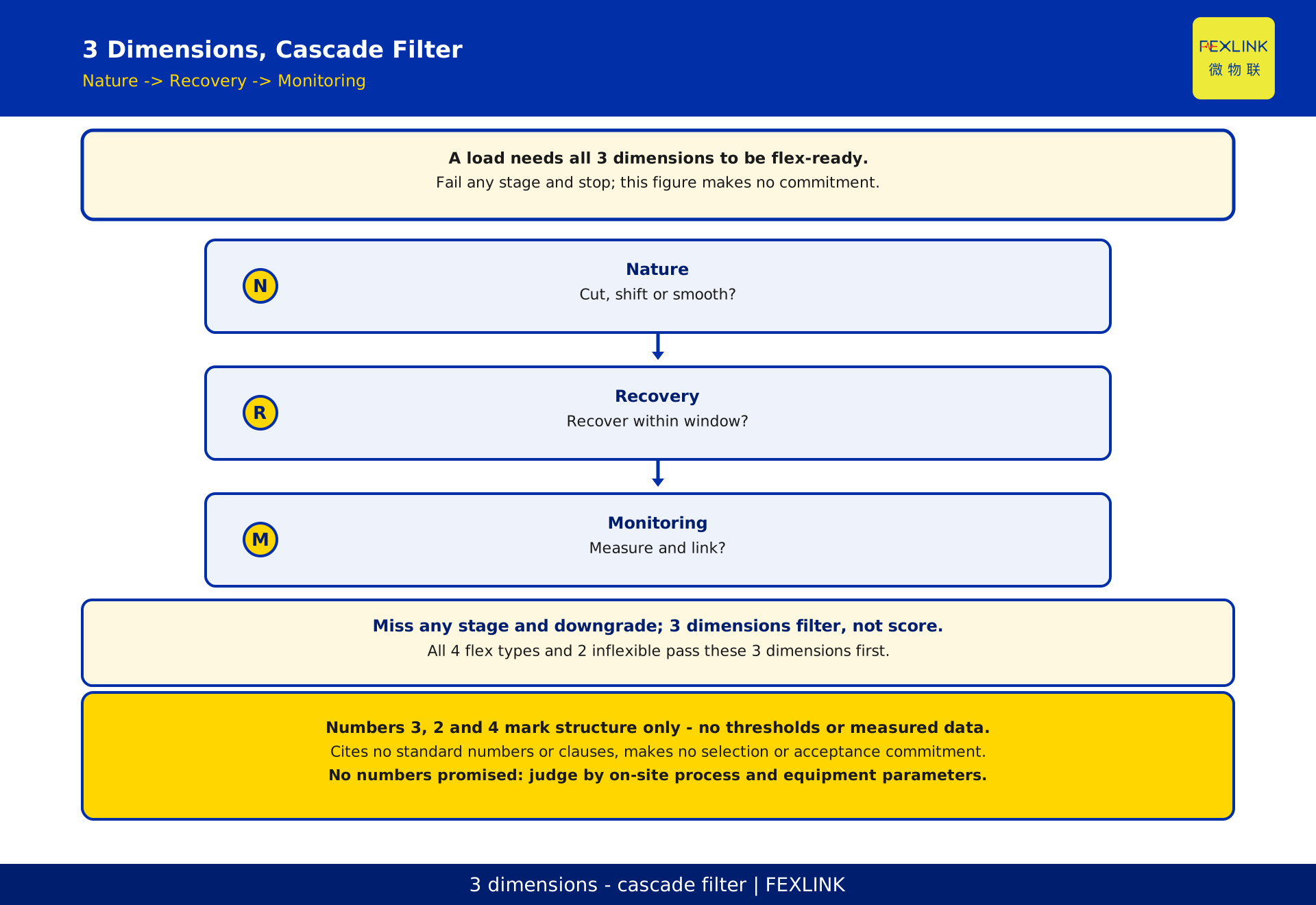
The method has 3 dimensions: nature of disturbance (cut, shift, or smooth adjust), recovery time (how fast it returns after the signal ends), and monitoring granularity (whether measurement and linkage exist so the command lands and the effect is visible). A load is flex-ready when the disturbance does not affect product or comfort, it recovers within the signal window, and it has measurement and linkage. Miss any one and you downgrade or exclude it. These 3 dimensions are not a parallel scoring but a cascade filter: judge disturbance nature first, recovery second, monitoring last; any stage failing makes later ones irrelevant. The method needs no standard clause — only the on-site process and the equipment itself.
3. HVAC: thermostat nudge, comfort margin
HVAC is the most overlooked flexible resource in offices and malls. You nudge the setpoint, not shut it down; occupants barely notice, and with a comfort margin a short upward or downward nudge has zero process impact. The point: it must be a setpoint nudge, not whole-building shutdown, which crosses the comfort boundary and becomes inflexible. The mistake is to report HVAC as an interruptible load: whole-building shutdown loses meeting rooms and server rooms, causing incidents. What flexes is always the setpoint, never the switch.
4. Air compressors: brief unload, air-storage margin
Factory compressors usually feed an air receiver; a short unload keeps pressure in the safe band while points of use are unaffected, and loading resumes after the signal with no break in continuity. The flex essence is "trade short power drop for receiver buffer" — flexibility depends on whether the buffer is enough and pressure stays in band during unload. Also judge the steadiness of the air-demand curve: if a stage draws air violently, the buffer is eaten frequently and the flexible window shortens.
5. Storage charging: time-shift, no energy lost
Storage and chargers share the signature "total unchanged, only the time moves": shift charging from peak to off-peak and the user's energy is intact, only the timing changes. This class is highly flexible because the disturbance is time-shift, not load cut, with zero production impact; it does require an energy management system to align the charge plan with the response signal. Note it is a two-way resource: off-peak charging is load, peak discharge is source; report both roles or you report only half.
6. Cold-chain: within temperature margin
Cold storage and pharmaceutical cold-chain have a temperature margin inside the safety threshold; briefly lowering refrigeration load or running off-peak keeps the temperature from crossing the limit. The test is the warm-up rate and the margin window: large margin and slow warm-up means flex; thin margin and temperature-sensitive means no. Cold-chain flex must stay inside the safety threshold — never trade response for storage quality. Pharmaceutical cold-chain also carries regulatory records: the flex action must be traceable and must not hide a temperature excursion — that is the hard prerequisite for cold-chain response.
7. Continuous lines and precision processes: the 2 usually-inflexible classes
The 2 classes are usually inflexible. Continuous production lines: cut material or slow down and the whole line scraps, yield collapses, recovery costs exceed any compensation, so they usually stay out. Precision-process loads: constant temperature, humidity, and cleanliness cannot be disturbed (semiconductor, pharmaceutical), and any disturbance goes straight into the product, also inflexible. These 2 classes are not absolutely immovable but too costly to assess per event; if a line has a buffered stage, assess that stage alone, never report the whole line as a block.
8. One inventory table of load flexibility
| Load class | Flexibility | Basis | Time scale | Product support |
|---|---|---|---|---|
| HVAC | High | Setpoint nudge, comfort margin | Minute-scale | FSA/FSB/FSE measure & link |
| Air compressor | High | Air-storage margin, brief unload | Minute-scale | FSA/FSB/FSE measure & link |
| Storage charging | High | Time-shift, energy intact | Hour-scale | FSA/FSB/FSE measure |
| Cold-chain | High | Temperature margin, slow warm-up | Minute-scale | FSA/FSB/FSE measure & link |
| Continuous line | Usually no | Scrap on cut, costly recovery | — | FECB2SP protection only |
| Precision process | Usually no | Constant T/H, cannot disturb | — | FECB2SP protection only |
The "product support" column only says which device class provides measurement and linkage; it does not rate model parameters. Actual selection and configuration follow the project design file; this article constitutes no selection or acceptance commitment.
9. How products make it measurable and controllable
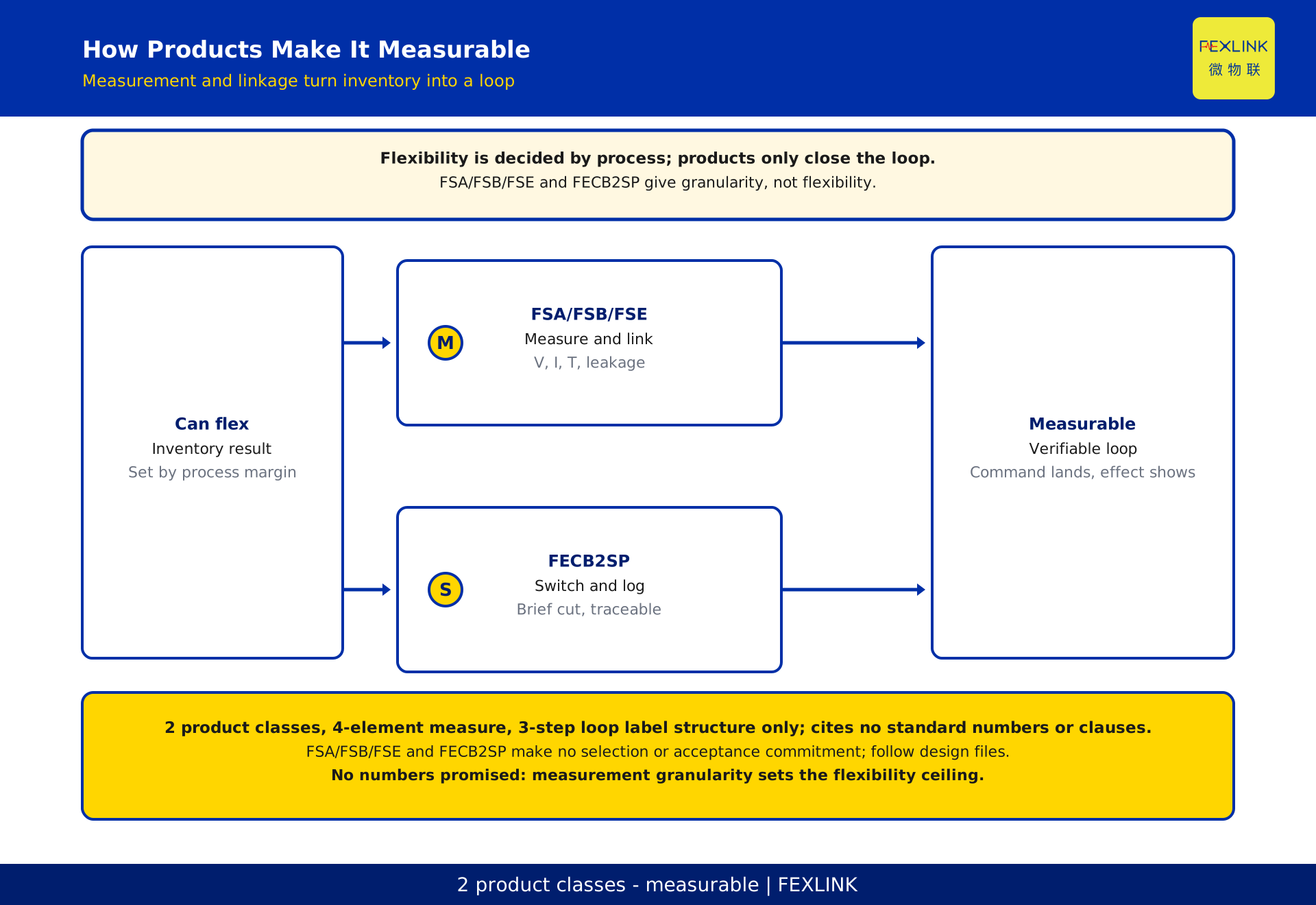
Turning "can flex" into "measurable and controllable" relies on measurement and linkage. FSA/FSB/FSE multi-element control devices combine voltage, current, temperature, leakage and more at one point and link switching or adjustment to the command, so flexible loads "take the command and show the effect"; the FECB2SP smart breaker provides fast switching and an event record of every operation, giving deterministic action and traceable evidence for loads that need a brief cut. Products do not decide flexibility — they turn the inventory conclusion into an executable, verifiable control loop. Measurement granularity sets the ceiling of flexibility: reading only the main meter tells you only whether total moved; reading branches and key devices locates flexible resources to a verifiable unit.
FAQ
Q: How do I quickly tell if a device can flex? A: Ask one question — does a short disturbance affect product or comfort? No impact means a base; large impact means exclude it. Add 2 more: can it recover within the signal window, and does it have measurement and linkage? Pass all 3 and it counts as flex. Without measurement, even real flexibility is only a verbal promise that settlement will not count.
Q: Can HVAC actually flex, or not? A: It depends on "setpoint nudge" versus "whole-building shutdown". The former sits inside the comfort margin and is highly flexible; the latter crosses the comfort boundary and becomes inflexible. Do not report a shutdown as adjustment.
Q: Do storage and chargers count as flexible resources? A: Yes, and with high potential. Their signature is "time-shift, energy intact", zero production impact, as long as an energy management system aligns the charge plan with the response signal.
Q: Can a continuous line never participate at all? A: Usually not advised. A continuous line scraps on cut and recovery is costly; the gain from response rarely covers the shutdown loss. A line with buffered stages may be assessed alone, but never reported as a whole line.
Q: After inventory, how do I turn it into a bid? A: Write each flexible resource's "class, constraint, time scale, measurement and linkage" into the bid file so the bid and settlement match; when uncertain, bid conservatively — better under and right than over and wasted. A thinner bid file means more later disputes; writing the constraint clearly makes the earned compensation easier to collect.
Scope and limitations
This article targets energy managers and demand-response aggregators in parks and factories; it provides a method and an inventory framework for judging load flexibility by process margin, not a technical manual for any equipment class. It cites no standard numbers or clauses and makes no conformance claims; no capacity, duration, frequency, or ratio figures are given — all are subject to on-site process validation. Specific flexible capacity, sustainable duration, and response rate must be validated item by item against on-site measurement curves and equipment parameters, outside this article's scope. It constitutes no selection or acceptance commitment, the generator does not self-approve, and publication requires independent verification. This article does not replace on-site energy audits or electrical design, nor does it constitute a selection basis for any equipment; engineering deployment requires professional assessment.
Frequently Asked Questions
How do I quickly tell if a device can flex?
Ask one question — does a short disturbance affect product or comfort? No impact means a base; large impact means exclude it. Add 2 more: can it recover within the signal window, and does it have measurement and linkage? Pass all 3 and it counts as flex. Without measurement, even real flexibility is only a verbal promise that settlement will not count.
Can HVAC actually flex, or not?
It depends on "setpoint nudge" versus "whole-building shutdown". The former sits inside the comfort margin and is highly flexible; the latter crosses the comfort boundary and becomes inflexible. Do not report a shutdown as adjustment.
Do storage and chargers count as flexible resources?
Yes, and with high potential. Their signature is "time-shift, energy intact", zero production impact, as long as an energy management system aligns the charge plan with the response signal.
Can a continuous line never participate at all?
Usually not advised. A continuous line scraps on cut and recovery is costly; the gain from response rarely covers the shutdown loss. A line with buffered stages may be assessed alone, but never reported as a whole line.
After inventory, how do I turn it into a bid?
Write each flexible resource's "class, constraint, time scale, measurement and linkage" into the bid file so the bid and settlement match; when uncertain, bid conservatively — better under and right than over and wasted. A thinner bid file means more later disputes; writing the constraint clearly makes the earned compensation easier to collect.