 FEXLINK Research Institute
The short answer
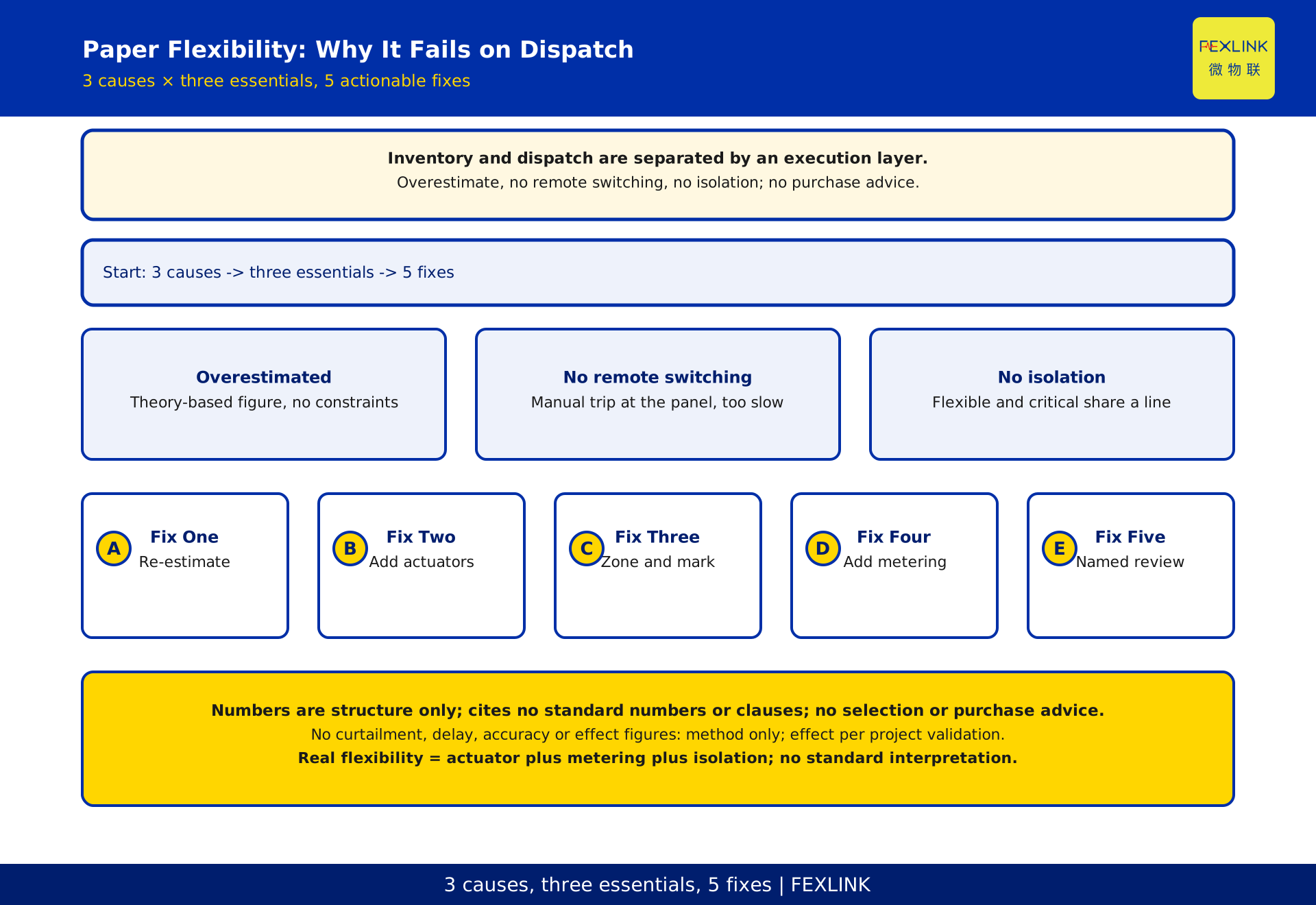
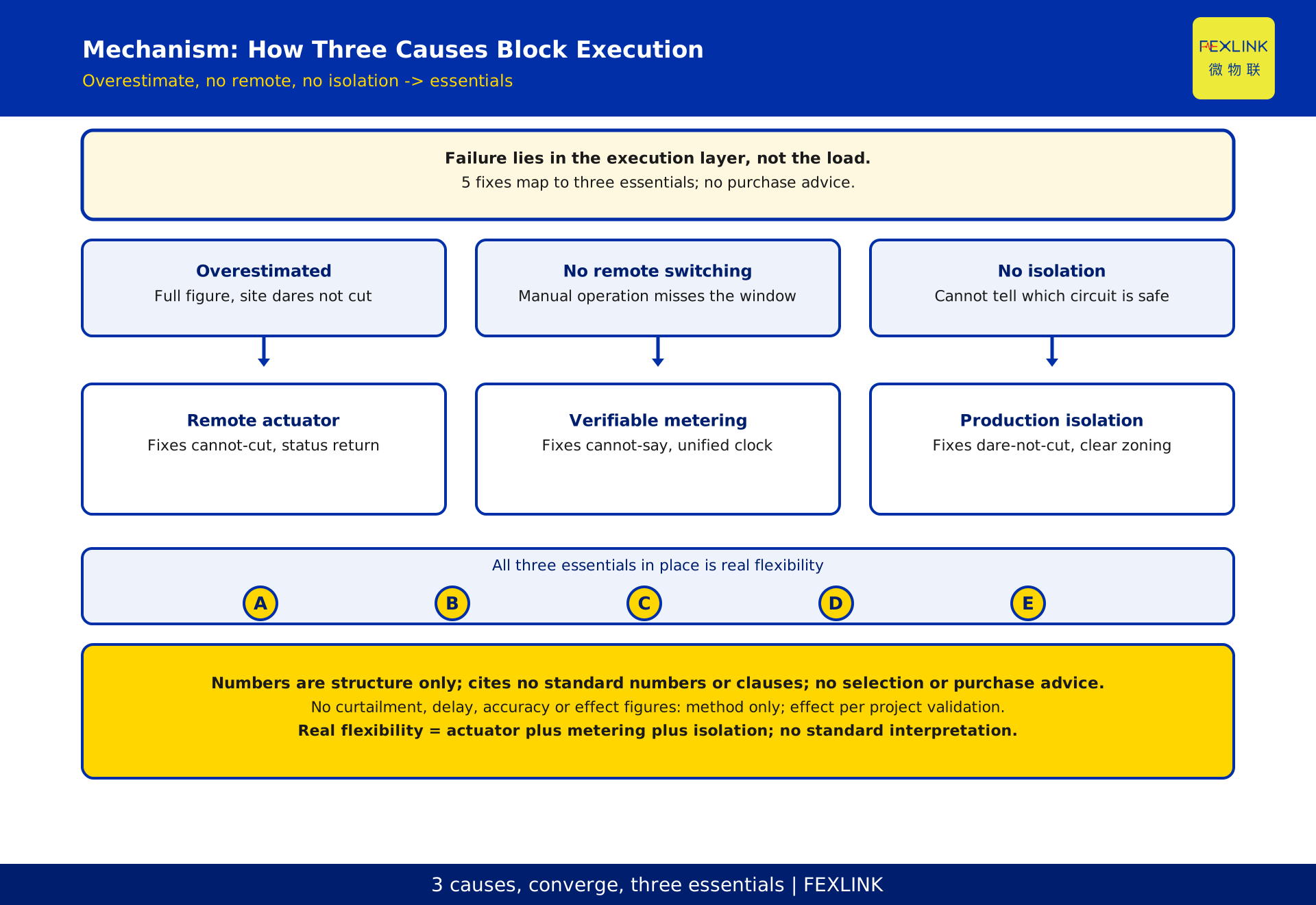
When an aggregator says your load is flexible but it falls apart the moment dispatch calls, the problem is usually not the load itself but the execution layer. Three causes recur: the curtailment potential was overestimated at inventory time, there is no reliable remote switching device on site, and switchable circuits were never physically separated from critical production circuits. Together they turn paper flexibility into a load that cannot be cut, or is cut in the wrong place. Real flexibility rests on three things — a remotely operable actuator, verifiable metering, and isolation design that separates switchable circuits from production. This article sets out 3 causes and 5 reinforcement measures. It cites no standard numbers or clauses and makes no conformance claims; it gives no curtailment, delay or effect figures; it constitutes no selection or procurement recommendation.
Why paper flexibility is not dispatchable
An inventory asks whether a load could in principle be moved; a dispatch order asks whether it can be moved now, safely and accurately. The operator reads the load curve and circuit list, judges whether a short reduction would disrupt product or comfort, and writes the resource into a table — that yields paper flexibility. When dispatch calls, a person or device must open the right circuit within a tight window, cut the right amount and report how much was cut. If the site has only local breakers needing a manual trip, or switchable circuits share a feeder with critical production circuits nobody dares touch, then however good the table looks the order ends in no cut or a wrong cut. Paper flexibility is necessary but not sufficient. Between the two sit remote execution, metering verification and circuit isolation — the gap this article diagnoses, not the inventory method.
Cause one: overestimating curtailment
The most common failure is reporting too much. The estimate comes from nameplate ratings or theoretical headroom without deducting production constraints one by one: does this circuit feed a critical process, would a short reduction breach a quality floor, is someone nearby to restore it. Miss one deduction and the reported amount is inflated. When the order comes the site either dares not cut that deep, or cuts and then restores after seeing production impact — achieving neither the response nor stable production. Worse, the inflation is invisible on paper: without a short-disturbance check between table and reality the error stays hidden until assessment exposes it. The fix is not simply shrinking the figure but building a reviewable method: replace pure theory with short-disturbance measurement, remove critical and non-interruptible circuits first, count only the rest and keep a margin. This gives the checking method, not any magnitude figure.
Cause two: no reliable remote switching
Many resources are judged flexible at inventory while the site has only local breakers and switching means a person at the panel. Demand-response windows are tight; walking over, identifying the circuit, switching and reporting takes longer than the window allows, and unclear labels can cause a wrong cut. That is the direct source of "cannot cut" and "cut the wrong device". Reliable remote switching needs three things: the circuit has a remotely operable actuator, an order actually moves it rather than merely showing success on screen, and the completed action returns a status for checking. Miss any one and remote is nominal. Reinforcement means checking "can this circuit be remotely switched" as a hard criterion circuit by circuit, not assuming control because communications exist. Actuator models, wiring and settings follow the latest selection manual and project design files; this article constitutes no selection or procurement recommendation.
Cause three: no physical separation
The third gap is easiest to overlook and most dangerous: switchable and critical production circuits share a feeder, with no separation or clear labelling. At inventory one may know from the ledger which section is flexible, but on site the operator faces similar-looking breakers and cannot tell which cut would hit a critical process — so nobody acts, or the wrong one is cut. Physical separation is more than labels: circuit zoning, distinguishable marks, and where needed interlocks and access control, so which circuit can be cut and what it affects is clear on site rather than living in memory. Without this layer, more remote devices do not help. The criterion: point at any circuit and ask whether a site person can state its attribute and switchability and locate its actuator and metering point. This gives the criterion, not power-distribution design detail.
The three essentials of real flexibility
Reverse the three causes and you get three essentials. First, a remotely operable actuator — it answers "cannot cut" by letting an order reach a specific circuit in the window and return status. Second, verifiable metering — it answers "cannot say how much" through independent data on load before and after a cut and any impact on critical circuits; metering points match circuits, clocks are unified, data is traceable. Third, isolation design relative to production — it answers "dare not cut" by separating switchable from non-interruptible parts through zoning, clear marks and interlocks, making the action boundary explicit. All three are needed: an actuator without metering cannot say how much was cut; metering without isolation leaves data too accurate to act on safely; isolation without an actuator still sends a person to the panel. Real flexibility is all three in place. This describes capability, not parameters.
Cause-to-reinforcement table
Aligning three causes with five reinforcement actions gives the table below. When a response falls short, find the matching cause row from the site symptom, read the root cause and reinforcement, then use the checking criterion to confirm the fix is in place.
| Cause | Site symptom | Root cause | Reinforcement | Checking criterion |
|---|---|---|---|---|
| Overestimated curtailment | Cannot cut deep, or production affected | Theoretical estimate, constraints not deducted | Re-estimate by short disturbance, remove critical circuits, keep margin | Measured magnitude recorded with margin |
| No remote switching | A person must switch at the panel | Local breakers only | Add remotely operable actuators and verify status return | Remote order switches and returns status |
| No physical separation | A critical circuit is cut by mistake | Shared feeder, unclear labels | Zoning, clear marks, interlocks, access control | Site can state circuit attribute and switchability |
| Unverifiable metering | Cannot say how much was cut | Metering points mismatch, clocks differ | Add metering, unify clocks, log actions and data | Metering data matches actions one by one |
| No ownership or updates | Stale list after changes | No periodic review | Assign owners and periodic review | Review records complete and traceable |
The last row is the common soil in which the first four recur: once the list is built nobody maintains it, and after changes the old figures still get reported. Reinforcement cannot be a one-off retrofit; review responsibility must sit with named people.
Order of deployment
Follow the order of dependency. Start with isolation and marking — separate and label switchable versus critical circuits, the prerequisite for safe execution. Next add metering so each circuit's load change is observable, clocks unified and data traceable. Then install and verify remote actuators, checking circuit by circuit that an order switches and returns status rather than assuming controllability once installed. Then re-estimate curtailment by short disturbance, remove the inflated part and form a reviewable method. Finally put it all into a dynamically maintained resource list with named review duties and update triggers. The logic: make actions safe and controllable first, then effects verifiable, then the method sustainable. Reporting the amount before building the capability leads back to paper flexibility. Each step yields an on-site criterion; critical circuits and settings must be confirmed by licensed professionals against project documents.
How this differs from the inventory article
An article on flexibility inventory answers whether a load can be moved and roughly how much, using a short-disturbance test and a table of common load types. This article does not take that question as its object. It starts after inventory is done and the table submitted, yet every dispatch falls apart — and diagnoses why the execution layer between inventory and response failed. The inventory article governs the judgement of movability; this governs why the judgement still cannot be executed. They are sequential, not substitutes: without inventory there is no amount; with inventory alone the amount stays on paper. If you have not inventoried, read that article first; if you have but keep failing at response, the three causes and five reinforcements here are what to look for.
How products support execution and data
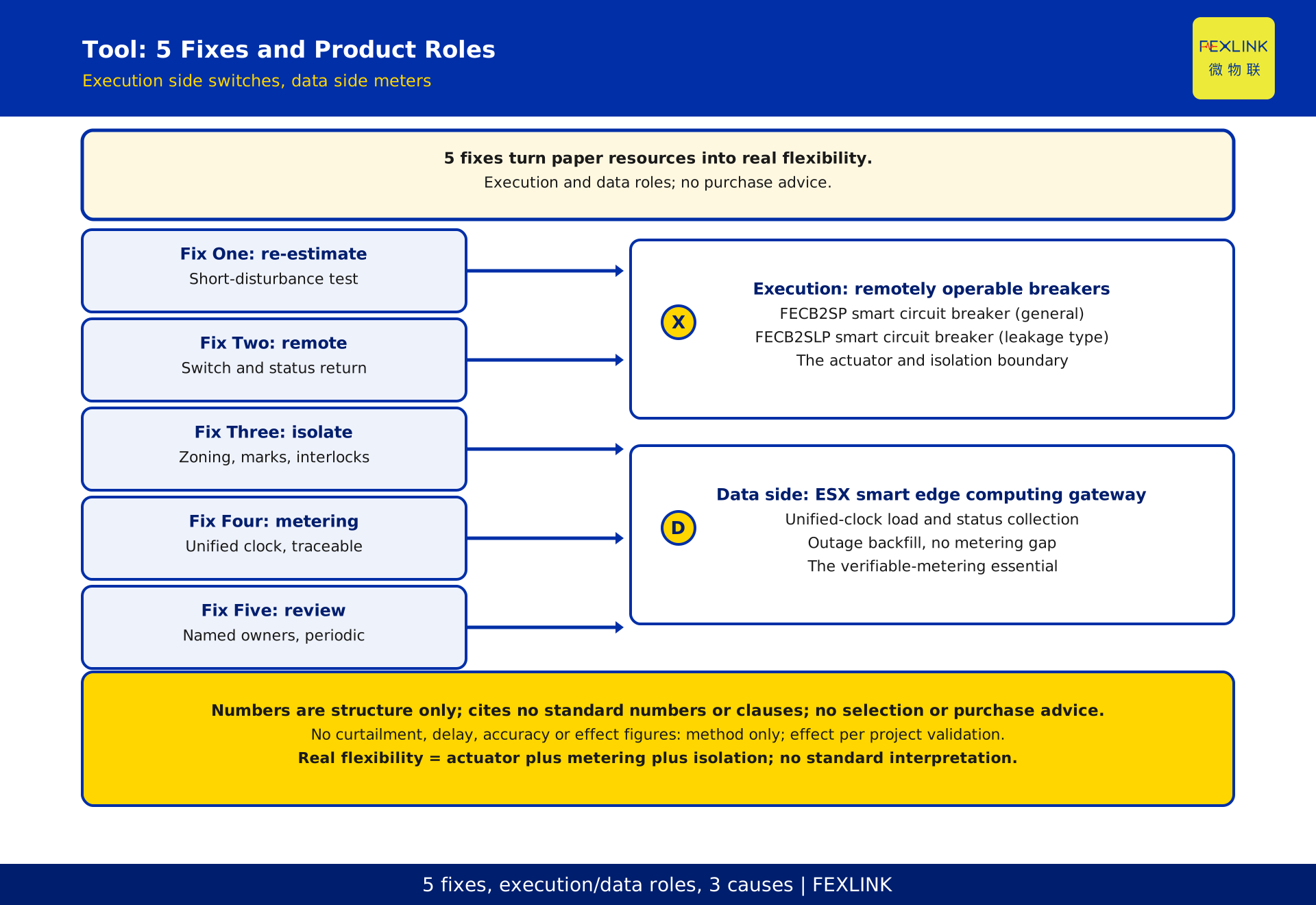
The three essentials split into execution and data roles. Execution is carried by remotely operable breakers: the FECB2SP smart circuit breaker handles remote switching and status return for ordinary switchable circuits; the FECB2SLP smart circuit breaker (residual-current type) serves circuits needing leakage protection, achieving remote controllability with safety. They cover the actuator and isolation boundary. The data side is carried by the ESX smart edge computing gateway: it collects load and status from switchable circuits under a unified clock so load before and after a cut has common-source data for checking, backfilling on network loss so a metering gap cannot obscure the effect. It covers verifiable metering, issuing no switching orders and deciding no flexibility amount. Products are only carriers: installing a breaker does not make a circuit safe to cut, and a gateway does not make metering credible; isolation design, review methods and licensed personnel remain decisive. Concrete models and access follow the latest selection manual and project design files; this article constitutes no selection or procurement recommendation.
FAQ
Q: The inventory said flexible — why cannot it be moved when dispatch calls?
A: Inventory asks whether it could in principle be moved; dispatch asks whether it can be moved safely and accurately now. Between them sit remote execution, metering verification and circuit isolation. When that layer is missing the best table is still paper flexibility.
Q: What is the most common cause?
A: Overestimated curtailment — a theoretical estimate without deducting critical circuits and production constraints. When the order comes the site dares not cut that deep, or restores after impact, and the response fails. Re-estimate with short disturbance and keep a margin.
Q: Once remote switching is installed, is everything solved?
A: No. Remote execution is only one essential. You also need verifiable metering to say how much was cut and physical separation of switchable from critical circuits so people dare cut and cut correctly. Miss any one and remote may be nominal.
Q: Why does metering matter so much?
A: It answers "how much was cut". Without metering that matches circuits, uses a unified clock and leaves a trace, effects cannot be verified and responsibility cannot be established. Metering is the link between execution and isolation.
Q: How does this differ from the flexibility inventory article?
A: The inventory article covers how to judge movability and how much; this covers why a dispatch still falls apart after inventory and how actuators, metering and isolation turn paper resources into real flexibility. They are sequential; this does not repeat the inventory method.
Scope and limitations
This article addresses energy managers and demand-response operators, diagnosing the execution-layer gap behind paper flexibility that falls apart when dispatch calls, with three causes, three essentials and five reinforcement measures. It does not repeat inventory methods, power-distribution design, or settlement and assessment rules. It cites no standard numbers or clauses and makes no conformance claims; it gives no curtailment, delay or effect figures; it constitutes no selection or procurement recommendation and no standard interpretation; the generator does not self-approve, and publication requires independent verification; implementation is carried out by licensed personnel under site procedures, and this article replaces neither electrical design nor site safety rules. Whether the three essentials are in place, and circuit attributes and settings, must be confirmed by qualified personnel against project documents.
Frequently Asked Questions
The inventory said flexible — why cannot it be moved when dispatch calls?
Inventory asks whether it could in principle be moved; dispatch asks whether it can be moved safely and accurately now. Between them sit remote execution, metering verification and circuit isolation. When that layer is missing the best table is still paper flexibility.
What is the most common cause?
Overestimated curtailment — a theoretical estimate without deducting critical circuits and production constraints. When the order comes the site dares not cut that deep, or restores after impact, and the response fails. Re-estimate with short disturbance and keep a margin.
Once remote switching is installed, is everything solved?
No. Remote execution is only one essential. You also need verifiable metering to say how much was cut and physical separation of switchable from critical circuits so people dare cut and cut correctly. Miss any one and remote may be nominal.
Why does metering matter so much?
It answers "how much was cut". Without metering that matches circuits, uses a unified clock and leaves a trace, effects cannot be verified and responsibility cannot be established. Metering is the link between execution and isolation.
How does this differ from the flexibility inventory article?
The inventory article covers how to judge movability and how much; this covers why a dispatch still falls apart after inventory and how actuators, metering and isolation turn paper resources into real flexibility. They are sequential; this does not repeat the inventory method.