 FEXLINK Research Institute
The short answer
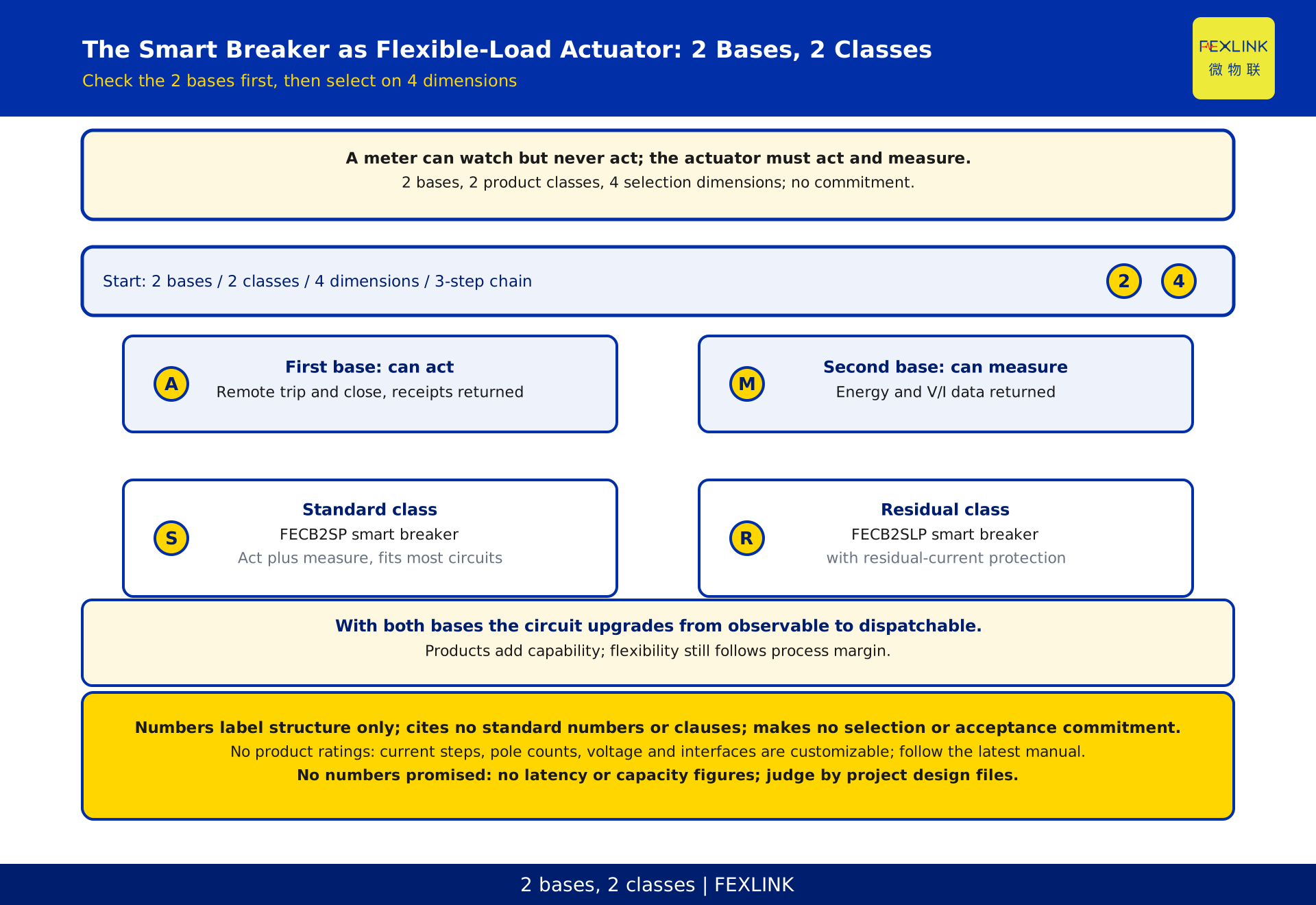
Making a circuit "flexible — remotely switchable or reducible" takes more than a smart meter: a meter can only watch, never act. The actuator is a smart breaker with 2 capability bases — it can act (remote trip and close, executing the cut and the restore on command) and it can measure (returning energy and voltage/current data). Remote tripping lands the response signal on the circuit, and the returned energy curve is both the metering evidence of this response and the basis for the next bid. By protection function, breakers come in 2 classes: the standard FECB2SP smart breaker handles execution and metering; circuits that need residual-current protection take the FECB2SLP smart breaker with residual-current protection, which adds an earth-fault trip on top of overload and short circuit. Selection is not memorizing a catalog: check 4 dimensions — actuation, metering granularity, protection, and access. It cites no standard numbers or clauses and makes no conformance claims; no concrete ratings, pole counts or latency figures are given — all follow the latest selection manual and project files; it constitutes no selection or acceptance commitment.
1. Why a flexible load needs an actuator
A demand-response chain has 3 roles: those who plan, those who measure, and those who act. Smart meters complete the first two well — they record how much energy a circuit drew and when; but "cut it or turn it down" is an action a meter can never take. Many projects stall here: the inventory reports a circuit as flexible, the dispatch signal arrives, and no device on site can act — someone walks to the panel and pulls a lever by hand, with neither the speed nor the traceability a response needs. A missing actuator is not a detail; it is the boundary that decides whether a circuit counts as a flexible resource at all: without one, "flexible" exists only on paper; with one, every line in the inventory finally has a landing point. So inventory first, then actuators — the order cannot be reversed.
2. The 2 capability bases: can act, can measure
A breaker qualifies as a flexible-load actuator when 2 bases are both present. One is being able to act: trip and close are no longer local-only but can be commanded remotely from the platform — the premise of being movable. The other is being able to measure: the device itself returns energy and voltage/current data — the evidence of whether it moved and by how much. Miss either base and the circuit falls back to "observable but not dispatchable": complete data on a circuit nobody can actuate is just a more visible meter. The 2 bases map to 2 checks: actuation asks "does the command land, does the action return a receipt"; metering asks "how fine is the curve, are events logged".
3. The remote trip chain in a response event
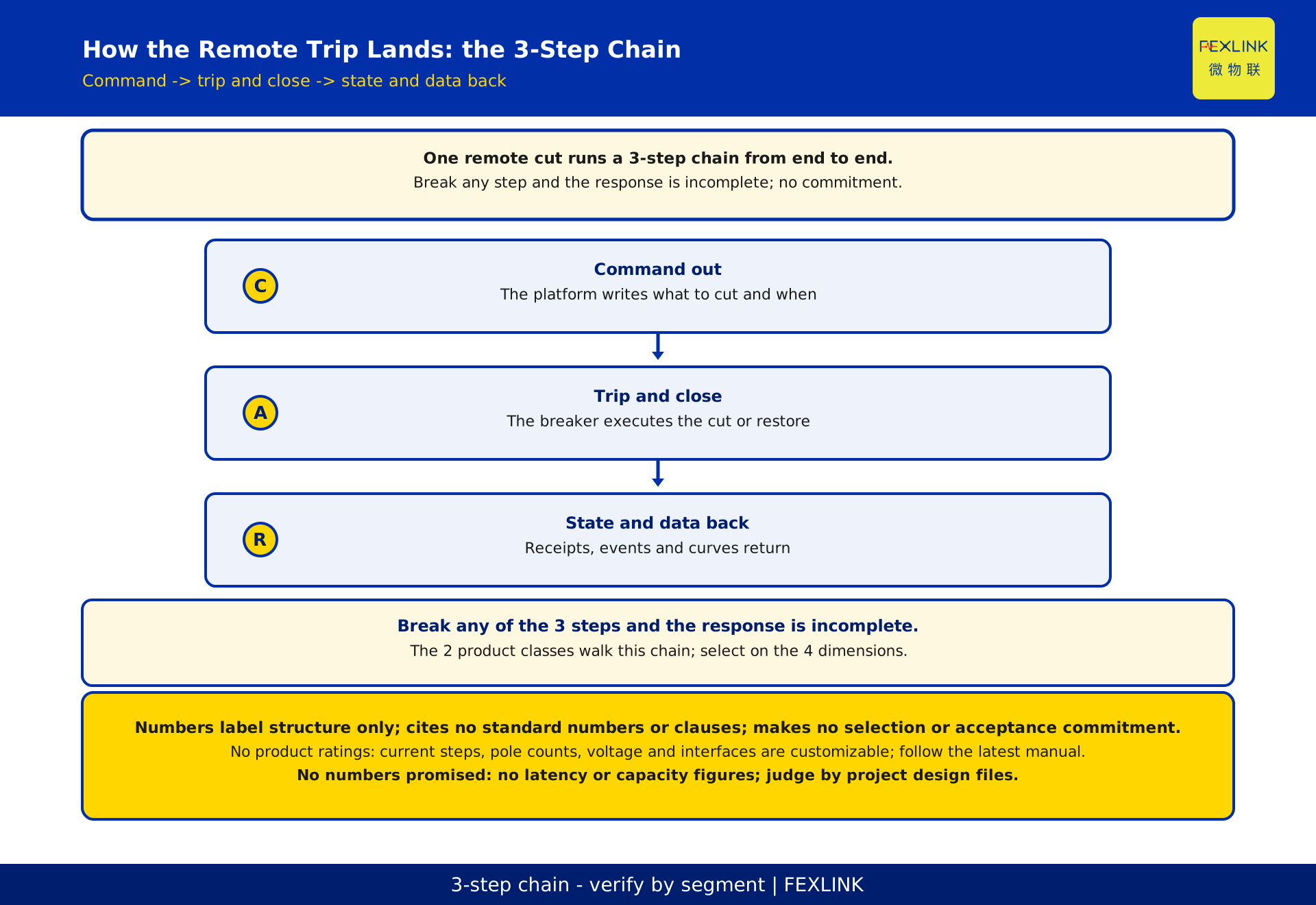
One remote cut is a 3-step chain: the response signal goes out, the breaker trips or closes remotely, the action state and energy data come back. Step one, the platform writes "cut this circuit now, for this long" into a command and sends it. Step two, the breaker executes the trip or close, completing the cut or restore. Step three, the device returns whether the command arrived, whether the action happened, and how voltage, current and energy moved. Break any of the 3 steps and the response is not complete: no command means nothing after it exists; an action without a receipt leaves settlement unable to say whether it executed; missing data makes the effect unmeasurable. So judging actuation is not asking "is it remote-controllable" — it is walking all 3 steps: who defines the command boundary, who executes the switch, who keeps the receipt and curve.
4. Reading the energy curve: effect metering and capacity basis
The returned energy curve has 2 uses, matching "after" and "before" a response. Use one, effect metering: compare the response-window curve against the baseline to state how much was cut and whether it restored — the settlement evidence; without the curve, "it executed" is a receipt with no quantity. Use two, capacity basis: read the shape of the circuit's historical curves — which hours are steady, which hours already swing — to decide what flexible capacity to bid and what response type fits. The 2 uses are one curve: history sets capacity, the response window sets effect; keep one reading convention, or the bid and the settlement will disagree.
5. Voltage, current and event records: every action traceable
The energy curve answers "how much was used"; voltage and current data answer "what was the electrical state at that moment" — together they support a complete response file. Around a trip or close, voltage and current shift visibly; aligning those shifts with the action event log reconstructs the full sequence of command arrival, executed action, and load response. The event log turns every remote operation into traceable evidence: when, what action, with what result — all logged; if an effect is later disputed, the parties return to the records instead of memories. Abnormal events such as residual current, when logged and alarmed separately, stay separate from response actions — response is response, protection is protection; reading the two records apart prevents mistaking a normal protection trip for a failed response.
6. Standard and residual-current classes: how they divide the work
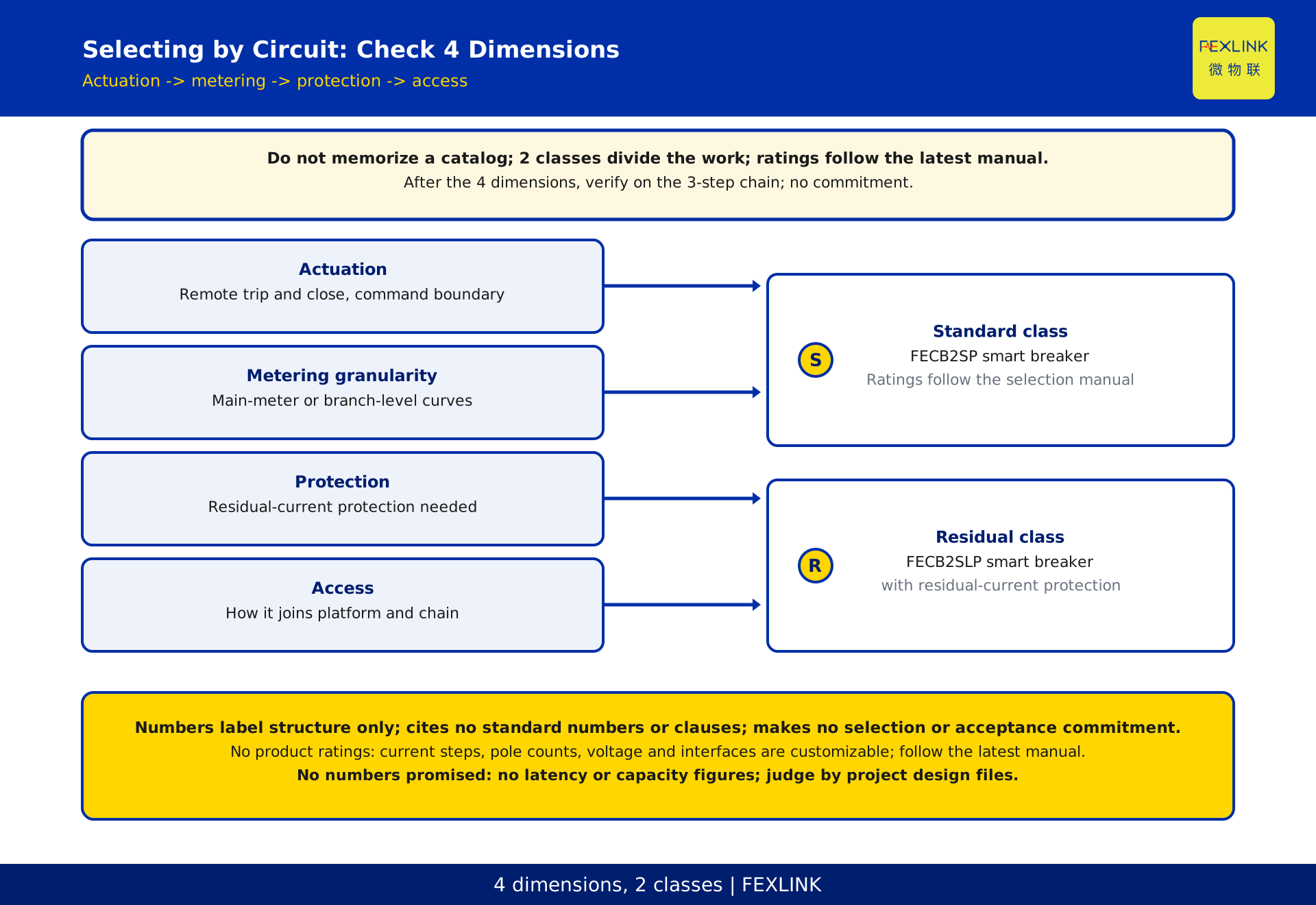
By protection function there are 2 classes. The standard FECB2SP smart breaker provides remote trip and close plus energy and voltage/current metering, fitting most flexible circuits that need only execution and metering. The FECB2SLP smart breaker with residual-current protection adds an earth-fault trip on top of overload and short circuit, for circuits with higher personal-safety requirements or those that need leakage protection anyway. The dividing question is exactly one: beyond execution and metering, does this circuit need residual-current protection? If yes, take the residual-current class; if no, do not add configuration for a function that will not be used. Both classes keep full execution and metering capability — the difference is only the added protection, not "one can flex and one cannot"; settle this before selection.
7. Choosing by circuit: 4 dimensions and the customization boundary
Do not memorize a catalog; check 4 dimensions in order: actuation (remote trip and close supported, and how the command boundary is defined), metering granularity (main-meter or branch-level curves), protection (whether residual-current protection is required), and access (how it joins the platform and the response chain). Within these 4 dimensions, concrete current ratings, pole counts, supply styles and communication interfaces are all customizable items — they vary by project; no standard model's fixed configuration should be stretched over every circuit, much less used to declare a device unqualified. The right order: define the circuit's response role first (cut or reduce, how long, how often), then write the 4 dimensions into the requirement, then take concrete ratings from the latest selection manual. The rating follows interval logic: the circuit's calculated current sits below the rated current of the chosen step, which sits below the cable's ampacity — clamped from both sides to be safe; this article gives no rating numbers, and figures follow the selection manual and on-site calculation. This article constitutes no selection or acceptance commitment.
8. Where latency hides: walk the 3 steps
Each step of the 3-step chain has its own latency composition. The command segment is about channel and polling: how fast the signal travels from platform to terminal depends on access and platform scheduling, and varies widely across projects. The action segment is about the mechanism: the inherent operating time of trip and close is a device property, confirmed with the manufacturer at selection. The return segment is about the data link: how fast receipts and curves reach the platform decides how quickly effects can be checked. Across the 3 segments, confirm latency separately with its own record — never a vague "is it fast". This article gives no millisecond or second figures: latency depends on site networking, device batch and platform strategy, and any number promised out of context is untrustworthy; to learn a circuit's real response speed, run one drill action and measure all 3 segments with logs — more convincing than any written figure.
9. How products support measurable-and-controllable
Back to the opening conclusion: an actuator equals can-act plus can-measure. The FECB2SP smart breaker and the FECB2SLP smart breaker with residual-current protection layer remote trip and close, energy and voltage/current metering, and event records onto a standard breaker, upgrading an ordinary circuit into a flexible-load unit where commands land, effects are visible and actions are traceable. Products do not change whether a circuit can flex physically — that is process margin; what they do is turn the inventory conclusion into an executable, verifiable loop: without an actuator the inventory is a list; with one, every line of flexible capacity has matching action evidence and metering proof.
FAQ
Q: We already have smart meters — why change breakers too? A: The meter solves "can see"; the actuator solves "can move". A flexible load needs both ends: with only a meter, no one executes the command — someone pulls a lever manually, with neither the speed nor the traceability a response requires. Meter and actuator are complements, not substitutes.
Q: Will remote tripping cut off critical loads by mistake? A: The command boundary is a design question, not a device question. The inventory states in advance what each flexible circuit may and may not lose, and commands take effect only on circuits inside that list; local protection — overload, short circuit, residual current — always outranks remote commands, and protection actions are never scheduled away. Keeping the 2 record types separate prevents mistaking a protection trip for a failed response.
Q: How does an energy curve become settlement evidence instead of just numbers? A: Through one agreed convention. How the baseline is built, how the window is cut, main-meter or branch curves — written into the plan beforehand, read the same way afterwards; align the curve with the trip and close event log on one clock and the effect can be recomputed. Divergent conventions are the largest source of settlement disputes.
Q: How do I choose between the standard and the residual-current class? A: By one question only: beyond execution and metering, does this circuit need residual-current protection? Kitchens, temporary supplies and damp locations usually do; ordinary power and lighting branches follow the design requirement. Both classes share the same execution and metering capability — the difference is only the added protection. Concrete ratings and pole counts follow the latest selection manual; this article constitutes no selection or acceptance commitment.
Q: Worried the response is too slow — where do I look? A: Split the 3-step chain and look segment by segment: the command segment for channel and scheduling strategy, the action segment for the mechanism's inherent time (confirm with the manufacturer), the return segment for the data link. Run one drill action, measure all 3 segments with logs — more reliable than any written promise. This article gives no latency figures; numbers out of project context are not trustworthy.
Scope and limitations
This article targets electrical engineers and demand-response integrators, covering the capability list, action chain, data reading and selection method of the smart breaker as a flexible-load actuator. It does not cover protection principles, short-circuit calculation or coordination settings — those belong to dedicated breaker-protection articles. It cites no standard numbers or clauses and makes no conformance claims; no concrete ratings, pole counts, voltage classes, communication interfaces or latency figures are given — those are customizable items or site-dependent, and follow the latest selection manual, the product knowledge base and project design files. It constitutes no selection or acceptance commitment, the generator does not self-approve, and publication requires independent verification; implementation is carried out by licensed electrical personnel under site procedures, and this article replaces neither electrical design nor site safety rules.
| Circuit case | Actuation need | Metering need | Product role | What to check |
|---|---|---|---|---|
| Ordinary power and lighting branches | Remote trip/close, time-window cuts | Branch-level energy curves | FECB2SP standard class executes and meters | Trip/close events with before-and-after curves |
| Circuits needing leakage protection | Actuation plus residual-current protection | Energy curves and residual-current events | FECB2SLP residual-current class | Protection log kept apart from response actions |
| Storage charging and charger branches | Time-window switching, plan alignment | Energy curves checked per window | FECB2SP standard class executes and meters | Energy difference across the window |
| Compressor and pump branches | Brief-unload style switching | Energy and current curves | FECB2SP standard class executes and meters | Current fall and recovery during unload |
| Observe-only circuits, not yet dispatched | No actuation, metering only | Energy and voltage/current curves | Metering devices carry it | Curve continuity and clock alignment |
| Multi-circuit centralized actuation | Per-circuit command boundaries | Branch and main-meter curves together | Actuator plus metering device combination | Command, action and curve aligned |
The "product role" column only says which device class carries execution and metering; it does not rate model parameters. Ratings, pole counts and access styles are customizable items, following the latest selection manual and project design files; this article constitutes no selection or acceptance commitment.
Frequently Asked Questions
We already have smart meters — why change breakers too?
The meter solves "can see"; the actuator solves "can move". A flexible load needs both ends: with only a meter, no one executes the command — someone pulls a lever manually, with neither the speed nor the traceability a response requires. Meter and actuator are complements, not substitutes.
Will remote tripping cut off critical loads by mistake?
The command boundary is a design question, not a device question. The inventory states in advance what each flexible circuit may and may not lose, and commands take effect only on circuits inside that list; local protection — overload, short circuit, residual current — always outranks remote commands, and protection actions are never scheduled away. Keeping the 2 record types separate prevents mistaking a protection trip for a failed response.
How does an energy curve become settlement evidence instead of just numbers?
Through one agreed convention. How the baseline is built, how the window is cut, main-meter or branch curves — written into the plan beforehand, read the same way afterwards; align the curve with the trip and close event log on one clock and the effect can be recomputed. Divergent conventions are the largest source of settlement disputes.
How do I choose between the standard and the residual-current class?
By one question only: beyond execution and metering, does this circuit need residual-current protection? Kitchens, temporary supplies and damp locations usually do; ordinary power and lighting branches follow the design requirement. Both classes share the same execution and metering capability — the difference is only the added protection. Concrete ratings and pole counts follow the latest selection manual; this article constitutes no selection or acceptance commitment.
Worried the response is too slow — where do I look?
Split the 3-step chain and look segment by segment: the command segment for channel and scheduling strategy, the action segment for the mechanism's inherent time (confirm with the manufacturer), the return segment for the data link. Run one drill action, measure all 3 segments with logs — more reliable than any written promise. This article gives no latency figures; numbers out of project context are not trustworthy.