 FEXLINK Research Institute
Direct Answer
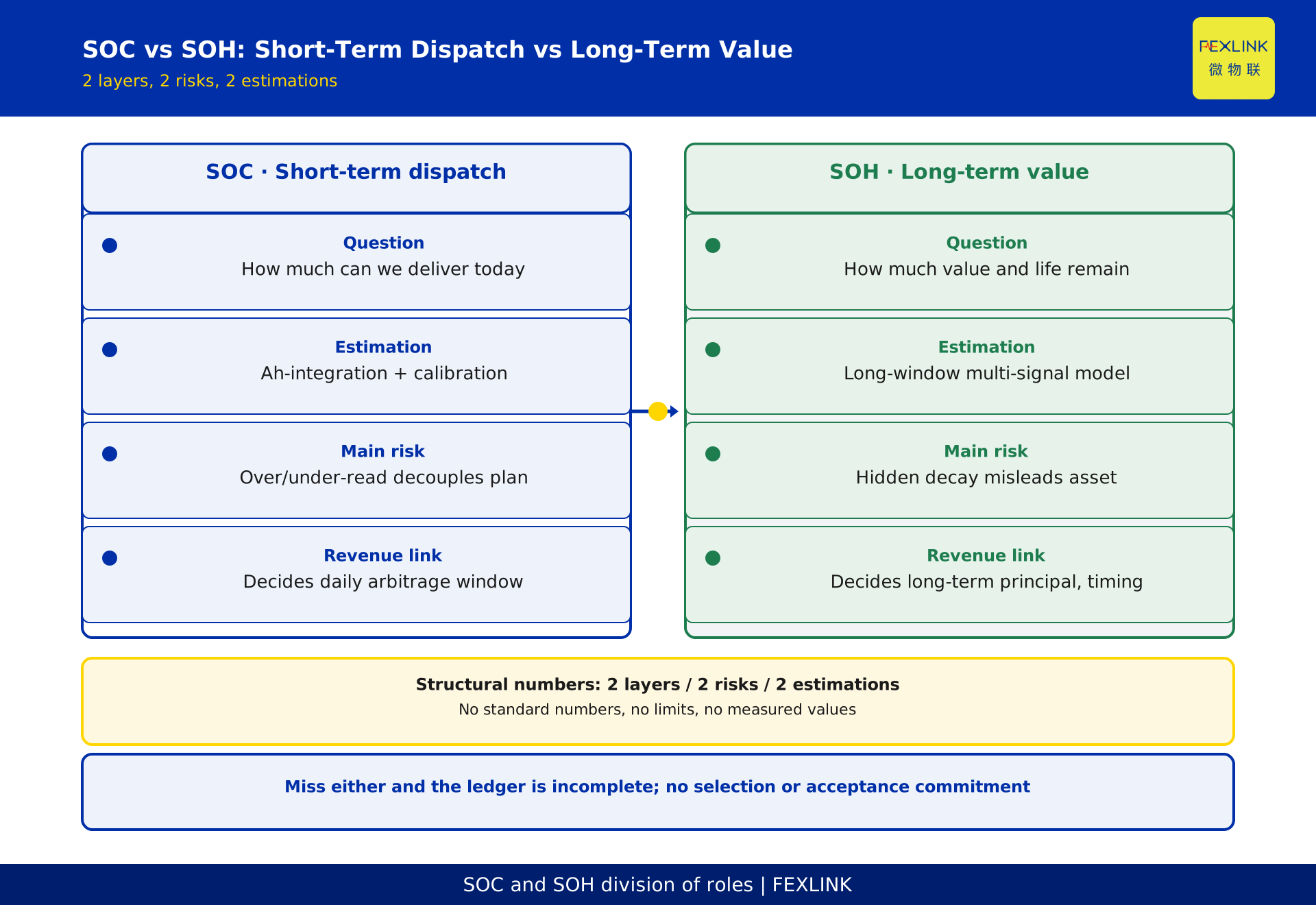
The SOC and SOH a storage plant reports every day are two numbers of completely different nature. SOC is the state of charge: the share of usable energy left in the battery right now, answering "how much can we still discharge today." SOH is the state of health: a measure of battery condition, answering "how much capacity and life remain." One governs short-term dispatch; the other governs long-term value and replacement decisions. Treating SOC as merely a percentage of charge hides the asset value that SOH decides; watching only the health score leaves today's charge and discharge unscheduled. They are estimated differently and carry different risks, so operations track both every day. Understanding this division is the first step to reading the storage ledger in full, and it is the shared basis for every dispatch and asset judgment that follows.
Why a Plant Watches Both Every Day
A battery is not a simple tank that is "full when charged and empty when drained." Its usable capacity shrinks slowly with cycles, and its real-time charge is quietly rewritten by temperature, rate, and self-discharge. A plant often parallels hundreds or thousands of cells, and a drift in any one of them distorts the whole rack's reading. SOC and SOH translate that drift into two languages operations can read: one says "how much is left now," the other says "how good is it still." Watching only one is reading half the ledger. Worse, the errors of the two numbers amplify each other—if SOC's denominator is not updated with SOH, the reading looks inflated; if SOH is left uncalibrated for long, the judgment of asset value drifts silently. Watching both daily keeps today's schedule and the multi-year ledger from diverging.
What SOC Is: Usable Charge, Not Just a Percentage
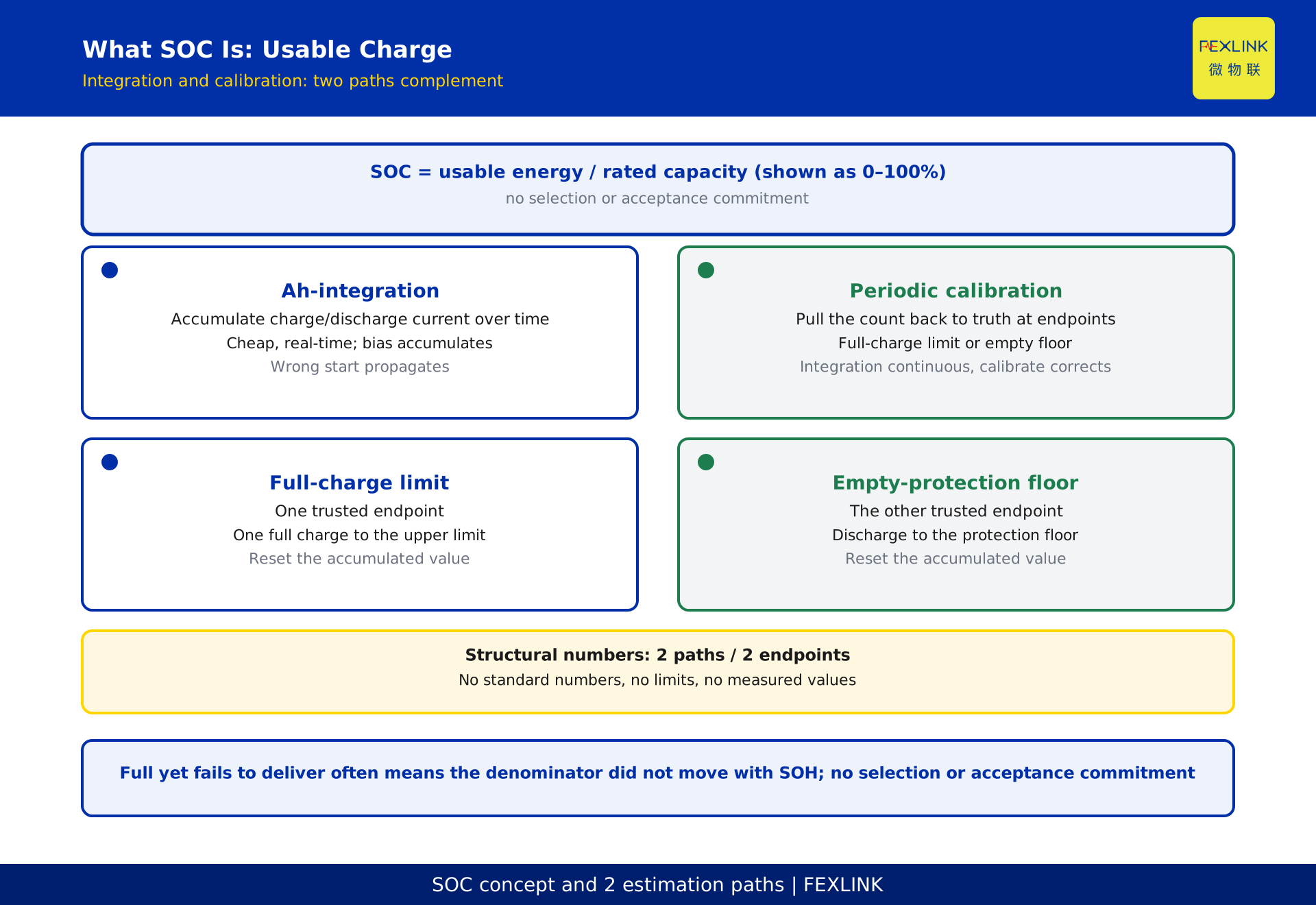
SOC stands for state of charge: the ratio of currently usable energy to rated capacity. It answers the question dispatch cares about most: how much of this energy can still be delivered today. Note the word "usable"—it is not the nameplate total, because the part already lost to aging was never in the deliverable range. So the denominator of SOC should move together with SOH; otherwise the battery can look "full" yet fail to deliver. This is also why understanding SOC as a static percentage misleads: a percentage is only a snapshot, and what really decides its accuracy is whether the underlying estimation and calibration have kept pace with battery aging.
How SOC Is Estimated: Ah-Integration and Periodic Calibration
The common method is ampere-hour integration: accumulate charge and discharge current over time and express it as a share of capacity. It is cheap and real-time, but it has two weaknesses—a wrong starting point propagates, and long-term bias accumulates. That is why periodic calibration is required: at a trusted endpoint, such as a full charge to the upper limit or a controlled discharge to the protection floor, pull the accumulated value back to truth. The two ideas complement, not compete: integration is continuous, calibration corrects. An SOC that only integrates and is never calibrated will drift from "slightly off" to "badly off," and that is precisely the hidden pit that decides whether the plan can deliver each day.
What SOH Is: Battery Health, the Decider of Remaining Value
SOH stands for state of health, often described as the ratio of current maximum usable capacity to initial capacity. It answers the asset question: how much is this battery still worth, and how long can it last. SOC tells you what you can deliver today; SOH tells you how much principal remains. When someone asks whether storage is still worth running, the number that matters is SOH, not SOC—it directly drives residual value, warranty judgment, and replacement timing. In other words, SOC is the day's balance on the operations ledger, while SOH is the principal balance on the asset ledger; miss either and you cannot tell whether this storage is still "worth it."
Why SOH Is Harder to Measure—and More Valuable
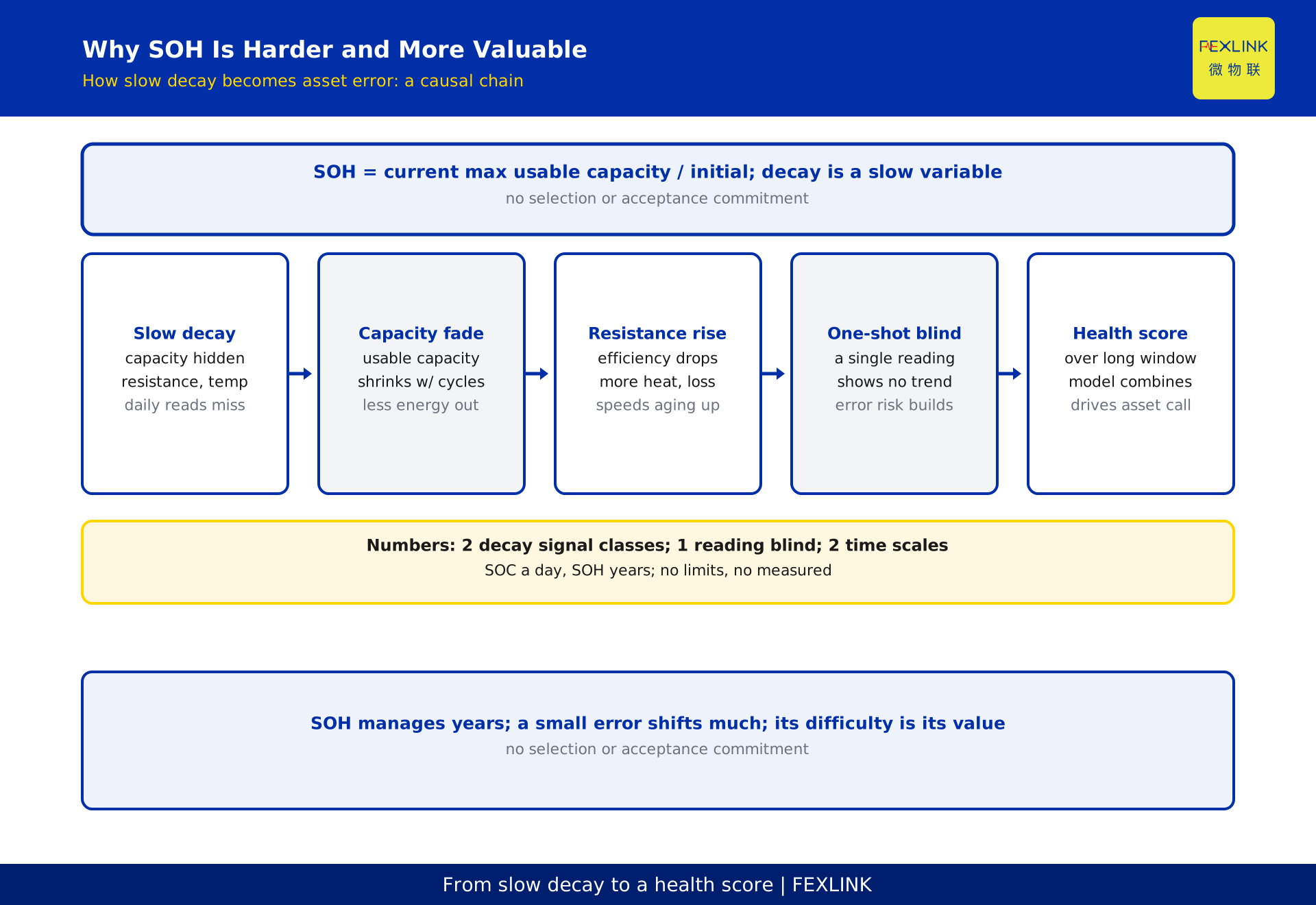
An SOC error is usually exposed in a single charge or discharge, while SOH decay is a slow variable hidden across capacity, internal resistance, and temperature rise; a single reading reveals almost nothing. Estimating it well means tracking the same cells across a long window and then combining several weak signals into one health score with a model. Precisely because it is hard, it is valuable: a small SOH error shifts the judgment of capacity and life by a wide margin and directly moves asset decisions. SOC manages a day; SOH manages years. The order of difficulty and the order of value are simply not in the same league.
The Fundamental Division: Short-Term Dispatch vs Long-Term Value
Put the two in one table and the split is clear. SOC is the operations team's daily lesson: it decides how to schedule charge and discharge today and whether a peak-shaving task can be taken. SOH is the asset team's yearly lesson: it decides whether the system can still create value and when it should retire. One is real-time, the other is trend; one leans on integration plus calibration, the other on a long-window model. Watching SOC daily keeps today smooth; reviewing SOH periodically keeps the years clear. Miss either and the ledger is incomplete. The comparison table below spreads this division across dimensions so the field team and the asset side can each take what they need.
| Dimension | SOC | SOH | Who reads it | Refresh |
|---|---|---|---|---|
| Question answered | How much can be delivered today | How much capacity and life remain | Dispatch and operations | Each cycle |
| Physical meaning | Share of usable energy | Current max usable capacity vs initial | Asset and finance | Periodic |
| How it is estimated | Ah-integration plus calibration | Long-window multi-signal model | Both sides | Calibrate live, model periodic |
| Main risk | Over- or under-read decouples plan | Slow decay hidden, misleads asset | Both sides | Must be logged |
| Link to revenue | Decides daily arbitrage window | Decides long-term principal and timing | Asset side | With review |
| Who cares most | Operations and dispatch | Asset owner | Each takes what fits | Each takes what fits |
How SOC Over- and Under-Reading Hurt Dispatch
An over-read SOC makes the system think energy remains, then fails to deliver when discharge is actually needed, breaking peak-shaving and backup mid-task. An under-read SOC makes the system think it is nearly empty and shuts down early, idling capacity that could still be used. Both decouple the plan from real charge: at best revenue shrinks, at worst power is lost in the very window it was needed. Endpoint calibration of SOC cannot be skipped, and its joint update with SOH must close the loop. A common misjudgment is to trust a displayed SOC and pack the schedule full, without checking whether it uses the latest usable capacity as the denominator—exactly why the two numbers must be watched together in the field.
When SOH Decay Should Trigger a Replacement Review
No fixed threshold is given here, because every project differs in cell chemistry, operating temperature, rate, and warranty terms. The thinking is trend, not a single point: when the decay trajectory of usable capacity or internal resistance crosses the site's predetermined warning line and already visibly shortens dispatchable duration and planned revenue, bring replacement into the evaluation. Whether to replace should combine field measurement, manufacturer data, and the asset model. This article offers a reading framework only and constitutes no replacement or acceptance commitment. It must be stressed that the replacement timing should enter the agenda early in the trend, not be reacted to only after capacity is visibly short.
How Both Move Charge-Discharge Strategy and Revenue
A charge-discharge strategy must schedule today's window with SOC and guard the long-term capacity principal with SOH. Running a battery whose SOH has slipped as if it were still at full capacity spends future deliverable energy in advance; conversely, a blunt power cap merely because SOH dipped slightly wastes today's arbitrage room. A good strategy lets the two talk: use SOC to smooth each day, use SOH to contain decay, so life-cycle revenue is not eaten by single-day optimization. The value of an edge device such as the ESX intelligent edge computing gateway is exactly to collect, align, and log the two signal classes on site, giving dispatch and asset judgment one shared source of truth, and making it easy to review afterwards whether each charge or discharge stayed within the real usable capacity.
Frequently Asked Questions (FAQ)
Q: Why can't operations just watch SOC and ignore SOH?
Because the two answer different accounts. SOC governs how much can be delivered today; SOH governs how much value and life the battery still holds. Watching only SOC hides asset-level decay, and by the time capacity is visibly short it is already late.
Q: What happens if SOC is over- or under-read?
An over-read fails to deliver when discharge is needed, breaking peak-shaving and backup; an under-read idles capacity that could still be used. Both decouple plan from real charge and directly cut revenue or lose power.
Q: At what SOH decay should replacement be considered?
This article gives no fixed threshold. Watch the trend: when the decay trajectory crosses the site warning line and already shortens dispatchable duration and planned revenue, bring replacement into evaluation, decided with measurement and manufacturer data.
Q: Why do people say SOH is harder to measure than SOC?
An SOC error is often exposed in a single charge or discharge; SOH is a slow variable hidden in capacity, resistance, and temperature, needing long-window tracking of the same cells to estimate, and a single reading shows almost nothing.
Q: How do SOC and SOH affect plant revenue?
SOC decides whether daily peak-shaving and arbitrage windows can be taken; SOH decides the long-term deliverable-energy principal and replacement timing. Together they decide life-cycle revenue; miss one and optimization lands only on a single day, spending the future.
Scope and Limitations
This article helps operations and energy managers build a conceptual division and daily reading framework for SOC and SOH. It does not replace site operating procedures, manufacturer manuals, or professional testing. Capacity, decay, and replacement judgments must follow field measurement, manufacturer data, and existing asset models; this article constitutes no selection or acceptance commitment, and forms no commercial commitment either. The relevant national standard follows the current text of GB/T 36276-2023 "Lithium-ion batteries for power storage"; the registry's related-standards field carried no year, and this article completes it to the current version per the national standards open system, without modifying the registry. All deliverables remain pending review; the generator does not self-approve.
Frequently Asked Questions
What SOC and SOH Actually Mean
The SOC and SOH a storage plant reports every day are two numbers of completely different nature