 FEXLINK Research Institute
The short answer
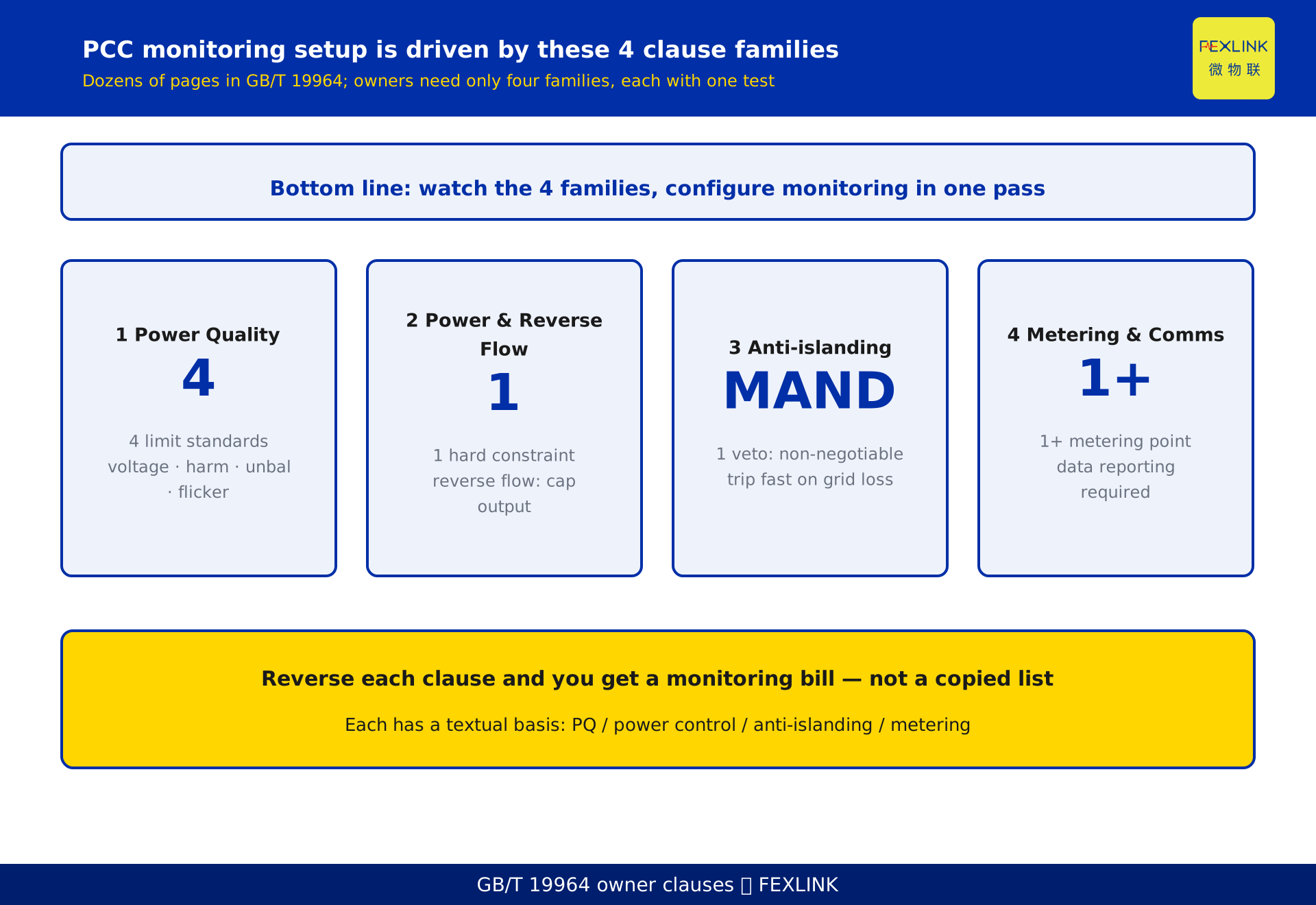
When grid-connection acceptance cites GB/T 19964, an owner does not need to read the whole standard. Only four families of clauses actually drive what gets installed and measured at the point of common coupling (PCC): power quality (voltage deviation, harmonics, unbalance, flicker), power control and voltage regulation (including reverse-flow prevention), anti-islanding protection, and metering and data reporting. Lock onto these four and you can state, in one pass, how the PCC monitoring setup should be configured, what quantities must be measured, and what acceptance will check — instead of being led by "just add one more meter." Below, each clause family is unpacked and mapped back to a concrete monitoring configuration.
1. First, what GB/T 19964 actually governs
GB/T 19964 is "Technical Rule for Photovoltaic Power Station Connected to Power System." The current version was issued in 2012, replacing the earlier guidance document GB/Z 19964-2005. Its role is that of an "interconnection" standard: it defines the obligations a PV station owes the public grid once it is connected, and the capabilities it must possess. It is neither an inverter product standard nor a plant design standard; it is a grid-connection threshold that the utility uses at acceptance to verify your station will not trouble the grid.
For an owner, the standard runs dozens of pages, and most clauses are aimed at the design institute and the inverter vendor (low-voltage ride-through, steady-state reactive/voltage curves, and so on). What the owner must personally police — and what directly decides "what to install, what to measure" at the PCC — sits in four families. Everything outside these four largely falls under equipment capability or the designer's remit, so the owner need not chew through it clause by clause.
2. Family one: power quality — where owners most often get "named"
After PV connects, the power quality at the point of common coupling must comply. GB/T 19964 itself does not state the limits; it requires PCC power quality to meet the following current national standards:
- Voltage deviation: GB/T 12325, Power Quality — Deviation of Supply Voltage
- Harmonics (including interharmonics): GB/T 14549, Power Quality — Harmonics in Public Supply Network
- Three-phase voltage unbalance: GB/T 15543, Power Quality — Three-phase Voltage Unbalance
- Voltage fluctuation and flicker: GB/T 12326, Power Quality — Voltage Fluctuation and Flicker
The key insight: the limits are not in the body of GB/T 19964 but in those four referenced standards. An owner should not mistake "the standard is thick" for "there are many limits" — what you check is the current limits of those four documents, then look back at whether PCC measurements stay under them.
Why the owner must watch personally: power-quality responsibility is divided at the PCC. If the harmonics or unbalance injected by the PV exceed limits, the responsibility sits on the owner's side; yet the grid-side background distortion also has to be acknowledged. Without PCC measurement data, no one can assign blame when a deviation appears. Accordingly, a device that continuously monitors these items belongs at the PCC. The ESE power-quality monitor (an online power-quality monitoring unit that tracks voltage deviation, harmonics, three-phase unbalance, and flicker) plays the "observable and evidentiary" role at this layer.
3. Family two: power control and voltage regulation — including the hard reverse-flow constraint
GB/T 19964 requires a PV station to have active-power control capability and to participate in grid voltage regulation (reactive/voltage support). For distributed owners, the most practical clause is reverse-flow prevention: when the project is contracted not to feed back into the grid, or only to deliver within a bounded range, the station must limit output or trip upon detecting reverse power, otherwise it disturbs the feeder and triggers protection.
Note that "reverse-flow prevention" is not a standalone clause written in isolation within GB/T 19964; it is the concrete implementation of "power control" in low-voltage and residential distributed scenarios, and many local utility interconnection rulings write it in as a hard condition. The owner's only test for this family is: is the PCC power direction observable, and can an over-limit be controlled? Inverters alone are insufficient — you also need a meter at the PCC that measures bidirectional energy and delivers a real-time power and direction signal, serving as the input to reverse-flow control and as acceptance evidence. The ZSA smart meter (a tariff/PCC smart metering unit supporting bidirectional active and reactive metering and reporting real-time power and direction) performs the bidirectional-metering role at this layer.
4. Family three: anti-islanding — mandatory, non-negotiable
Anti-islanding is the only family among the four with no room for negotiation. GB/T 19964 requires the PV station to rapidly detect an island and disconnect from the grid; once the grid loses power (maintenance, fault trip), the station must detect the island and disconnect within the prescribed time, otherwise it keeps energizing as an "island" and endangers maintenance personnel and equipment. GB/T 19939, Technical Requirements for Grid-Connected Photovoltaic Systems, also addresses this.
The common owner misconception is "the inverter has anti-islanding, so we are covered." Mainstream inverters do embed anti-islanding, but acceptance looks at: (1) whether the protection is enabled and correctly set; (2) whether the protection device and the grid-tie switch form a complete trip chain; and (3) whether the station reliably locks out after disconnection without spurious reclosure. This is a primary-safety matter; the author recommends writing the anti-islanding enablement and disconnection test into the acceptance checklist rather than assuming "it ships that way."
5. Family four: metering and data reporting — the "last mile" of acceptance
Connecting the wires is not the end. GB/T 19964 requires a metering device at the PCC that satisfies settlement and monitoring needs, and requires the station to provide operating information to the grid dispatcher (active/reactive power, voltage, current, generation, PCC status, etc.) meeting data-reporting requirements.
For the owner, this family means: there must be at least a compliant tariff metering point at the PCC, and the station's operating data must reach the dispatcher or the owner's own platform. Two layers are easily missed — first, the metering-point location and ratio must match the settlement basis; installing at the wrong place (e.g., on the main incoming feeder but analyzed as a branch circuit) voids every reading; second, the data-reporting channel must be provisioned, and many projects discover at acceptance that "the meter has data but it never reaches the network." The ZSA smart meter at this layer produces settlement energy and, through its communication interface, pushes operating data out — a dual-purpose metering-and-communication node.
6. Mapping clauses back to a monitoring bill of materials: four maps to four
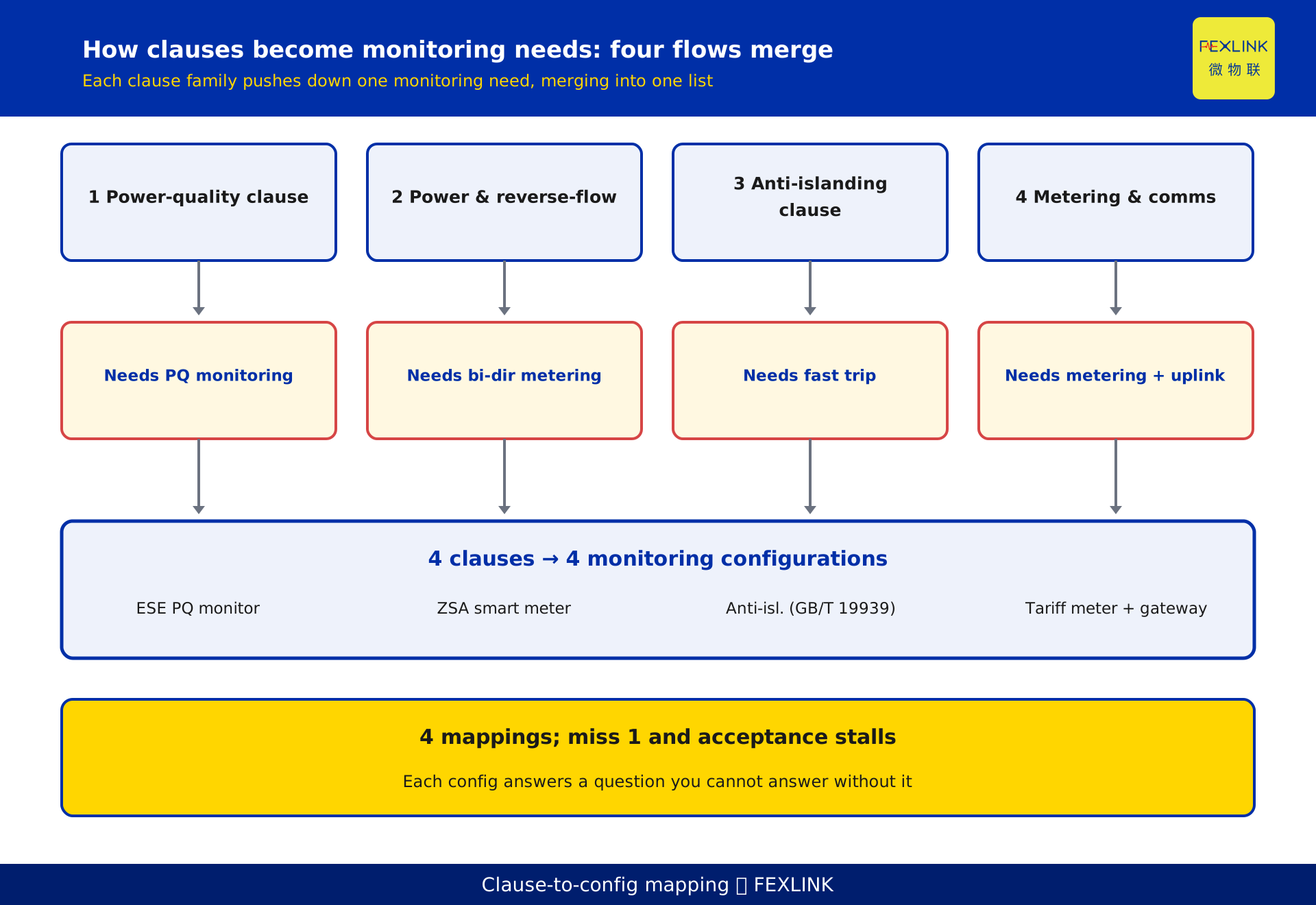
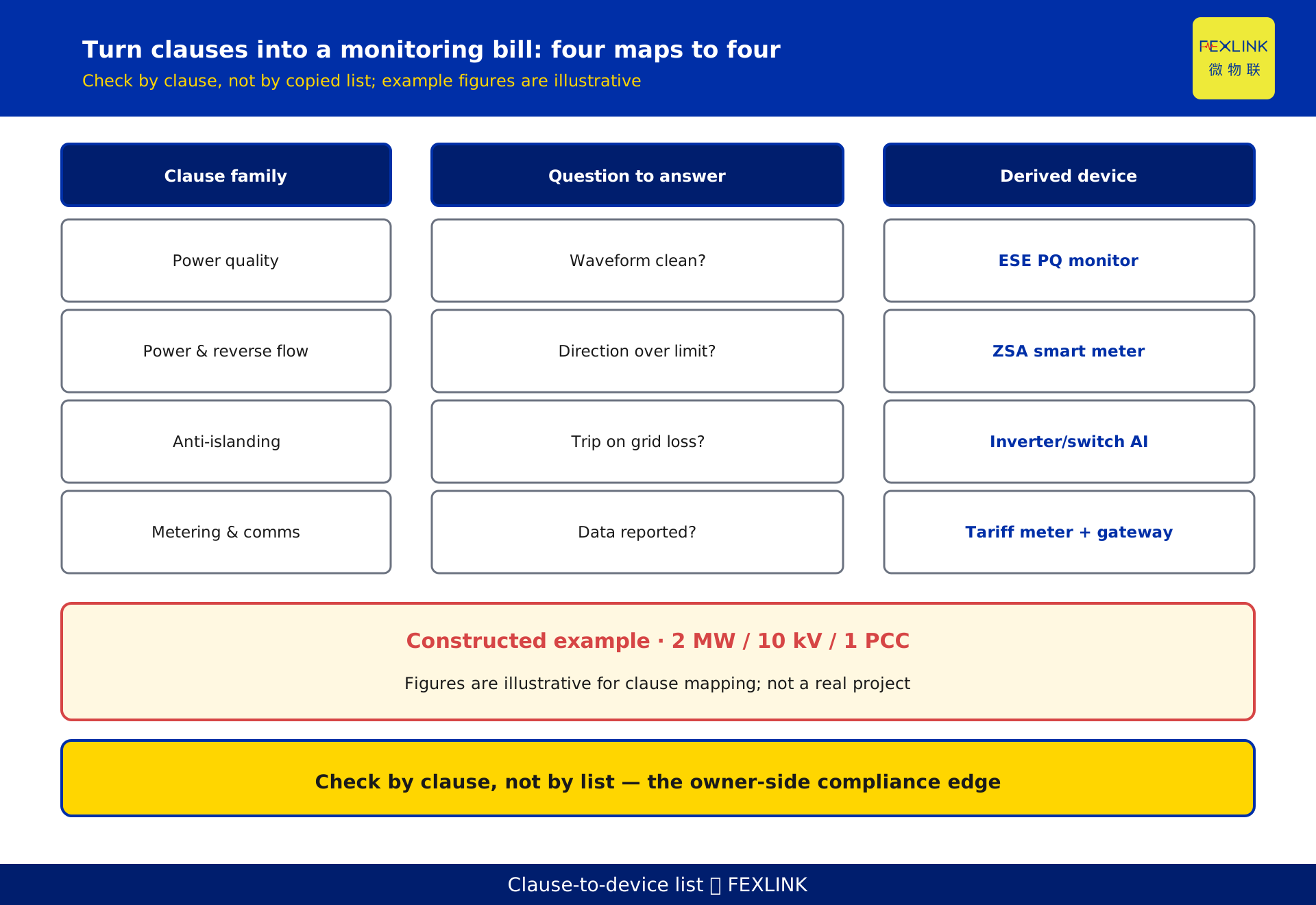
Reverse each of the four clause families and you get a monitoring configuration that was not copied from someone else's list. The increment over device-selection articles (such as KD-0543's three-layer PCC configuration) lies exactly here: instead of arguing by "mandatory vs. optional" equipment tiers, we map clause by clause so that "why install this" has a textual basis.
| Clause family | Question the owner must answer | Derived monitoring configuration |
|---|---|---|
| Power quality | Is the PCC waveform and voltage clean enough | ESE power-quality monitor (continuous voltage deviation / harmonics / unbalance / flicker) |
| Power control & reverse flow | Has output direction crossed the line, and can it be controlled | ZSA smart meter (bidirectional metering + real-time power-direction signal) |
| Anti-islanding | Can it disconnect fast when the grid loses power | Inverter / grid-tie switch anti-islanding per GB/T 19939 + disconnection test record |
| Metering & communication | Where does settlement energy come from, does data get reported | Tariff meter + data-reporting gateway (unified time axis and point tags) |
The logic of the table: every clause maps to a question that cannot be answered without the corresponding device. Remove any one and acceptance stalls at some step.
7. A constructed example: a 2 MW distributed PV PCC at one campus
The following is a constructed example to show how clauses land in a configuration. It represents no real customer or project; actual configuration follows the current standard text, project documents, and local utility requirements.
A campus hosts a 2 MW distributed PV plant, PCC voltage level 10 kV, with one point of common coupling. Checking against the four clause families above:
- Power quality: one ESE power-quality monitor at the PCC continuously records voltage deviation, harmonics, three-phase unbalance, and flicker;
- Power and reverse flow: one ZSA smart meter at the PCC meters export/import energy bidirectionally and outputs a real-time power-direction signal for reverse-flow logic;
- Anti-islanding: the inverter's embedded anti-islanding is enabled, the grid-tie switch trip circuit is complete, and a disconnection test is recorded at acceptance;
- Metering and communication: tariff metering and operating data are reported through a gateway, keeping settlement and dispatch data on one source.
The example figures "2 MW / 10 kV / 1 PCC" are there only to chain the four clause families into a checkable configuration; the numbers themselves are not a selection recommendation.
8. Five misconceptions owners most often hold
- "Watching the inverter datasheet equals compliance." Inverter parameters cover only equipment capability; PCC measurement, metering, and communication are absent from that sheet.
- "Harmonics are read from the inverter's sample values." PCC harmonics are the superposition of PV, grid background, and other loads on the same bus — they must be measured on site.
- "Reverse-flow prevention is optional." When the local utility writes it into the interconnection ruling, it is a hard condition; omit it and acceptance fails.
- "One settlement meter is enough." The settlement meter answers "how much energy," but not "is the waveform clean" or "has direction crossed the line."
- "Data reporting can wait." Acceptance frequently stalls on "the meter has data but it never reaches the network" — the channel must be provisioned at design time.
9. FAQ
Q: Which clauses of GB/T 19964 must the owner personally watch?
Four families: power quality; power control and voltage regulation (including reverse-flow prevention); anti-islanding; and metering and communication/data reporting. The rest mostly concern equipment and design and need not be studied clause by clause.
Q: Why does the article not give specific limits, such as the percentage for voltage deviation?
The limits are not in the body of GB/T 19964 but in the standards it references — GB/T 12325, GB/T 14549, GB/T 15543, and GB/T 12326. The exact figures follow those current standard texts; this article does not pronounce them on their behalf.
Q: Is reverse-flow prevention actually mandatory?
When the local utility's interconnection ruling lists it as a condition, it is a hard requirement. Its textual basis lies in the power-control clause of GB/T 19964 and the anti-islanding provisions of GB/T 19939; whether it is "mandatory" depends on the local interconnection approval, not on the standard's wording alone.
Q: Must ESE and ZSA be installed as a pair?
No binding relationship. ESE handles continuous power-quality monitoring; ZSA handles bidirectional metering and data reporting, each mapping to a different clause family. A small, low-voltage residential project may need only metering and reverse-flow prevention and not power-quality monitoring; a large plant with a voltage-sensitive PCC needs both.
Q: What does acceptance check for data reporting?
Two things: first, whether the metering-point location and ratio match the settlement basis; second, whether operating data (power, voltage, generation, etc.) can be reported steadily to the dispatcher or the owner's platform. Put both into the acceptance checklist and verify early.
Scope and limitations
- This article frames GB/T 19964's structure and applies to acceptance preparation for both distributed and centralized PV stations; the precise applicability boundary follows the current standard text and the project's interconnection approval.
- The power-quality limits cited here all point to current national standards GB/T 12325, GB/T 14549, GB/T 15543, and GB/T 12326; this article lists no specific limit figures, and quantitative conclusions follow those current standard texts.
- The textual basis for anti-islanding spans both GB/T 19964 and GB/T 19939; whether it is listed as a hard acceptance condition depends on the local utility's interconnection ruling, and this article makes no conformance determination.
- The "2 MW campus distributed PV" in section 7 is a constructed example showing how clauses map to configuration; it is explicitly labelled a constructed example and represents no real customer, project, or product-selection advice.
- Model numbers, interfaces, and ranges for the ESE power-quality monitor and the ZSA smart meter follow the latest selection manual and product knowledge base; this article is not a selection or procurement recommendation.
- Standard numbers cited reflect currently valid versions; if a standard is revised, the related conclusions require rechecking.
Frequently Asked Questions
What Owners Should Actually Watch in GB/T 19964
When grid-connection acceptance cites GB/T 19964, an owner does not need to read the whole standard