 FEXLINK Research Institute
The short answer
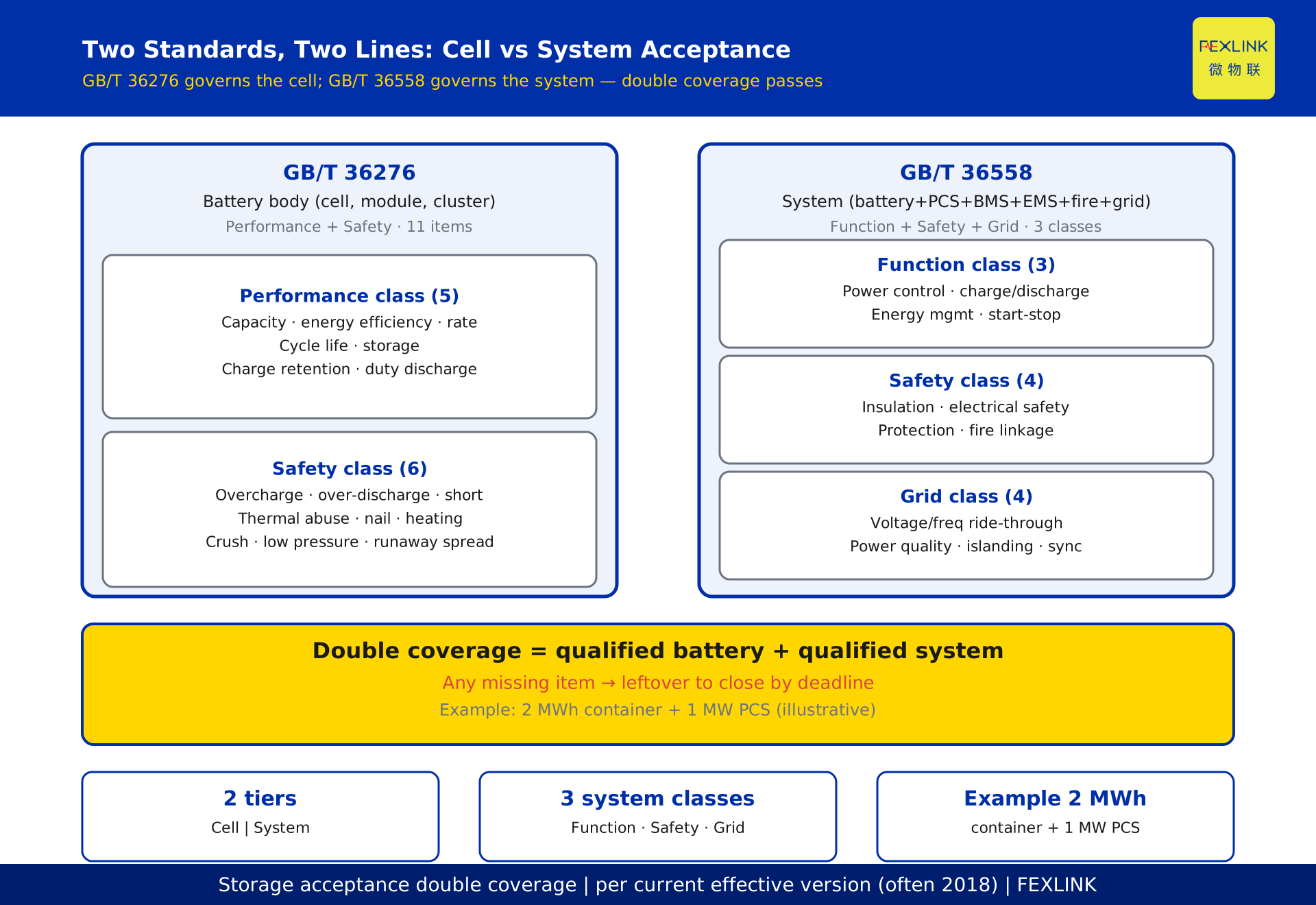
At storage-site acceptance, the owner's most common miss is checking the wrong layer: treating the battery factory test report as the system acceptance, or staring at the system while forgetting the cells. The conclusion first: GB/T 36276 governs the battery's performance and safety; GB/T 36558 governs the system's function, safety, and grid connection. Acceptance must achieve "qualified battery + qualified system" — double coverage. Both standards commonly circulate as the 2018 edition, but specific clauses, test items, and limits must always follow the currently effective version. This article only maps the governance boundary and the acceptance viewpoint.
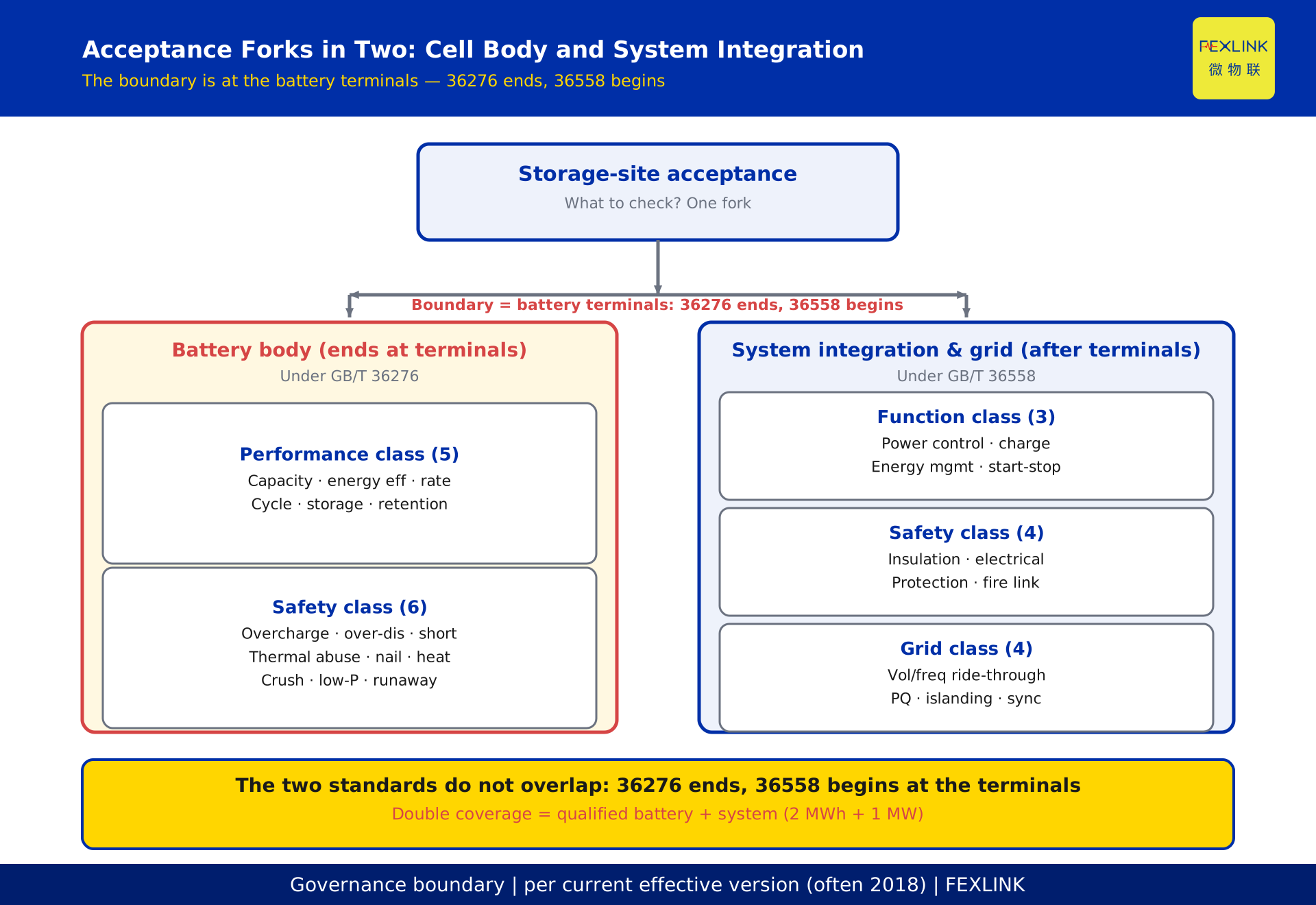
Draw the line first: which layer each standard governs
GB/T 36276 governs the battery itself — from the cell, through the module, to the battery cluster. It specifies "whether this battery is good and safe in itself." It covers two broad categories: the performance class (initial capacity, energy efficiency, rate capability, cycle life, storage, etc.) and the safety class (overcharge, over-discharge, short circuit, thermal abuse, nail penetration, heating, etc.). Most of these tests are completed at the type-test and factory-inspection stage.
GB/T 36558 governs the storage system: once the battery, PCS converter, BMS, EMS, fire protection, and grid-connection switch are integrated into a grid-connected unit, it specifies "whether the system can charge and discharge on dispatch command, self-protect when the grid fluctuates, and connect cleanly." It covers three broad categories: the function class (power control, charge/discharge, energy management), the safety class (insulation, electrical safety, protection, fire linkage), and the grid-connection class (voltage/frequency ride-through, power quality, islanding, synchronization).
The boundary sits at the battery terminals: 36276 ends at battery delivery; 36558 begins at system integration and grid connection. They do not overlap and cannot substitute for each other. Buying the battery is one thing; running it through together with the system and the grid point is another.
Cell-level acceptance: what GB/T 36276 actually checks
Cell-level acceptance asks "could this battery survive the tests at the factory," along two streams.
Performance stream. Capacity and energy, discharge capability at normal/high/low temperature, energy efficiency, rate discharge, cycle life, charge retention and storage — these are the baseline for judging "whether the battery can be used and for how long." At acceptance, obtain the type-test report for the corresponding model, confirm that the test items cover the categories above, and verify that the sample matches the delivered batch.
Safety stream. Overcharge, over-discharge, short circuit, heating, nail penetration, crush, drop, low pressure, thermal-runaway propagation — these are the floor for judging "it will not catch fire or explode when something goes wrong." Safety tests are usually non-recoverable, destructive verification that must be completed by a qualified laboratory before delivery, and the report must be traceable.
Note: specific test items, test methods, pass criteria, and limits must always follow the currently effective GB/T 36276 text. This article only categorizes; it does not replace the standard nor give any specific value.
System-level acceptance: what GB/T 36558 actually checks
System-level acceptance asks "once integrated, can this thing safely connect to the grid and obey dispatch," along three streams.
Function stream. Power-control accuracy, charge/discharge response, energy-management and start-stop logic — at acceptance, run on-site joint commissioning: see whether the system executes per EMS commands and whether response time meets the bar, not just a device list.
Safety stream. Insulation resistance, creepage and clearance, protection actions (over-current, over-voltage, over-temperature), fire linkage — these surface only after field integration, beyond what the factory report covers; they must be verified on site, and the linkage logic among fire protection, BMS, and EMS must be genuinely effective.
Grid-connection stream. Voltage ride-through and frequency ride-through (the ability to stay online under low/high voltage, low/high frequency), power quality (harmonics, three-phase imbalance, voltage fluctuation), islanding protection, synchronization and power factor — these are the hard items directly tied to the grid and the part owners most often miss.
Again, specific limits, test conditions, and pass criteria follow the currently effective GB/T 36558 text; this article gives no specific value.
Operations monitoring and data upload: from one-off acceptance to continuous visibility
Type tests and on-site commissioning solve "qualified at delivery," but the long-term safety of battery and system relies on online monitoring during operation. A qualified acceptance should also confirm that this data channel is open at delivery, rather than discovering blind spots only when something breaks in operation.
Long-term safety rests on online monitoring. For this layer, connect both ends. The ESX Smart Edge Computing Gateway collects and uploads real-time data from the BMS and PCS (voltage, current, state of charge, temperature, alarms) to the monitoring platform, so the owner can always see the system-level operating state. The EST Multi-channel Temperature Controller collects and alarms on multi-point temperatures of battery clusters, racks, or containers — the basis for early thermal-runaway warning. Together they extend "factory-qualified" into "operation-visible" and leave a data foundation for later O&M and review.
A mapping table: acceptance item versus governing standard
| Dimension | Layer | Governing standard | What to check (category) |
|---|---|---|---|
| Capacity, energy efficiency, cycle life, rate, storage | Cell | GB/T 36276 | Performance-class tests |
| Overcharge, over-discharge, short circuit, thermal abuse, nail, heating | Cell | GB/T 36276 | Safety-class tests |
| Power control, charge/discharge, energy management | System | GB/T 36558 | Function class |
| Insulation, electrical safety, protection, fire linkage | System | GB/T 36558 | Safety class |
| Voltage/frequency ride-through, power quality, islanding, sync | System | GB/T 36558 | Grid-connection class |
| Operations monitoring and data upload | Cross-layer | Interface of both | Online monitoring (ESX, EST support) |
This table is an acceptance checklist for the owner: tick items on the left, label on the right which standard governs, avoiding "checked the battery but missed grid connection" or "checked the system but forgot the cells."
A worked (illustrative) acceptance scenario
The following scenario is constructed to illustrate the acceptance logic; it represents no real customer or project, and all parameters are illustrative.
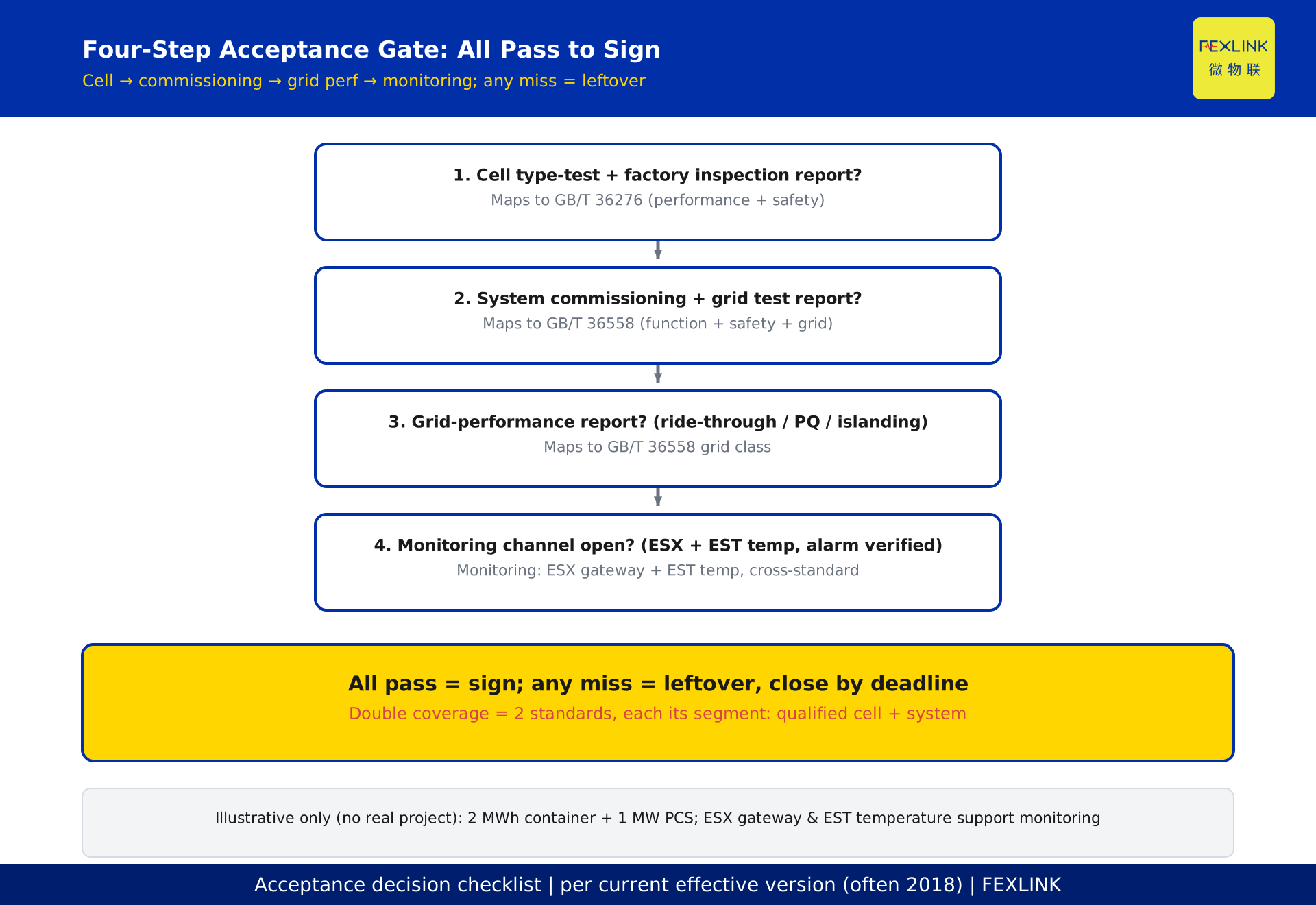
At a 10 kV-connected storage site configured with a 2 MWh battery container and a 1 MW PCS, the owner at the acceptance meeting confirms three things. First, the battery: the supplier provides the GB/T 36276 type-test and factory-inspection reports for the corresponding model; the performance class (capacity, energy efficiency, cycle life, etc.) and the safety class (overcharge, short circuit, thermal abuse, etc.) are complete and match the delivered batch. Second, system integration: on-site GB/T 36558 system joint commissioning and grid-connection testing are complete; the three categories — function (power control, energy management), safety (insulation, protection, fire linkage), grid-connection (voltage/frequency ride-through, power quality, islanding protection) — have complete reports. Third, the monitoring channel: the ESX Smart Edge Computing Gateway has uploaded BMS and PCS data to the platform, and the EST Multi-channel Temperature Controller's multi-point temperature alarm has been triggered and verified on site. All three complete, acceptance can be signed; any one missing, record as a leftover item to be closed within a deadline.
The only point this scenario makes: double coverage is not "as long as there is a report," but that battery, system, and monitoring all land on site and on data.
The three most commonly missed item groups
First, only looking at the battery factory report without doing system-level on-site commissioning. A qualified battery does not mean the system can connect — PCS, BMS, and EMS integration problems only surface on site; no matter how good the factory report looks, it cannot cover them.
Second, missing the grid-connection performance. Voltage/frequency ride-through, power quality, and islanding protection are hard items directly tied to the grid; they are often questioned at the acceptance meeting but no report was prepared, leaving only last-minute re-testing or passive rectification.
Third, not confirming the monitoring channel after acceptance. Whether the ESX gateway and EST temperature data are truly uploaded and alarms truly triggered — if not verified at delivery, the operation period is a blind spot, leaving "continuous visibility" an empty phrase.
Decision guidance: how to judge "acceptance passed"
One executable criterion, no hedging:
Battery qualified (has the GB/T 36276 type-test and factory-inspection report for the corresponding model, items covering the performance and safety classes) + System integration qualified (has the GB/T 36558 system joint-commissioning and grid-connection test report, covering the function, safety, and grid-connection classes) + Operations monitoring channel open (ESX gateway and EST temperature data uploaded, alarms verified) = double coverage met, acceptance can be signed.
Any item missing leads to a leftover item to be closed within a deadline; do not sign first and fill later. Signing first and back-filling usually means the rectification responsibility shifts from the supplier to the owner.
Frequently Asked Questions (FAQ)
Q: Is checking one of GB/T 36276 and GB/T 36558 enough?
No. 36276 governs the battery; 36558 governs system grid connection. They sit at different layers and cannot substitute. Check only the battery and the system's grid-connectivity is unverified; check only the system and the battery's safety is unbacked. You need double coverage.
Q: If the battery factory report is complete, does the system acceptance pass?
Not necessarily. The factory report only proves the battery is qualified; PCS, BMS, and EMS integration and grid-connectivity performance are site-only problems — you must have the 36558 system joint-commissioning and grid-connection test report.
Q: Why should the owner check voltage ride-through and power quality themselves?
These are hard thresholds for a storage system to connect to the grid; the utility's grid-connection acceptance will check them. If the owner does not prepare, they hand over the initiative. They belong to the 36558 grid-connection class and are the easiest to miss.
Q: Why put operations monitoring into acceptance?
Acceptance is a point-in-time qualification; operational safety is long-term. The ESX gateway and EST temperature open the battery-system-platform data channel, turning "one-off qualified" into "continuously visible"; otherwise the operation period is a monitoring blind spot.
Q: Which edition of the two standards should I read?
Both standards commonly circulate as the 2018 edition, but specific clauses, test items, and limits follow the currently effective version; after a revision, related conclusions need re-checking. Mentioning the year here only illustrates "editions update" and does not constitute recognition of the currently effective version.
Scope and limitations
- This article only maps the standards' governance boundary and acceptance viewpoint; it does not replace the GB/T 36276 or GB/T 36558 texts. Specific test items, methods, limits, and pass criteria always follow the currently effective version.
- Both standards commonly circulate as the 2018 edition; mentioning the year only illustrates "editions update" and does not constitute recognition of the currently effective version.
- The ESX Smart Edge Computing Gateway and EST Multi-channel Temperature Controller are introduced to illustrate the "operations monitoring and data upload" logic; specific specs, interfaces, and selection follow the latest product knowledge base and selection manual, and this article is not a procurement suggestion.
- The three missed-item lists in the section above and the criterion in the decision section are methodological suggestions; actual acceptance should follow the project contract, grid-connection rules, and authority requirements.
- All illustrative parameters in this article (for example, a 2 MWh battery container and a 1 MW PCS at a park) are constructed to illustrate the point and represent no real customer, project, or test data; this article cites no real customer cases, test data, or energy-saving rates.
Frequently Asked Questions
GB/T 36276 and GB/T 36558
At storage-site acceptance, the owner's most common miss is checking the wrong layer: treating the battery factory test report as the system acceptance