 FEXLINK Research Institute
The short answer
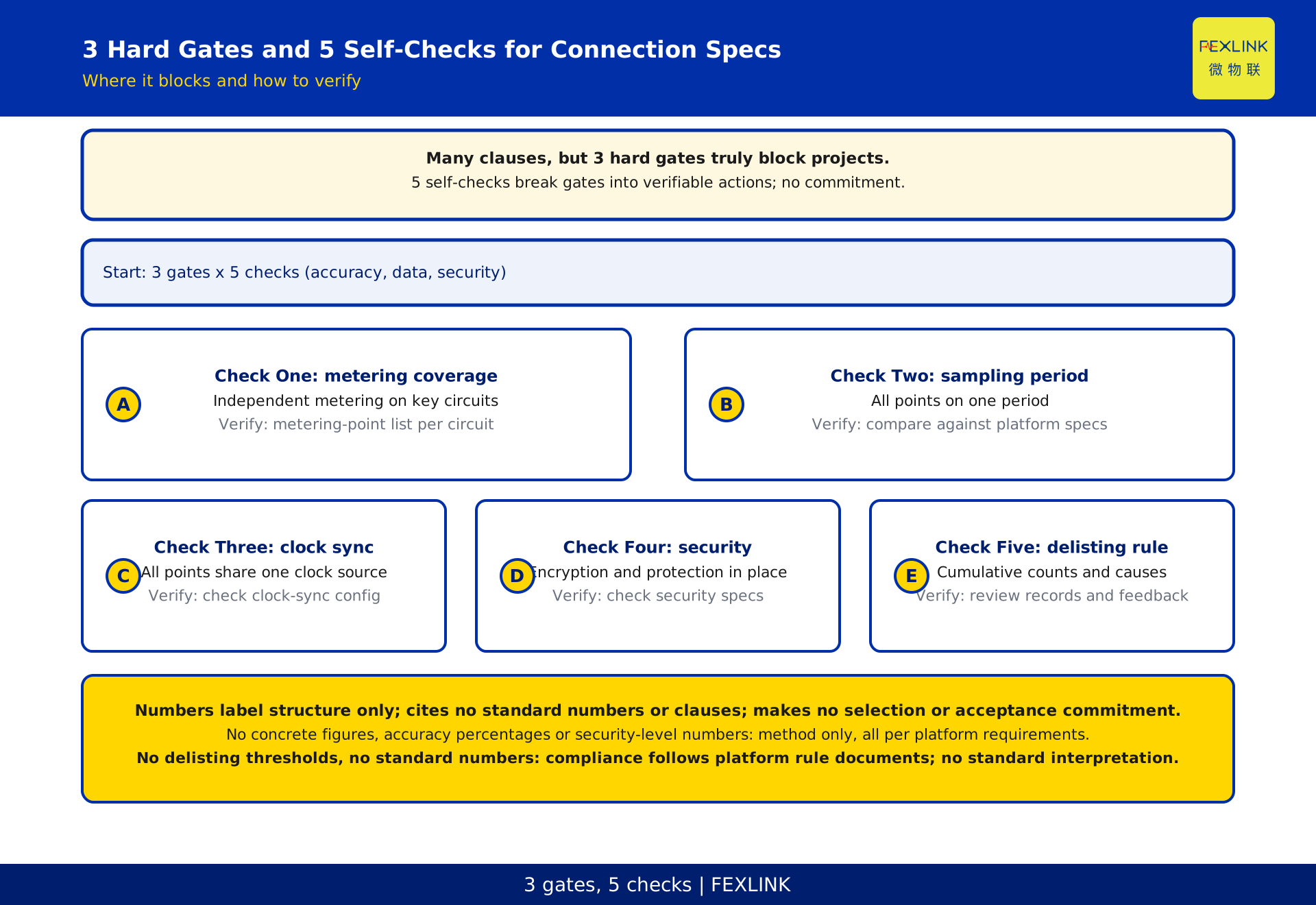
Local platform connection specs carry many clauses, but the ones that truly block a project — that reject connection or trigger delisting when unmet — fall into 3 hard gates: response accuracy with metering density, data completeness with time synchronisation, and security compliance (encryption and classified protection). Without meeting accuracy or data completeness, no amount of flexible capacity clears the connection review — that is the core conclusion. Five self-check items (5 items) break the three gates into verifiable actions: whether metering coverage is sufficient, whether sampling periods align, whether clocks share one source, whether encryption and authentication comply, and whether delisting rules are understood. The 3 gates and 5 checks are two views of the same thing — gates tell you "where it blocks", checks tell you "how to verify". This article cites no standard numbers or clauses and makes no conformance claims; the VPP development guiding document is a policy document, not a technical standard, cited only for qualitative context with no year, clause or limit values; no concrete figures, accuracy percentages or security-level numbers are given — all follow platform requirements and the latest rule documents; it constitutes no selection or acceptance commitment.
Gate One: Response accuracy and metering density
What the connection spec demands of response accuracy is not "how much was curtailed" but "whether the curtailed amount can be verified to the required accuracy grade". The platform wants not the action but its measurability — which requires metering density: a main meter at the point of common coupling is not enough; circuits participating in regulation need independent metering, and the execution status of each command must be reportable. Where does accuracy get blocked? At "you curtailed, but the platform cannot read how much" — one branch meter missing, and the main-meter change is drowned in noise; or sampling periods differ, the platform reads on its cycle, you report on yours, and misalignment means failure. The self-check method for metering density: verify circuit by circuit whether independent metering exists, whether the meter accuracy grade suffices, whether status signals have a return channel. Whichever item is missing, that is the action to complete. No specific accuracy percentages or sampling-period numbers appear here — platform requirements vary by region and follow the platform rule documents.
Gate Two: Data completeness and time synchronisation
Data completeness is the gate most likely to block connection approval. After a response, the platform verifies the effect and finds data gaps, clocks on different sources, or inconsistent sampling periods — the curves cannot assemble into one complete record, and the result is failure. The compliance method for data completeness: whether the response-window curve has gaps, whether outage backfill is planned, whether all metering points share one clock source. Time synchronisation is the premise of data completeness — if each meter stamps its own clock, post-hoc alignment is impossible, and more data only means more fragments. The self-check method: unify the clock source across all metering points, unify sampling periods, plan outage backfill, and keep event records of the response window under one convention. The ESX smart edge computing gateway carries the data-completeness-chain role here: unified clock, unified sampling, outage backfill — the premise of a verifiable effect. No specific completeness percentages or time-sync precision numbers appear here — the compliance standard follows the platform rule documents.
Gate Three: Security compliance
Security compliance is the third hard gate, covering communication encryption and cybersecurity classified protection. The platform requires encrypted command links, identity authentication, and traceable access logs — these are not optional but hard gates. The self-check method for security compliance: whether the communication link is encrypted, what authentication method is used, how long access logs are retained, and whether cybersecurity classified protection is in place. Encryption protocols and protection requirements vary by platform; this article gives no specific security-level numbers or encryption algorithm names — all follow the platform security specifications. What happens if it fails? Security failure is not "restricted dispatch" but outright connection rejection — the platform will not connect an unencrypted command link to its dispatch system.
What "three-strike" delisting rules mean
Many local platforms include a "three-strike" delisting clause: after a cumulative number of failed responses, incomplete data incidents, or security violations, the resource is removed from the aggregator's list. The self-check method for delisting rules: know what the delisting conditions are, know the current cumulative count, and know the cause and rectification record of each failure. What does the delisting rule mean? It means connection is not permanent — passing the review is only the entry ticket; sustained compliance keeps you in the game. The fifth of the five self-check items is the delisting-rule check — not waiting for a delisting notice, but proactively reviewing the cumulative status after each response. No specific strike counts or days appear here — delisting thresholds follow the platform rule documents.
Five self-check items: how to verify each
Breaking the three gates into five self-check actions, verified one by one:
| Self-check | Gate | What to verify | How to check | If it fails |
|---|---|---|---|---|
| Metering coverage | Accuracy | Independent metering on key circuits | Check metering-point list circuit by circuit | Install metering or remove the circuit |
| Sampling period | Completeness | Whether all points use one period | Compare against platform requirements | Unify or add adaptation |
| Clock sync | Completeness | Whether all points share one clock source | Check clock-sync configuration | Unify the clock source |
| Security | Security | Whether encryption and protection are in place | Compare against platform security specs | Add encryption and authentication |
| Delisting rule | Delisting | Cumulative failure count and causes | Review response records and platform feedback | Rectify and retain records |
The self-check methods in the table describe verification conventions, not parameter values; actual standards follow platform requirements and project validation. This article constitutes no selection or acceptance commitment.
Gate-check correspondence
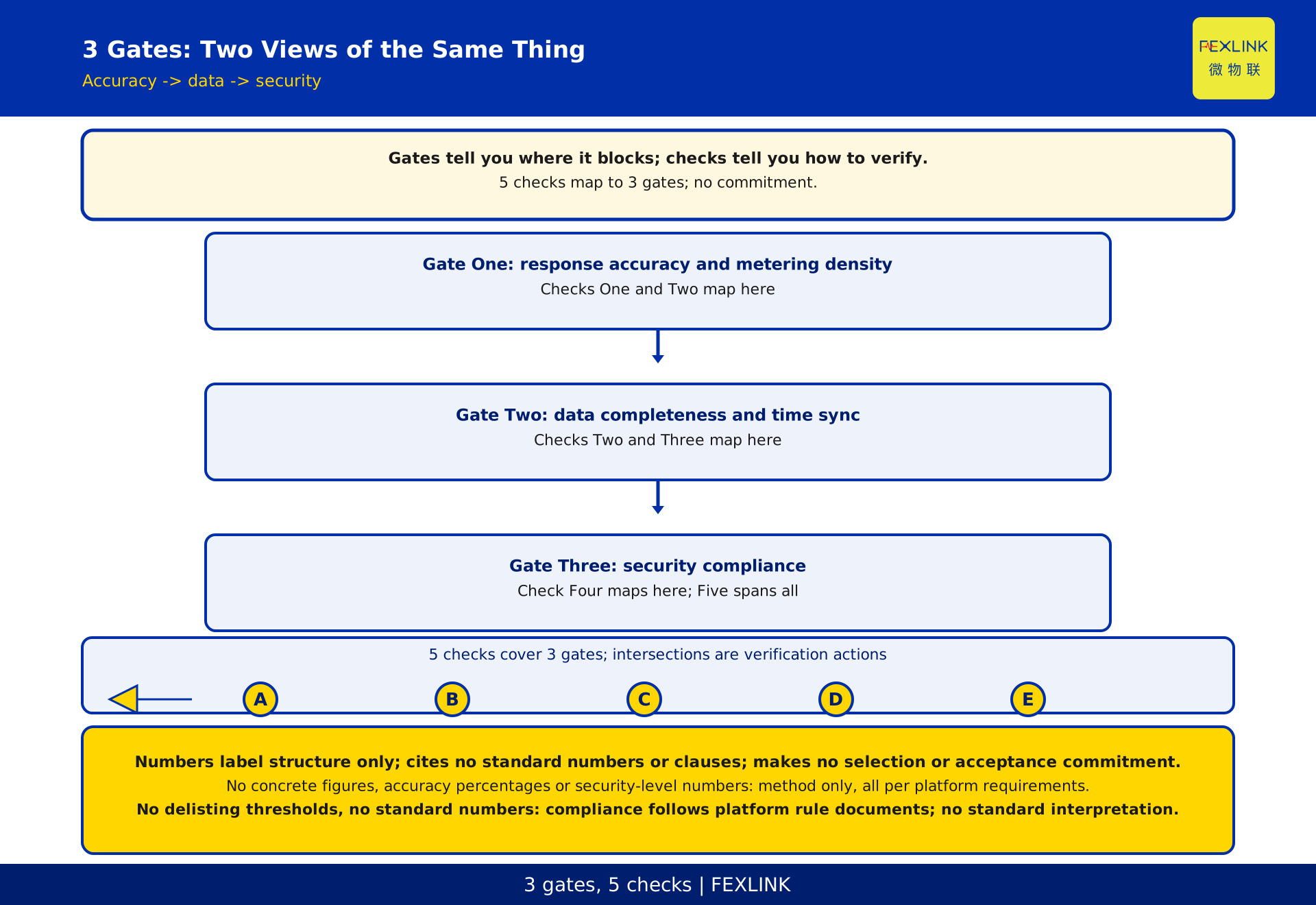
The three gates and five self-check items are not two independent lists but two views of the same thing: gates tell you "where it blocks", checks tell you "how to verify". The accuracy gate maps to the metering-coverage check — verifiable accuracy requires sufficient metering density; the data-completeness gate maps to the sampling-period and clock-sync checks — completeness requires unified periods and one clock source; the security gate maps to the security check — encryption, authentication and classified protection; the delisting rule maps to its own check — cumulative counts and causes traceable. Three gates and 5 checks form a matrix: gates run across, 5 checks run down, and each intersection says "which gate this check addresses and what happens if it fails". The matrix matters because self-checking is not for passing the audit but for removing risks before it — when every check has a conclusion, every gate has a foundation.
The self-check sequence across three gates
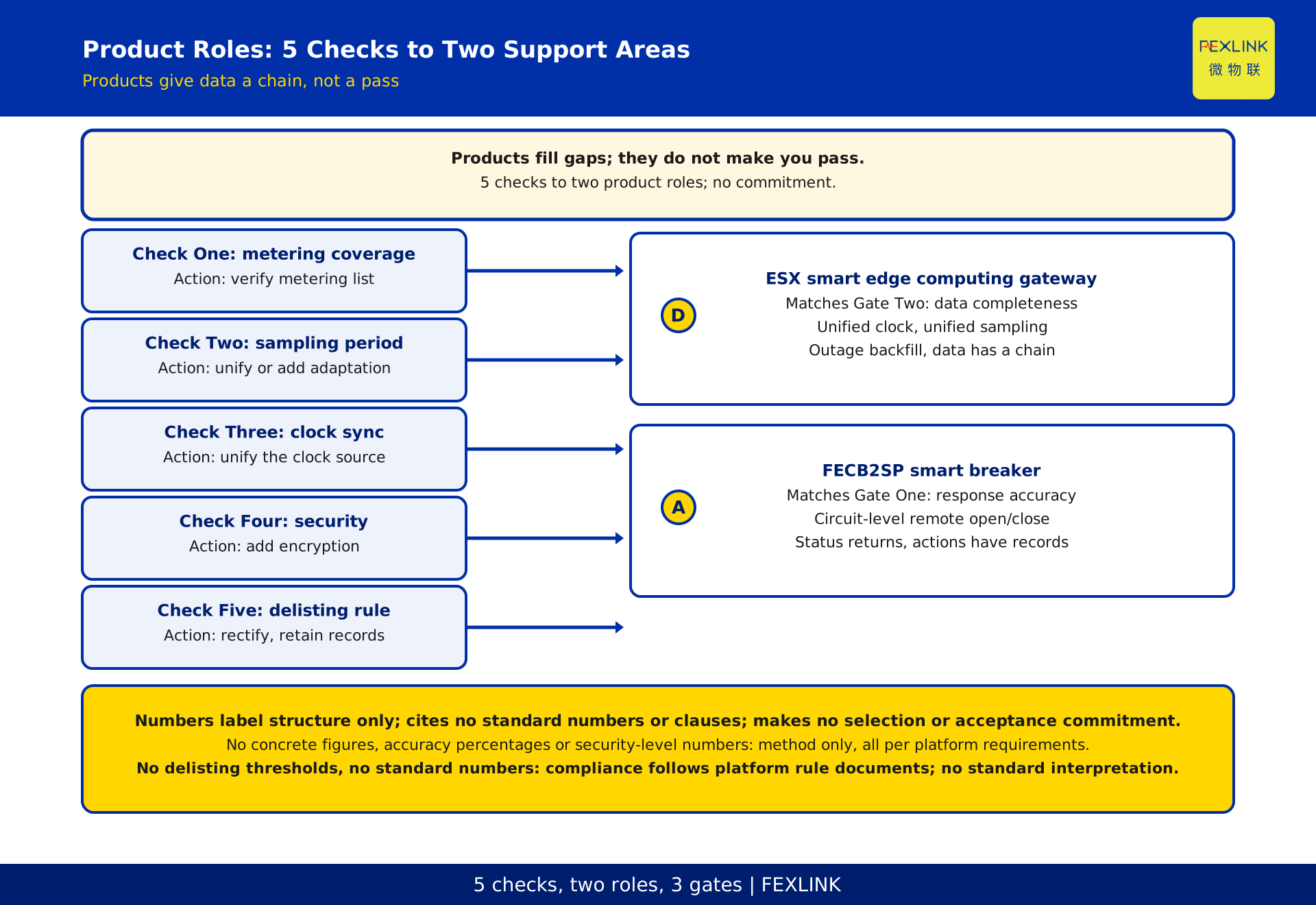
String the five checks into a self-check chain along the three gates. Accuracy — ask: is metering sufficient? Are status signals returning? Data — ask: is the clock one source? Is sampling unified? Is outage backfill planned? Security — ask: is the link encrypted? Is classified protection in place? All three answered before applying for connection; whichever question fails, patch that gate first. Self-checking is not one-time — do it before connection, after every response, and whenever platform rules update. The FECB2SP smart breaker carries the accuracy-gate role here: execution-status return from remote open/close gives evidence that "it was curtailed". The ESX smart edge computing gateway carries the data-gate role: unified clock, unified sampling, outage backfill gives a complete record of "how much was curtailed".
What happens when a gate fails
The three gates have tiered consequences: accuracy or data failure typically means restricted dispatch — the platform lowers call frequency or reduces adjustable capacity, restored after rectification; security failure typically means outright rejection or link disconnection — the platform will not accept the security risk of an unencrypted link; delisting-rule triggering means removal — cumulative failures exhaust the quota, the resource exits the aggregator list and must reapply. The cost of failure is stepwise: restricted dispatch affects revenue but does not remove you; rejection suspends participation; delisting clears you out. The value of self-checking is keeping problems before "restricted dispatch" — after each response, run the five items, and if any shows risk, rectify early, do not wait for the platform notice.
How products support compliance
Back to the three gates: products fill the matching gaps; they do not make you pass. The ESX smart edge computing gateway matches data completeness — unified clock, unified sampling, outage backfill gives the data a complete chain for verification; the FECB2SP smart breaker matches response accuracy — circuit-level remote execution with status return gives the action a record for verification. Products do not replace platform security specifications — which encryption protocol, what protection level, how long logs are retained follow the platform security specs; what products do is give data a traceable link and execution a verifiable record. Concrete models, interfaces and access follow the latest selection manual and project design files; this article constitutes no selection or acceptance commitment.
FAQ
Q: Which clauses in the connection spec are hard gates and which are recommendations?
A: The three hard gates are response accuracy with metering density, data completeness with time synchronisation, and security compliance — failing any means connection rejection or delisting. Other clauses are mostly recommendatory or negotiable. The distinguishing method is the consequence: failure causing rejection or delisting is a hard gate; failure only affecting dispatch frequency is a recommendation.
Q: How is data completeness deemed acceptable?
A: The platform rule document defines the standard — typically requiring no data gaps in the response window, all metering points on one clock source, and unified sampling periods. The self-check method: check whether curves have gaps, whether clock configurations are consistent, and whether outage backfill is planned. No specific completeness percentages are given here; the standard follows the platform rules.
Q: What exactly does security compliance involve?
A: Encrypted communication links, identity authentication, traceable access logs, and cybersecurity classified protection — these four are common requirements. The specific encryption protocol and protection level vary by platform; no specific security-level numbers are given here, following the platform security specifications.
Q: Does the VPP development guiding document specify connection technical specs?
A: That document is the guiding opinions on accelerating virtual power plant development, promoting VPP aggregation of distributed resources for demand response and markets — a policy document, not a technical standard. Connection technical specs are defined by local platforms and industry rule documents. This article does not provide rule-document reading; the policy background is cited only for qualitative context.
Q: How is the delisting rule typically triggered?
A: The common mechanism is removal from the aggregator list after a cumulative number of failed responses, incomplete-data incidents, or security violations. The specific count and days follow the platform rule documents; no specific delisting thresholds are given here. The self-check method: after each response, proactively review the cumulative status — do not wait for a notice.
Scope and limitations
This article targets demand-response integrators and technical leads, lining up the three hard gates that most often block projects in local connection specs — response accuracy with metering density, data completeness with time synchronisation, and security compliance — broken into five self-check actions. It does not cover the five-readiness retrofit checklist, the five-pitfall avoidance guide, policy-opportunity analysis, execution-breakdown troubleshooting, or whole-plant architecture. It cites no standard numbers or clauses and makes no conformance claims; the VPP development guiding document is a policy document, not a technical standard, cited only for qualitative context with no year, clause or limit values; no concrete figures, accuracy percentages, security-level numbers or delisting thresholds are given — all follow platform requirements and the latest rule documents. It constitutes no selection or acceptance commitment and no standard interpretation, the generator does not self-approve, and publication requires independent verification; implementation is carried out by licensed electrical and professional personnel under site procedures, and this article replaces neither electrical design nor site safety rules.
Frequently Asked Questions
Which clauses in the connection spec are hard gates and which are recommendations?
The three hard gates are response accuracy with metering density, data completeness with time synchronisation, and security compliance — failing any means connection rejection or delisting. Other clauses are mostly recommendatory or negotiable. The distinguishing method is the consequence: failure causing rejection or delisting is a hard gate; failure only affecting dispatch frequency is a recommendation.
How is data completeness deemed acceptable?
The platform rule document defines the standard — typically requiring no data gaps in the response window, all metering points on one clock source, and unified sampling periods. The self-check method: check whether curves have gaps, whether clock configurations are consistent, and whether outage backfill is planned. No specific completeness percentages are given here; the standard follows the platform rules.
What exactly does security compliance involve?
Encrypted communication links, identity authentication, traceable access logs, and cybersecurity classified protection — these four are common requirements. The specific encryption protocol and protection level vary by platform; no specific security-level numbers are given here, following the platform security specifications.
Does the VPP development guiding document specify connection technical specs?
That document is the guiding opinions on accelerating virtual power plant development, promoting VPP aggregation of distributed resources for demand response and markets — a policy document, not a technical standard. Connection technical specs are defined by local platforms and industry rule documents. This article does not provide rule-document reading; the policy background is cited only for qualitative context.
How is the delisting rule typically triggered?
The common mechanism is removal from the aggregator list after a cumulative number of failed responses, incomplete-data incidents, or security violations. The specific count and days follow the platform rule documents; no specific delisting thresholds are given here. The self-check method: after each response, proactively review the cumulative status — do not wait for a notice.