 FEXLINK Research Institute
The short answer
The number that jumps out on a storage spec sheet is "rated capacity in kWh", but what actually decides revenue and lifetime years later is the system round-trip efficiency, cycle life multiplied by depth of discharge (DoD), and the power-to-energy ratio. Reading only the rated capacity systematically overstates the usable energy, because it neither subtracts the DoD limit nor the losses of a full charge-discharge round trip. Read those three groups of figures first, then look at capacity.
1. Rated capacity is not usable energy
Rated capacity is the total energy the battery can store under nominal conditions, measured in kilowatt-hours. It is not the energy you can actually draw each cycle; two deductions stand between them.
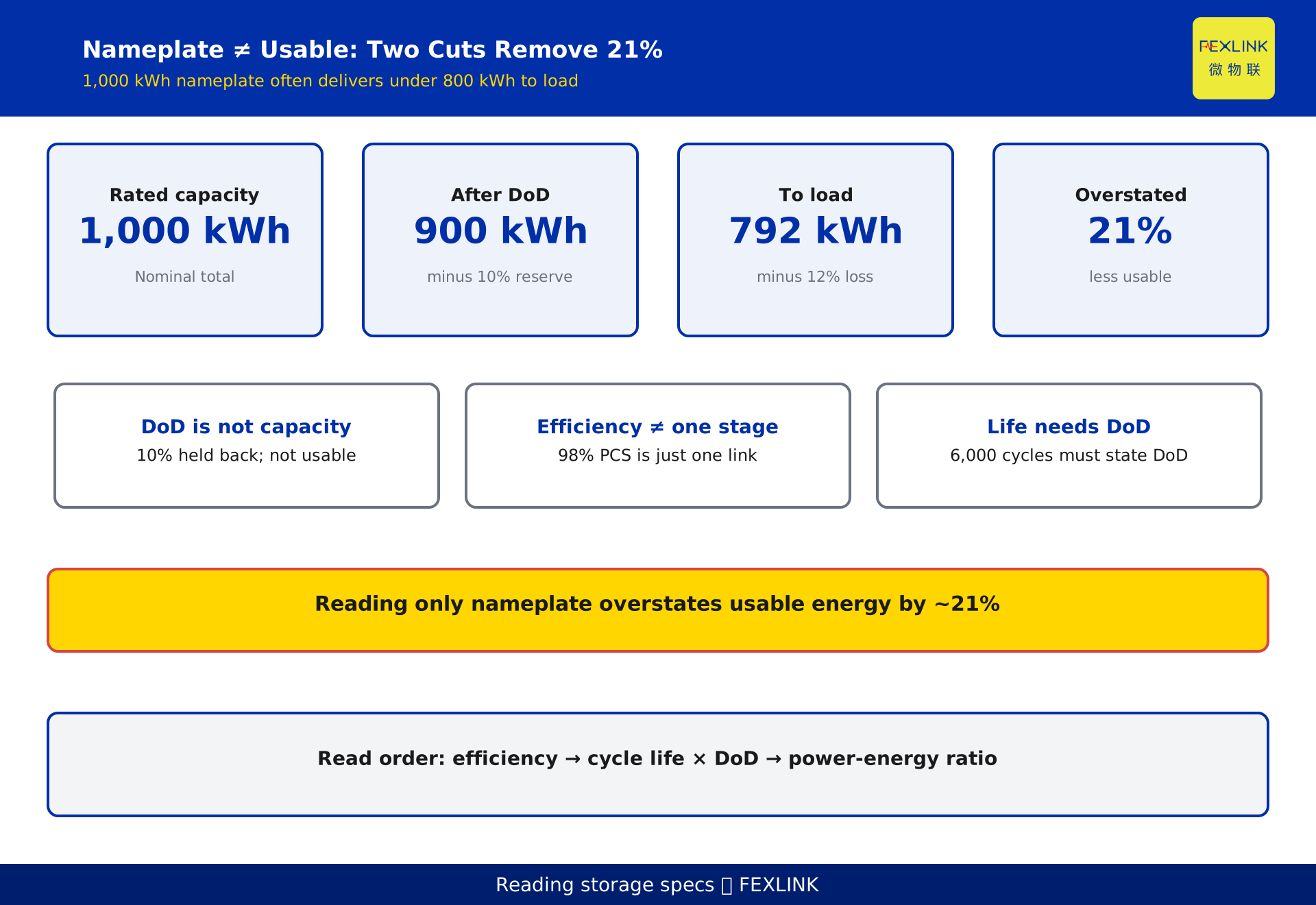
The first is depth of discharge. For lifetime reasons a manufacturer will not let you empty the battery; a common recommendation is to discharge at most about 90% of rated capacity, leaving roughly 10% as a protective margin. So a 1,000 kWh system delivers about 900 kWh per cycle.
The second is system round-trip efficiency. The energy you push in passes through conversion, the battery's own round trip, wiring losses and thermal management before it returns to the load. In a worked example at 88% system efficiency, that 900 kWh reaches the load as about 792 kWh — roughly 21% less than the 1,000 kWh nameplate. In practice a "1,000 kWh" unit often delivers under 800 kWh to the load per cycle.
2. System efficiency is not PCS efficiency, and not cell efficiency
This is where spec sheets most often mislead. Vendors advertise "PCS efficiency 98%" as a highlight, but that is a single-stage number.
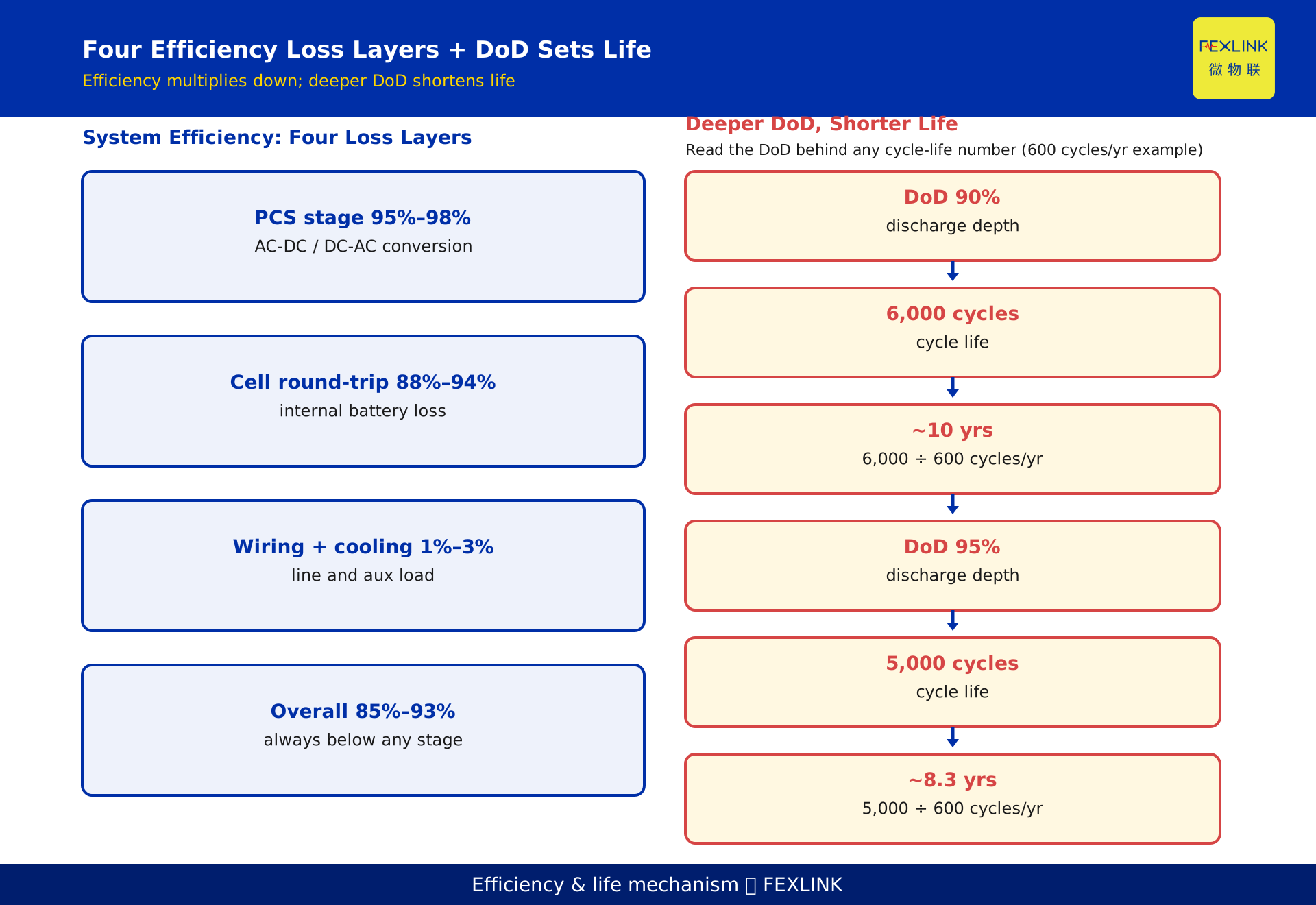
System round-trip efficiency is the product of stacked losses: the power conversion system (PCS) AC-DC/DC-AC conversion, typically in the 95%–98% range; the battery's own round-trip efficiency, typically 88%–94%; plus line losses, thermal management and auxiliary self-consumption, usually another 1%–3%. Multiplied together, overall efficiency normally lands in the 85%–93% band and is always lower than any single component's headline figure.
So when you read an efficiency number, ask: is this the system value or one component's value? A sheet that reports only a component efficiency biases your estimate of usable energy upward. The PCS, as the core conversion device of a storage system, is covered by GB/T 34133 (technical specification for energy storage converters); the exact clauses and limits should be taken from the currently effective edition of that standard.
3. Why DoD is tightly tied to lifetime
The deeper you discharge a cell each cycle, the greater the stress on electrode materials and electrolyte, and the faster the degradation. So the same battery endures fewer cycles the deeper it is discharged.
The catch: a vendor's "6,000-cycle life" is always specified "at a certain DoD". In the worked example, a vendor's datasheet quotes 6,000 cycles at 90% DoD; if you actually discharge to 95% DoD, the example life drops to about 5,000 cycles. Five extra percentage points of DoD can shave a meaningful slice off lifetime.
Therefore you cannot read cycle life as a bare number; you must read the DoD condition behind it. Treating "6,000 cycles at 80% DoD" as if it held at 95% DoD is the most common misreading at the bidding stage.
4. Converting cycle life into usable years
Divide cycle life by "cycles per year" to get roughly the usable lifetime. Annual cycles depend on usage: one charge-discharge per day is about 365 cycles, two per day about 730.
In the example, 6,000 cycles at 90% DoD with 600 cycles per year gives about 10 years; at 95% DoD with 5,000 cycles and the same 600 cycles per year, about 8.3 years. Now total throughput (capacity × DoD × cycles): about 5.4 million kWh at 90% DoD, about 4.75 million kWh at 95% DoD. Discharging deeper yields more per cycle but a shorter life, so total throughput can actually fall — that is the price of deep DoD. Choosing DoD is a balance between per-cycle availability and total lifetime throughput, not a "bigger is better" knob.
5. Reading the power-to-energy ratio (C-rate)
Rated power (kW) divided by rated capacity (kWh) gives the C-rate, which tells you how fast the system charges or discharges and how long it lasts.
The example pairs 500 kW with 1,000 kWh, i.e. 0.5C, meaning it empties in roughly 2 hours at rated power (energy-biased). At 1C it empties in half an hour, suited to frequency regulation; at 0.25C it lasts 4 hours, suited to long-duration peak shaving. Reading the C-rate tells you whether the system was designed for short, high-power duty or long energy shifting — and helps you avoid buying one that is short on power or on duration.
6. A reference table: what magnitude to expect per parameter
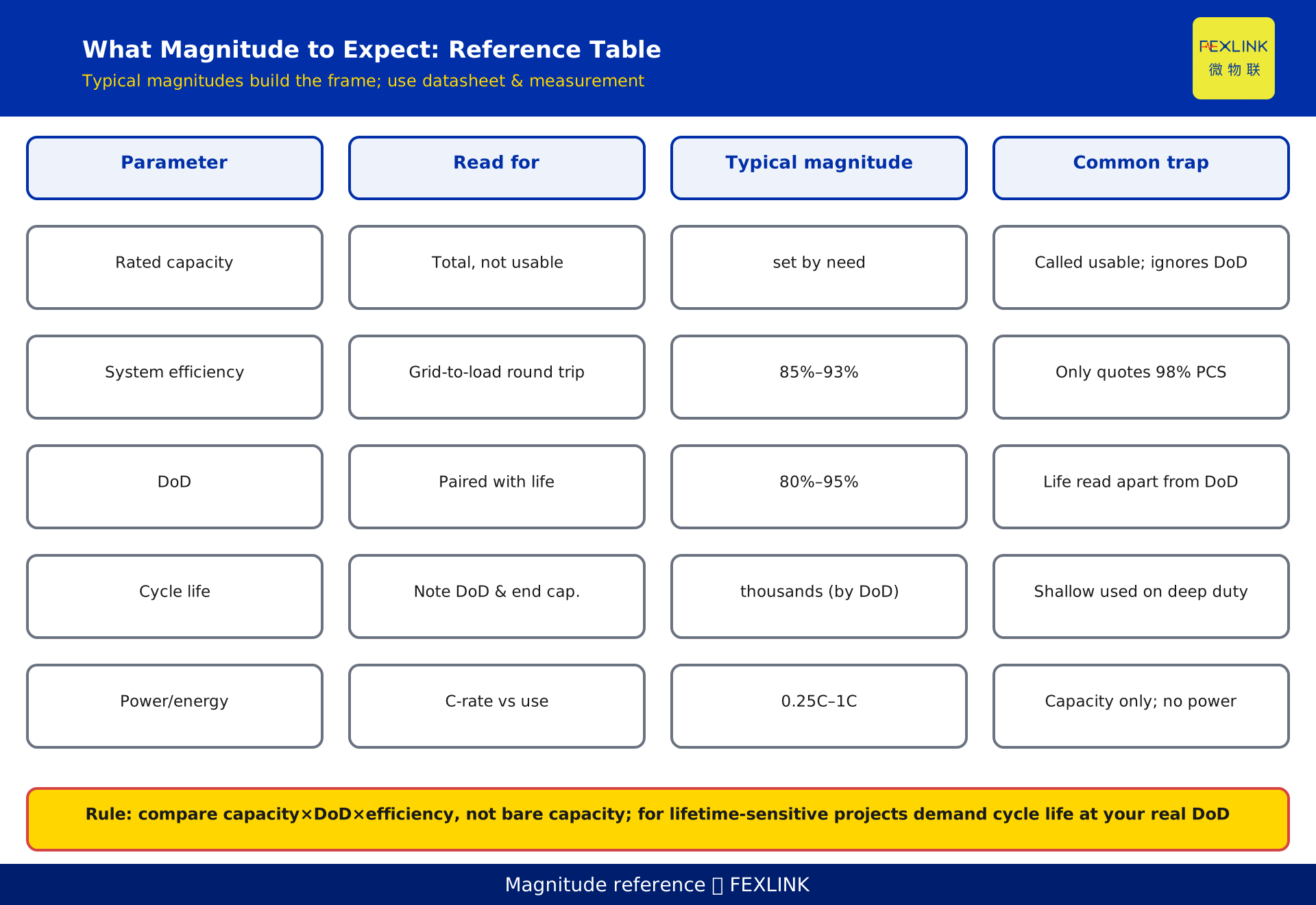
| Parameter | What to read | Typical magnitude (datasheet & measured) | Common trap |
|---|---|---|---|
| Rated capacity | Total storage, not usable | Set by project need | Treated as usable, ignoring DoD & efficiency |
| System efficiency | Grid-to-load round trip | 85%–93% | Only the 98% PCS stage quoted |
| DoD | Paired with life condition | 80%–95% | Reading cycle life apart from DoD |
| Cycle life | Note DoD & end-of-life capacity | Thousands of cycles (DoD-dependent) | Shallow-discharge figure applied to deep duty |
| Power/energy ratio | C-rate vs application | 0.25C–1C | Capacity read while power/duration ignored |
7. Translating parameters into revenue: a worked example
The following scenario is constructed to illustrate the arithmetic and represents no real customer or project.
A park plans a 1 MWh storage unit: 1,000 kWh rated capacity, 500 kW rated power (0.5C). The vendor's datasheet quotes 88% system efficiency and 6,000 cycles at 90% DoD. The operator plans 600 cycles per year.
Reading the sheet: about 900 kWh usable per cycle after DoD, about 792 kWh delivered to load after the 12% loss; usable life about 10 years; ten-year throughput about 5.4 million kWh. If the operator pushes to 95% DoD for more per-cycle energy, life falls to about 8.3 years and throughput to about 4.75 million kWh — superficially an extra 50 kWh per cycle, but roughly 650,000 kWh less over ten years.
Sustaining this data and reconciling it against the real DoD and efficiency is exactly what "storage system operation data monitoring" delivers. At the edge, the ESX intelligent edge computing gateway (an edge acquisition and protocol-conversion gateway that aggregates PCS, BMS and meter data for upload) supports that monitoring and the efficiency reconciliation.
8. How this differs from KD-0552
The neighbouring article KD-0552 (article 552 in the series) explains the "power-capacity decoupling principle" — why a storage system's power and energy can be designed and sized independently. This article does not repeat that principle; instead it translates efficiency, life and DoD into the language of revenue: a magnitude reference table and a method to convert the numbers into usable energy and usable years. In short, KD-0552 is about how to design the decoupling; this article is about how to read a spec sheet without being misled by the numbers.
9. A concrete selection rule
One actionable criterion: when a project is driven by per-kilowatt-hour revenue (peak-valley arbitrage), compare "actual deliverable energy per rated kWh = capacity × DoD × system efficiency" rather than bare capacity; when the payback period exceeds 8 years and lifetime matters, require the vendor to state cycle life at the DoD you will actually use, and refuse the paper figure quoted at 80% DoD. When both conditions hold, prefer a system with a conservative DoD and a measured-stable efficiency.
10. FAQ: frequently asked questions
Q: Why does a 1,000 kWh unit deliver under 800 kWh per cycle?
Because rated capacity is total storage; it must first lose the depth-of-discharge margin (commonly about 10% held back) and then the round-trip efficiency loss (about 7%–15%). Stacked together, delivered energy to the load is routinely one or two tenths below the nameplate.
Q: The vendor says 6,000 cycles — does that mean 6,000 days of life?
No. Cycle life is counted in cycles; first read the DoD at which it is quoted, then divide by your actual annual cycles to get years. The same 6,000 cycles is about 10 years at 600 cycles per year, but under 10 years at two cycles per day, and deeper DoD shortens it further.
Q: Does PCS efficiency of 98% mean the system is very efficient?
It does not. The 98% is only the converter's single-stage efficiency. System efficiency must also multiply the battery round trip (about 88%–94%) and line/thermal losses (about 1%–3%), ending up typically at 85%–93%. Always ask whether an efficiency figure is system-wide or a component figure.
Q: Is a larger DoD always more cost-effective?
Not necessarily. A larger DoD gives more per cycle but faster degradation and fewer cycles, so total throughput can fall (in the example, 95% DoD throughput is below 90% DoD). Balance single-cycle availability against total lifetime, and be conservative on lifetime-sensitive projects.
Q: Can GB/T 34133 be used directly as a selection pass/fail line?
GB/T 34133 is the technical specification for storage converters and can serve as a baseline for PCS capability, but the efficiency, life and DoD of a concrete system still rest on the vendor's datasheet and field measurement, and the standard itself should be the currently effective edition; quantitative conclusions must be re-checked after any revision.
Scope and limitations
- The reading method here applies to lithium and other electrochemical storage systems in bidding, procurement and technical evaluation; other routes (flywheel, compressed air) differ enough in efficiency and life behaviour that they should not be mapped directly onto these rules.
- The efficiency bands (PCS 95%–98%, battery round trip 88%–94%, system 85%–93%) and the DoD band (80%–95%) are typical magnitudes used to build a reading framework, not guaranteed values of any product; actual values come from the datasheet and field measurement.
- The section-7 scenario (1 MWh, 1,000 kWh, 500 kW, 88% system efficiency, 6,000 cycles at 90% DoD, 600 cycles per year, 792/5.4 million/4.75 million kWh, etc.) is constructed purely to illustrate the arithmetic and represents no real customer, project or vendor; actual returns require site survey and measured data.
- The reference to GB/T 34133 is a standard-number citation only; no clause number, limit or test value is quoted. The standard should be the currently effective edition, and quantitative conclusions must be re-checked on revision.
- The description of the ESX intelligent edge computing gateway follows the latest selection manual and product knowledge base; this article is not a selection or procurement recommendation.
- This article and KD-0552 (power-capacity decoupling) are neighbouring pieces: this one focuses on reading the spec sheet and magnitude reference, and does not replace the other's explanation of the decoupling principle; they are complementary, not overlapping.
Frequently Asked Questions
Reading Storage System Specs
The number that jumps out on a storage spec sheet is "rated capacity in kWh"