 FEXLINK Research Institute
Direct Answer
When a factory wants to connect flexible load to a virtual power plant, the platform rarely hands over a purchase order; it hands over a list of entry conditions. The common mistake is patching them one at a time, so the conditions never quite close. A steadier approach is to work backwards from five readiness items—observable, measurable, adjustable, controllable, and trustworthy—into a retrofit checklist. First add metering at the critical circuits so resource status is visible and quantities are sound; then add remote switching actuators and a command path so instructions reach the site and stay within bounds; finally use complete, time-aligned data and an agreed baseline so a response can be recomputed and trusted. Each of these 3 phases has a deliverable: lock one when it is done. These 5 readiness items are an industry-level way of structuring entry conditions, not the wording of any policy clause. The policy context is the direction set by the NDRC and NEA document [2025] No. 357, the Guiding Opinions on Accelerating Virtual Power Plant Development, which encourages aggregating distributed resources for demand response and market participation. This article discusses retrofit method in that context only, does not interpret policy clauses, and constitutes no selection or acceptance commitment.
Why Patchwork Retrofits Never Get You Connected
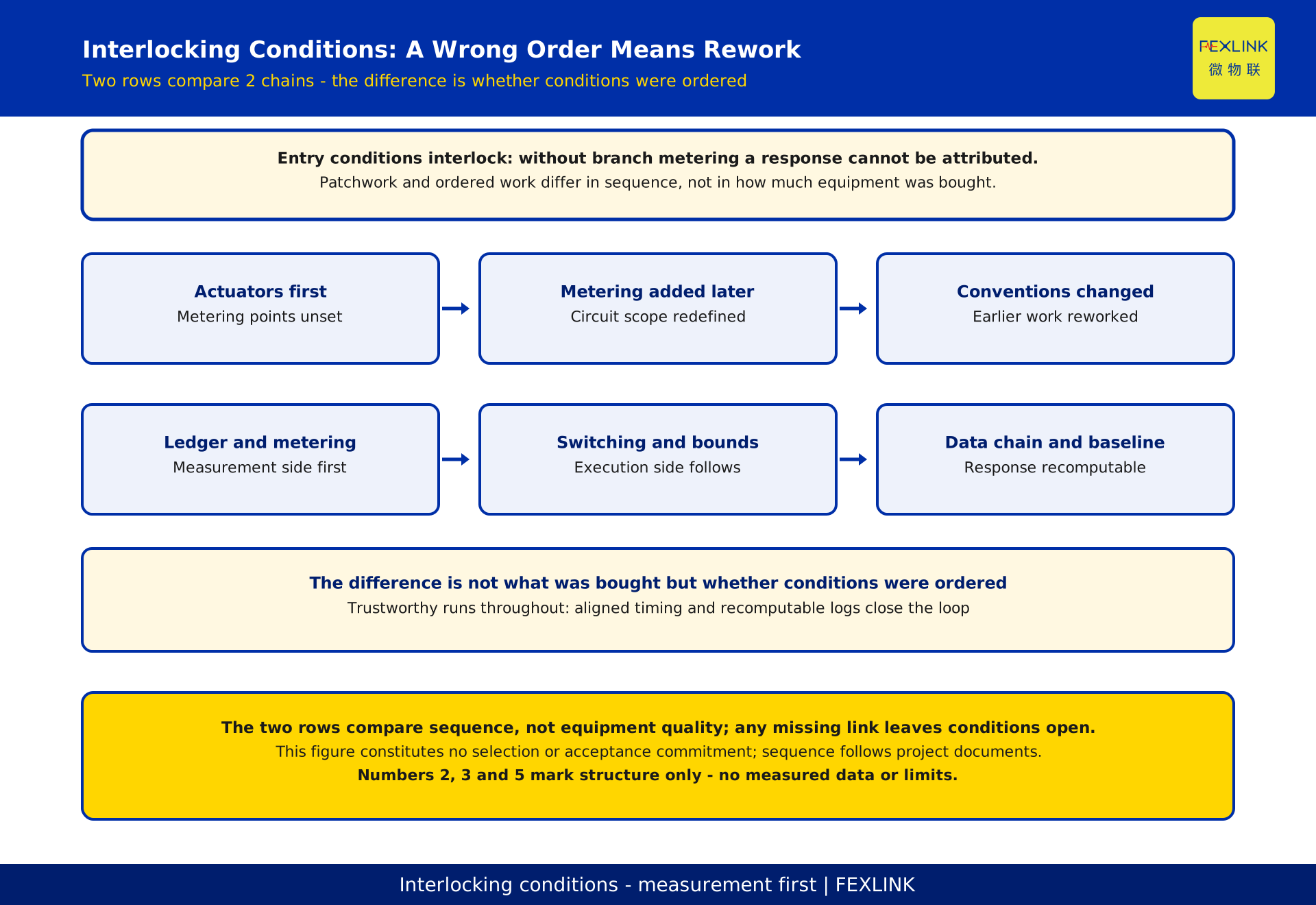
Entry stalls rarely because one device was not bought. It stalls because nobody ordered the conditions into a sequence. The platform's conditions interlock: without branch metering, an aggregated response cannot be attributed; without switchable end devices, a command arrives on site but lands nowhere; without a shared time base and an agreed baseline, a response may have happened yet leave no evidence anyone can accept. Fix conditions as you discover them and you may install actuators first, then find the metering points missing and tear work out again. A wrong sequence turns earlier work into rework. Responsibility also splits: metering to electrical, actuation to process, data to the platform, so nobody owns the complete set. The first step is therefore not procurement. It is turning the conditions into a checklist of items that can be delivered and accepted one by one, with a named owner signing off each line.
Turning the 5 Readiness Items Into a Retrofit Framework
We will not redefine what the 5 readiness items mean here. Instead we treat each as an entry question to work backwards from: what physical condition must be in place, who delivers it, and what does acceptance look at? Converted into retrofit actions, they are not parallel purchases but a chain with an order. A resource must be visible and its quantities sound before you can decide where a command goes; a command must be executed within bounds before the data means anything; and only with consistent conventions, aligned time stamps, and a recomputable baseline can a response be verified. Working backwards translates "a set of conditions" into site language: what to install, which circuit to wire, which records to keep. This five-item framework is a general way to structure entry conditions; actual thresholds and acceptance rules follow the platform and current local documents. This article replaces no connection specification.
Observable: Make Resource Status Visible
Observable answers where the resources are and what state they are in right now. The usual gap is a ledger that holds only a single aggregate line: whether an end circuit is online, already claimed by another system, in manual or in remote control, the operations side cannot see. Start with an inventory. Register every circuit that may take part in regulation, mark whether it is non-critical, its normal direction of adjustment, and the boundary where action is forbidden. Then bring those status points into site acquisition so the platform can distinguish online, offline, local, and remote. This step is about making "visible" real: once the ledger matches the field, all later data has an owner. A device such as the ESX intelligent edge computing gateway aggregates status and normalizes protocols into one readable signal set. Acceptance checks distinguishable states and a matching ledger, not meter counts.
Measurable: Add Metering at the Critical Circuits
Measurable answers how much was adjusted and whether it can be accounted for. The usual gap is a single meter at the point of connection, so nobody can tell which aggregated resource contributed what; or different circuits use different conventions and the data will not reconcile. The retrofit sets points in layers: independent metering on the critical circuits taking part in regulation, an aggregate meter retained at the pooling layer for cross-check, and explicit conventions between layers so branch and total validate each other. A device such as the ESA smart meter corresponds to energy and power acquisition at the branch layer. Ranges and interfaces are configurable items and follow the latest selection manual; this article makes no selection recommendation. Installing a meter is not the same as measuring soundly: conventions, multipliers, and the time reference must align during commissioning, or the data cannot be used for verification. Acceptance looks at consistent conventions, a branch-to-total cross-check, and exportable records.
Adjustable and Controllable: Add Actuation and Command Boundaries
Adjustable means a command can get through; controllable means that once it arrives it is truly executed and stays within bounds. The two must be added together. The usual gap is that commands stop at the edge with no switchable end point; or switching is possible but critical process and safety loads were never excluded from the controlled set. The retrofit has two layers. First, add remote switching points on circuits tagged non-critical; a device such as the FECB2SP smart circuit breaker corresponds to end-side switching and local protection. Second, establish a command path and safety interlocks defining which circuits accept commands, when local confirmation is needed, and how the system returns to a safe state. Boundaries matter more than capability: better to connect fewer circuits than let a regulation action touch a load it should never touch. Acceptance checks receipts, logged execution, out-of-bounds blocking, and drill reproducibility.
Trustworthy: Close the Loop With Data and Baselines
Trustworthy answers whether a completed response can be recomputed and accepted. The usual gap is that status, metering, and command records sit in different systems with mismatched time stamps, or no baseline was agreed, so afterwards nobody can say "reduced relative to what." The retrofit is not another round of purchases; it is linking existing data into a recomputable chain. Unify the time base and measurement conventions; retain command issue, execution receipts, branch-to-total metering, and status snapshots on one timeline; provide a traceable index over those records. The baseline method and scope must be agreed in writing before commissioning and then followed, not changed on the day. The easiest miss is log granularity: keep only results and a settlement dispute cannot be recomputed. Acceptance looks for complete data, alignable timing, and recomputable responses. Specific completeness requirements, error limits, and settlement rules follow the platform and current published documents; this article gives no thresholds.
2 Classes of Retrofit and a Five-Item Comparison Table
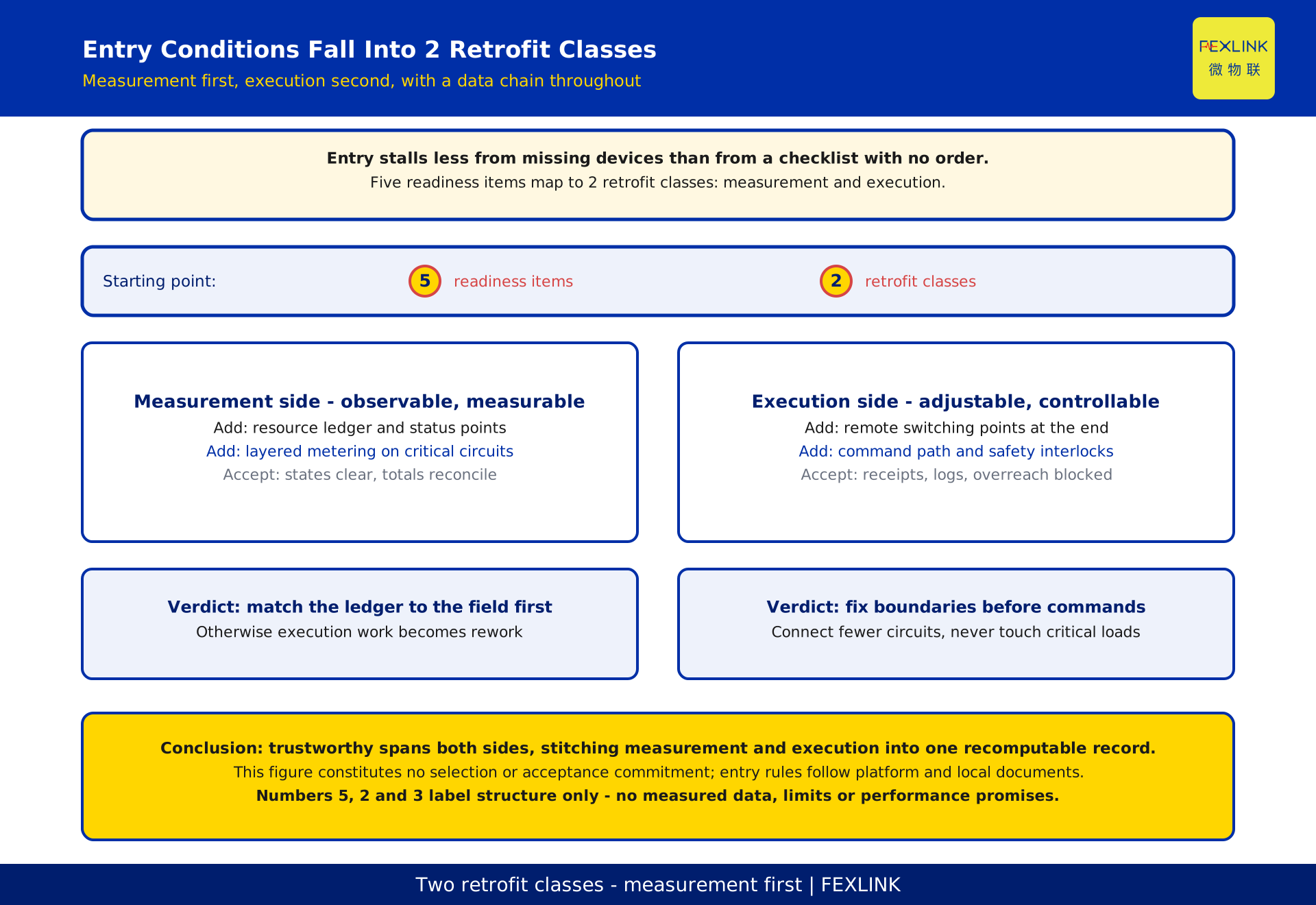
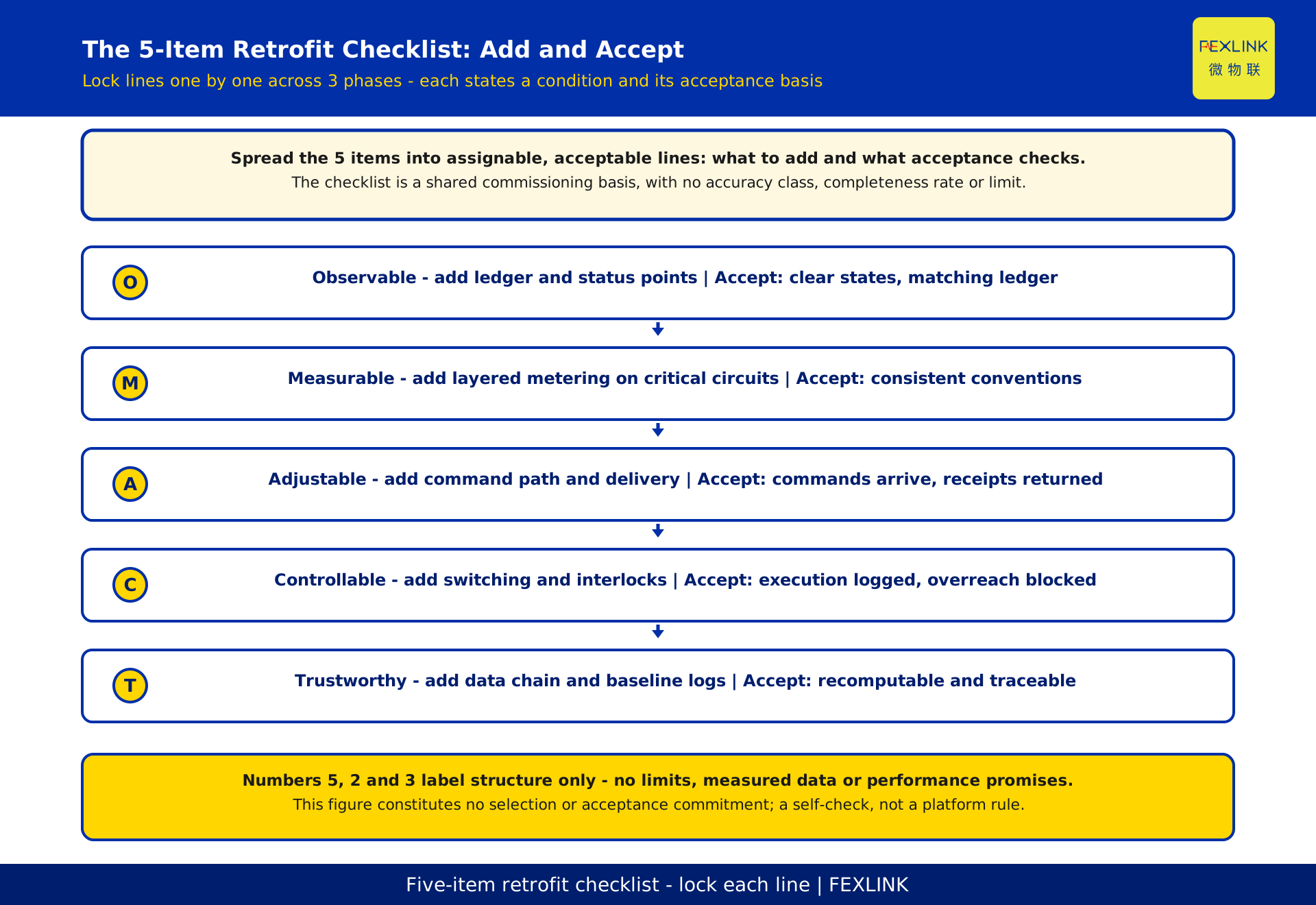
The previous sections collapse into 2 classes of relationship. The measurement side (observable, measurable) delivers the ledger, metering points, and data conventions; the execution side (adjustable, controllable) delivers switching points, a command path, and safety boundaries. Trustworthy spans both, stitching them into a verifiable whole with a data chain and a baseline. Separating them keeps scheduling sane: measurement first, execution second, data chain throughout. The table below spreads the 5 readiness items into assignable, acceptable lines; no row states a threshold.
| Item | Common gap | Retrofit to add | Who delivers | What acceptance checks |
|---|---|---|---|---|
| Observable | Thin ledger, blind states | Resource ledger and status points | Owner and integrator | States distinguishable, ledger matches field |
| Measurable | Only a total meter, mixed conventions | Layered metering on critical circuits | Electrical and metering | Conventions consistent, branch-to-total cross-check |
| Adjustable | Commands stop at the platform | Command path and delivery | Platform and edge | Commands arrive, receipts returned |
| Controllable | Commands issued, bounds unclear | Switching execution and interlocks | Electrical and process | Execution logged, overreach blocked |
| Trustworthy | Misaligned timing, no baseline | Data chain and baseline logging | Platform and owner | Recomputable, traceable |
| Handover | Fragmented sign-off, no single owner | Staged commissioning records | Integrator as owner | Lines locked one by one, transferable |
A 3-Phase Access Roadmap
Three phases exist so that each has a clear exit condition. Phase one is the measurement side: complete resource inventory, critical-circuit metering, and status integration. Exit when the ledger, branch quantities, and aggregate meter reconcile and conventions are confirmed in writing. Phase two is the execution side: add switching points on non-critical circuits, open the command path, set safety interlocks and an allow-list. Exit when one drill reproduces the full issue-receipt-action-log chain and an out-of-bounds attempt is blocked. Phase three is the data chain and baseline: unify the time base, agree the baseline method, and open the traceable log index. Exit when any drill response can be recomputed from baseline to outcome. Each phase has a lead and signatory, with a joint review between phases. The NDRC and NEA document [2025] No. 357 points toward faster VPP development and aggregating distributed resources for market participation; a phased connection turns that direction into site steps without reproducing any policy timetable or target figure.
Bringing the Checklist Into Commissioning and Acceptance
The checklist should finally become the shared basis for commissioning and acceptance. Map each readiness item to one observable commissioning action: are states distinguishable point by point, do branch quantities reconcile with the aggregate, are command receipts complete, are safety boundaries proven in a drill, can one response be recomputed from its baseline. Lock a line as soon as it passes and form a transferable record; later changes go through a change process rather than a verbal note. If the platform adjusts its entry rules, you replace the corresponding line instead of pulling earlier work apart. One more caution: being connected is not the same as being dispatched. Whether you are called and under what rules you are settled depends on market mechanisms and local implementation. Retrofit delivers the conditions; it does not guarantee a call.
Frequently Asked Questions (FAQ)
Q: The platform asks for the 5 readiness items-does that mean buying one of each device category?
No. The 5 readiness items structure entry conditions; they are not a purchase list. Observable and measurable sit on the measurement side, adjustable and controllable on the execution side, and trustworthy stitches both with a data chain and a baseline. Working backwards from a checklist saves more rework than buying equipment to match the labels.
Q: Does NDRC and NEA document [2025] No. 357 define the 5 readiness items?
It does not. That document is the Guiding Opinions on Accelerating Virtual Power Plant Development, encouraging VPPs to aggregate distributed resources for demand response and market participation. The 5 readiness items are an industry-level way to structure entry conditions, not policy wording. Actual entry and acceptance follow the platform and current local documents; this article is not a policy interpretation.
Q: Why does installing actuators before metering cause rework?
Because an action can only be accounted for with branch metering. If metering points are not fixed, the scope and conventions of controlled circuits get redefined, and switching points and command configuration follow. Measurement first gives every later step a reference.
Q: Are there uniform figures for data completeness, error limits, or settlement thresholds?
This article gives none. They differ by platform rules, market mechanisms, and local implementation, and must follow platform requirements, project documents, and manufacturer data. We provide only a framework of what to agree and which records to keep; this constitutes no selection or acceptance commitment.
Q: Do the three products have to be deployed together?
No such recommendation is made. The ESX intelligent edge computing gateway, the FECB2SP smart circuit breaker, and the ESA smart meter correspond to edge aggregation and logging, end-side switching, and branch metering respectively. Whether to use them and how to combine them depends on site circuits and platform requirements; interfaces, ranges, and protocols follow the latest selection manual.
Scope and Limitations
This article helps energy managers and demand-response integrators turn VPP entry conditions into an assignable, acceptable retrofit checklist. It does not replace platform connection specifications, site operating procedures, manufacturer manuals, or professional design. The 5 readiness items here are a solution-level structuring, not policy wording; the policy context is cited qualitatively only, and the specific clauses, quotas, compensation standards, and timetables of NDRC and NEA document [2025] No. 357 follow the currently published text and local implementation. This article is not a policy interpretation or an engineering basis. Requirements on metering, actuation, data, and baselines state only what to add and what acceptance examines; they state no accuracy class, completeness rate, error limit, duration, amount, ratio, or performance promise, and constitute no compliance determination. Related judgments must follow field measurement, platform rules, and current documents. Products are named only for the roles they carry; model numbers, interfaces, and specifications follow the latest selection manual. This article constitutes no selection or acceptance commitment, and forms no procurement or commercial commitment. All deliverables remain pending review; the generator does not self-approve.
Frequently Asked Questions
Bringing Distributed Load Into a VPP
When a factory wants to connect flexible load to a virtual power plant, the platform rarely hands over a purchase order