 FEXLINK Research Institute
The short answer
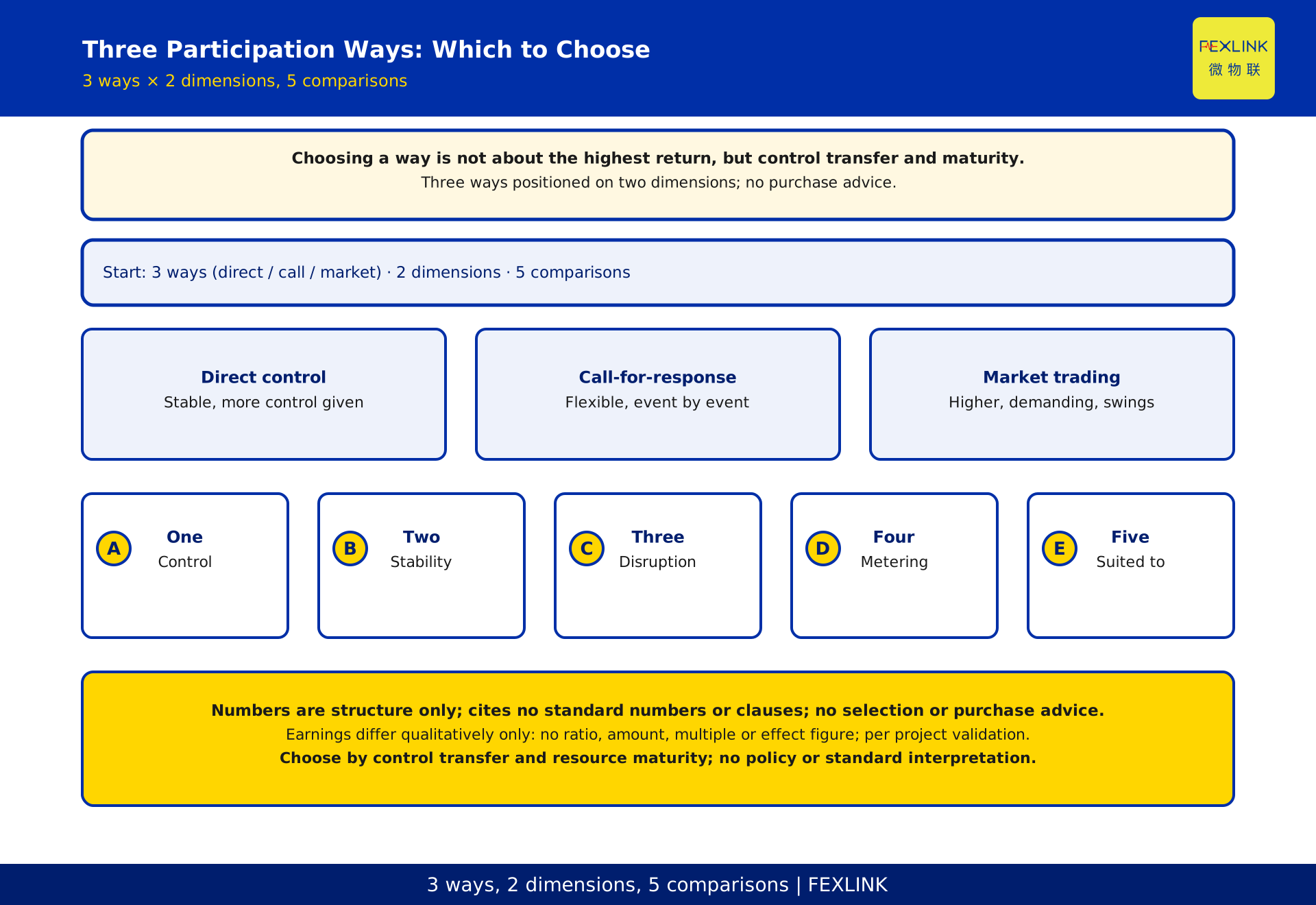
A plant can take part in demand response in 3 ways: direct load control, call-for-response, and market trading. None is universally best; the choice rests on 2 dimensions — how much control you are willing to hand over, and how mature your resources are. Direct load control brings stable returns but gives up the most control, suiting interruptible loads. Call-for-response is flexible and participation is event-by-event, suiting adjustable loads. Market trading offers higher potential but demands more and swings more, suiting well-resourced sites with complete metering. This article compares control transfer, earnings stability, production disruption and metering/execution needs, and gives a 5-aspect "which way suits whom" decision table. It covers qualitative differences and decision criteria only; it cites no standard numbers or clauses, makes no conformance claims, gives no return ratios, amounts or effect figures, and constitutes no selection or purchase recommendation.
What the three ways actually compare: control transfer
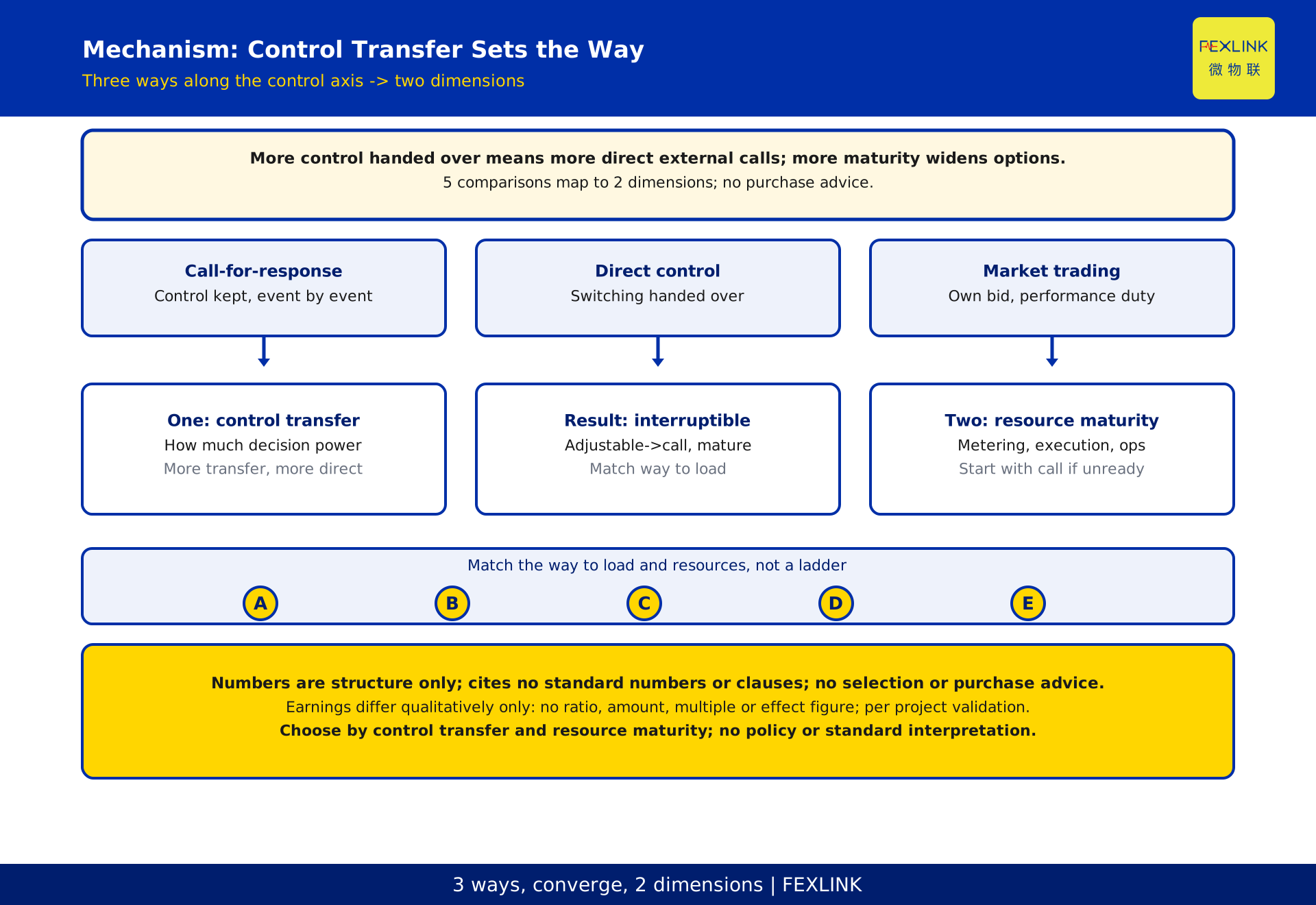
The essential difference is how far a dispatcher can reach into your loads. Direct load control hands the switching right of part of your load outside: under agreed conditions the dispatcher can cut a designated load, and what you give up is the decision of when it can be cut. Call-for-response issues an invitation each time; you decide whether to join and how much based on current orders and schedules, keeping the initiative largely in your own hands. Market trading means you bid and clear as a market participant — control looks like yours, but so do the obligation to perform and the pressure of assessment. So the first criterion is not which pays most, but how much control you can accept handing over. The more you hand over, the more directly and easily the outside party can call on your load, but the deeper the intrusion into your production plan. Settle that first and the other comparisons have a basis.
Direct load control: stable, but transfers the most control
Direct load control is characterized by stability. Because the curtailable resource is agreed in advance and execution is triggered externally under the agreement, the participant need not decide on each occasion; the rhythm of returns is relatively steady and the operating burden is light. The price is handing over more control: once active, the dispatcher can act under agreed conditions, and your production schedule must leave room for that interruptibility. It therefore suits loads that are genuinely interruptible — equipment whose brief stoppage does not harm product quality or delivery. For such loads, giving up control costs little, and the stable return in exchange is worthwhile. Conversely, putting critical production circuits under direct control is a mismatch that can disrupt production when they are cut. The deciding point is interruptibility, not capacity.
Call-for-response: flexible, event by event
Call-for-response is the most flexible of the three. The platform sends an invitation and you decide, against your current orders, schedule and equipment state, whether to join this time and how much to offer; declining carries no mandatory obligation. This event-by-event decision keeps the initiative with the plant: when production is tight you can hold back, when it is slack you can offer more, and disruption to the plan stays controllable. Returns occur per event — less continuous than direct control — but the flexibility buys a smaller intrusion into production. It suits adjustable loads — equipment that can be modulated within a range but should not be cut off at will from outside. For operators, call-for-response requires judging quickly each time whether and how much to offer, which depends on a live grasp of one's own load. The deciding point is adjustability and response speed, not returns alone.
Market trading: higher potential, higher demands, more swing
Market trading has the largest upside: you bid and clear as a participant, and returns are set by the market — done well they can exceed the other two. But higher potential is a possibility, not a promise; it comes with higher demands and bigger swings. Complete metering is needed to account for performance, mature trading and operational skill to judge bids and manage risk, and the ability to absorb price movement. For a plant with thin resources and incomplete metering, entering hastily often means bearing risks it cannot read rather than earning more. It therefore suits well-resourced sites with complete metering and a professional operations team, not a plant just starting out. This is a qualitative judgement: market trading has the highest threshold and the largest swing, and whether it is worth entering depends on your resource maturity. Any concrete return level must be established by the actual market rules and project data; no figures are given here.
Earnings and stability: qualitative only, no figures
Earnings is the item most often misread. The differences can be stated qualitatively: direct control is relatively stable but transfers the most control; call-for-response is per-event, flexible but not continuous; market trading has higher potential but swings more. These are structural features, not numbers to put in a decision table. Real returns depend on local market rules, invitation frequency, your load curve and ability to perform; the same way can yield very different results across projects. This article therefore deliberately gives no return ratio, amount or multiple, and does not imply that one way "always earns more" — that would be both unsound and misleading. What operators should do is base return expectations on their transferable control and resource maturity, and judge which way fits using checkable criteria, rather than choosing on someone else's reported figure.
Disruption to production: from interruptible to adjustable
Disruption is the constraint plants care about most. Direct load control, triggered externally, requires switchable and critical circuits to be separated in advance; the disruption boundary must be designed before the fact — which is why it suits interruptible loads. Call-for-response is decided by you each time, so disruption is contained in the judgment of whether to join, suiting adjustable loads. Market trading carries a firmer performance obligation, and its disruption risk comes from the pressure to deliver after clearing, requiring enough regulating headroom without touching the main production line. The three ways map onto a continuum from interruptible to adjustable: the closer to interruptible, the more suitable it is to trade control for stable returns; the closer to adjustable, the more suitable it is to keep the initiative and join event by event; only when metering and regulation are mature enough does market trading with heavier obligations enter the picture. Judge disruption by where your load sits on that continuum.
Metering and execution requirements
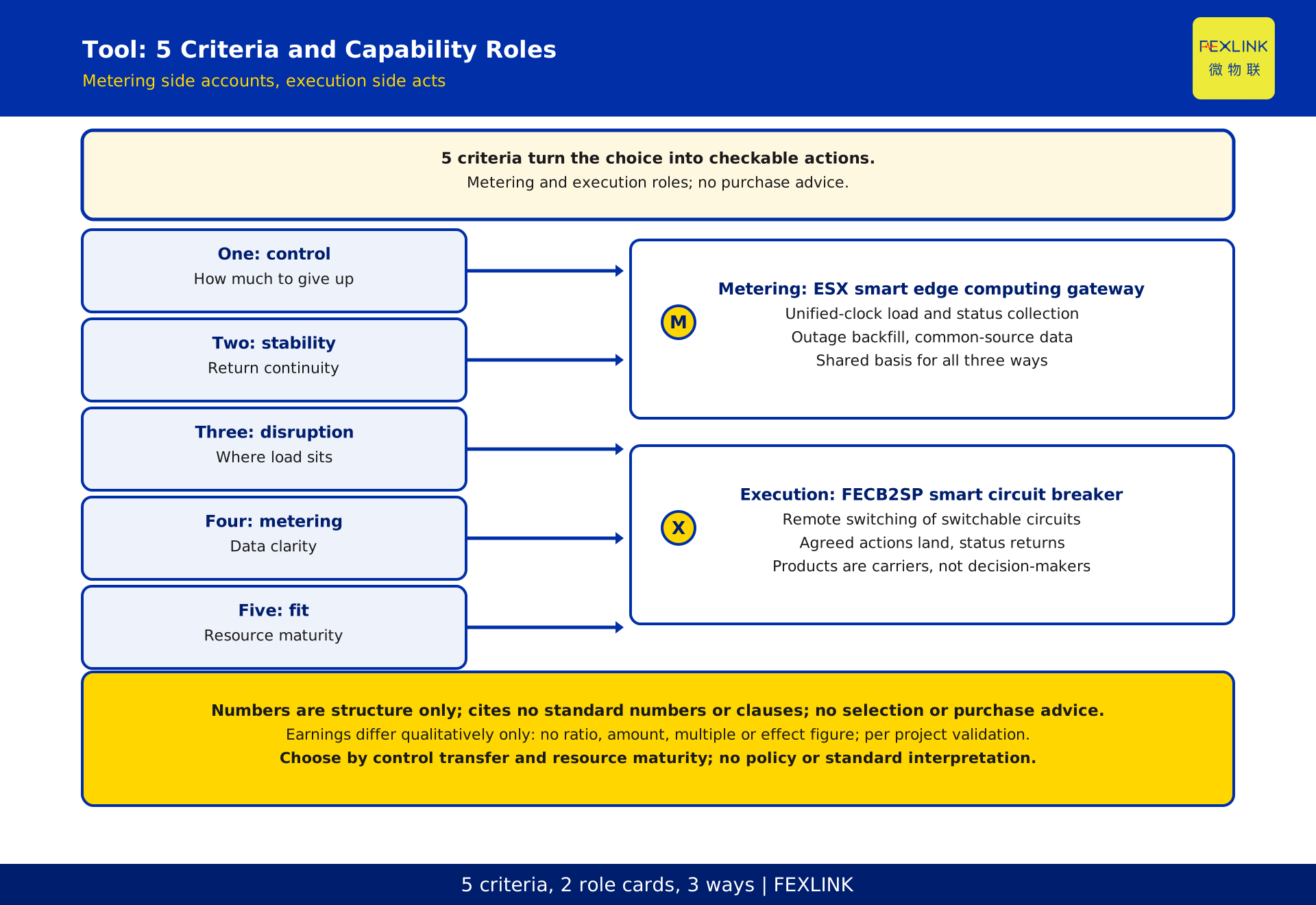
The three ways also differ in underlying capability. Direct load control needs a reliable remote switching device so that an action under agreed conditions really reaches the circuit and reports status back; without execution, stability is impossible. Call-for-response needs a live grasp of your load and adjustable headroom so that each invitation can be answered with a sound offer — this depends on timely, accurate metering. Market trading demands the most: performance data must be clear, checkable and on a unified clock, or you can neither prove performance nor control deviation risk. The ESX smart edge computing gateway collects load and status from switchable circuits under a unified clock, providing a common-source data basis for all three ways; the FECB2SP smart circuit breaker carries remote switching on the execution side, letting agreed actions land reliably. Products are only capability carriers; which way to join is still decided by your willingness to transfer control and your resource maturity.
"Which way suits whom" decision table
The comparison distils into a decision table. Locate yourself by load attribute (interruptible or adjustable) and metering/execution maturity, then check your willingness to transfer control to find the fitting way. The table carries qualitative criteria only, no earnings figures.
| Dimension | Direct load control | Call-for-response | Market trading | Deciding point |
|---|---|---|---|---|
| Control transfer | Most, externally triggered | Mostly kept, event by event | Own bidding, performance duty | How much decision power to give up |
| Earnings and stability | Relatively stable | Per-event, flexible | Higher potential, more swing | Qualitative only, no figures |
| Production disruption | Deeper, needs prior separation | Contained in join decision | Risk from performance pressure | Where load sits on the continuum |
| Metering/execution | Reliable remote switching | Timely metering, quick judgment | Complete metering, checkable | Whether data can be accounted for |
| Suited to | Interruptible loads | Adjustable loads | Well-resourced, well-metered sites | Whether resources are mature enough |
The table's horizontal axis is the three ways; the vertical axis is the five key-point aspects. Do not fixate on the earnings row — earnings must be read together with how much control is transferred, whether disruption is bearable, and whether metering and execution can keep up. Choosing on the strength of a single row is usually how the wrong choice gets made.
Two dimensions in practice: control transfer × resource maturity
The decision compresses further into two dimensions. Transferable control asks whether you are willing and able to hand over the switching right of part of your load; resource maturity asks whether your metering, execution and operations are up to it. With low transfer willingness and resources still starting, begin with call-for-response — join event by event and build up metering as you go. Where the load is genuinely interruptible and stable returns are attractive, direct load control is the simpler fit. Only with sufficient resources, complete metering and professional operations does market trading enter the options. This is not a ladder from low to high, but a fit for different conditions: an interruptible load is not necessarily better off in market trading, nor an adjustable load in direct control. The point is to match the way to your load attribute and resource condition, not to chase someone else's choice.
FAQ
Q: Which of the three pays the most?
A: It cannot be generalized. Market trading has higher potential but higher demands and bigger swings; direct control is relatively stable but transfers the most control; call-for-response is per-event, flexible but not continuous. Real returns depend on market rules, invitation frequency and your ability to perform; no figures are given here.
Q: Our load is interruptible — which way should we choose?
A: Interruptible loads suit direct load control — handing over control for stable returns costs little. The prerequisite is separating switchable from critical circuits in advance, so critical loads never enter the switchable set.
Q: Our metering is not complete — can we go straight into market trading?
A: Not recommended. Market trading demands the most metering; performance data must be clear, checkable and on a unified clock. With incomplete metering, starting with call-for-response and building metering as you go is the steadier path.
Q: Why is call-for-response less disruptive to production?
A: Because you decide each time whether to join and how much. When production is tight you can hold back, when slack you can offer more; disruption is contained in the join decision and the initiative stays with the plant.
Q: How does this differ from the article on what demand response is?
A: That article covers the concept — what demand response is and how it differs from peak-shifting and orderly power use. This one does not repeat concepts; it compares the three participation ways and how to choose by control transfer and resource maturity. If the concept is unclear, read that first; to choose a way, read this.
Scope and limitations
This article addresses plant energy managers and owner decision-makers, setting out the qualitative differences and selection criteria for direct load control, call-for-response and market trading. It does not repeat demand-response concepts, nor local market rules, invitation frequencies and settlement details, and gives no return ratios, amounts or effect figures. It cites no standard numbers or clauses, makes no conformance claims, constitutes no selection or purchase recommendation and no policy interpretation or standard interpretation; the generator does not self-approve, and publication requires independent verification. Specific participation conditions, returns and performance requirements are subject to local current rules and project documents, and must be confirmed by qualified personnel.
Frequently Asked Questions
Which of the three pays the most?
It cannot be generalized. Market trading has higher potential but higher demands and bigger swings; direct control is relatively stable but transfers the most control; call-for-response is per-event, flexible but not continuous. Real returns depend on market rules, invitation frequency and your ability to perform; no figures are given here.
Our load is interruptible — which way should we choose?
Interruptible loads suit direct load control — handing over control for stable returns costs little. The prerequisite is separating switchable from critical circuits in advance, so critical loads never enter the switchable set.
Our metering is not complete — can we go straight into market trading?
Not recommended. Market trading demands the most metering; performance data must be clear, checkable and on a unified clock. With incomplete metering, starting with call-for-response and building metering as you go is the steadier path.
Why is call-for-response less disruptive to production?
Because you decide each time whether to join and how much. When production is tight you can hold back, when slack you can offer more; disruption is contained in the join decision and the initiative stays with the plant.
How does this differ from the article on what demand response is?
That article covers the concept — what demand response is and how it differs from peak-shifting and orderly power use. This one does not repeat concepts; it compares the three participation ways and how to choose by control transfer and resource maturity. If the concept is unclear, read that first; to choose a way, read this.