 FEXLINK Research Institute
The short answer
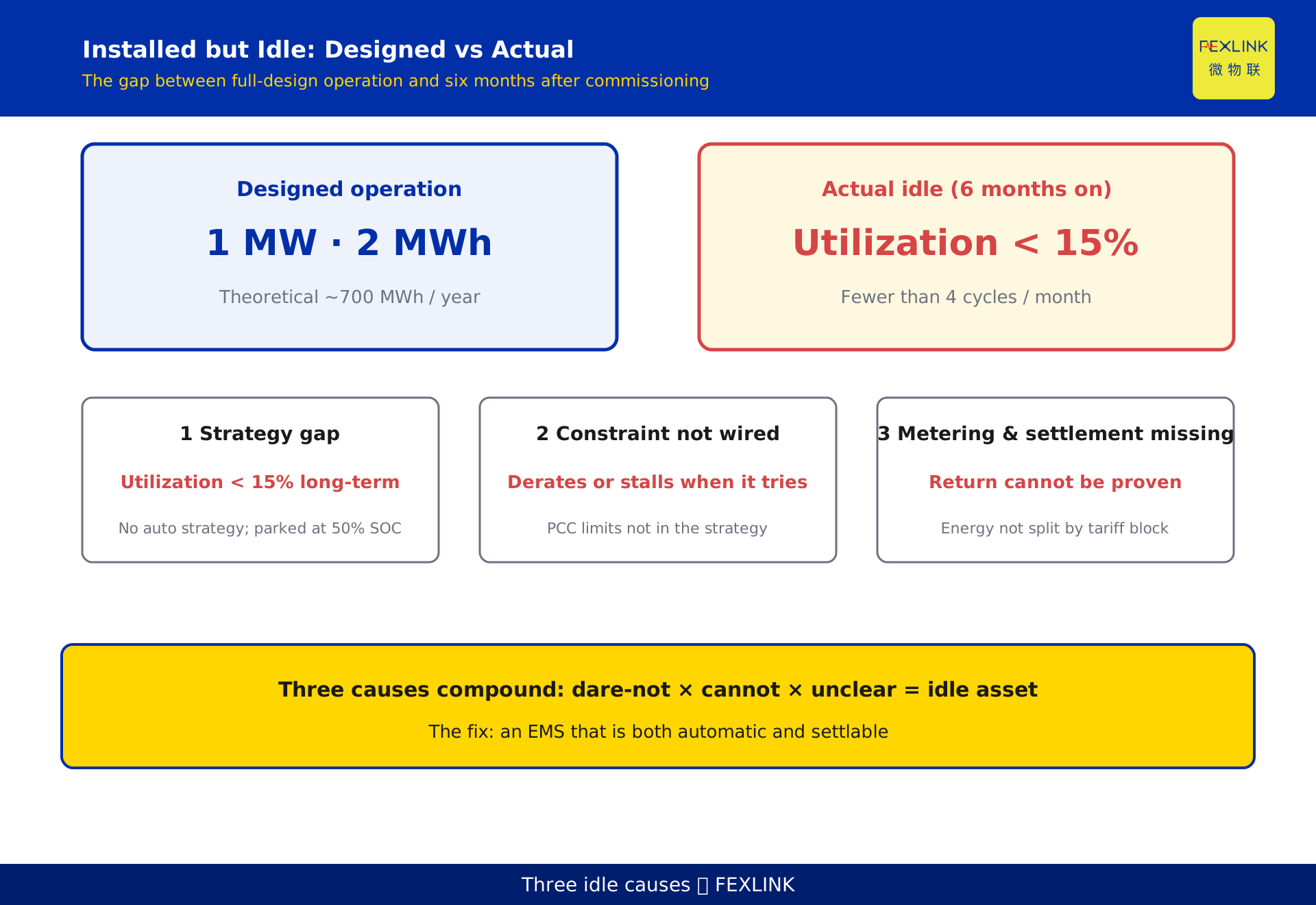
A storage system that sits idle and "bakes in the sun" is usually not a hardware problem — it is a "installed but unmanaged" problem. Three causes dominate: there is no automatic charge/discharge strategy, so operators dare not release energy without manual supervision; the point-of-common-coupling (PCC) and dispatch constraints are not wired into the controller, so the system is physically limited even when it wants to discharge; and metering and settlement are incomplete, so no one can prove the revenue after discharging. The fix is an automated, settlable energy management layer that connects strategy, constraints, and revenue.
1. Storage is not useless — it is simply unmanaged after installation
In many plants, storage draws attention for the first quarter after commissioning, then quietly parks itself near 50% SOC and "bakes in the sun" half a year later. The problem is not that the system cannot discharge; it is that the operational routine between "can discharge" and "discharges at the right moment every day" is missing.
The economics of behind-the-meter storage depend fundamentally on how many real cycles it runs per year and which price spread each cycle captures. A 1 MW / 2 MWh system designed for one charge and one discharge per day has a theoretical annual throughput near 700 MWh; if it runs only a few dozen times a year — fewer than four complete cycles in a typical month — most of its capacity and cell life stay idle. The industry often calls the ratio of days it actually cycles to available operating days its utilization; idle assets frequently sit below 15% utilization for long stretches — like a heavy asset accruing carrying cost while producing almost nothing. This article does not discuss sizing; it diagnoses why an already-installed storage system stays idle.
2. Cause one: no automatic strategy, so manual operation is too risky
The most common cause is that storage has no "brain" that knows when to charge and when to discharge on its own.
Early on, an electrical engineer often sets a few time windows manually on a local HMI. But tariffs are dynamic, load fluctuates, and demand-response signals arrive on short notice. Relying on a person to watch the curves and push strategies daily means that as soon as the engineer is on leave or changes role, storage reverts to its "do-nothing-is-safest" resting state.
The deeper issue is accountability: a manual discharge timed wrong can buy at peak and sell at valley, or shave demand so hard that production suffers. No one wants to own a "clever but counterproductive" discharge, so the conservative choice is not to use it. This is not a people problem; it is the absence of an auditable, reversible automatic strategy.
3. Cause two: PCC and dispatch constraints are not wired in
The second class of cause comes from external constraints. Grid connection does not mean free charging and discharging; the storage must meet power-quality limits at the point of common coupling — voltage deviation, harmonic distortion, power factor — and the dispatcher or interconnection agreement may cap charge/discharge power, restrict discharge windows, or require participation in coordinated demand response.
In practice, many storage EMSs are not connected to these constraints: either they do not know the current PCC limits at all, or they know them but cannot automatically avoid them inside the strategy. The result is a system that wants to discharge but, blocked by unmodeled constraints, conservatively derates or stalls. This "wants-to-discharge-but-cannot" idleness has nothing wrong with the equipment; the problem is that the constraint line was never fed into the strategy.
4. Cause three: metering and settlement are missing, so revenue is unprovable
The third cause is the most hidden and the most fatal: even if the strategy runs, without proper metering and settlement you cannot close the books after discharging.
Storage revenue must be counted across three electricity categories — energy charged (usually at low off-peak prices), energy discharged (offsetting high peak consumption or exported), and incremental energy from demand response. Their unit prices and ownership differ completely. If metering only records gross in/out without splitting by peak/flat/valley and response events, finance can only hand-wave with "we probably saved a bit."
When an investment cannot prove its return, next year's budget will not approve a second round, and storage gets labeled "not worth it." The real problem is not storage; it is that the revenue-metering chain is not closed.
5. How the three causes compound into "baking in the sun"
Taken separately, each is only "earn a little less." Compounded, they become "earn nothing at all."
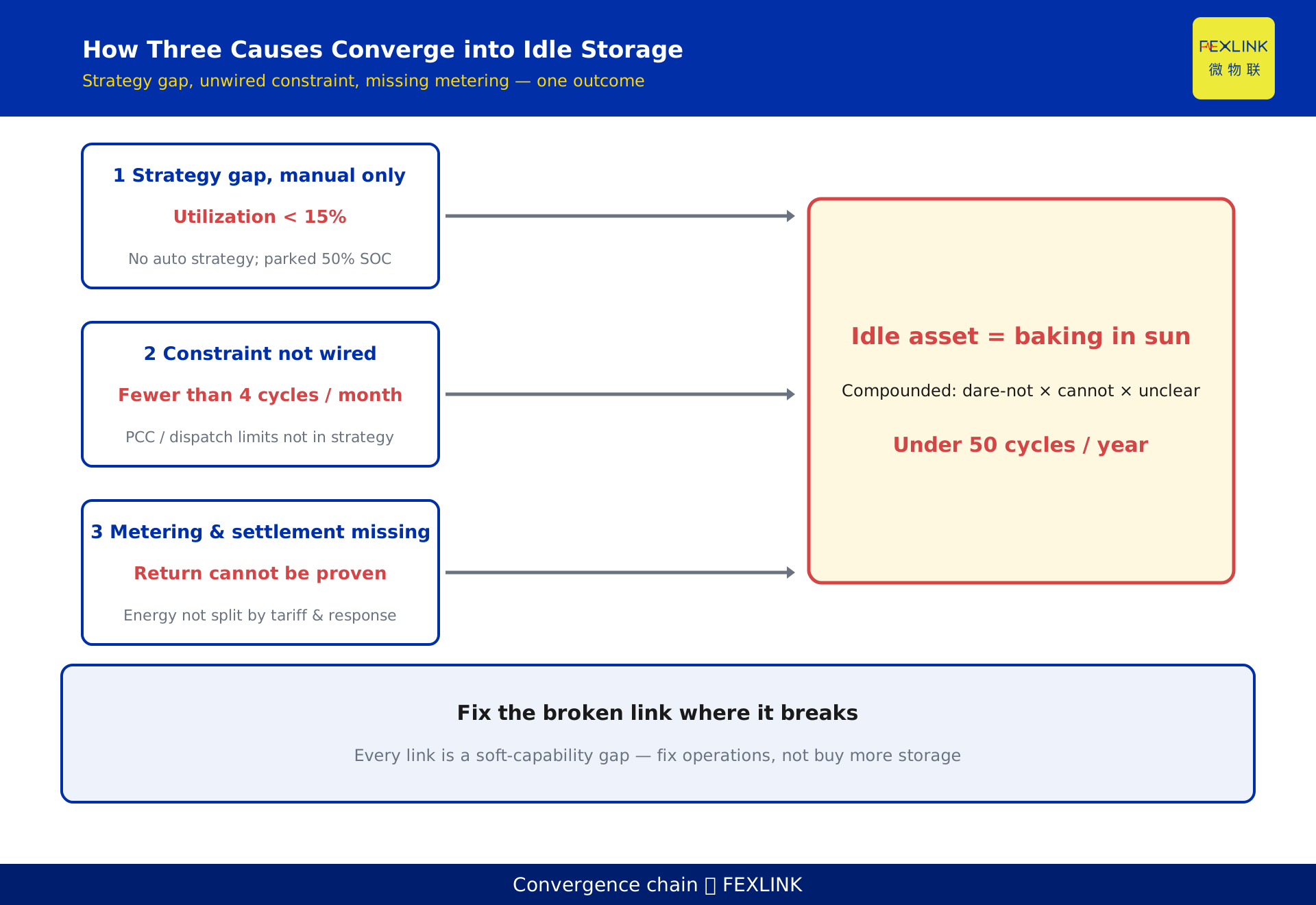
No automatic strategy means no one actively uses it; even if someone wants to, the PCC constraint blocks another path; and after finally discharging, unclear metering reinforces the belief that "using it brings no benefit." The three lines reinforce each other, eventually locking a profit-making asset into a "connected but unused" state.
Diagnosis can draw this as a single chain: strategy gap → dare not use → constraint not wired → cannot discharge → metering missing → revenue unclear → even less willing to use. Fix the broken link where it breaks. Importantly, every link in this chain is a soft-capability gap — what you add is operations and interfaces, not another storage unit.
6. Using an automatic EMS to make storage "work"
The key to breaking the deadlock is an automatic energy management system (EMS): within the four boundaries of SOC, power, time window, and PCC constraint, it automatically schedules charge/discharge and turns every action into auditable, settlable data.
A good EMS does at least four things. First, it schedules automatically by peak/valley windows and real-time tariffs, so no one watches curves daily. Second, it writes PCC limits and dispatch windows into the strategy as hard constraints, avoiding non-compliant discharge. Third, it tracks SOC in real time, maximizing usable cycles within life and safety boundaries. Fourth, it auto-tags charge/discharge energy by peak/flat/valley and response event, feeding settlement directly.
Strategy, constraint, and revenue are carried by one EMS; people only supervise and handle exceptions.
7. Five steps from idle to peak-valley / response participation
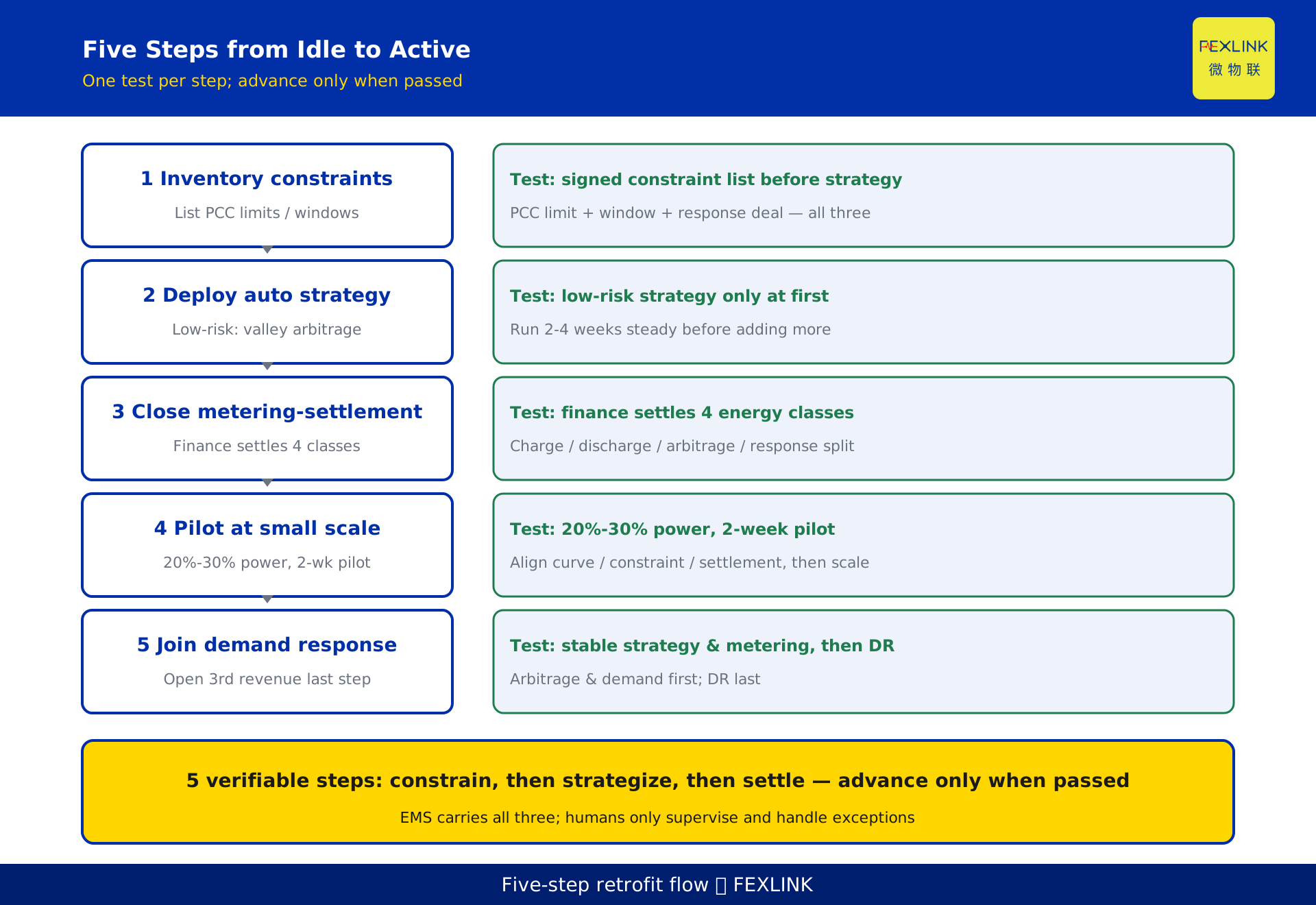
Activating an idle storage system rarely needs major hardware changes. Follow five steps:
- Inventory the constraints. List PCC limits, dispatchable discharge windows, and demand-response agreements first — this is the foundation of any strategy.
- Deploy automatic strategy. Roll out the EMS, starting only with low-risk peak-valley arbitrage; add more once it is stable.
- Close the metering-settlement loop. Ensure metering splits energy by peak/flat/valley and response event so finance can account independently.
- Pilot at small scale. Run at 20%–30% power for two weeks to verify curves, constraints, and settlement all line up before gradually opening up.
- Connect demand response. Only after strategy and metering are stable, apply to join grid dispatch demand response and open the third revenue stream.
Each step has a verifiable criterion; advance one step at a time to avoid the accountability and safety risk of opening everything at once.
8. How it lands at the edge: from "seeing" to "acting"
For the EMS to truly run automatically, the site needs an edge device that both "sees" and "acts" — one that collects meter and PCS data at the PCC in real time, runs strategy locally, and reports time-split energy for settlement on schedule.
Take the ESX intelligent edge computing gateway as an example: deployed at the user-side PCC, it collects energy-metering and PCS data downstream and connects upstream to the EMS strategy platform and the finance settlement system, closing the "see data — execute strategy — report settlement" chain at the edge. To be clear, the gateway does not replace storage cells or the PCS; its value is connecting strategy, constraint, and revenue on site so idle assets actually turn.
9. Common misconceptions
Misconception one: storage "earns by itself once connected." Storage is an asset, not an automatic teller machine; without operation it is a sunk cost.
Misconception two: blaming idle status on equipment quality. Most idleness is an operations and constraint-chain issue, not bad cells.
Misconception three: counting only peak-valley arbitrage and ignoring demand and response. The latter two streams are often more stable than arbitrage yet most easily missed.
Misconception four: opening full power at once. The prudent approach is a small-scale pilot — verify first, then scale.
FAQ
Q: Does idle storage mean it should never have been installed?
Not necessarily. Most idleness is an operations gap, not a sizing error. Run the three-step diagnosis here first to confirm whether the issue is strategy, constraint, or settlement before deciding on further investment.
Q: What exactly does the PCC constraint restrict?
Mainly the impact of charge/discharge on power quality (voltage, harmonics, power factor) and the power cap and time windows agreed with the dispatcher. Specific values follow the local interconnection agreement and dispatch rules.
Q: Can manual daily supervision replace an automatic EMS?
Short term, yes, but it does not last. Manual strategy cannot cover dynamic tariffs, ad-hoc response signals, or staff changes, and will drift back to a resting state over time.
Q: What happens if revenue cannot be accounted for?
The investment return becomes unprovable, future budgets suffer, and storage is misjudged as "not worth it," creating a vicious cycle.
Q: Does activating idle storage require hardware changes?
In most cases no major hardware change is needed; the focus is closing the strategy, constraint, and metering-settlement chains, and the edge gateway can reuse existing PCC collection.
Scope and limitations
This article targets enterprises that have already installed behind-the-meter commercial and industrial storage but show low utilization, and diagnoses the operational root cause of "installed but unused." The specific figures in the text — a "1 MW / 2 MWh storage at a certain park," "annual cycle count," "idle rate" — are constructed for illustration only and do not represent any real customer or project; actual configuration should follow on-site assessment and local tariff and interconnection policy.
It must be stressed that the PCC power-quality limits, dispatch agreements, peak/valley windows, and tariffs referenced here all vary by region and year; the specific basis should follow the local utility, the development and reform commission's published documents, and the interconnection agreement. This article is not investment or engineering decision guidance.
Frequently Asked Questions
Does idle storage mean it should never have been installed?
Not necessarily. Most idleness is an operations gap, not a sizing error. Run the three-step diagnosis here first to confirm whether the issue is strategy, constraint, or settlement before deciding on further investment.
What exactly does the PCC constraint restrict?
Mainly the impact of charge/discharge on power quality (voltage, harmonics, power factor) and the power cap and time windows agreed with the dispatcher. Specific values follow the local interconnection agreement and dispatch rules.
Can manual daily supervision replace an automatic EMS?
Short term, yes, but it does not last. Manual strategy cannot cover dynamic tariffs, ad-hoc response signals, or staff changes, and will drift back to a resting state over time.
What happens if revenue cannot be accounted for?
The investment return becomes unprovable, future budgets suffer, and storage is misjudged as "not worth it," creating a vicious cycle.
Does activating idle storage require hardware changes?
In most cases no major hardware change is needed; the focus is closing the strategy, constraint, and metering-settlement chains, and the edge gateway can reuse existing PCC collection.