 FEXLINK Research Institute
The short answer
Whether a C&I storage site needs a separate EMS (energy management system) depends on scale and the scenarios stacked on top — not every site should have one. The PCS/BMS controller built into the storage usually runs only a basic "fixed time-slot charge/discharge" strategy. The value of an EMS is that it dynamically optimizes charging and discharging against time-of-use prices, demand charges and PV self-consumption in real time, squeezing out more revenue than a fixed schedule. The practical rule: a separate EMS pays off only when usable storage capacity reaches roughly 1 MWh (≥500 kWh) and at least two of the following hold — demand-charge management or PV self-consumption is in play, or the local tariff is complex (≥3 time bands / dynamic pricing). A small site with a single arbitrage purpose can use the equipment's built-in basic strategy.
1. Two control layers, not one: built-in controller ≠ EMS
Many owners are told by vendors that "the controller built into the storage already is an EMS." That conflates two different things.
Every storage system ships with a control layer inside the PCS (power conversion system) and BMS (battery management system). Its job is to run the battery safely — charge, discharge, and protect against over-charge or over-discharge. This layer answers "can we charge and discharge safely," and it typically follows a fixed schedule: charge during the off-peak window at night, discharge during a set block in the day. We call this the "basic strategy" or "fixed time-slot schedule."
An EMS sits on top of that layer as the "decision brain." It does not replace the PCS safety protection; within the safe envelope it decides when to charge, when to discharge, how much, and who gets the energy first. The difference: the basic strategy is a hard-coded timetable, while the EMS computes the optimum live from prices, load and PV output. This article's "is EMS worth it" question compares the gap between a fixed schedule and EMS-driven dynamic optimization.
2. Three leaks in a fixed time-slot schedule
The biggest weakness of a fixed schedule is that it locks the charge/discharge windows while the real world changes every day. It leaves at least three things on the table.
First, arbitrage is not fully captured. A fixed strategy assumes the same peak/valley shape every day, but holidays, summer peaks and unscheduled maintenance shift the optimal windows. Locking the timetable means giving up those temporary price-gap opportunities.
Second, demand is not managed. The fixed strategy only "moves energy," it does not "shave the peak." If the host site has high demand charges, an EMS can use storage to shave part of the on-peak load and pull down the month's maximum demand — saving a separate demand component the fixed strategy never touches.
Third, PV is not self-consumed. On sites with rooftop PV, midday output often coincides with a non-peak price. A fixed strategy will not preferentially store that surplus in the battery for release at the evening peak, wasting the local self-consumption opportunity.
A fixed strategy does none of these three. An EMS exists precisely to pick all three up at once.
3. The three things EMS optimizes at once
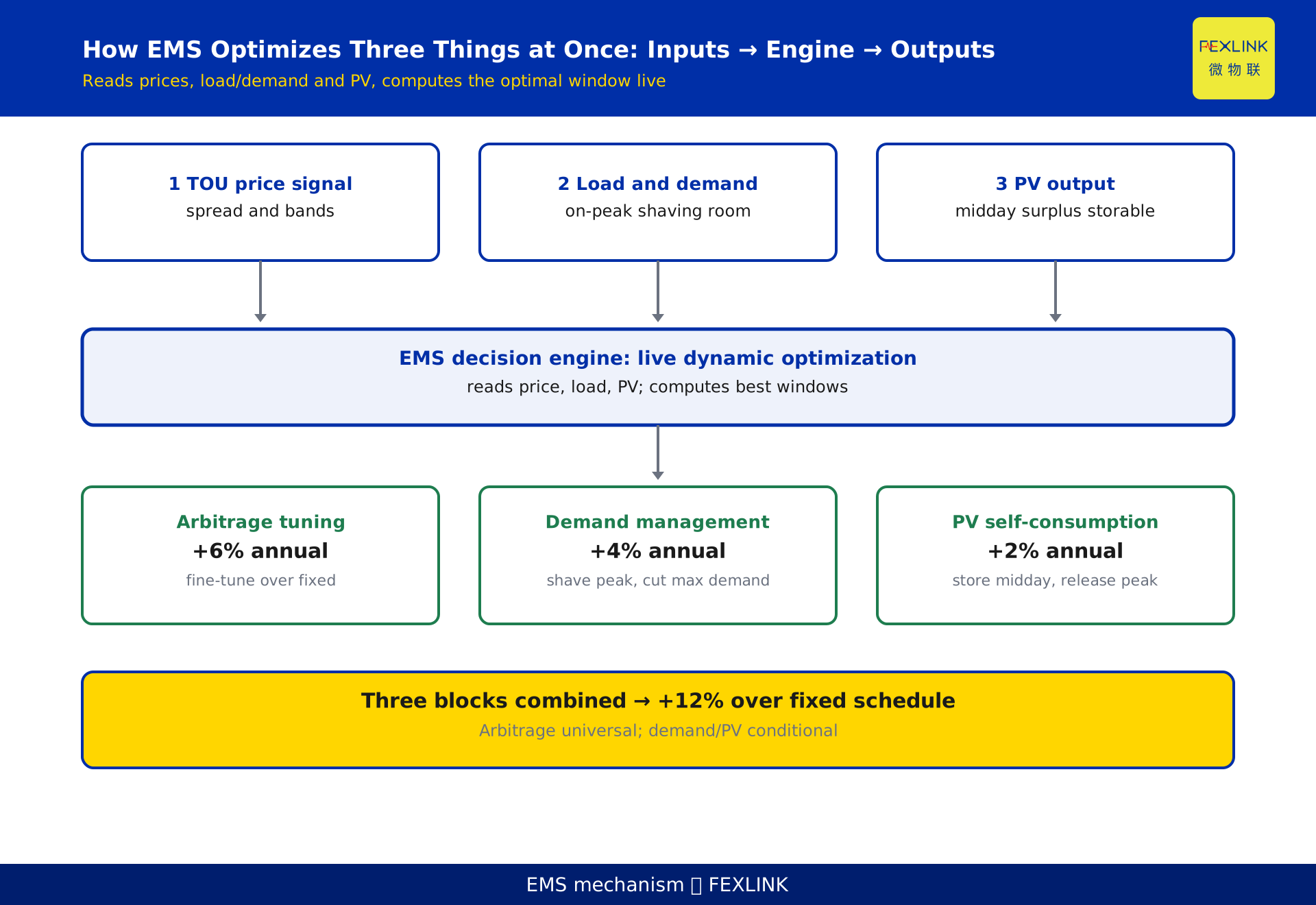
The incremental revenue of an EMS breaks into three blocks (a constructed split for illustration only, not real project data):
- Arbitrage tuning: on top of a fixed two-cycle schedule, the EMS fine-tunes windows against live prices and load, pushing more energy into higher-priced bands, contributing about +6% annual revenue;
- Demand management: at on-peak, storage shaves the peak and lowers the month's maximum demand, contributing about +4% annual revenue (only where demand charges are significant);
- PV self-consumption: midday PV surplus is stored and released at the evening peak, cutting PV curtailment and grid purchases, contributing about +2% annual revenue (only where PV is substantial).
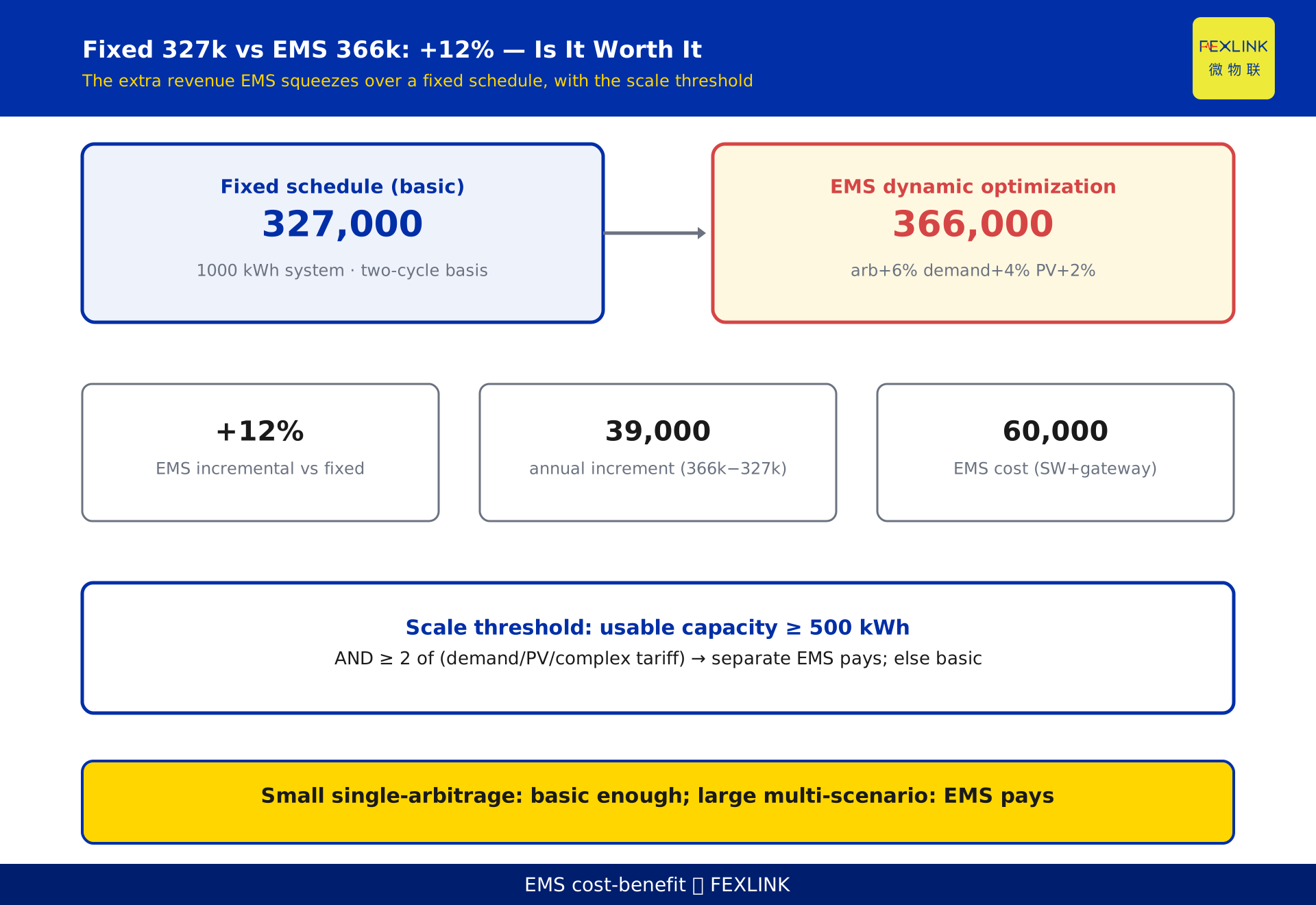
Together, the EMS incremental versus a fixed strategy is about +12%. Note this is a constructed illustrative magnitude: the arbitrage block is captured by any system to some degree, while the demand and self-consumption blocks are scenario-dependent — a site without PV loses that +2%, and a low-demand site shrinks the +4%. That is exactly the scale-and-scenario threshold addressed next.
4. Why "stacking" is what makes it pay: the structure of the revenue
To judge whether EMS is worth it, look at whether its three incremental blocks can actually land. Arbitrage tuning is universal — any peak/valley spread enables it. Demand management and PV self-consumption are conditional — they require the site to have the right tariff structure or generation.
In other words, the EMS investment is relatively fixed (software plus edge-control hardware), but its incremental revenue swings widely with the scenario. A small site with a single arbitrage need, no PV and low demand may squeeze so little extra that it cannot cover the EMS cost. Only when several incremental sources hold at once does EMS move from "nice to have" to "necessary." This is why the common industry line is: EMS is not fitted to every storage system, it is fitted to storage in "complex scenarios."
5. The scale threshold: how big before EMS pays
A clear criterion, not "it depends":
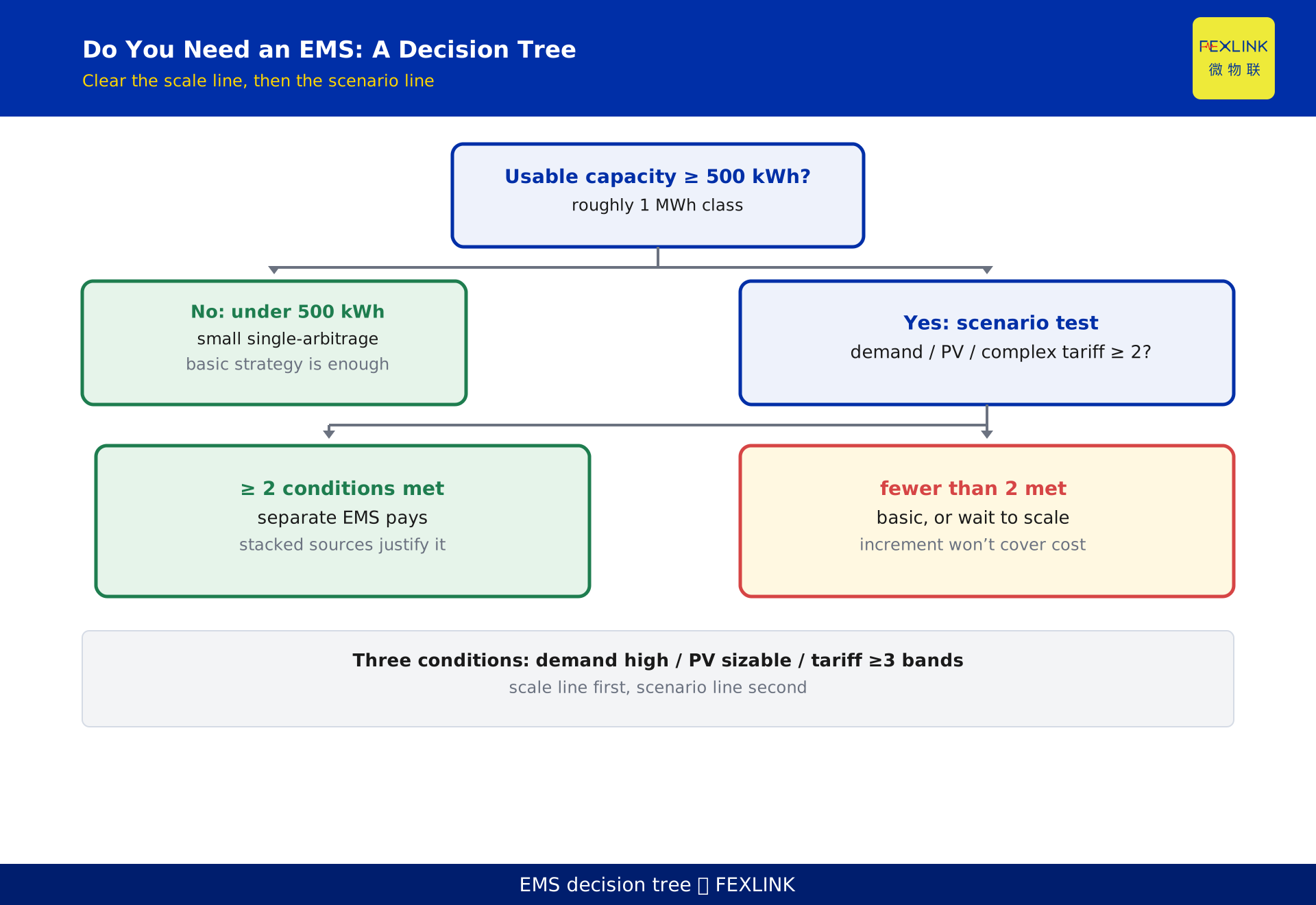
A separate EMS pays off only when usable storage capacity is ≥ 500 kWh (roughly the 1 MWh class) AND at least two of these three additional conditions hold —
- The site's demand charges are a significant share of the bill, with clear on-peak shaving headroom;
- The site has substantial rooftop or ground PV with local self-consumption potential;
- The local tariff is complex (time-of-use ≥3 bands, critical-peak/deep-valley, or spot / dynamic pricing) and a fixed timetable cannot cover it.
Small sites meeting none of these (under 500 kWh, single arbitrage, no PV, simple tariff) should just use the equipment's built-in basic strategy and skip a separate EMS. This criterion turns "should we invest in EMS" from a vague debate into a tick-box list.
6. A constructed example: how the incremental revenue is built
The following set of numbers is constructed to show how EMS incremental revenue arises (not any real customer or project; actual figures require the local tariff file and measured data):
Take a 1000 kWh / 500 kW system. On the two-cycle basis from the adjacent storage-arbitrage-account topic, the fixed strategy yields about 327,000 CNY net per year. With EMS, arbitrage tuning +6%, demand management +4% and PV self-consumption +2% total about +12%, lifting net revenue to about 366,000 CNY, an incremental of about 39,000 CNY per year.
If the EMS (software plus edge gateway) costs 60,000 CNY, incremental payback is about 1.5 years. To repeat: this is a constructed example. The overall storage arbitrage account (an adjacent topic) and this article are two separate lines — that topic settles the baseline account, this article only discusses whether adding an EMS layer on top is worth it; the increment is EMS's +12% and the applicable scale criterion. The real increment depends on the site's tariff structure, PV and demand reality and may be far above or below this figure — measured data governs.
7. How EMS splits work with the gateway and platform
An EMS is not a standalone box; it lands as a three-layer structure:
At the bottom is the equipment controller (PCS/BMS), which handles safe charge/discharge and does not touch strategy. The middle layer is the edge-control gateway, which executes the EMS decision locally in real time and collects battery SOH, tariff windows, load and PV data. The top layer is the EMS decision engine and energy-management platform, which computes strategy, produces reports and runs long-term optimization.
The ESX intelligent edge computing gateway (intelligent edge computing gateway) plays the key middle-layer role: locally and in real time it reads the local tariff windows, battery state of health and PV output, and translates the EMS directives — when to charge, when to discharge, how much — into live commands to the PCS, so even if the platform loses connection the day's charge/discharge rhythm continues. Simply put, the EMS is the brain, the ESX gateway is the nerve, and the PCS is the hand — three roles that divide labor without replacing one another.
8. The checklist: do you need EMS
Turn the section 5 criterion into a tick-box list and just check the boxes:
- □ Usable storage capacity ≥ 500 kWh? No → use the basic strategy directly.
- □ Site demand charges are high (clear on-peak spike)? Score 1.
- □ Site has substantial PV available for local consumption? Score 1.
- □ Local tariff has ≥3 bands / critical-peak-deep-valley / dynamic spot? Score 1.
- □ Score on the three additional conditions ≥ 2? Yes → a separate EMS pays off; No → basic strategy, or re-evaluate after capacity grows.
This list is the tooling of section 6: clear the scale line first, then the scenario line; invest only when both clear. Do not force a system onto a small site, and do not let a complex site settle for a fixed schedule and leave revenue on the table.
9. Common misconceptions
Misconception 1: the storage's built-in controller is already an EMS. Wrong. The built-in board only runs safety and a fixed plan; it does no dynamic optimization. They are not the same thing.
Misconception 2: EMS always earns an extra 12%. Wrong. The 12% is a constructed illustrative magnitude; the demand and self-consumption blocks are highly scenario-dependent. A site with no PV and low demand may keep only the arbitrage +6% or even less.
Misconception 3: once EMS is installed you can ignore strategy. Wrong. The EMS optimization boundary is set by the objective you define (prioritize arbitrage / prioritize peak shaving / prioritize self-consumption). Set the wrong objective and the EMS will drift off too — a human still defines the priorities.
Misconception 4: a more expensive EMS is better. Wrong. EMS cost should match the incremental revenue it brings; an expensive EMS on a small site dilutes the return.
10. FAQ
Q: A small factory with 200 kWh of storage — does it need an EMS?
By this article's criterion, under 500 kWh and typically without PV and with low demand, it should just use the equipment's built-in basic strategy; a separate EMS will likely fail to cover its cost. Re-evaluate once capacity grows toward the 1 MWh class.
Q: We already have PV and storage but only do arbitrage — can EMS still earn more?
Yes, but only the arbitrage block. With PV, storing the surplus and releasing it at the evening peak captures the self-consumption increment (about +2% in the constructed example); ignore the PV entirely and that revenue is wasted.
Q: Is the EMS the same thing as the site's energy-management platform?
No. The energy-management platform leans toward monitoring, reporting and long-term analysis; the EMS leans toward real-time charge/discharge decision and execution. The ESX intelligent edge computing gateway bridges the two in the middle, landing the platform's strategy locally.
Q: Does the EMS fail if the network drops?
When the decision engine sits on the platform side, a network drop affects strategy updates; but the edge gateway (such as the ESX) caches the latest strategy locally and keeps running on preset rules, so the day's charge/discharge rhythm does not stop, and it re-syncs after recovery.
Q: How do we tell whether the EMS really earned more, rather than the vendor's word?
Compare incremental revenue against a pre-retrofit baseline versus post-retrofit measurement, and have it computed independently by a party that does not carry the sales target; lock the baseline before retrofit and keep a trace, and the gap is the EMS's real increment. This article is a methodology note; the actual accounting rests on local measured data.
Scope and limitations
- The EMS cost-benefit framework here applies to time-of-use tariff users with C&I storage; it does not apply to sites on a single flat tariff with no arbitrage headroom.
- All energy, capacity, revenue, cost and payback figures in this article are constructed examples for illustrating the method, and represent no real customer, project or region; actual estimates require the local utility's published time-of-use tariff, site survey and measured data.
- The EMS incremental of +12% versus a fixed strategy, and the split of arbitrage +6% / demand +4% / PV self-consumption +2%, are constructed illustrative magnitudes used only to explain the revenue structure, and constitute no investment or selection advice.
- The criterion "usable storage capacity ≥ 500 kWh, with ≥2 additional conditions" is an empirical rule for decision reference; the actual threshold should be adjusted to the project's real capacity, tariff structure and PV / demand situation.
- The functional description of the ESX intelligent edge computing gateway follows the latest selection manual and product knowledge base; this article is not a procurement recommendation.
Frequently Asked Questions
Does C&I Storage Need a Separate EMS
Whether a C&I storage site needs a separate EMS (energy management system) depends on scale and the scenarios stacked on top — not every site should have