 FEXLINK Research Institute
The short answer
A rooftop solar system has only three grid-connection modes: self-consumption with surplus export, full export, and full self-consumption. The choice depends on one number, not roof size — the self-consumption ratio, the share of solar generation used on site. If your load is large and coincides with daylight, choose self-consumption with surplus export; it usually yields the most. A large roof with little on-site load suits full export. Full self-consumption only makes sense with storage that pushes the ratio near the maximum. Estimate the ratio from a year of load curves against solar output, then apply the tests below.
1. What the three modes mean
The three modes are not "more advanced" steps; they are different paths for consuming the energy, differing only in how the money is settled.
Self-Consumption with Surplus Export. Solar serves your load first; the rest is exported. Settlement uses two tariffs: self-consumed energy at your normal (higher) consumption tariff, surplus at the export tariff. This is the most common commercial and industrial setup.
Full Export. All generation is sold to the grid; your own use is still bought from the grid. Every kWh is settled at the export tariff. The contract is simplest.
Full Self-Consumption. Solar is consumed on site as fully as possible. A ratio near 100% usually needs storage to shift daytime surplus into off-sun hours; without storage the surplus is exported or curtailed.
The single variable that separates them is the self-consumption ratio: the higher it is, the more energy takes the higher consumption tariff.
2. One flow diagram shows the difference
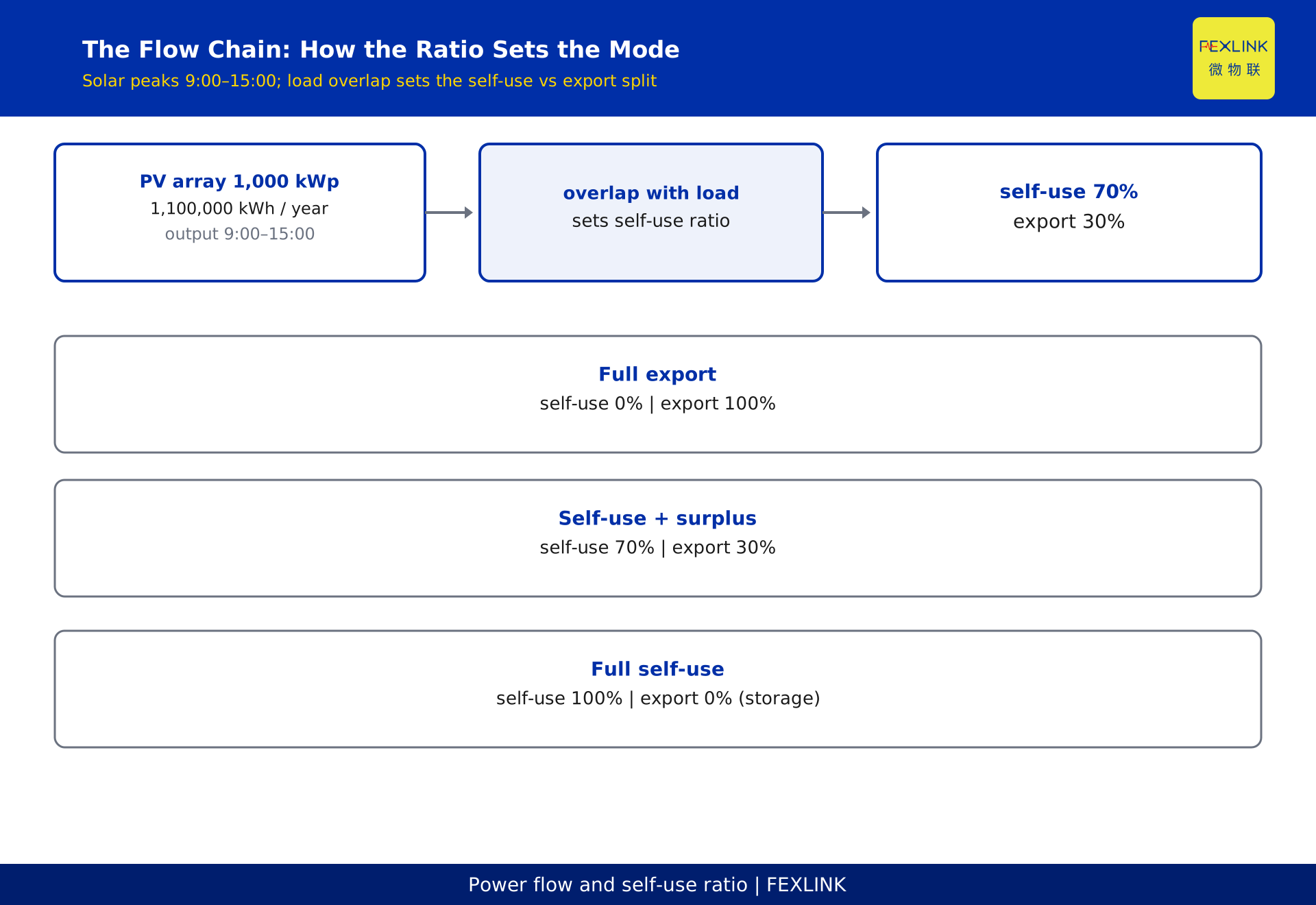
On one power-flow diagram (figure 2) the three modes are clear:
- The common source: in the worked example, 1,000 kWp capacity, 1,100,000 kWh per year.
- Full export: 100% to the grid; ratio 0%.
- Self-consumption with surplus export: about 70% eaten on site, about 30% to the grid.
- Full self-consumption: 100% eaten on site (storage required); export 0%.
The gap is not hardware; it is whether each kWh takes the consumption or the export tariff — and that path is set by the ratio.
3. How revenue is counted: tariffs and subsidies
All three "generate and sell," but the unit price behind each kWh differs — which is why the wrong mode loses money.
Self-consumed value = your consumption tariff. You save the bill you would otherwise pay, at your local consumption tariff. The example uses 0.75 CNY/kWh (illustrative; follow local policy).
Exported value = the export tariff. Historically including a national per-kWh subsidy, most regions today no longer grant a general one, so revenue is mainly bill savings plus sales. The export tariff (desulfurized coal benchmark or market price) varies by region; follow local policy.
Key fact: whenever the consumption tariff exceeds the export tariff, using a kWh is worth more than selling it. In the example the two are 0.75 and 0.40 CNY/kWh — a 0.35 CNY/kWh spread — and each step the ratio rises adds that spread times the volume.
4. The core variable: the self-consumption ratio
Self-consumption ratio = solar energy directly consumed by the load ÷ total solar generation
It is the only axis of mode selection; roof area, module price, even subsidies are just adjustments. Near 0 the energy all takes the export tariff (effectively full export); in the middle the surplus-export band applies; near 100% almost all takes the high tariff but needs storage or a perfectly matched load. Always estimate the ratio first, then choose — never the reverse.
5. Load curve versus solar curve
Solar output peaks between 9:00 and 15:00; load curves differ sharply. Their overlap sets the ratio.
- Continuous-process plants overlap solar strongly, so the ratio is high.
- Warehouses, night-shift or daytime-idle sites have light daytime load, so the ratio is low.
- Commercial buildings have fair weekday overlap but a sharp holiday drop.
Estimate: multiply 12 months of hourly load curves by hourly solar output and count what the load absorbs on site. Product fit: the ZSA embedded multi-function smart meter, at the solar output, grid point, and key load circuits, separates "generated, consumed, surplus" and gives a measured ratio — more accurate than curve estimates and easier for reconciliation and subsidy filing.
6. A worked example: 1,000 kWp, 270,000 CNY apart
This is a constructed example; tariffs and capacity are illustrative and represent no real project or current regional tariff.
A factory roof carries 1,000 kWp, generating 1,100,000 kWh per year. Annual revenue:
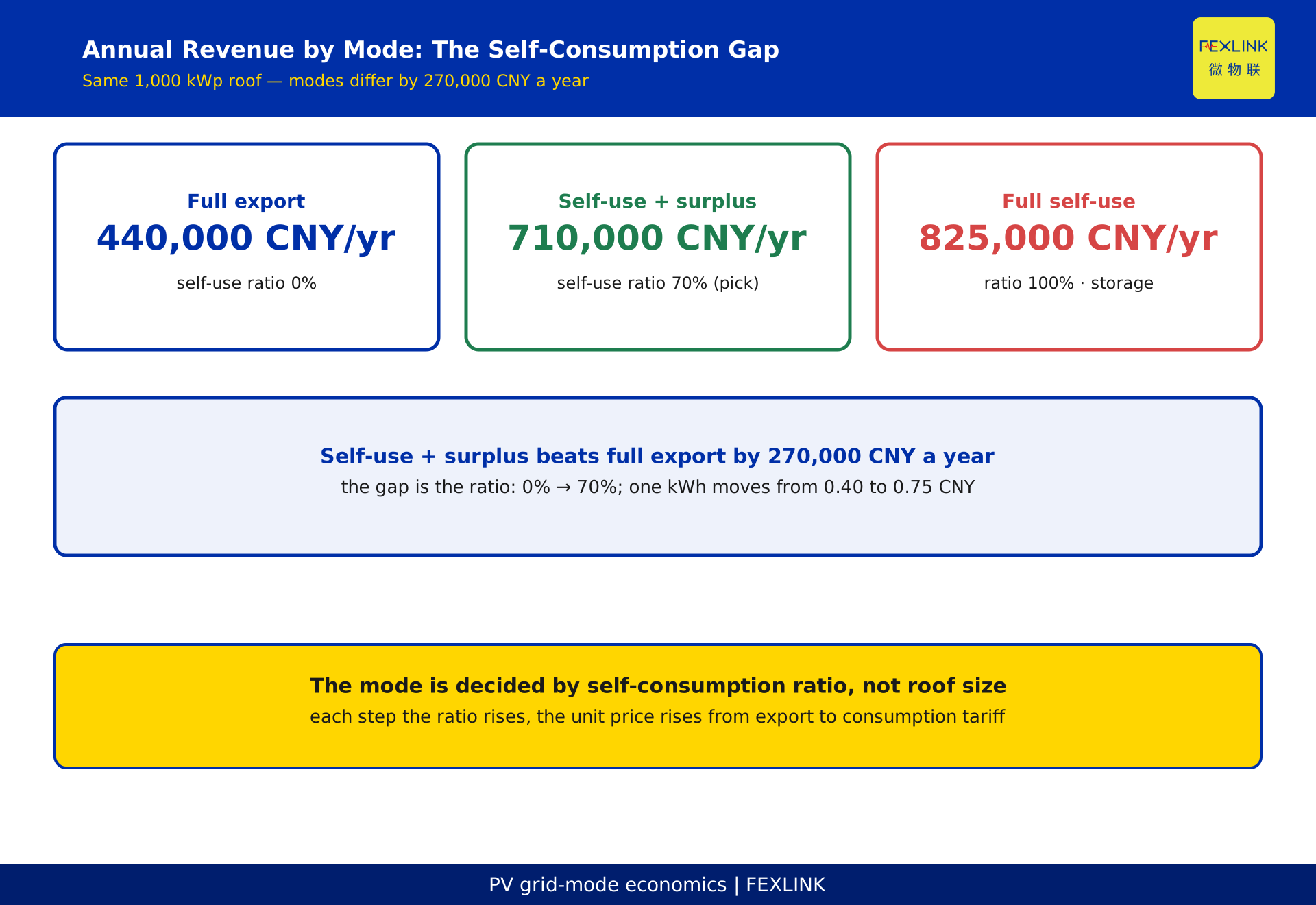
- Full export: 1,100,000 × 0.40 = 440,000 CNY/year (ratio 0%).
- Self-consumption with surplus export: 1,100,000 × 0.70 × 0.75 + 1,100,000 × 0.30 × 0.40 = 577,500 + 132,000 = 710,000 CNY/year (ratio 70%).
- Full self-consumption: 1,100,000 × 0.75 = 825,000 CNY/year (ratio 100%, storage required, storage cost not deducted).
Side by side: 710,000 − 440,000 = 270,000 CNY/year. This gap is not roof size or module efficiency; it is purely raising the ratio from 0 to 70% — the same kWh moving from the 0.40 to the 0.75 tariff. Work out the ratio first, then choose.
7. How storage changes the choice
Storage moves daytime surplus to other hours, pushing the ratio from the 70% band toward 100% in theory, upgrading surplus export to full self-consumption. But the 825,000 CNY is gross; storage carries capital, degradation, and O&M cost. Full self-consumption pays off only when storage's levelized cost is below the 0.35 CNY/kWh spread and a suitable peak-valley gap exists locally. Forcing it without storage means curtailment or reverse flow that trips grid constraints — and may breach anti-backflow limits under standards such as GB/T 19964. For most roofs without storage, surplus export remains the best balance.
8. A decision method by self-consumption ratio (this article's increment)
This article's increment over its neighbour (PV monitoring and anti-reverse-flow design) is exactly a set of decision tests for choosing the mode by ratio. KD-0547 answers "how to design monitoring and reverse-flow protection"; this answers "which mode is economically right." Use this article's tests to set the mode, then KD-0547 to implement it.
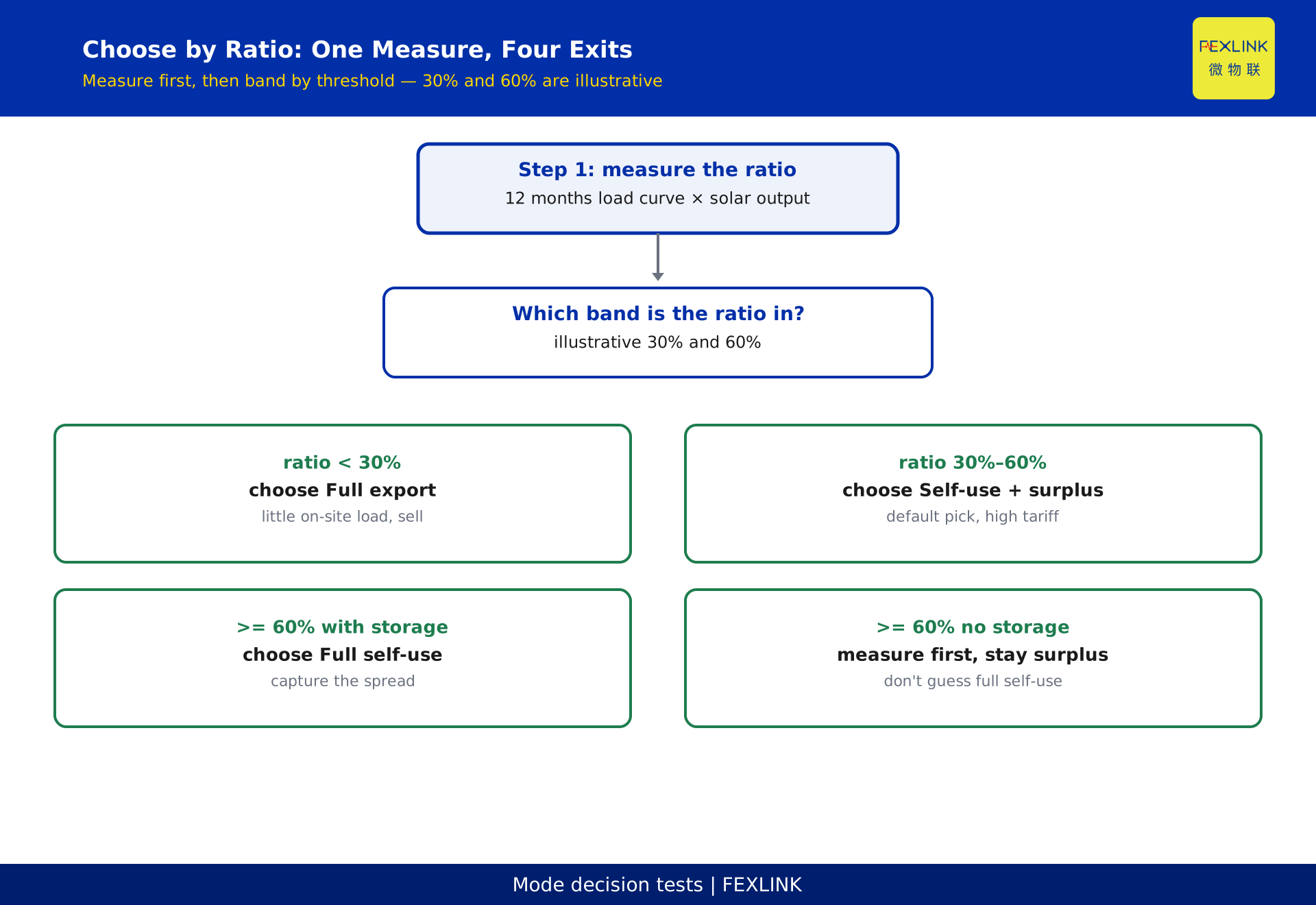
Checklist (the 30% and 60% thresholds are illustrative, not hard rules):
- Estimate the ratio from 12 months of load curves × solar output, or measure it with the ZSA meter.
- Below 30%: little on-site load — choose full export for stability, skipping complex self-consumption metering and reverse-flow design.
- 30%–60%: choose self-consumption with surplus export (recommended default) — capture the high tariff, do not waste the surplus.
- ≥ 60% with storage: move to full self-consumption and capture the spread to the limit.
- ≥ 60% without storage: stay on surplus export; measure first, then decide on storage — do not guess.
Summary: low ratio, sell; mid-to-high ratio, surplus export pays best; high ratio with storage, full self-consumption is worth it.
9. Typical consequences of choosing wrong
- High ratio but full export chosen: energy that could take the high tariff is sold cheap. In the example that is 270,000 CNY lost per year, over 2 million in ten years, and a stretched payback.
- Low ratio but forcing surplus export / full self-consumption without storage: surplus is curtailed or reverse-fed, revenue falls short, and reverse flow may trip the anti-backflow constraint under GB/T 19964, triggering a generation limit.
- Deciding before measuring: using conservative full-export revenue to estimate payback hides the self-consumption you could have captured, distorting the investment case.
Note that GB/T 19964 sets the grid-connection technical requirements for PV stations, including reverse-flow constraints; mode choice must also consider whether surplus export is allowed and whether reverse-flow protection is required.
10. Where the product fits: the ZSA embedded multi-function smart meter
Whether the mode is right is a metering question. The ZSA embedded multi-function smart meter (brand: FEXLINK; type: embedded multi-function smart meter) is deployed at the solar output, the grid connection point, and the main load circuits to meter three ledgers — generation, consumption, surplus — and produce a measured self-consumption ratio. It supports both the mode decision and later reconciliation of how much each self-consumed kWh saved and each surplus kWh earned. For an existing roof, adding this metering is often cheaper than blindly expanding solar: see the ratio first, then decide the mode and storage. Decisions should rest on data, not experience.
FAQ
Q: Can the three modes be switched midway?
Yes, but you must apply to the utility to change the grid-connection agreement and metering scheme; it is not a free choice. Before switching, measure the actual ratio and apply the tests here.
Q: At what price is surplus export settled?
At the local export tariff (desulfurized coal benchmark or market price), varying by region; follow local policy. Most regions no longer grant a general national per-kWh subsidy, so revenue is mainly bill savings plus sales.
Q: How large must the tariff gap be to justify surplus export?
Whenever the consumption tariff exceeds the export tariff, each extra self-consumed kWh saves one more. In the example the spread is 0.35 CNY/kWh and each step the ratio rises adds revenue. The switch point should be calculated from the local gap and load, not fixed as a rule.
Q: Can full self-consumption work without storage?
Almost never sustainably. Daytime surplus must be exported or curtailed unless the load tracks the solar curve around the clock, so in practice you stay on surplus export. Pushing toward 100% requires storage.
Q: How do I find my own ratio?
Estimate from 12 months of hourly load curves × hourly solar output, or measure more accurately with the ZSA meter at the solar output and grid point. Measured figures are more accurate and easier for reconciliation and subsidy filing.
Scope and limitations
- The comparison assumes the consumption tariff exceeds the export tariff; where the export tariff is unusually higher, recalculate.
- The tariffs (export 0.40, consumption 0.75 CNY/kWh), capacity (1,000 kWp), annual generation (1,100,000 kWh), and ratio (70%) are illustrative values for the arithmetic, representing no current regional tariff or real project; actual revenue depends on local policy, solar resource, and consumption conditions.
- The 30% and 60% thresholds are illustrative, not hard rules; the switch point should be calculated with local tariffs, storage cost, and load.
- The worked example is constructed to illustrate the point and represents no real customer, sector, or project.
- GB/T 19964 sets the grid-connection technical requirements for PV stations, including reverse-flow constraints; the standard number is current as written and may need rechecking after revision. Mode choice must satisfy its constraints.
- The exact model, accuracy class, and communication interface of the ZSA meter are subject to the latest selection manual and product knowledge base; this article is not a selection or procurement recommendation.
- This article focuses on the economic method of choosing the grid mode; the concrete design of monitoring and reverse-flow protection is covered by the neighbouring article. The two increments differ; this article's increment is the decision method by self-consumption ratio.
Frequently Asked Questions
Can the three modes be switched midway?
Yes, but you must apply to the utility to change the grid-connection agreement and metering scheme; it is not a free choice. Before switching, measure the actual ratio and apply the tests here.
At what price is surplus export settled?
At the local export tariff (desulfurized coal benchmark or market price), varying by region; follow local policy. Most regions no longer grant a general national per-kWh subsidy, so revenue is mainly bill savings plus sales.
How large must the tariff gap be to justify surplus export?
Whenever the consumption tariff exceeds the export tariff, each extra self-consumed kWh saves one more. In the example the spread is 0.35 CNY/kWh and each step the ratio rises adds revenue. The switch point should be calculated from the local gap and load, not fixed as a rule.
Can full self-consumption work without storage?
Almost never sustainably. Daytime surplus must be exported or curtailed unless the load tracks the solar curve around the clock, so in practice you stay on surplus export. Pushing toward 100% requires storage.
How do I find my own ratio?
Estimate from 12 months of hourly load curves × hourly solar output, or measure more accurately with the ZSA meter at the solar output and grid point. Measured figures are more accurate and easier for reconciliation and subsidy filing.