 FEXLINK Research Institute
The short answer
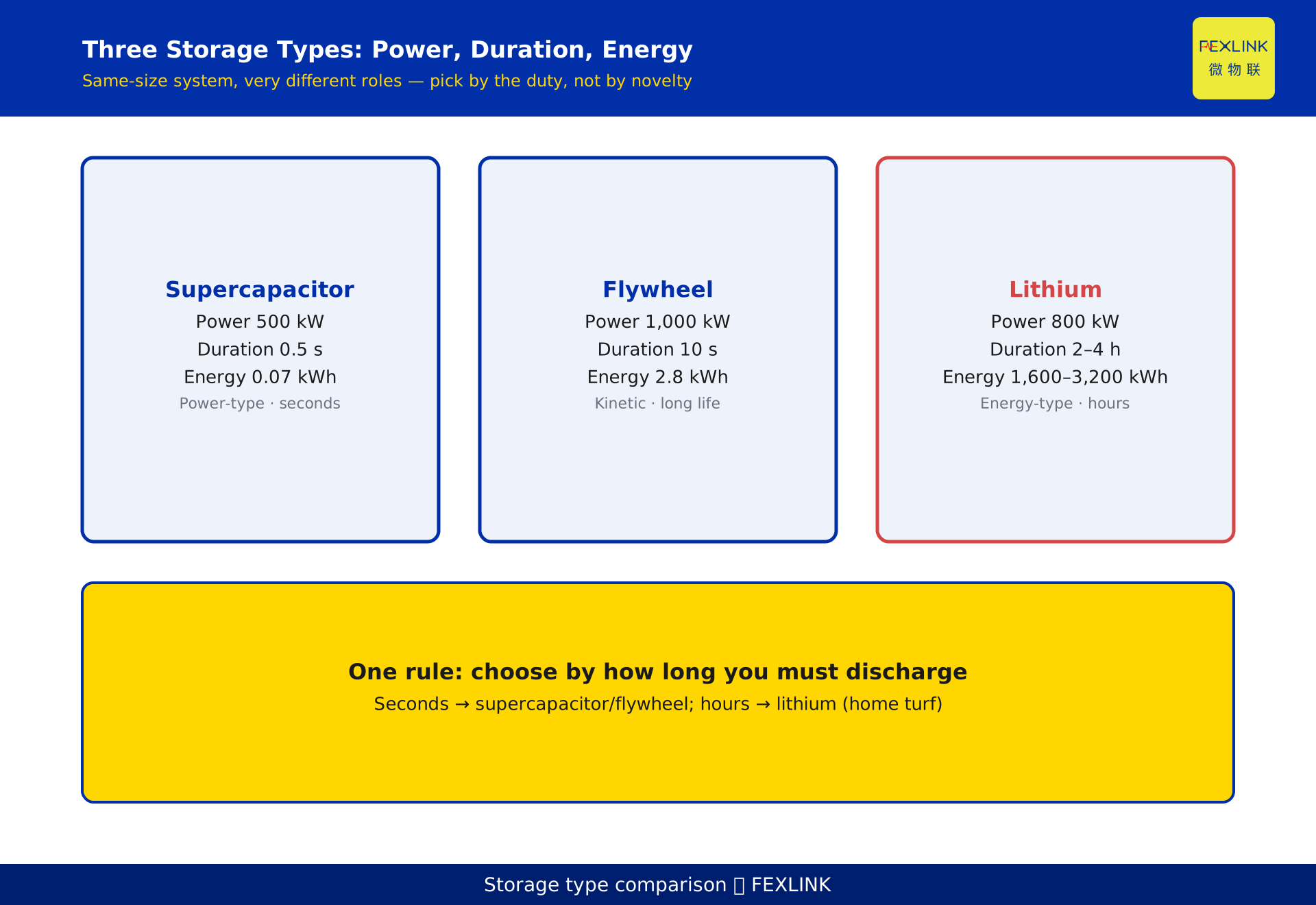
Do not switch technology routes just because "new storage" sounds attractive. For commercial and industrial short-duration duty there is only one hard rule: choose by how long you need to discharge. For second-scale, high-frequency duty with dozens or hundreds of cycles per day, pick a supercapacitor or a flywheel (very long cycle life, but small capacity). For minute-to-hour duty where you must accumulate kWh for peak-valley arbitrage or demand management, lithium is almost always the home turf. Power rating and energy capacity are not the same thing; separate "how long" from "how hard" and the choice stops being confusing.
One map: power-type versus energy-type
Lithium, flywheels and supercapacitors are all called "storage", but their physical roles differ sharply. Put them on a map of power density against energy density:
- Supercapacitor: the highest power density, the lowest energy density. It moves current extremely fast but stores very little energy — a shallow well with a very fast tap.
- Flywheel: stores kinetic energy in a spinning rotor; high power density, low-to-mid energy density, sitting between the supercapacitor and lithium.
- Lithium: clearly higher energy density, able to deliver energy over hours; its power rate (C-rate) and cycle life are bounded by the chemistry.
Public engineering sources agree on one point: no technology is best on all four axes, so selection is trade-off. A lithium cell's energy density is commonly in the 100–300 Wh/kg band (it varies widely by chemistry, and you should confirm against the vendor's datasheet); a flywheel or supercapacitor reaches several kilowatts per kilogram of power density.
Power and energy are different questions
Two independent metrics describe any storage system:
- Energy (kWh) decides how long it can discharge. It is the total energy of the load you want to shave; too little and you never reach the off-peak tariff window.
- Power (kW) decides how hard it can hit. It is the single impulse you must back up instantly, for example a production line that drops out and needs several hundred kW within one second.
Divide the two and you get discharge duration = energy ÷ power. The same energy discharges faster at higher power. So "how long" is not an inherent tag of the storage but a task you assign to it — yet each technology has a very different economic discharge window. That is the first watershed: does the job want "hard" or "long"?
Time scales: seconds, minutes, hours
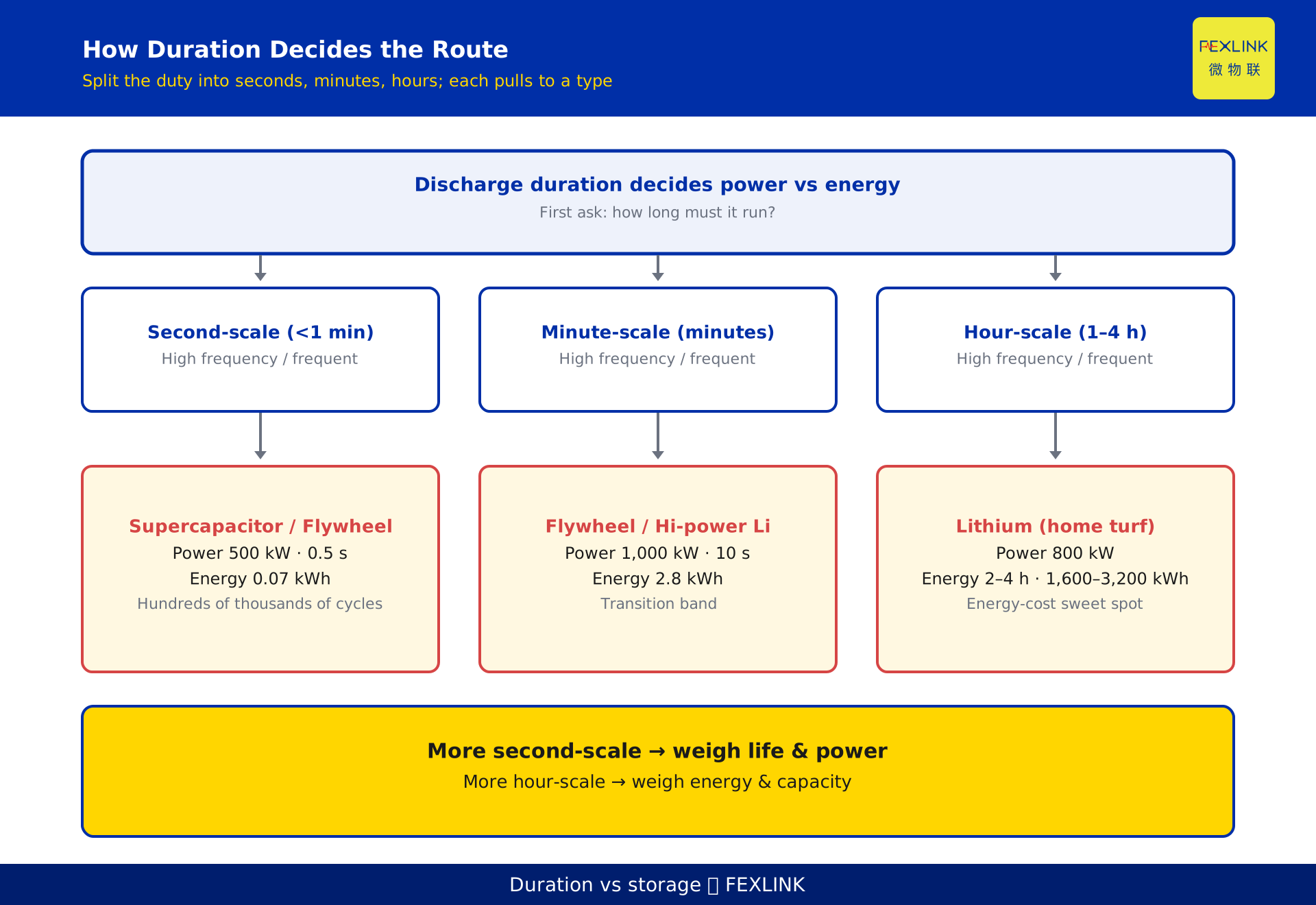
Split the duty by discharge duration and the technology route follows almost one-to-one:
| Duration | Typical duty | Better-matched technology |
|---|---|---|
| Second-scale (<1 minute, high frequency) | Voltage sag correction, impulse load smoothing, UPS-grade bridging | Supercapacitor, flywheel |
| Minute-scale (minutes to tens of minutes) | Primary frequency regulation, ramp support, short bridging | Flywheel, high-power lithium |
| Hour-scale (1–4 hours) | Peak-valley arbitrage, demand management, short backup | Lithium (home turf) |
The middle row is a transition band. Inside 30 minutes, grid primary frequency regulation favours the flywheel and supercapacitor for speed and cycle life; but once you must sustain energy for one or two hours, their energy cost runs away and lithium becomes cheaper. A useful rule: the more second-scale the duty, the more you weigh cycle life and power; the more hour-scale, the more you weigh energy cost and capacity.
Cycle life and cost: long life is not the same as cheap
The most misread figure is "cycle life", and it must be read as an order of magnitude rather than a fixed count; confirm specifics against the vendor datasheet or site measurement:
- Supercapacitor: cycle life reaches the hundreds of thousands of cycles and above, suited to hundreds or thousands of shallow cycles per day.
- Flywheel: cycle count is limited by bearing and vacuum mechanical wear, typically tens of thousands of cycles, still far better than lithium.
- Lithium: typically thousands to ten thousand cycles, and it fades faster under deep charge-discharge.
But long life does not mean low total cost. The supercapacitor's and flywheel's energy cost per kWh is far above lithium's, and their low energy density means more space and more power electronics. What they save is the replacement cost of lithium that would wear out fast under frequent cycling — not the energy unit price itself.
Where flywheels and supercapacitors pay off: the second-scale
A flywheel or supercapacitor is not "a more advanced lithium"; it pays off only where lithium is weak. Here is a worked example, constructed to illustrate the point (it represents no real customer): a commercial user has a 500 kW-class impulse load that must be supported within 0.5 seconds. The matching supercapacitor is about 500 kW and 0.07 kWh — because 500 kW × 0.5 s ≈ 0.07 kWh, very high power and very small energy, exactly the signature of the power type. Likewise, a 1,000 kW flywheel holding for 10 seconds stores only about 2.8 kWh (1,000 kW × 10 s ≈ 2.8 kWh).
This kind of "high-frequency, small-sip" duty is where lithium's cycle life fails and the flywheel or supercapacitor fits. Other typical portraits: contactor closing, elevator energy recovery, regenerative braking absorption at port cranes — discharge for 10 seconds, power in the thousands of kW, total energy only a few kWh.
Where lithium wins: the hour-scale
Step back to what most commercial users actually pay for — peak-valley arbitrage and demand management:
- Arbitrage needs the storage to charge in the valley and discharge in the peak, a full cycle that usually delivers 2–4 hours of sustained energy, precisely lithium's energy-density sweet spot.
- Demand management needs storage to "hold" the few monthly peaks for half an hour to a few hours; it is essentially energy shifting and again favours lithium.
- A flywheel or supercapacitor forced into 2–4 hours of arbitrage either has trivial capacity or an energy cost with an ugly payback.
The constructed example again: a park with an 800 kW daily peak, if levelled by lithium for 4 hours, is about 800 kW / 3,200 kWh (800 kW × 4 h = 3,200 kWh); for a 2-hour shave it is about 800 kW / 1,600 kWh (800 kW × 2 h = 1,600 kWh). These parameters are constructed only to show the "power × duration = energy" relationship and represent no real customer. This "large-energy, hour-scale" need is lithium's home turf; the few kWh a flywheel or supercapacitor carries cannot survive even one peak shave.
Making the choice work on site: the ESX edge gateway
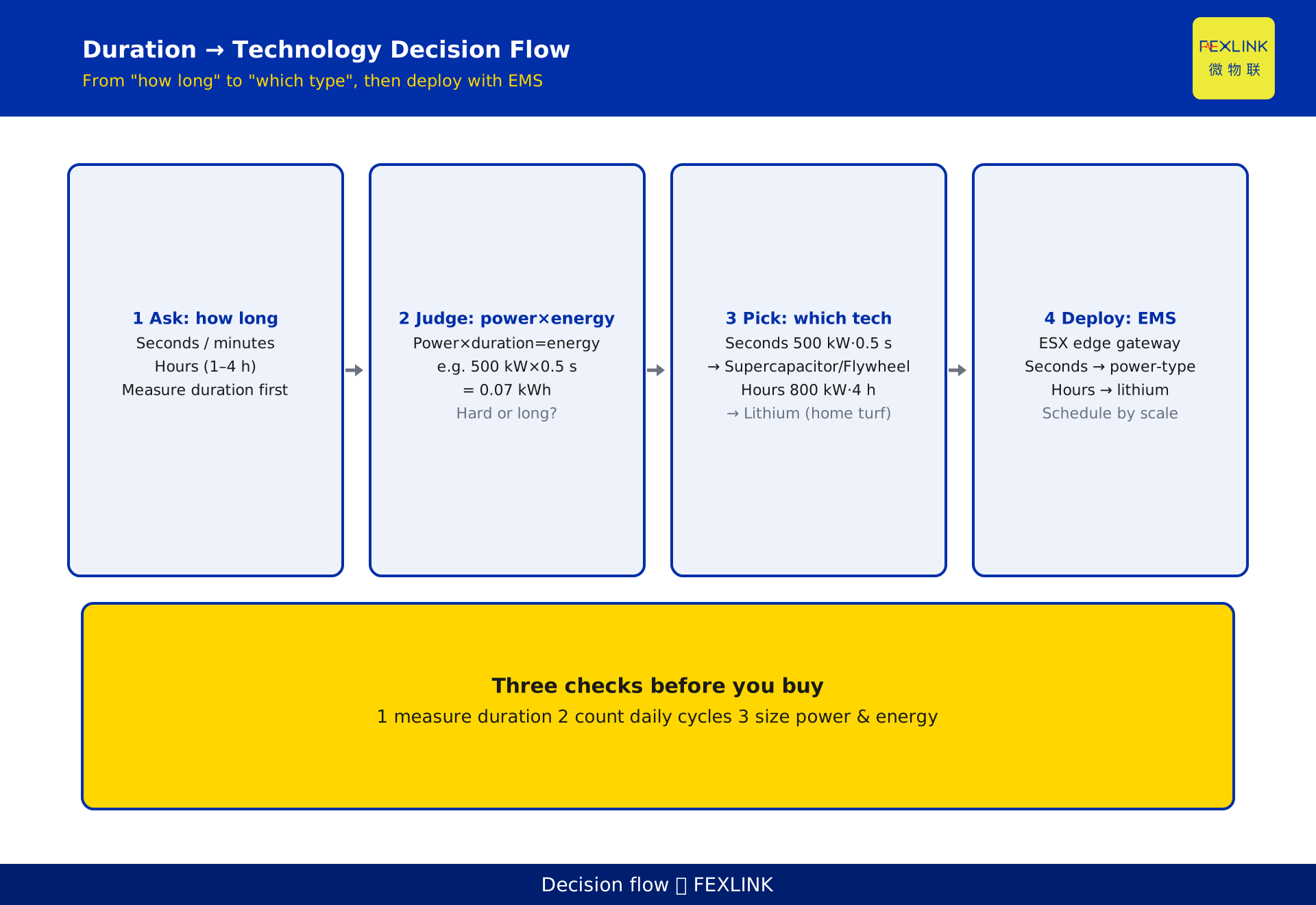
Picking the right technology is only step one; making it actually run "by time scale" on site depends on an energy management system (EMS). Second-scale smoothing needs a control loop closed in milliseconds to seconds, with sampling and commands done locally — you cannot ship every frame to the cloud and wait, because by the time it returns the disturbance is over.
This is where an edge node like the ESX smart edge computing gateway earns its place: it collects data from the power conversion system (PCS), the battery management system (BMS) and the grid connection point locally, runs control strategy and short-horizon forecasting on site, and keeps the "should it discharge, and how much" decision at the edge, sending only aggregated reports and alarms to the platform. For a user running both lithium and a power-type store, it can also schedule by time scale: second-scale fluctuations to the flywheel or supercapacitor, hour-scale arbitrage to lithium — avoiding wasting the high-cycle-life power type on long duty, and avoiding dragging lithium down with high-frequency micro-cycles. The edge gateway does not replace the storage itself; it keeps the selection conclusion from drifting on site.
A decision table: duration versus storage type
Collapse the criteria above into one table you can look up:
| Your discharge duration | Cycle frequency | Technology better suited by time scale | Criterion |
|---|---|---|---|
| Second-scale (<1 minute) | High (tens to hundreds per day) | Supercapacitor, flywheel | Cycle life holds up; lithium fades too early |
| Minute-scale (minutes to tens of minutes) | Medium | Flywheel, high-power lithium | Transition band; depends which of power and life is tighter |
| 1–4 hours | Low (once per day) | Lithium | Energy-cost and capacity sweet spot; arbitrage and demand home turf |
Fix the decision order: first ask "how long must it run", then "how many cycles per day", and only last "how much power and energy per event". The first two questions lock the technology route; the third only sizes the capacity. The table says "better suited", not "only answer" — engineering often allows parallel options, not a ranked best.
Common misconceptions
- Misconception 1: high power equals large capacity. A supercapacitor has extremely high power density but very low energy density; do not read "can back a big impulse" as "can back it for long".
- Misconception 2: longer cycle life is always cheaper. It depends on your real cycle frequency. At one arbitrage cycle per day, lithium's thousands of cycles last many years; a supercapacitor is wasted money.
- Misconception 3: flywheel or supercapacitor can replace lithium for arbitrage. Forced into long discharge, the energy cost runs away and the payback looks bad.
- Misconception 4: judge only by unit equipment price. In high-frequency duty you save the cost of replacing lithium often; in long duty you save the energy unit price. Score it by the cycle rhythm.
Frequently asked questions (FAQ)
Q: Flywheels and supercapacitors are also popular — should commercial peak shaving pick something other than lithium?
Not necessarily. If your goal is peak-valley arbitrage or demand management and the discharge must last 2–4 hours, that is lithium's energy-density sweet spot and lithium is almost a default choice. Flywheels and supercapacitors only pay off in second-scale, high-frequency, frequent-cycle duty or in processes with very large instantaneous power.
Q: Can I use only a supercapacitor for all storage?
Hard to do. A supercapacitor's energy density is low; storing enough for 2–4 hours is impractical in volume and cost. It fits better as "second-scale patching", working with lithium: lithium carries the long energy, the supercapacitor carries the instantaneous power.
Q: Flywheel or supercapacitor — which to choose?
It is a trade between power and footprint. A single flywheel delivers more power and suits large-power bridging; a supercapacitor responds faster, lasts more cycles and is simpler to maintain. For millisecond voltage-sag correction the supercapacitor is often the calmer choice; for sustained multi-second high power the flywheel fits better. Confirm specifics against the vendor datasheet.
Q: A duty of 200 cycles per day — will lithium really fail?
At a "thousands of cycles" life estimate, roughly 70,000 cycles a year far exceeds typical lithium life; under deep cycling it fades fast and the economics turn poor. That is exactly where the flywheel or supercapacitor shine — their cycle-life order of magnitude is one to two steps higher.
Q: Is the ESX smart edge computing gateway a storage device?
No. It is an edge-side data and control node that collects PCS, BMS and grid-connection data locally, runs second-scale control strategy and short-horizon forecasting on site, and lands the selection conclusion in the field. It does not replace the storage itself; it makes the storage work correctly by the intended time scale.
Scope and limitations
- This article addresses storage technology selection for commercial and industrial short-duration duty, focusing on lithium, flywheels and supercapacitors, and does not cover long-duration or large-scale systems such as pumped hydro, compressed air or hydrogen storage.
- All figures on energy density (about 100–300 Wh/kg), cycle life (hundreds of thousands to millions of cycles, thousands to ten thousand cycles), cost and efficiency are expressed as orders of magnitude or engineering ranges; confirm specifics against the vendor datasheet or site measurement. This article makes no fixed-parameter promise or procurement recommendation.
- The parameters in sections five and six — 500 kW / 0.5 s / 0.07 kWh, 1,000 kW / 10 s / 2.8 kWh, 800 kW / 4 h / 3,200 kWh, 800 kW / 2 h / 1,600 kWh — are constructed only to illustrate the "power × duration = energy" relationship and represent no real customer, park or project; actual parameters must be derived from site survey and load measurement.
- No standard number, clause number or fixed limit is cited; the conclusions are qualitative engineering descriptions. Where a project involves mandatory grid-connection, fire-safety or acceptance requirements, follow the currently valid standards and the competent authority's rules.
- The model, interfaces and compute of the ESX smart edge computing gateway are subject to the latest selection manual and product knowledge base; this article only describes its supporting role in storage energy management.
- This article is adjacent to the piece on power-capacity decoupling: this piece selects which technology route by time scale, while that piece models how power and capacity are decoupled; the added value here is the decision criterion for technology selection by time scale.
Frequently Asked Questions
Lithium Battery vs. Flywheel vs. Supercapacitor
Do not switch technology routes just because "new storage" sounds attractive