 FEXLINK Research Institute
The short answer
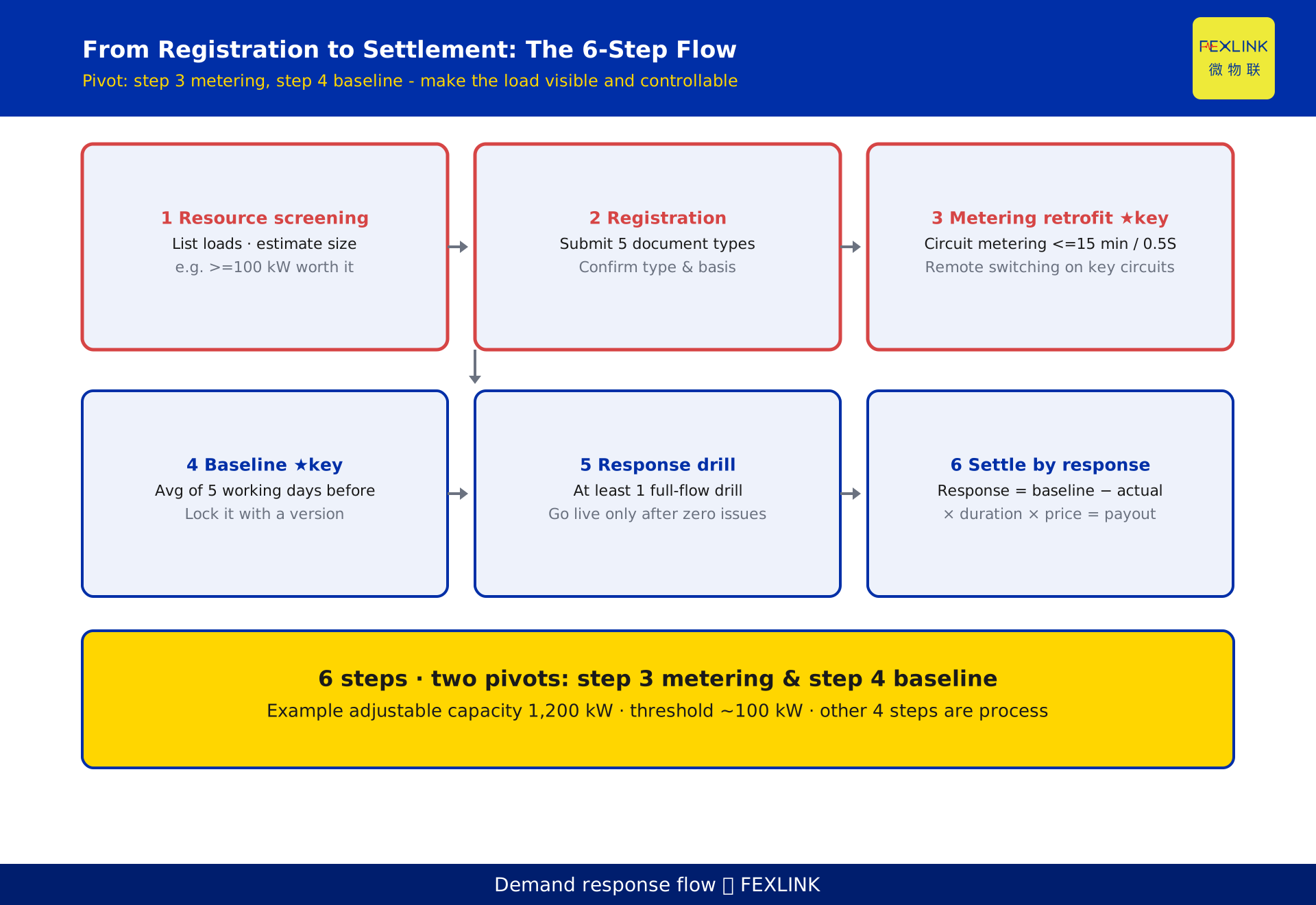
For a factory joining demand response for the first time, the path from sign-up to getting paid is six steps: resource screening and adjustable-capacity assessment → register with the platform or an aggregator → metering and controllable retrofit → commissioning and baseline establishment → response drill → settlement by response quantity. The two pivotal steps are step 3 (metering and controllable retrofit) and step 4 (baseline establishment). Step 3 decides whether the platform can see and command your load; step 4 decides how the response quantity is measured and how the money is paid. Get those two right and settlement stops being a dispute.
1. The whole picture first: the six-step flow
Demand response is not "cut the power when notified." It is a closed loop with registration, metering, a baseline, and settlement. First-timers usually stall at "where do I even start, what do I prepare." The spine of this article:
① Resource screening and adjustable-capacity assessment → ② Registration and admission documents → ③ Metering and controllable retrofit → ④ Commissioning and baseline establishment → ⑤ Response drill → ⑥ Settlement by response quantity.
Steps ③ and ④ are the real technical gates and the foundation for "measured clearly, paid in full." Once those two are done, ⑤ and ⑥ are mostly process and commercial actions.
2. Step 1: resource screening and adjustable-capacity assessment
Before signing up, know your own assets: which loads can be lowered or interrupted during a response window, by how much, for how long, and at what cost.
Three concrete actions. First, list adjustable resources: central AC, chillers, air compressors, lighting, non-continuous process lines, storage or backup generation — each with rated power and available time window. Second, assess adjustable capacity: subtract "production will not allow" loads from "technically adjustable" loads to get the declarable capacity. A practical rule: adjustable load above roughly 100 kW that can hold for at least 1 hour is worth declaring; below that, platforms usually decline. Third, estimate potential and cost: lowering load costs output or comfort, so compare "compensation saved per kWh curtailed" against "cost of stopping or slowing production."
The deliverable is an Adjustable Resource List, used by both registration and retrofit later.
3. Step 2: registration and admission documents
With the list ready, register with the local demand-response platform or an aggregator. An aggregator packages scattered load and interfaces with the grid on your behalf; smaller users usually find it easier.
Five categories of documents: account number and name, single-line diagram and load distribution, adjustable resource list with capacity, metering-point locations and current collection status, and contact plus settlement-account information. Fields vary by region and platform, but the backbone is these five.
At registration, confirm three things: the response type you are classified into (peak shaving / valley filling, invitation-based / real-time), the response window and minimum duration, and the compensation metering basis. These three dictate how the account is settled; ambiguity at registration guarantees a fight at settlement.
4. Step 3: metering and controllable retrofit (pivotal step one)
This is the first technical gate and where most first-timers trip. For the platform to see and command your load, you need circuit-level metering and remote switching on key circuits.
Metering side: install circuit-level metering on at least the participating circuits. The ESA all-factor smart meter is recommended — it collects voltage, current, power and energy per circuit and supports common interfaces such as RS485/Modbus, answering "which line is the deviation on." The sampling interval must be fine: keep the granularity no coarser than 15 minutes, and the metering device accuracy class should be no lower than 0.5S — otherwise, even a perfect baseline rides on data with too much noise to trust.
Control side: loads to be interrupted or lowered must be remotely switchable, e.g. with a controllable switch such as the FECB2SP circuit breaker that supports remote open/close, isolating the interruptible circuit from the main breaker. Switching is issued from the edge: the ESX edge gateway aggregates meter data and pushes commands — it sends field data up to the platform and translates response commands into open/close actions on specific circuits.
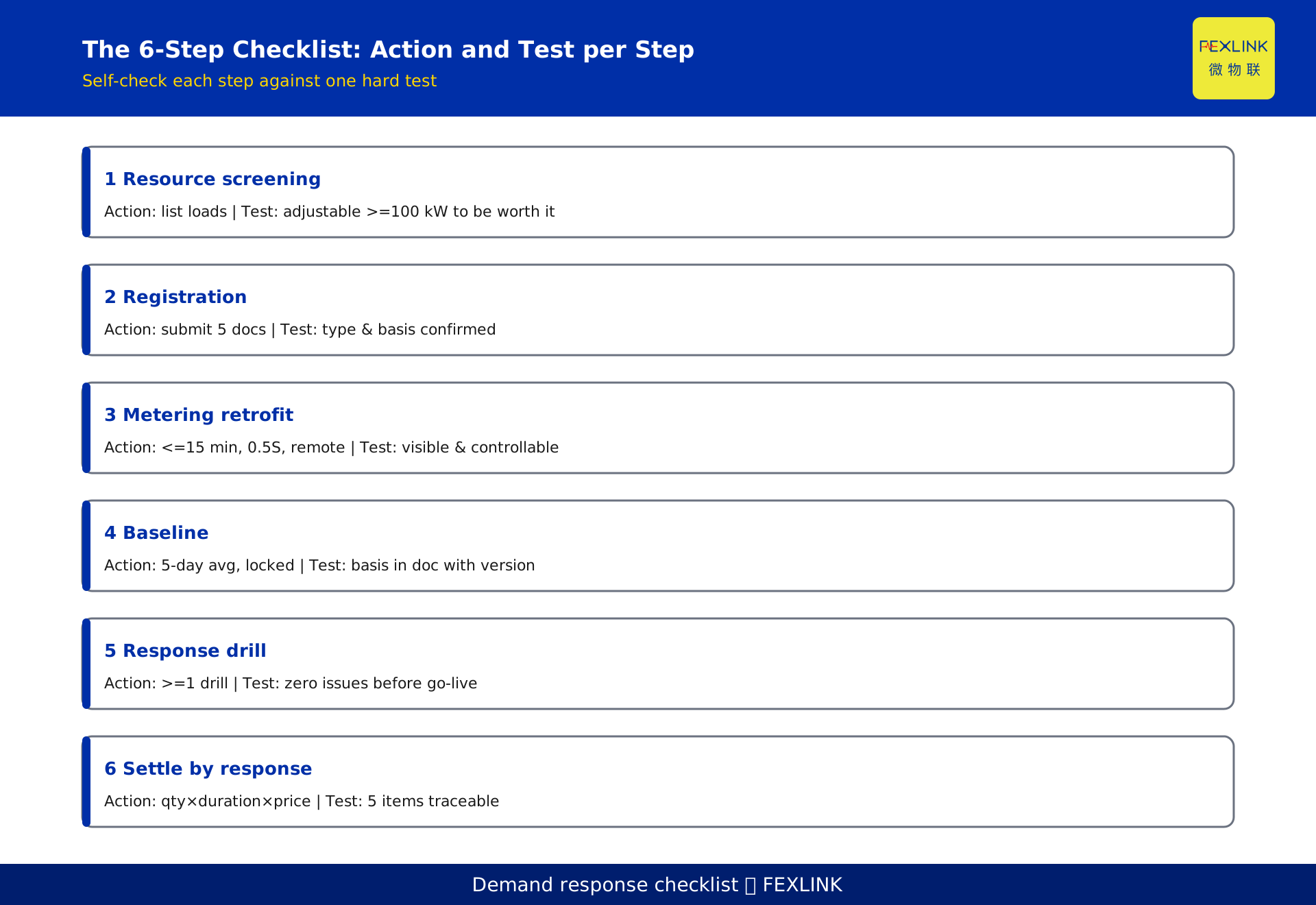
In one line, the test for step 3 is: the platform can see your load at 15-minute granularity and can issue execution on the circuits you confirmed. Until both hold, do not move to step 4.
5. Step 4: commissioning and baseline establishment (pivotal step two)
With metering and control in place, commission first: chain the meter, gateway and breaker, and simulate one full loop — "platform issues command → gateway forwards → breaker acts → load changes → meter re-samples" — confirming no data loss and no stuck commands.
After commissioning passes, establish the baseline. The baseline is not your electricity bill at the response moment; it is the reference curve of "how much you would have used if you had not responded." The common method takes the average load of comparable working days before the response day — for example, the average of the same time window (e.g. 09:00–11:00) over the 5 working days before the response day as the baseline load. Baseline validity depends on historical data quality: fine sampling interval, exclusion of maintenance and anomaly days, and coverage of production conditions close to the response day.
Once built, lock the baseline with a version number; all later response quantities are computed as "actual load vs baseline." The test for this step: baseline basis, modeling window, and anomaly-exclusion rules are written into the integration document and signed off by the parties.
6. Step 5: response drill
Before taking a real order, run at least one full-flow drill. A drill is not a formality; it detonates the mines planted in the first three steps early.
Cover three scenarios: normal response (load drops as expected after the command), partial failure (a circuit fails to switch, verifying the platform detects and alarms), and early termination (response cancelled or shortened, verifying how settlement basis changes). A qualified drill yields a Drill Report: actual response quantity, deviation from baseline, anomalies and closed-loop fixes. Complete at least 1 drill before going live, and only go live after issues are zeroed out.
7. Step 6: settlement by response quantity, collect compensation
After the response, the platform pays you "response quantity × response duration × compensation price." One sentence captures the core formula: response quantity = baseline load − actual load.
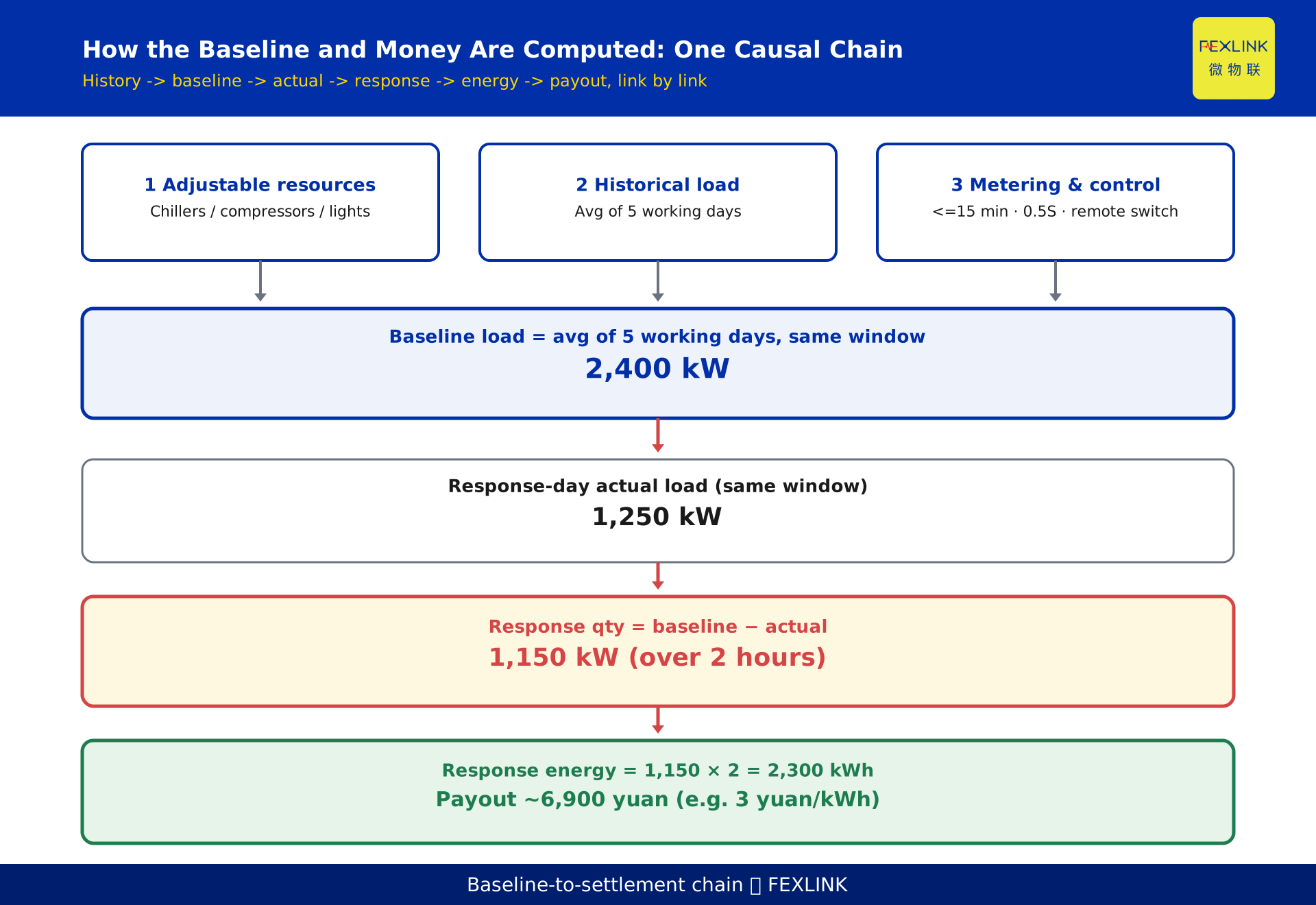
Using the desensitized example in this article: a factory has a baseline load of 2,400 kW; on the response day actual load drops to 1,250 kW, so response quantity is 2,400 − 1,250 = 1,150 kW; over a 2-hour response, response energy = 1,150 × 2 = 2,300 kWh; at an illustrative compensation price of 3 yuan/kWh, one event pays about 6,900 yuan. Note compensation often has both a capacity component and an energy component, with penalties for "inflated response quantity" or "actual non-curtailment"; the real credited amount follows the platform settlement statement.
The test for this step: the five items on the statement — baseline, actual load, response quantity, duration, price — are each traceable and consistent with the basis in your integration document.
8. One view of the accounting logic: baseline, response quantity, compensation
Unpacking step 6, the logic is a straight line: historical same-period load → baseline load (example 2,400 kW) → response-day actual load (1,250 kW) → their difference is the response quantity (1,150 kW) → times duration (2 h) gives response energy (2,300 kWh) → times price (example 3 yuan/kWh) gives compensation (about 6,900 yuan).
In this chain the baseline is the first domino: too high and the response quantity is inflated; too low and the load you actually curtailed is not counted. So step 4's baseline establishment, in essence, underwrites every cent in step 6.
9. How this differs from the "never got paid" article (this article's increment)
This article is an implementation guide for "first participation, from registration to settlement"; the neighboring KD-0563 is a diagnostic for "participated but never got paid." They do not overlap: KD-0563 targets users already in the hole, reviewing failure causes like baseline inflation, missing metering, and unclear contract terms; this article targets users who have not started, giving the six-step flow and each step's key action. The increment is the technical foundation of "step 3 metering/controllable retrofit" and "step 4 baseline establishment." Walk the six steps here first, then read KD-0563 to avoid the pits — that order pays best.
10. A desensitized example: from registration to credited account
The following is a constructed example to illustrate the flow and represents no real customer or project.
A machinery plant with two 10 kV feeders and transformers 2×1,250 kVA; main adjustable resources are 2 chillers, 10 air compressors and off-production lighting, with assessed adjustable capacity about 1,200 kW. Step 1 screens out an Adjustable Resource List. Step 2 registers through an aggregator, submits the five admission documents, and is classified into "peak-shaving invitation type, minimum duration 2 hours." Step 3 installs ESA all-factor smart meters on the chiller and compressor circuits, uses FECB2SP circuit breakers for remote switching, and deploys an ESX edge gateway to aggregate data and issue commands. Step 4, after commissioning passes, builds and locks a baseline of 2,400 kW from the average of the 5 working days before the response day. Step 5 completes 1 full-flow drill and zeroes out issues. Step 6, on first response, actual load drops to 1,250 kW; response quantity 1,150 kW over 2 hours settles to about 6,900 yuan credited.
FAQ
Q: For a first demand-response participation, what documents do I prepare?
Usually five categories to the platform or aggregator: account number and name, single-line diagram and load distribution, adjustable resource list with capacity, metering-point locations and collection status, contact and settlement account. That is the backbone; exact fields follow the local platform.
Q: Is the "average of the 5 working days before" baseline fixed?
No, it is an illustrative common practice, not a fixed constant. The baseline may take the average load of several comparable working days before the response day; the exact number of days, exclusion rules and condition-matching requirements are set by platform rules or contract. The key is that the basis is written into the integration document with a version number.
Q: Can I join without circuit-level metering?
You can register, but you cannot settle cleanly. Without circuit-level metering the platform cannot see your load structure, so response quantity is only a rough estimate and easily penalized; install metering on at least the circuits carrying most of the adjustable capacity before taking a real order.
Q: Why is compensation often less than expected?
Commonly because baseline basis, metering granularity or contract terms were not aligned at registration, compounded by penalties for inflated or non-realized response. Solid step-3 metering and step-4 baseline make the five statement items traceable and shrink the gap.
Q: Direct platform connection or through an aggregator — how to choose?
Plants with large adjustable capacity and dedicated operations staff suit direct platform connection; smaller or scattered-resource users save effort with an aggregator, which packages load, interfaces uniformly, and handles metering and settlement. The test: do you have the staff to maintain both the metering and the contract lines?
Scope and limitations
- This article takes C&I users participating in electricity demand response as its setting; the six-step flow is a general implementation skeleton. Provincial platforms and aggregators differ in fields, response types and compensation rules — follow the local current detailed implementation rules.
- The baseline "average of the 5 working days before, same time window," the 3 yuan/kWh compensation price and the 100 kW adjustable threshold are constructed example parameters for illustrating the method and represent no real customer or project; actual values follow site survey, platform rules and contract.
- The plant scenario in section 10 (two 10 kV feeders, 2×1,250 kVA, adjustable about 1,200 kW, baseline 2,400 kW, response quantity 1,150 kW, compensation about 6,900 yuan) is constructed to illustrate the flow and represents no real customer or project.
- The metering sampling interval ≤15 minutes and accuracy no lower than 0.5S class are general engineering recommendations; the specific class follows the metering device selection and local regulations.
- The ESA all-factor smart meter, ESX edge gateway and FECB2SP circuit breaker are described by function (circuit-level metering, data aggregation and command dispatch, remote open/close). Specific models, interfaces and parameters follow the latest selection manual and product knowledge base; this article is not a selection or procurement recommendation.
- Demand-response compensation is a market activity; amounts, rules and policies may change, and the example figures carry no earnings-promise implication.
Frequently Asked Questions
For a first demand-response participation, what documents do I prepare?
Usually five categories to the platform or aggregator: account number and name, single-line diagram and load distribution, adjustable resource list with capacity, metering-point locations and collection status, contact and settlement account. That is the backbone; exact fields follow the local platform.
Is the "average of the 5 working days before" baseline fixed?
No, it is an illustrative common practice, not a fixed constant. The baseline may take the average load of several comparable working days before the response day; the exact number of days, exclusion rules and condition-matching requirements are set by platform rules or contract. The key is that the basis is written into the integration document with a version number.
Can I join without circuit-level metering?
You can register, but you cannot settle cleanly. Without circuit-level metering the platform cannot see your load structure, so response quantity is only a rough estimate and easily penalized; install metering on at least the circuits carrying most of the adjustable capacity before taking a real order.
Why is compensation often less than expected?
Commonly because baseline basis, metering granularity or contract terms were not aligned at registration, compounded by penalties for inflated or non-realized response. Solid step-3 metering and step-4 baseline make the five statement items traceable and shrink the gap.
Direct platform connection or through an aggregator — how to choose?
Plants with large adjustable capacity and dedicated operations staff suit direct platform connection; smaller or scattered-resource users save effort with an aggregator, which packages load, interfaces uniformly, and handles metering and settlement. The test: do you have the staff to maintain both the metering and the contract lines?