 FEXLINK Research Institute
The short answer
In a campus, HVAC, EV chargers and storage each live in their own system — building automation, charging operations, battery management. To the outside they are isolated loads with no common interface: when a dispatch signal arrives, nobody can answer for all of them. Bundling them into one aggregatable "load package" is not about replacing equipment; it is about unifying measurement and dispatch: collect power and status at each resource, align the curves on one time base by an ESX smart edge computing gateway, then orchestrate charging, discharging and peak-shaving under the constraint of "never hurting production or charging experience", so the bundle presents itself as one package that bids and settles as a whole. Bundling is a 4-step chain: collect, align, orchestrate, bid. The 3 resource classes carry different constraints: HVAC is bounded by comfort, chargers by charging experience, storage by energy limits — the package's flexible ceiling is set by the tightest constraint, not by the most flexible resource. It cites no standard numbers or clauses and makes no conformance claims; no capacity figures and no latency figures are given — all follow project validation and the latest selection manual; it constitutes no selection or acceptance commitment.
1. Why scattered resources cannot join a response
A demand response is a promise about one aggregate load curve: a guaranteed reduction at bidding, the same convention recomputed afterwards. Scattered resources cannot stand behind that promise. There are three breaks: first, data live in separate silos — HVAC logs in building automation, chargers in the operations platform, storage in the battery management system, each with its own convention, none speaking for the whole; second, time does not align — the systems' clocks and sampling periods differ, curves cannot stack onto one axis, and neither an aggregate baseline nor an aggregate effect can be computed; third, dispatch is not unified — commands must go to several systems, with no common orchestration of who yields first and who covers whom, so coordination falls to group chats. Without a package, aggregation means negotiating and settling resource by resource — costly and dispute-prone.
2. The constraints of the 3 resource classes
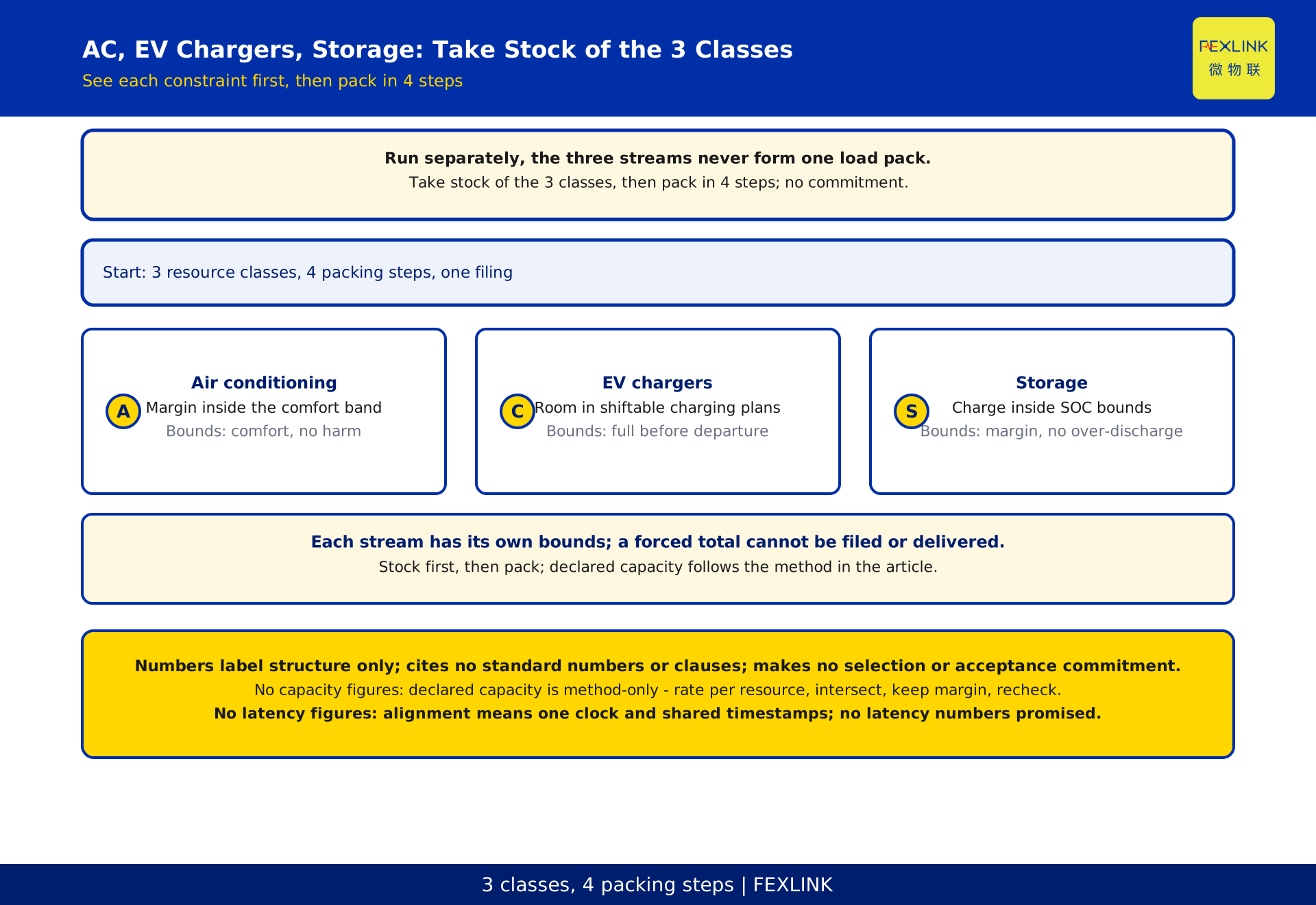
Before bundling, map each class's flexible boundary. HVAC's flexibility comes from thermal inertia: setpoint nudges within the comfort band, pre-cooling to shift load — but comfort is a hard constraint, and a narrower band means less flexibility. Chargers' flexibility comes from plan elasticity: staggered schedules and orderly charging can shave peaks — but charging experience is a hard constraint: charging time must not exceed user expectation and the final segment must not be cut. Storage is the most flexible — discharge for peaks, charge off-peak, all on command — but energy limits and power limits are hard constraints: run empty and it cannot cover later peaks; cross the limits and the device and cycle costs say no. These 3 constraints give each class a different flexible window and depth: storage is nimble but energy-bounded, HVAC is bulky but comfort-clamped, chargers are concentrated but experience-locked. Bundling does not take the longest plank; it aligns to each constraint.
3. The 4-step chain: from scattered to a package
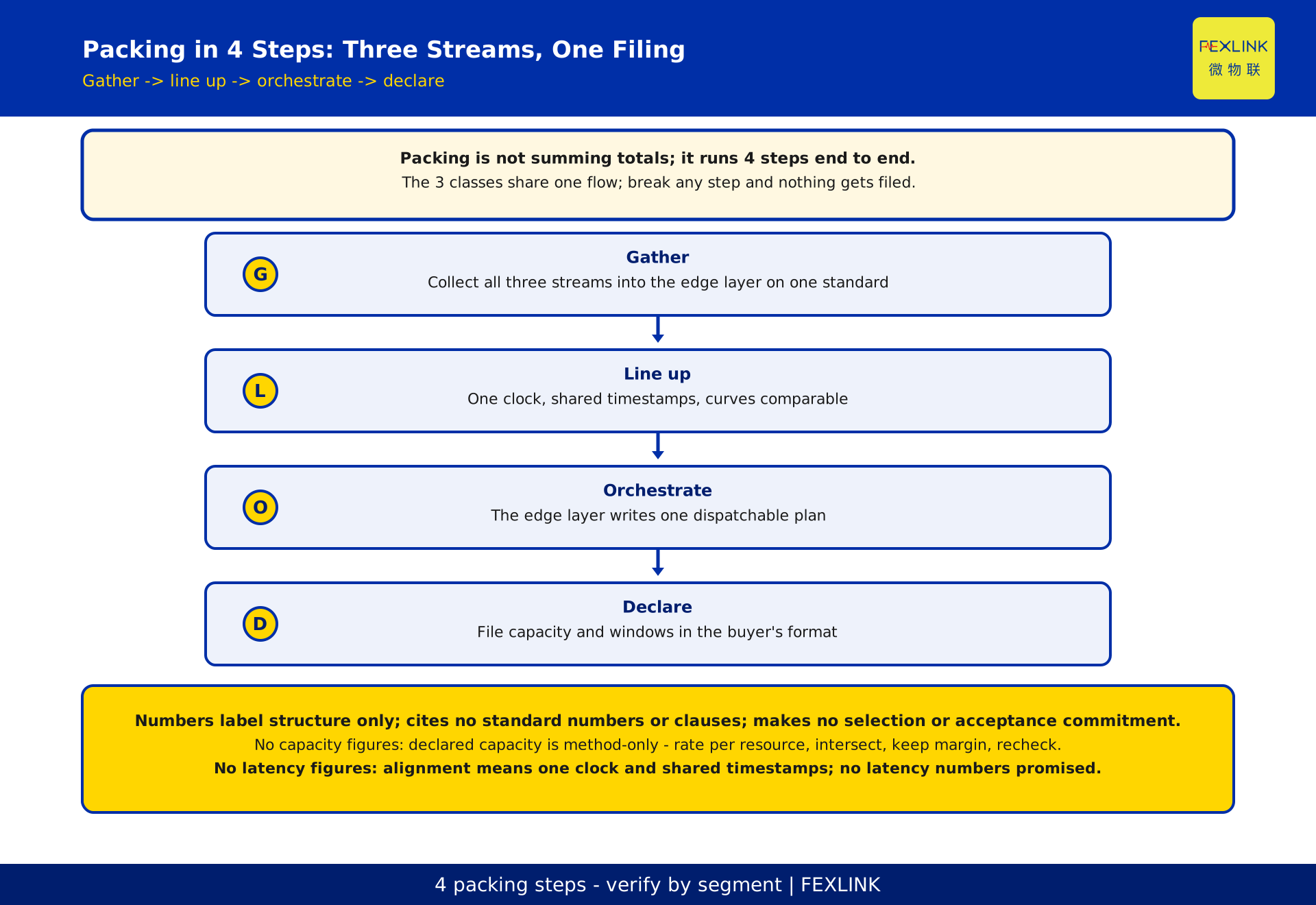
From scattered to bundled is a 4-step chain: collect, align, orchestrate, bid. Step one, collect: gather power, energy and running status at each resource into one metering system, instead of letting each system self-report. Step two, align: land every curve on one time base with one clock stamping events — only then can an aggregate baseline and an aggregate effect be computed. Step three, orchestrate: the edge gateway arranges charging, discharging and peak-shaving under each class's constraints — when storage covers, when HVAC yields, when chargers ramp down — one brain decides. Step four, bid: derive the biddable capacity from the aligned aggregate curve, exposed through one interface and one convention. Miss any of the 4 steps and the package falls back to a list of resources — a list is not a package; a package is schedulable and meterable as a whole.
4. One time base: curves must stack into a package
A response effect is defined as the aggregate curve in the response window minus the baseline — on the premise that all curves stack on one time axis. Misaligned time brings three failures: the baseline cannot be computed cleanly, because each system logs its own moments and the stacked "aggregate curve" is shifted; contributions cannot be split without disputes — how much storage covered and how much HVAC yielded will not reconcile, leaving nothing to settle inside the package; bidding and settlement diverge — one convention for bidding moments, another for settlement, and disputes follow. Alignment is three moves: one clock source so every metering point trusts the same time; one sampling period so curves share a granularity; event timestamps — command, action and status return all carry the same clock. This article gives no latency figures: synchronization precision follows site networking and project validation.
5. One metering convention: bidding and settlement from the same source
The package faces the outside as a whole, but inside it needs main-meter and branch curves together: the main-meter curve checks the package baseline and the package effect; branch curves split contributions and verify that constraints held. The convention is written down beforehand: where the metering points are fixed, main or branch curves, how the baseline is built, how the response window is cut — all into the response plan, read the same way afterwards. A unified convention also makes constraints verifiable: whether HVAC left the comfort band, whether chargers lost their final segment, whether storage crossed its energy limits — all checkable from branch curves and status records. Constraints held, effects stand. Divergent conventions are the largest source of in-package settlement disputes; a unified convention lets disputes return to the original records.
6. Orchestration at the edge: one scheduler for 3 resources
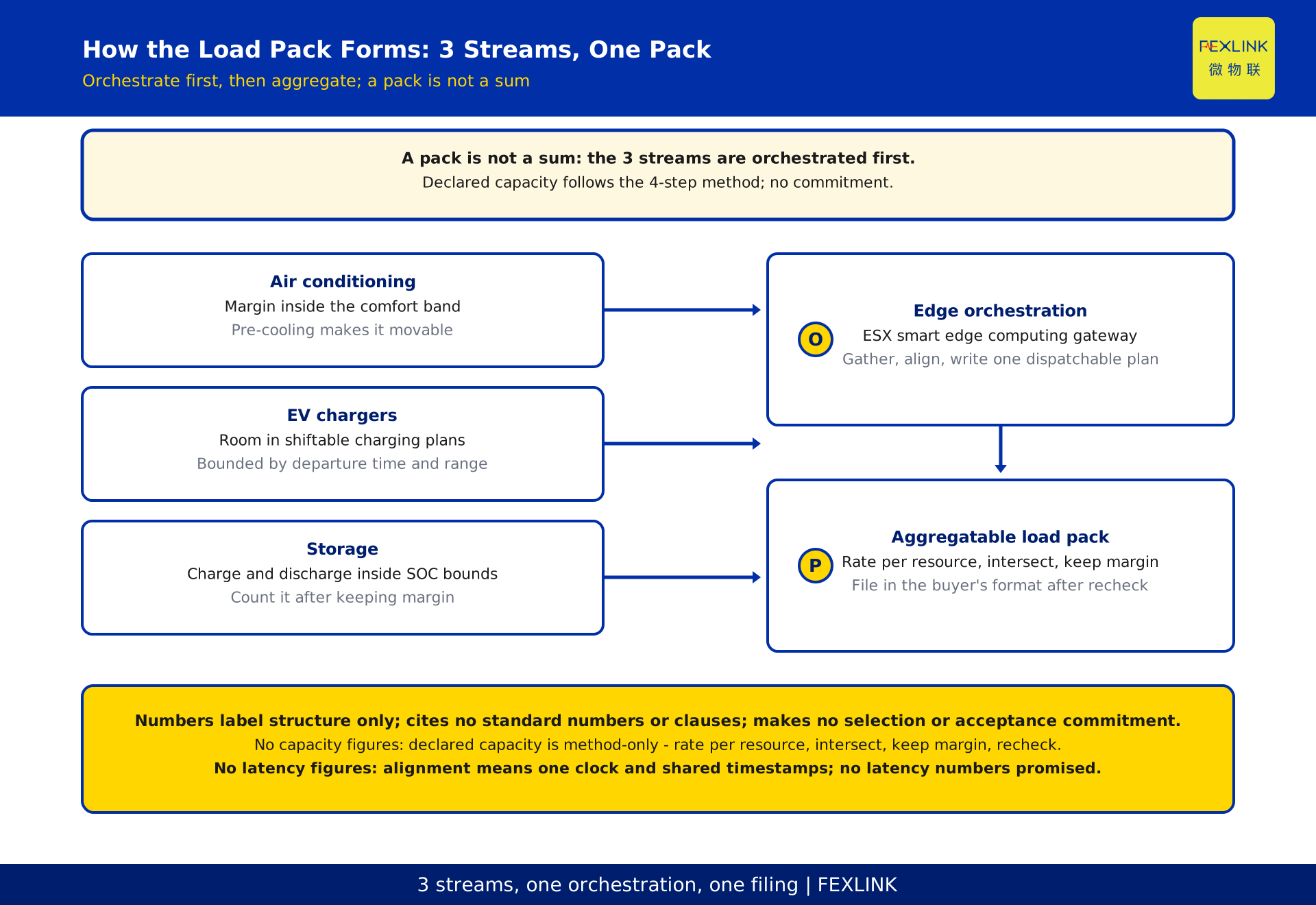
Orchestration lives at the edge, not in a round trip to the cloud. The ESX smart edge computing gateway carries three edge duties: collect — multi-protocol access to each resource's metering and status, converging at one node; align — stamp curves and events on the unified time base; orchestrate — generate charge, discharge and peak-shaving strategies locally under each class's constraints, keep running on presets through network outages, and backfill curves after recovery. The orchestration order is constraints first, response second: any strategy combination must first satisfy "no harm to production or charging experience"; only the space left after that goes to the response. The execution end acts on the orchestration result: the FECB2SP smart breaker completes circuit-level cuts and restores (its single-device capability and selection belong to the dedicated actuator article; here it appears only as a role). With 3 resources in one orchestration logic, the outside sees a package; without unified orchestration, three systems each act alone and it is still scattered sand.
7. Computing the biddable capacity: tighten constraints, take the intersection
The biddable capacity is not a summed-up big number; it is a conservative value derived by tightening constraints and taking the intersection. Four moves: first, per-resource assurance — with each class's constraints tightened one notch (a narrower comfort band, a lower charging-time cap, margin inside energy limits), fix each class's guaranteed reduction; second, the intersection — find the time windows where all 3 constraint classes hold; outside them only part of the package is available, so do not bid the whole package there; third, margin — leave room for device differences, metering error and surprises, and bid the conservative value; fourth, review — read back the aligned aggregate curve and confirm the bid holds across drills and real actions. This article gives no capacity figures: the numbers depend on the campus's resource mix and constraint widths, all following project validation. Over-bidding and failing costs more than under-bidding — assessments and reputation both land on "promise unmet".
8. The package composition table: modes and constraints
| Resource or combination | How it flexes | Core constraint | Metering and alignment | What to check |
|---|---|---|---|---|
| HVAC group | Setpoint nudges, staggered starts | Comfort band held | Zone power curves, one clock | Aggregate curve vs baseline |
| Charger group | Orderly charging, staggered plans | Charging time within expectation | Per-charger energy, session-aligned | Power drop across the window |
| Storage | Peak discharge, off-peak charge | Energy and power limits | Meter and battery state one source | Discharge stays inside limits |
| HVAC + chargers | Daytime shifting, night-time ordering | Comfort and experience both hold | Package curve aligned | Combined curve drops as a whole |
| Storage + chargers | Storage covers, chargers ramp down | Energy and experience both hold | Package curve aligned | Charger power steady, storage measured |
| Full 3-resource package | One orchestration, one bid | Intersection of all constraints | Main and branch curves one source | Package baseline recomputable |
| Emergency backup circuits | Not bundled, not dispatched | Backup outranks response | Status observable | Never enters the response list |
The table states each resource's role and boundary inside the package, not model parameters; actual access, metering-point layout and constraint values are project design content, following the latest selection manual and project design files. This article constitutes no selection or acceptance commitment.
9. How products support the package
Back to the opening: bundling hinges on unified measurement and unified dispatch. The ESX smart edge computing gateway carries the three edge duties — collect, align, orchestrate — putting 3 resource classes on one time axis and generating strategy at one node; the FECB2SP smart breaker carries circuit-level execution, landing the orchestration result on concrete circuits. Products do not change the constraints — comfort, charging experience and energy limits are decided by operations; what products do is turn scattered resources into one schedulable package: data from one source, time on one axis, strategy from one brain, one interface to the outside. Concrete models, interfaces and access follow the latest selection manual and project design files; this article constitutes no selection or acceptance commitment.
FAQ
Q: Which of the 3 resources contributes most — is bundling storage alone enough? A: Contribution follows constraint width and curve shape, not nominal size. Storage is the most nimble but energy-bounded and cannot cover the whole day; HVAC is bulky but comfort-clamped; chargers are concentrated but experience-locked. The right way is to fix each class's guaranteed amount and take the intersection; bundling storage alone leaves the rest of the flexible space on the table.
Q: How is the charging-experience constraint defined? A: Written into the response plan beforehand: a charging-time cap, a power floor, no cutting of the final segment — explicit terms in the plan. Only with constraints fixed does orchestration get its boundaries and verification its basis. Wider constraints mean more flexible space, but every promise must land inside them.
Q: If the network drops, can the package still respond? A: Orchestration lives at the edge and keeps running on local presets through outages; curves backfill after recovery. Bidding and settlement conventions are fixed beforehand and do not change with the network — that is why orchestration sits at the edge: one outage must not paralyze the whole package.
Q: Can one package span several buildings? A: Yes, provided the metering points are fixed, the time base is unified and each building's constraints are written down separately. Cross-building aggregation flattens the package-level curve; in-building branch curves verify each constraint. If one building's constraint fails, the package bid narrows accordingly.
Q: How do I avoid bidding more than I can deliver? A: Bid the conservative value — assure with tightened constraints, take time-window intersections, keep margin, review against drills. Under-bid rather than over-promise: failing to deliver costs more than bidding less. Recompute the package curve against the baseline after every action, and revise down any convention that cannot be met.
Scope and limitations
This article targets energy managers and virtual-power-plant operators; it covers the method of bundling HVAC, EV chargers and storage into one aggregatable load package: unified metering, one time base, edge orchestration and the derivation of the biddable capacity. It does not cover the single-device actuator capability list and selection (a dedicated article exists), NILM load decomposition, failure diagnosis, or a whole-plant source-grid-load-storage architecture. It cites no standard numbers or clauses and makes no conformance claims; no capacity figures and no latency figures are given — capacity conventions and synchronization precision depend on the campus's resource mix and site networking, all following project validation and project design files. It constitutes no selection or acceptance commitment, the generator does not self-approve, and publication requires independent verification; implementation is carried out by licensed electrical and professional personnel under site procedures, and this article replaces neither electrical design nor site safety rules.
Frequently Asked Questions
Which of the 3 resources contributes most — is bundling storage alone enough?
Contribution follows constraint width and curve shape, not nominal size. Storage is the most nimble but energy-bounded and cannot cover the whole day; HVAC is bulky but comfort-clamped; chargers are concentrated but experience-locked. The right way is to fix each class's guaranteed amount and take the intersection; bundling storage alone leaves the rest of the flexible space on the table.
How is the charging-experience constraint defined?
Written into the response plan beforehand: a charging-time cap, a power floor, no cutting of the final segment — explicit terms in the plan. Only with constraints fixed does orchestration get its boundaries and verification its basis. Wider constraints mean more flexible space, but every promise must land inside them.
If the network drops, can the package still respond?
Orchestration lives at the edge and keeps running on local presets through outages; curves backfill after recovery. Bidding and settlement conventions are fixed beforehand and do not change with the network — that is why orchestration sits at the edge: one outage must not paralyze the whole package.
Can one package span several buildings?
Yes, provided the metering points are fixed, the time base is unified and each building's constraints are written down separately. Cross-building aggregation flattens the package-level curve; in-building branch curves verify each constraint. If one building's constraint fails, the package bid narrows accordingly.
How do I avoid bidding more than I can deliver?
Bid the conservative value — assure with tightened constraints, take time-window intersections, keep margin, review against drills. Under-bid rather than over-promise: failing to deliver costs more than bidding less. Recompute the package curve against the baseline after every action, and revise down any convention that cannot be met.