 FEXLINK Research Institute
The short answer
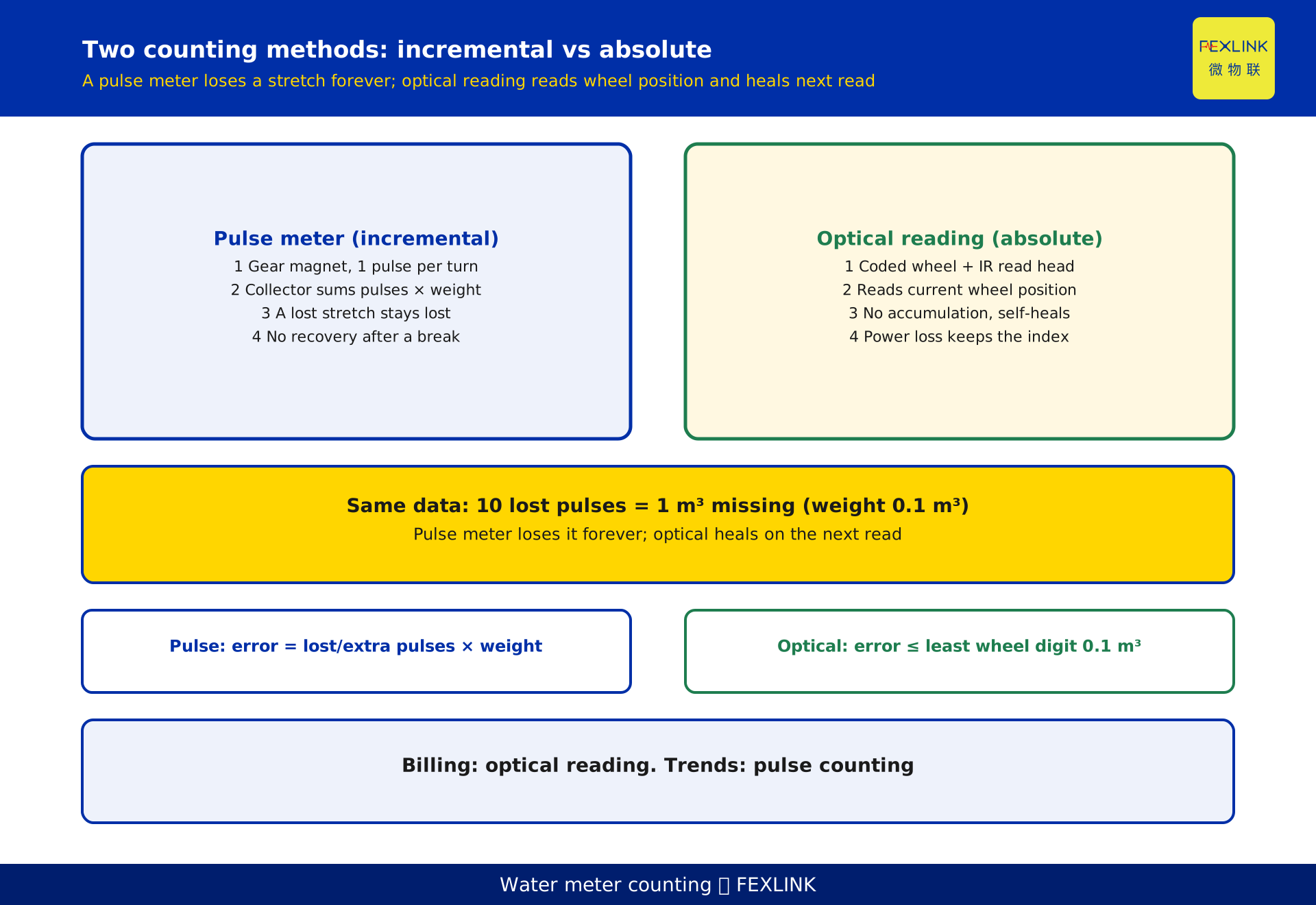
When automatic meter reading disagrees with the dial, do not start by blaming the meter. Water meters count in two fundamentally different ways. A pulse meter puts a small magnet on a gear in the register; each revolution sweeps the magnet past a reed switch or a Hall sensor and emits one pulse, and the collector multiplies the pulse count by the pulse weight to get volume. A direct optical reading meter reads the encoded position of the digit wheels, so what it returns is the meter index itself.
The decisive difference is the nature of the error. Pulse counting is incremental: a stretch lost in the middle is lost permanently. Optical reading is absolute: a bad reading is corrected by the next good one, and the error does not accumulate.
So a "1–2 m³ gap" should be checked in three steps, in order: what is the pulse weight, was it dropped pulses or a communication gap, and is the meter creeping on its own. Confirm the weight first, then judge drop versus double-count, and only then discuss whether the meter itself is accurate.
1. Separate three different "mismatches"
On site, "the readings don't match" bundles three unrelated problems:
- Dial versus system, off by 1–2 m³ — dropped pulses, a communication gap, a wrong pulse weight, or all three.
- The dial creeps with no water drawn — usually caused by air pockets, water hammer or pressure fluctuation.
- This meter versus the master meter or a neighbour — leakage, cross-connection, or the meter's own indication error.
These three have different diagnostic paths and costs. Investigate them mixed together and the usual outcome is "we replaced the meter and the problem is still there" — the cause was an offline gateway, which a new meter cannot fix.
2. Where the pulse comes from
A pulse meter's sending mechanism is simple: a gear at one digit position — usually the least significant, or the 0.1 m³ position — carries a magnet; each revolution sweeps it past the sensor, emitting one pulse. The collector counts pulses and multiplies by the weight.
The two sensor types differ:
- Reed switch. Two magnetised reeds sealed in a glass tube: the magnet pulls them together and releases them as it passes, closing a dry contact. Passive, cheap and immune to power loss, which is why it dominates pulse meters. The cost is a mechanical contact that bounces at closure, oxidises with use, sticks and double-counts, or develops contact resistance and drops counts.
- Hall element. A semiconductor whose output voltage flips with the magnetic field. No contact, vibration-resistant, long-lived, but it needs a supply and is sensitive to strong magnetic fields and supply ripple.
The pulse weight — how much water one pulse represents, calibrated by the manufacturer, commonly 0.1 m³ or 1 L, printed on the nameplate — must be pinned down first. It is the denominator of every later conversion; get it wrong by one digit and everything downstream is wrong.
3. Five causes of dropped pulses
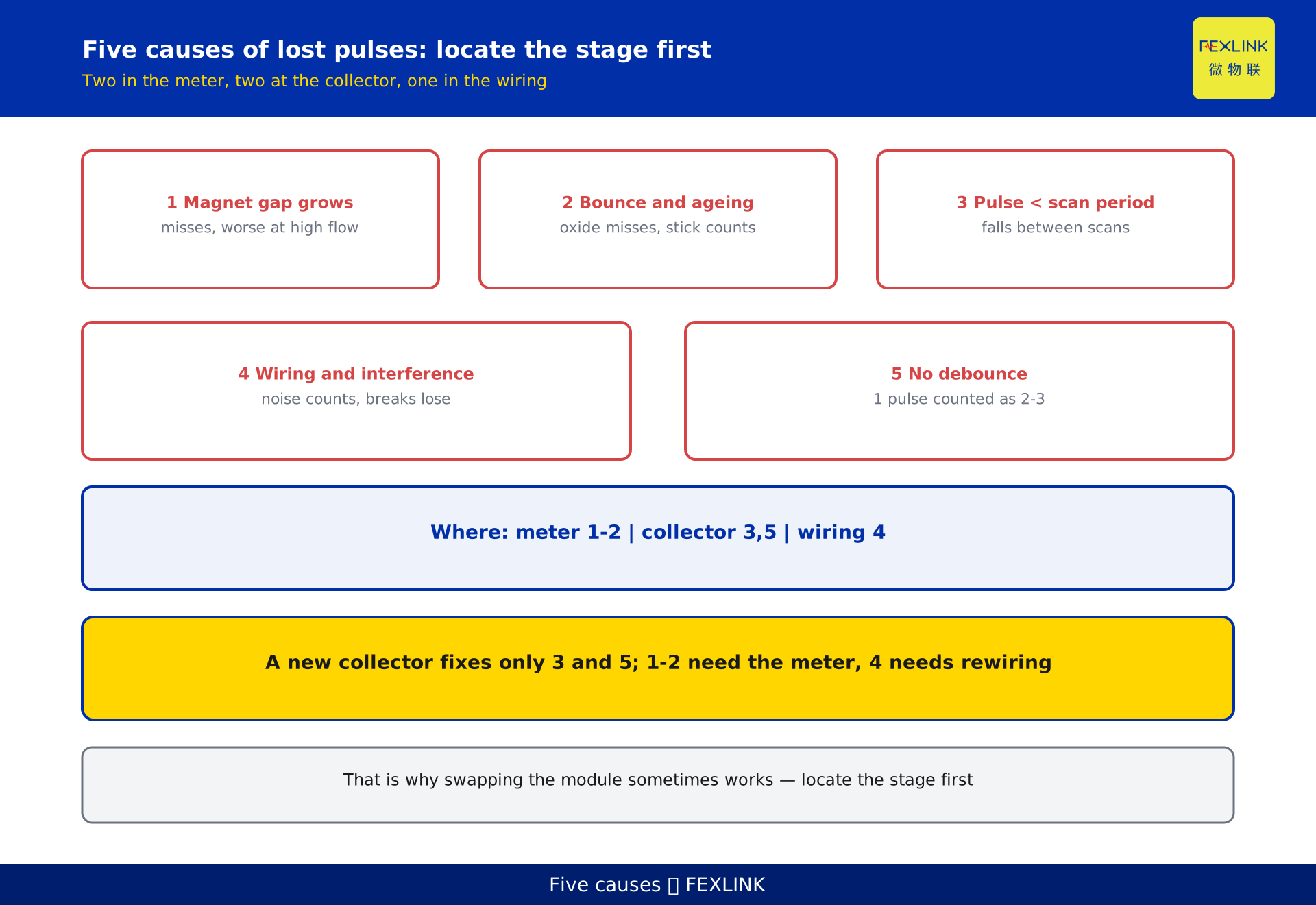
Dropped pulses are not one fault but five, and they are fixed in completely different ways.
First, the magnet-to-sensor gap grows. Gear wear, assembly tolerance or a deformed case can weaken the field below the triggering threshold. The signature is occasional missed counts, worse at higher flow — the magnet sweeps past faster, leaving less time for the field to build.
Second, contact bounce and ageing. Oxidised reeds and fatigued springs raise contact resistance until the collector no longer sees a clean level change; reeds that stick closed instead make one pulse look like a permanently closed contact and can stall the count.
Third, the pulse is narrower than the scan period. If the pulse lasts tens of milliseconds while the collector polls once per second, pulses fall between scans. This is the most common integration error and has nothing to do with the meter: replacing ten meters will not help.
Fourth, wiring and interference. Pulse cables running parallel to power, unshielded and without a pull-up, let interference count as valid pulses, so the meter over-counts; a broken conductor or oxidised joint loses whole stretches instead. Both can happen on one site.
Fifth, no debounce at the collector. A mechanical contact bounces at closure; without "accept only after N consecutive samples at the same level", one pulse becomes two or three and the error flips to over-counting.
Seeing all five explains why "replacing the acquisition module" sometimes works and sometimes does not: only the third and fifth live at the collector. The first two live inside the meter; the fourth lives in the wiring.
4. Double counting and creeping: why air makes the meter run
Harder to deal with than dropped pulses is over-counting, whose classic symptom is "nobody is using water, but the meter is running".
The mechanism is air in the pipe: pockets expand and contract with pressure, pushing the impeller back and forth, and a single sensor sums the oscillation as consumption. Related causes are water hammer after a valve shuts or a pump starts, and negative pressure when a neighbour draws heavily.
How to tell creeping from a leak: close every draw-off point and watch the least significant pointer. Slight oscillation instead of one-way advance means creeping; a leak advances steadily. Night minimum flow tells the same story: creeping fluctuates, a leak shows a flat floor.
One difference is easily missed: creeping genuinely over-counts a pulse meter, but barely affects optical reading. It reads wheel position: if the oscillation never advances the wheel, nothing changes; if it advances one digit, that digit is recorded, not dozens of oscillations.
5. Optical direct reading: why creeping does not matter
Each digit wheel carries an encoded disc — transparent and opaque sectors by angle — read by infrared emitter-receiver pairs that recover the digit.
It reads an absolute position, not "how many times something happened". Three consequences:
- No data loss on power failure. The index is engraved on the wheels; one powered read returns the current value, with no continuous supply to accumulate.
- No accumulated error. A reading spoiled by a dirty optical path is replaced by the next correct one; a pulse meter never recovers the pulses it lost.
- Immunity to creeping. Oscillation does not change the net wheel position.
The costs are real: higher price; momentary power to read (bus power or a battery); an optical path vulnerable to condensation, dirt and sunlight; slower digit-by-digit serial reading; and precise disc-to-head alignment. So it is not "more advanced, therefore replace everything" — it is "use it where it fits".
6. Error magnitude: incremental versus absolute
Comparing the nature of the error beats comparing datasheets:
- Pulse meter: error = missed or extra pulses × pulse weight, permanently frozen in. At 0.1 m³ per pulse, ten missing pulses mean 1 m³ missing, and no later reading brings it back.
- Optical reading: error is bounded by the least significant wheel digit (0.1 m³ or 0.01 m³) and does not accumulate; the next read heals it.
In one line: a pulse meter fears the process — any bad stretch leaves a permanent scar; optical reading fears the moment — whether the optical path was clean at the instant of reading. The first suits trends and internal accounting; the second suits billing.
7. A worked example: how many pulses is a 1.5 m³ gap
Constructed to illustrate the test; no real customer.
A domestic meter has a pulse weight of 0.1 m³ per pulse and a monthly consumption of 30 m³, which is 30 ÷ 0.1 = 300 pulses. The reading system is 1.5 m³ below the dial, i.e. 15 pulses, or 5% of the month's pulses.
A 5% loss rate is high for occasional missed counts. More plausibly the gateway was offline about 1.5 days: at roughly 1 m³ per day, that is exactly 1.5 m³ — a whole communication gap, not individual lost pulses.
Now the other case: if this meter's weight were actually 1 m³ per pulse, then 1.5 m³ is not a whole number of pulses, and the gap cannot have come from dropped pulses. Check the weight setting or the backfill first.
This gives the most useful test in the article: can the gap be divided exactly by the pulse weight? If yes, dropped pulses are possible; if not, suspect a wrong weight or a communication gap first. One division halves the search space.
8. Four selection and wiring criteria
One: choose the method by the metering purpose. For a billing basis that must be reviewable with no accumulated error, choose optical reading. For trends, leakage analysis and internal accounting, pulse counting suffices and is far cheaper.
Two: the weight must enter the asset register. Pulse weight, opening index and installation date must be checked against the nameplate. If these three are wrong, every later analysis is wrong, and wrong in a way that hides itself.
Three: the collector needs debounce and store-and-forward. Debounce (accept only after N consecutive samples) prevents over-counting; store-and-forward (local buffering, backfill on recovery) prevents "one communication gap becomes one permanently missing stretch".
Four: run pulse cables separately. Shielded twisted pair, not in the same conduit as power, with a pull-up resistor and filtering at the collector.
In product terms, the ESI digital status monitor acquires dry-contact and pulse signals with debounce, stopping bounce before it reaches the counter; the ESX edge computing gateway handles local accumulation and store-and-forward, backfilling data buffered while offline, so a communication break does not become a permanently missing volume. Channel counts, debounce parameters and buffer depth follow the latest selection manual.
9. Five field checks, in order
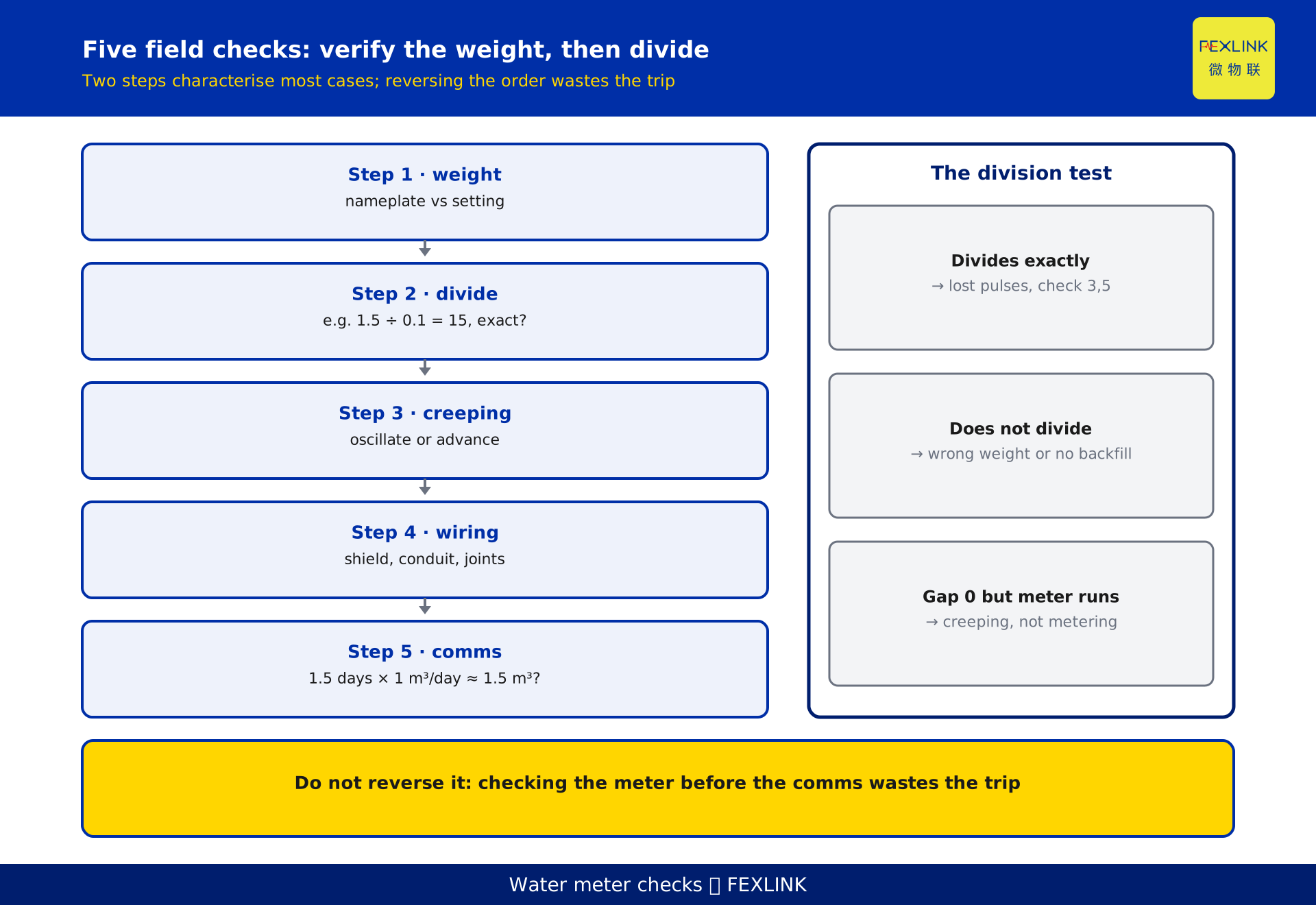
Follow this order and most cases are characterised within two steps:
- Check the weight: nameplate versus system setting.
- Do the division: is the gap divisible by the weight?
- Close the valve and watch for creeping: does the least significant pointer oscillate or advance steadily?
- Check the wiring: shielded, separate from power, joints not oxidised.
- Check communication: gateway online rate and offline length; does offline time × daily average consumption match the gap?
The order cannot be reversed: checking the meter before the communication is the most common wasted trip — the meter is replaced, the money spent, and the gateway is still the problem.
FAQ
Q: The reading is 1–2 m³ below the dial — is it certainly dropped pulses?
Not necessarily. Test whether the gap divides exactly by the pulse weight: only then are dropped pulses plausible. If it does not divide, a wrong weight or an unbackfilled offline period is more likely. At this scale, a day of outage usually beats individual lost pulses.
Q: Reed switch or Hall sensor?
For a passive, cost-sensitive, battery-powered meter, the reed switch — but accept contact bounce and limited life, and debounce at the collector. Where supply is stable, vibration high and long life matters, the Hall sensor — and handle supply ripple and magnetic interference.
Q: The meter creeps slowly when no water is used — is it broken?
Usually not broken; usually creeping. Close every draw-off point and watch the pointer: oscillation points to air or pressure fluctuation, steady one-way advance to a leak. Creeping over-counts a pulse meter and barely affects optical reading.
Q: Why is optical reading expensive?
The cost is in the precision of the code discs and read-head array, and the digit-by-digit readout circuit. What it buys is absolute position, no accumulated error and immunity to creeping — usually worth it for billing, not for internal trend monitoring.
Q: What happens if the pulse weight is set wrong?
Every volume is scaled by the wrong ratio: too large a weight reads low, too small reads high. Nothing alarms; every entry in the account is quietly wrong, and because the error is a fixed ratio it is invisible in a trend chart.
Q: When switching to an optical-reading meter, what about the old total?
Record the closing index of the old meter and the opening index of the new one at the swap, accumulate the two segments and add them. Record only the new opening index and the history is broken, along with the account.
Scope and limitations
- This article covers pulse counting and optical direct reading for automatic reading of cold-water meters in domestic and general industrial use. Heat and gas meters use similar principles but different metering and verification requirements, and are outside scope.
- No product-standard clauses or indication-error limits are cited. Meter-body accuracy is verified against water-meter product standards and verification regulations; that is a different matter from counting-method error, and the two cannot substitute.
- The figures "0.1 m³ per pulse, 30 m³ per month, 1.5 m³ gap" are constructed for easy verification and represent no real customer or project; the actual weight is governed by the site nameplate and manual.
- Service life, bounce time and pulse width of reed switches and Hall elements vary widely between manufacturers; this article explains mechanisms only, and specific values are subject to the device datasheet.
- Descriptions of the ESI digital status monitor and the ESX edge computing gateway are subject to the latest selection manual and product knowledge base; this article is not a selection or procurement recommendation.
Frequently Asked Questions
The reading is 1–2 m³ below the dial — is it certainly dropped pulses?
Not necessarily. Test whether the gap divides exactly by the pulse weight: only then are dropped pulses plausible. If it does not divide, a wrong weight or an unbackfilled offline period is more likely. At this scale, a day of outage usually beats individual lost pulses.
Reed switch or Hall sensor?
For a passive, cost-sensitive, battery-powered meter, the reed switch — but accept contact bounce and limited life, and debounce at the collector. Where supply is stable, vibration high and long life matters, the Hall sensor — and handle supply ripple and magnetic interference.
The meter creeps slowly when no water is used — is it broken?
Usually not broken; usually creeping. Close every draw-off point and watch the pointer: oscillation points to air or pressure fluctuation, steady one-way advance to a leak. Creeping over-counts a pulse meter and barely affects optical reading.
Why is optical reading expensive?
The cost is in the precision of the code discs and read-head array, and the digit-by-digit readout circuit. What it buys is absolute position, no accumulated error and immunity to creeping — usually worth it for billing, not for internal trend monitoring.
What happens if the pulse weight is set wrong?
Every volume is scaled by the wrong ratio: too large a weight reads low, too small reads high. Nothing alarms; every entry in the account is quietly wrong, and because the error is a fixed ratio it is invisible in a trend chart.
When switching to an optical-reading meter, what about the old total?
Record the closing index of the old meter and the opening index of the new one at the swap, accumulate the two segments and add them. Record only the new opening index and the history is broken, along with the account.