 FEXLINK Research Institute
The short answer
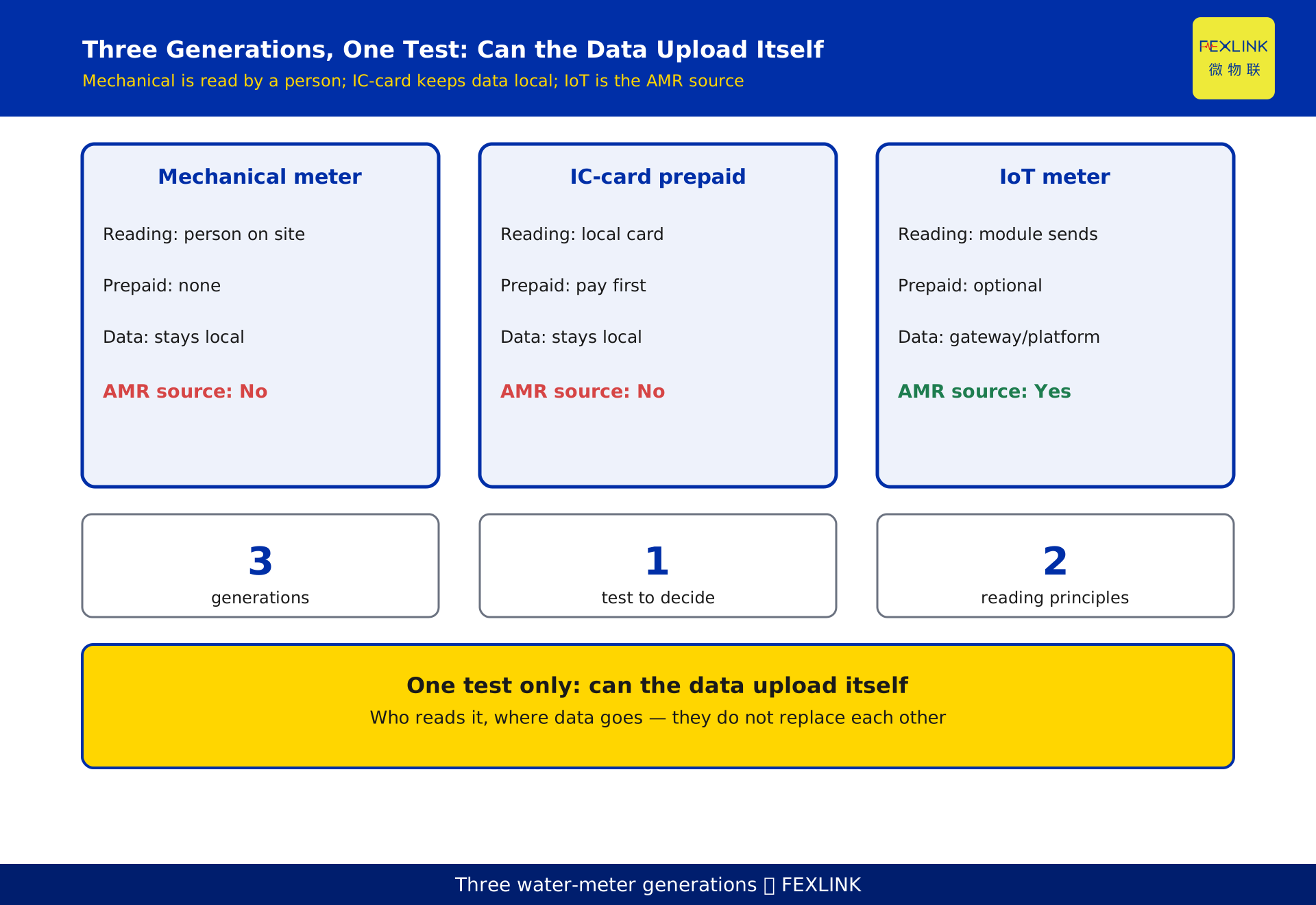
There is only one test for choosing among the three generations of water meters: can the reading upload itself automatically. The mechanical cold-water meter is read by a person on site. The IC-card prepaid meter solves pay-before-use but keeps its data on the local card. The communicating IoT meter is the data source for AMR — Automatic Meter Reading. Select by asking two questions — who reads it, and where the data goes — and the three generations do not replace one another during a utility retrofit; newer is not automatically better.
1. Defining "smart" before buying
In the trade, any meter with an electronic screen gets called a smart meter, and that is where procurement goes wrong. Strictly, a water meter earns the label "smart" on a single point: can it send its reading out automatically. Remote transmission is what makes automatic reading, automatic billing and anomaly alarms possible afterwards. Without it, the fanciest screen is just a local display. This article groups the mechanical cold-water meter, the IC-card prepaid meter and the communicating IoT meter as "three generations" — not to rank them, but to draw their boundaries: which scenario calls for which type.
2. Structure and reading method across three generations
The core difference sits in what happens after the count is made.
- Mechanical cold-water meter: purely mechanical gear counting; the register shows cumulative volume and a person must read it on site. There is no electronic interface at all.
- IC-card prepaid meter: on top of a mechanical or electronic count, it adds a prepaid control module and a local card reader. The user buys water, taps the card to open the valve, and the valve shuts automatically when the volume runs out. But its usage data stays on the card and inside the meter; it is not sent outward.
- IoT meter: on top of the counting mechanism it has a built-in communication module that sends the reading out on a schedule, over wired or wireless links, making it the data source for an AMR (Automatic Meter Reading) system.
In one line: the mechanical meter is read by a person, the IC-card meter is read by a card with local control, and the IoT meter is read over the network with remote transmission.
3. Pulse output vs optical direct reading
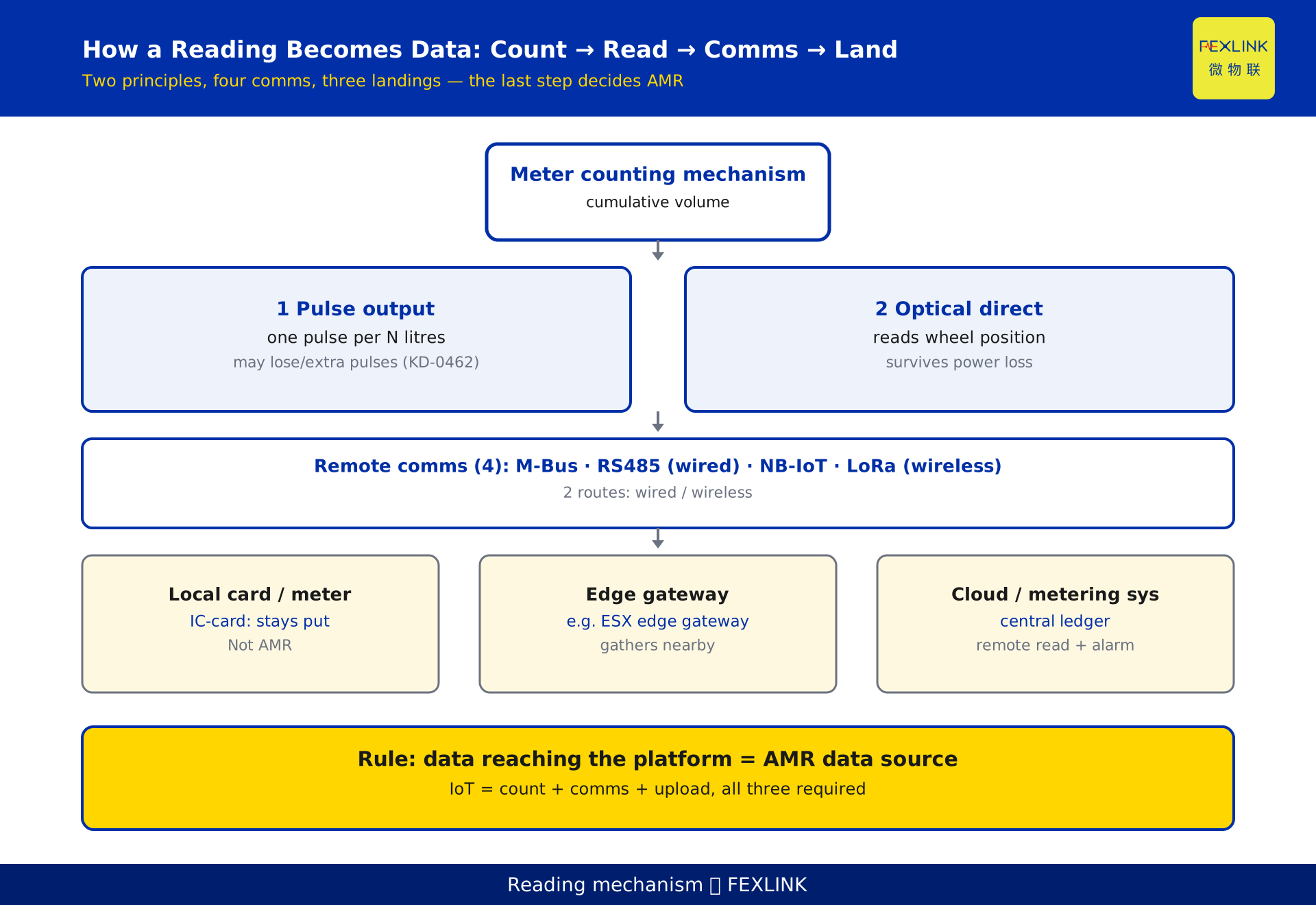
IoT meters and some retrofit remote meters take their reading by two main principles.
Pulse output: the counting mechanism emits one electrical pulse per fixed volume of water (say N litres), and the collector totals the pulses to derive volume. The upside is simple construction and low cost; the weakness is that pulses can be lost or double-counted on the line, so long-term totals can drift (why pulses get lost or multiplied is covered by the neighbouring article KD-0462).
Optical direct reading: the register digits carry an optical code, and the collector reads the current wheel position on demand. The reading is the true indication, it survives a power cut, and it needs no continuous powered accumulation. The trade-off is that each read is a spot check; it does not accumulate on its own between reads.
Both are "automatic reading", but to become an AMR data source the reading still has to be sent out — that is the missing final step.
4. Communication methods and where the data lands
After automatic reading, where the data lands decides whether the meter can enter AMR.
Remote communication comes by two routes: wired, typically M-Bus or RS485 bus (per meter-bus standards such as EN 13757), and wireless, typically NB-IoT or LoRa. Whichever is used, the data has three possible landing points:
- On the local card or inside the local meter (the IC-card meter): the data does not leave; it can only be viewed on site and is not AMR.
- At an edge gateway (for example the ESX edge computing gateway): the gateway gathers many meters nearby and forwards upward.
- At a cloud platform or metering system: a central ledger forms, supporting remote reading, consumption analysis and anomaly alarms.
The hard rule: whether the data reaches the platform automatically is the watershed between a "smart meter" and a "screened mechanical meter".
5. Fit across campus, water plant and sub-metering
Selection is not "new replaces old"; it is placing each type where it belongs.
- Campus main meters and water-plant outlet meters: few points, but they need remote automatic reading and water-balance analysis, so the IoT meter should be preferred as the AMR data source. In one campus, replacing 12 main meters with IoT meters turned a once-a-month manual read into a daily platform refresh, and leak detection moved from guessing by the month to watching by the day.
- Rented rooms, dormitories and apartment sub-meters: the core need is pay-before-use with auto shut-off on arrears, so the IC-card prepaid meter remains the right choice; prepayment and remote reading are two separate requirement lines.
- Ageing pipe networks and temporary construction water: low retrofit budget, only a base reading is wanted, so the mechanical meter still stands and there is no reason to pay extra for "smart".
Coexistence is the norm; the key is who reads it and where the data goes.
6. Unifying water, gas and electricity metering
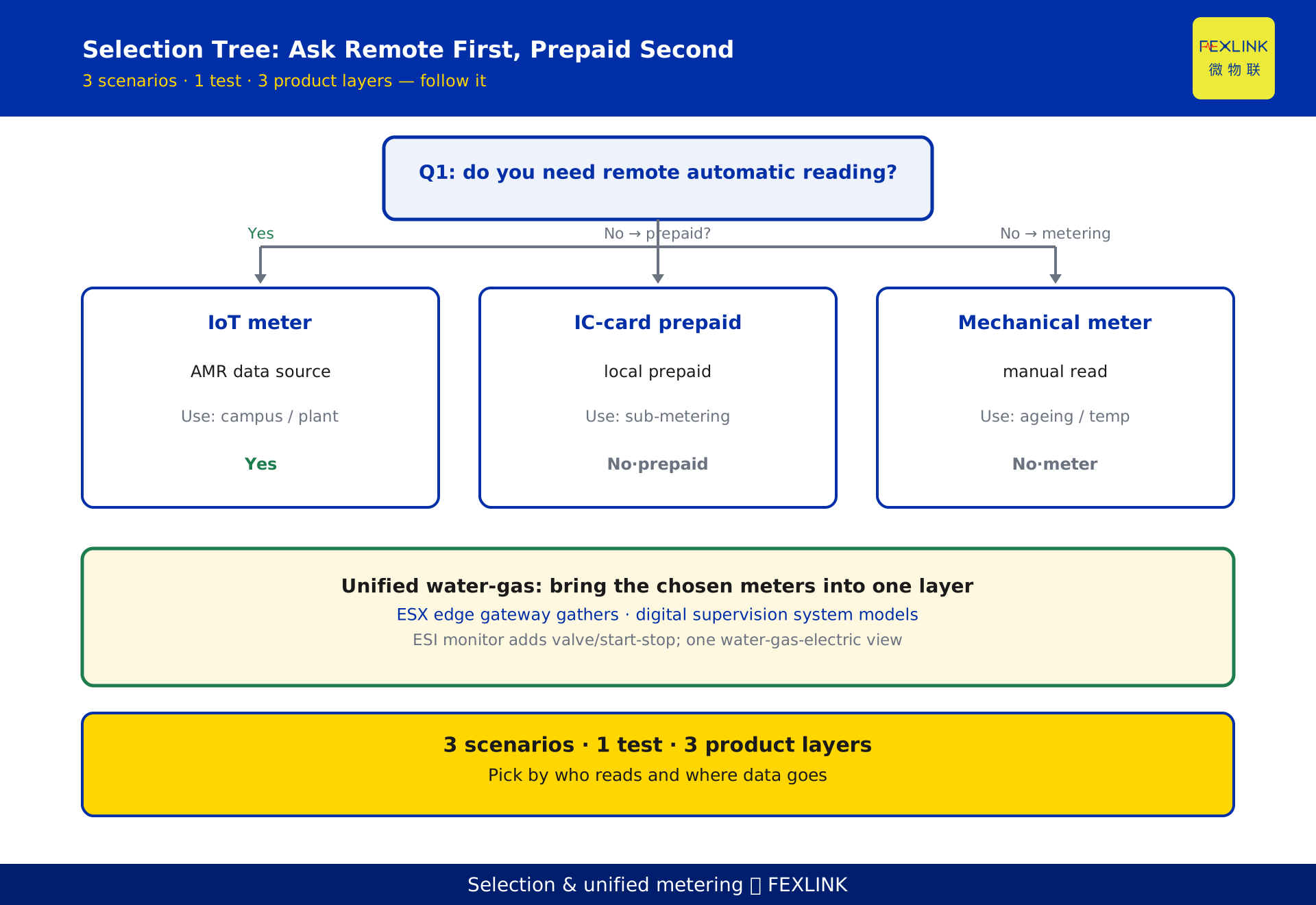
Once the water meter can transmit, the real value is not in the single meter but in joining the electricity and gas meters on one collection layer. Through the ESX edge computing gateway, water, gas and electricity meters are gathered locally; the digital electrical intelligent supervision system (water-gas unified collection) then models them together, merging three separate ledgers from three teams into one water-gas-electricity unified energy view. The ESI digital state monitor adds switch-quantity monitoring such as valve status and equipment start/stop, filling the gap that meters quantify but do not sense state. This step upgrades the water meter from a measuring device to an energy data node.
7. Why meters arrive without remote reading
Back to the opening pain: seeing an electronic screen at purchase, the buyer assumed it was a smart meter, only to find on delivery no communication interface and no data outlet, with the prepaid function completely disconnected from the existing metering system. The root cause is that the procurement list wrote only the words "smart water meter" and omitted three things — communication method (M-Bus / RS485 / NB-IoT / LoRa), data landing point (gateway or platform), and the integration protocol with the existing system. Write those three fields into the technical specification and you will not buy back a "screened mechanical meter".
8. A selection checklist
A practical test, no detours:
- Do you need remote automatic reading? No — go to item 2; Yes — choose the IoT meter (AMR data source).
- Must it control water by prepayment? Yes — the IC-card prepaid meter; No and budget is minimal with only a base reading wanted — the mechanical meter.
- Will it join unified water-gas-electricity management? Yes — confirm the meter is communicating and its data can land on the ESX edge computing gateway and the digital electrical intelligent supervision system.
Remember: the boundary of the three generations is "reading method + data landing point", not price or era. Choose by who reads it and where the data goes, and the retrofit will not be a duplicated investment.
9. Pace the retrofit: connect transmission first, replace gradually
Many campuses, on starting, want to swap every mechanical meter for an IoT meter at once, but a retrofit should "get the data out first, then talk about replacement". The recommended pace: first convert the campus main meters and water-plant outlet meters to IoT meters, building the AMR data source and getting the reading platform running; if the sub-metering side already uses IC-card prepaid meters, keep their prepaid capability and assess adding transmission in the next round; pure-metering, low-value ageing-network mechanical meters can stay long term. This way every yuan spent first solves "can the data get out", rather than paying for the word "smart". The key is to schedule item by item by "who reads it and where the data goes", avoiding the water-outage and reconciliation risk of a one-shot tear-down.
FAQ
Q: Is the IoT meter always better than the mechanical meter, so should we replace everything?
No. The mechanical meter still has value in ageing networks, temporary water use and minimal-budget cases; its only problem is that a person must read it, not that it cannot be used. The three coexist by scenario; the IoT meter solves automatic transmission, not every metering problem.
Q: Can the IC-card meter also count as a smart meter and do remote reading?
No. The IC-card meter's core is local prepaid control, and its usage data stays on the card and in the meter, not sent out automatically, so it is not an AMR data source. When remote reading is needed, choose an IoT meter instead; do not expect adding a module to an IC-card meter to make it transmitting.
Q: Which is more accurate, pulse output or optical direct reading?
They serve different purposes. Pulse output is simple and cheap but long-term totals can drift from lost or extra pulses; optical direct reading reads the true wheel position each time and survives power loss. Selection follows installation conditions and maintenance habits, with the main line being "can the data transmit remotely".
Q: Once a water meter is connected to the ESX edge computing gateway, is it managed together with the electricity meters?
The gateway gathers water, gas and electricity meters locally, but a unified view also needs the digital electrical intelligent supervision system (water-gas unified collection) to model them together. The gateway is the collection layer; the system is the application layer; only together do they form unified water-gas management.
Q: Why does writing "smart water meter" on the procurement list still lead to a wrong purchase?
Because "smart" has no single technical definition; writing only those four words lets a supplier deliver a screened but non-communicating, non-exporting meter. The specification must state the three fields — communication method, data landing point and integration protocol — to lock in a truly transmitting meter.
Scope and limitations
- This article is at the conceptual level (the boundary and selection logic of the three generations) and gives no model-specific, range-specific or capacity-specific selection advice; a meter's communication interface, range and power supply are customizable items subject to the latest product knowledge base and selection manual.
- The "one campus, 12 main meters" case is constructed to illustrate the point and does not represent any real customer or project; actual meter counts, communication methods and benefits require site survey and measured data.
- Communication methods M-Bus, RS485, NB-IoT and LoRa are common options in water-gas-heat metering and are public technical information; which to adopt depends on site wiring, operator coverage and system architecture, and this article makes no technical commitment.
- The ESX edge computing gateway, the ESI digital state monitor and the digital electrical intelligent supervision system (water-gas unified collection) mentioned here are product-capability descriptions only; no model numbers, communication distances or capacities are invented, and deployment parameters follow the product knowledge base.
- The lost/multiplied pulse issue of pulse output is treated specifically by the neighbouring article KD-0462; this article cites its conclusion only at the conceptual level and does not expand the mechanism.
- Cited standards GB/T 778 (cold and hot water meters for domestic use) and EN 13757 are taken from their current valid editions; if a standard is revised, the related statements here require rechecking.
Frequently Asked Questions
Is the IoT meter always better than the mechanical meter, so should we replace everything?
No. The mechanical meter still has value in ageing networks, temporary water use and minimal-budget cases; its only problem is that a person must read it, not that it cannot be used. The three coexist by scenario; the IoT meter solves automatic transmission, not every metering problem.
Can the IC-card meter also count as a smart meter and do remote reading?
No. The IC-card meter's core is local prepaid control, and its usage data stays on the card and in the meter, not sent out automatically, so it is not an AMR data source. When remote reading is needed, choose an IoT meter instead; do not expect adding a module to an IC-card meter to make it transmitting.
Which is more accurate, pulse output or optical direct reading?
They serve different purposes. Pulse output is simple and cheap but long-term totals can drift from lost or extra pulses; optical direct reading reads the true wheel position each time and survives power loss. Selection follows installation conditions and maintenance habits, with the main line being "can the data transmit remotely".
Once a water meter is connected to the ESX edge computing gateway, is it managed together with the electricity meters?
The gateway gathers water, gas and electricity meters locally, but a unified view also needs the digital electrical intelligent supervision system (water-gas unified collection) to model them together. The gateway is the collection layer; the system is the application layer; only together do they form unified water-gas management.
Why does writing "smart water meter" on the procurement list still lead to a wrong purchase?
Because "smart" has no single technical definition; writing only those four words lets a supplier deliver a screened but non-communicating, non-exporting meter. The specification must state the three fields — communication method, data landing point and integration protocol — to lock in a truly transmitting meter.