 FEXLINK Research Institute
The short answer
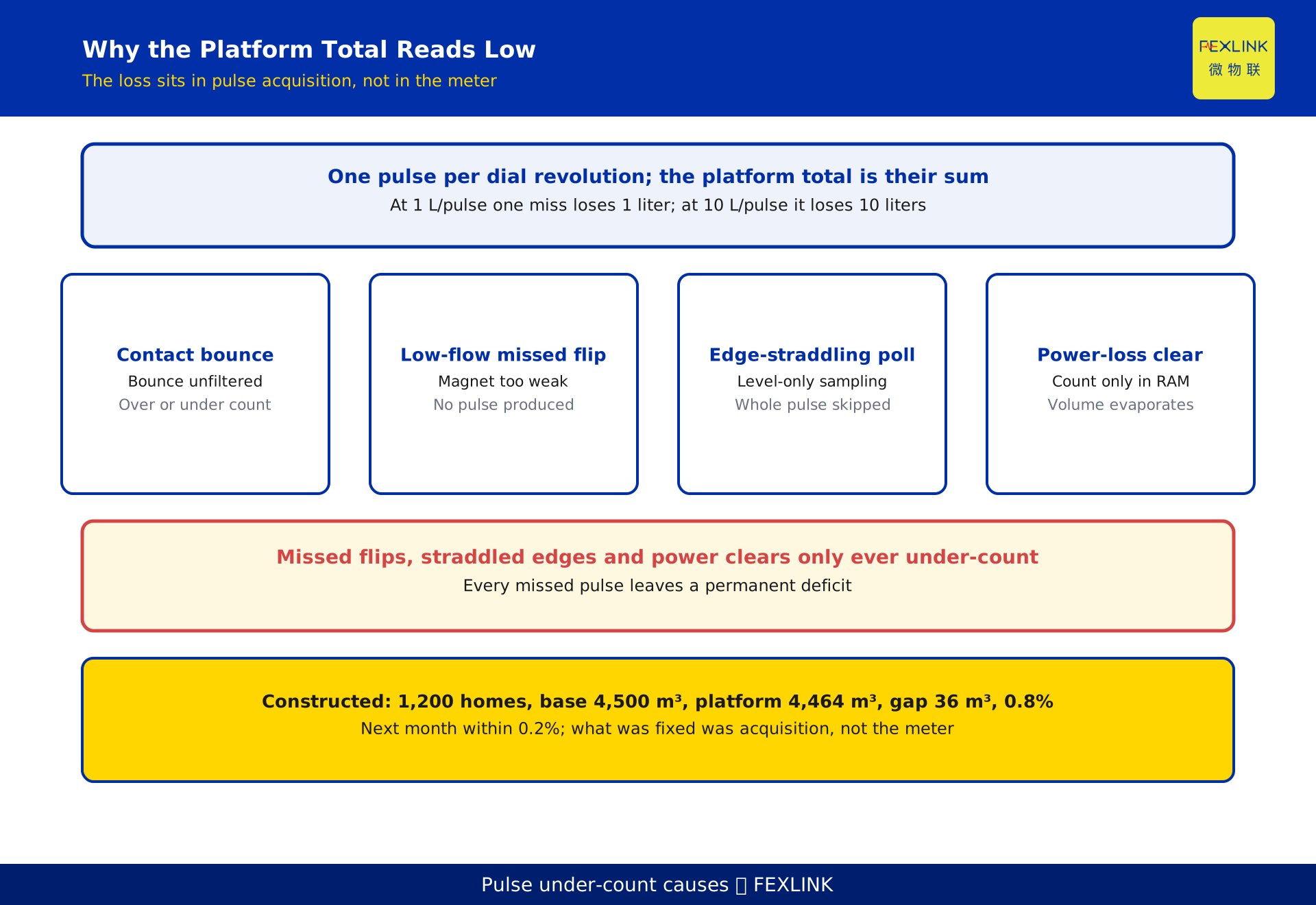
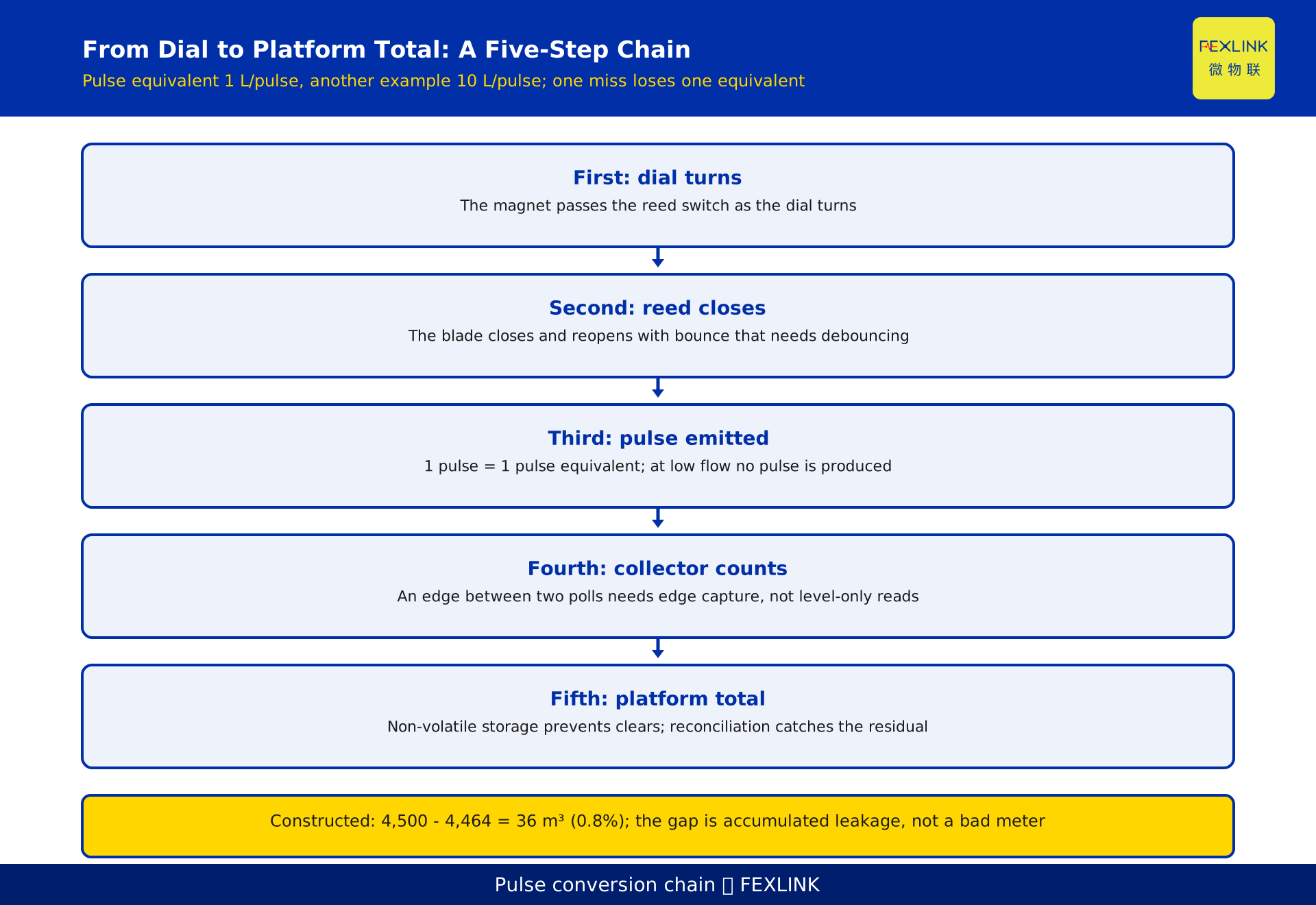
When a pulse water meter's platform reading persistently comes in lower than the field mechanical register, the meter is usually not "broken" — the loss sits in the pulse-acquisition stage. The mechanical register carries a small magnet; each revolution (or half-revolution, depending on construction) passes the magnet by a dry contact (reed switch), closing and opening it once to emit one electrical pulse. Each pulse stands for a fixed volume (the pulse equivalent; this article uses 1 L per pulse as a constructed example). The platform total is simply the sum of those pulses. Pulses are missed in four links: contact bounce that is never debounced, missed flips at very low flow where the magnet fails to actuate the reed reliably, polling that straddles a pulse edge, and power loss that wipes a counter held only in RAM. Reliable debounced counting plus double-edge detection, a non-volatile counter, and a monthly reconciliation against the base register together push the accumulated error to its minimum.
1. The conversion chain: how the dial becomes a number
To see where the loss occurs, first see how the signal is born. A pulse telemetry water meter adds a small magnet to the base mechanical register. Each time the dial turns past the magnet, the dry contact (reed switch) closes and reopens once, producing one electrical pulse. The collector counts these pulses and multiplies by the pulse equivalent to obtain the volume used.
The chain has two conversions: mechanical rotation to a magnetic/electrical closure, then that closure to a digital count. Miss one count at either step and the total loses one pulse equivalent. With the example equivalent of 1 L per pulse, one miss loses 1 liter; at 10 L per pulse it loses 10 liters - the larger the equivalent, the heavier a single dropped pulse. The equivalent is a meter-design parameter; the values used here are constructed examples.
2. Four links where pulses are lost: bounce, missed flip, edge straddle, power loss
Unpacking the shortfall, missed pulses cluster in four links.
Link 1: contact bounce. A reed blade bounces as it closes, so one physical "click" can look like several make/break cycles. Without debouncing the collector may over-count, but the more common failure runs the other way: bounce plus an unstable contact drops or miscounts an event that should register once.
Link 2: missed flip. At extremely low flow the water's force on the dial is weak, and the magnet may not reliably drive the reed closed, so that revolution passes "silently" with no pulse produced. The lower the flow, the higher the missed-flip probability — which is precisely why low nighttime flow is where "under-reporting" shows up most.
Link 3: edge-straddling polling. The collector polls each input on a fixed cycle. If a pulse edge falls between two polls and the collector only reads the level at sample points (rather than capturing edge events), that pulse can be skipped entirely. The longer the polling period, the greater the risk of missing a pulse at the boundary.
Link 4: power loss. If the running total lives only in RAM, any power cut or reset clears the unsaved count. When power returns, the volume for that interval has "evaporated." This is the most hidden case and the one most easily mistaken for a dead meter.
3. Why it is "under" rather than "over"
One may ask: doesn't bounce also cause over-counting? Why does everyone only complain about "less"?
Over- and under-counting are symmetric for one event, but several forces push the bias one way: missed flips, edge-straddling polls and power-loss clears only ever under-count, and stacked together they depress the reading; bounce-induced over-counting is normally suppressed by debounce. So the field pattern is uniform - the platform reads systematically below the base register and the gap widens over time. That is accumulated error: every missed pulse leaves a permanent deficit that never self-corrects.
4. Debounced counting and double-edge detection: two ways to lose fewer pulses
Two measures address bounce and narrow pulses and make "one mechanical action = one count" hold.
Debounced counting. A detected state change is confirmed only after a short window in which the signal stays stable, so one bounce yields one count. Reed-contact bounce is a classic electromechanical problem and debouncing is the standard remedy.
Double-edge detection (rising + falling). Capturing both edges rather than reading the level at a fixed phase catches narrow pulses that a single sample would miss. For reed-switch meters the fundamental fix remains reliable single-pulse counting plus non-volatile storage; double-edge detection complements it by resolving the sampling-phase mismatch. Together they cut the link-1 and link-3 losses.
5. Power-loss retention: the count must not live only in RAM
The third measure targets power loss. The running counter must live in non-volatile storage (EEPROM, Flash, or a battery-backed register): the current total is committed every so many pulses or every so often, and after a cut the counter resumes from that value instead of zero.
This step pays the largest dividend and is the easiest to overlook. In many "we replaced the meter but it still reads low" cases, the old collector kept the total in RAM and cleared a stretch on every dropout. A collector with power-loss retention makes this evaporation disappear. FEXLINK's ESI digital-status monitor (dry-contact counter) sits exactly at this link, while the CX-08R06AI08-C1 (8DI) digital-input module handles parallel collection of many meters' pulses. Both only count pulses trustworthily: they never touch the meter's own accuracy, so the base error is not amplified - what the base meter measured is simply delivered without loss.
6. Periodic reconciliation: the safety net between platform total and base register
No collector is perfect, so what truly catches the accumulated error is periodic reconciliation: the platform total is periodically compared against the base mechanical register's field reading, and any difference beyond a threshold raises an alert for manual review.
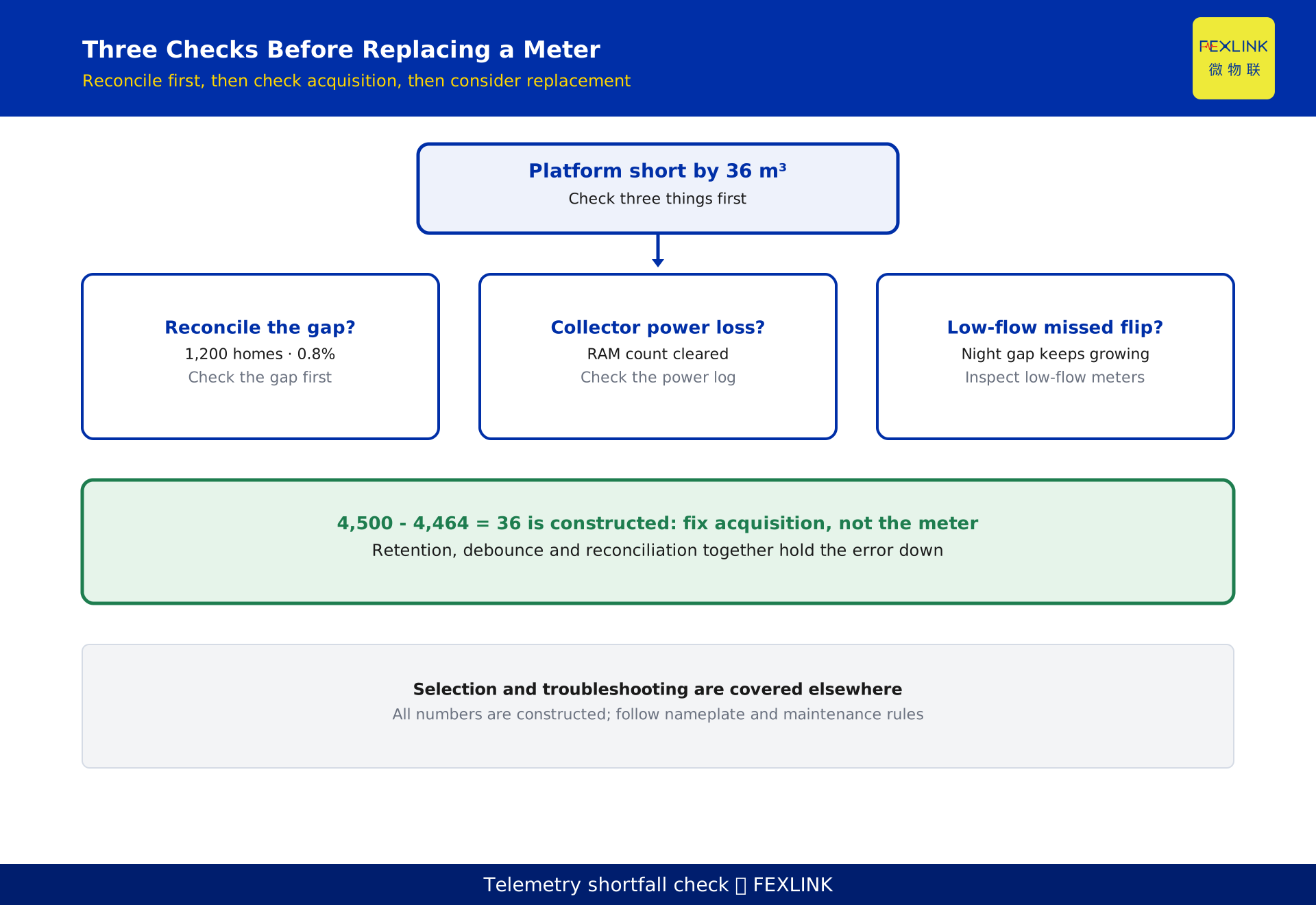
Each month (a constructed example), read the base register's true cumulative total and subtract the platform total. If a 1,200-household community is short by 36 m³ in a month - base 4,500 m³, platform 4,464 m³, 0.8% - that magnitude sits within reasonable acquisition residual. But a growing deviation means a link is leaking continuously and must be traced link by link per section 2. Period and alert threshold are operational settings; "monthly" and "above 1% triggers review" are constructed examples.
7. Worked example: a community short by 36 m³ in one month
The following is a complete constructed example used to show how error arises link by link and is reconciled. It represents no real customer or project.
A community of 1,200 households installed pulse telemetry meters all with a pulse equivalent of 1 L per pulse, polled by one multi-channel collector. Three months after commissioning, operations noticed the platform grand total persistently below the field readings.
Taking one month for reconciliation: the field base register read a cumulative 4,500 m³, while the platform telemetry read 4,464 m³ — a gap of 36 m³, a 0.8% deviation. Further analysis traced the gap to two sources: several meters showed missed flips during low nighttime flow (low flow failing to drive the reed), and the collector had cleared its RAM count twice during momentary power blinks. After replacing the collector with the power-loss-retaining ESI digital-status monitor (dry-contact counter) and tightening inspection of low-flow meters, the next month's deviation fell within 0.2%.
The example shows that the 36 m³ was not a "broken" meter but the accumulation of two systematic leaks on the pulse chain; what was fixed was the acquisition link, not the meter.
8. How products deliver: reliable collection of dry-contact pulses
To put the above into hardware, the core is "pick the right collector, wire it correctly, configure reconciliation properly."
For circuit-level collection, the ESI digital-status monitor (dry-contact counter) performs debounced counting, double-edge detection and non-volatile retention; the CX-08R06AI08-C1 (8DI) digital-input module handles parallel collection of many meters before handing data upstream. Neither does anything but count pulses trustworthily, so neither affects the meter's own accuracy - what the base meter measured is delivered without loss.
At wiring time, keep the dry-contact leads from reversing and avoid sharing ground with other loops that could cause false triggers; for long pulse leads, use shielding so electromagnetic interference does not amplify bounce. These are field-implementation details to be carried out per the product installation manual.
9. Boundary with the selection and troubleshooting articles
This article focuses on the mechanism of pulse under-counting — why pulses go missing, which link loses them, and how to remove the leaks technically. The two neighbors do not duplicate this increment.
The selection article covers the three generations of water meters and answers which meter to choose. The troubleshooting article covers the field process for locating a low telemetry reading and answers what sequence to follow. This article is the middle layer: it explains why each link on the pulse chain leaks, giving both a shared physical basis. Together the three form the complete "select - understand - troubleshoot" chain.
FAQ
Q: The platform reads lower than the base register — is the meter broken and should it be replaced?
In most cases the meter is not broken. First reconcile to confirm the deviation magnitude: a 0.8% monthly gap like the example is more likely acquisition-stage missed flips or power-loss clears. Replacing the meter swaps only the base register, not the collector, so the problem persists unchanged. Trace the pulse acquisition link by link per section 2 before deciding to replace the meter.
Q: What exactly is the pulse equivalent, and is bigger better?
The pulse equivalent is set by meter design (this article uses 1 L per pulse as an example); 10 L per pulse and others exist, and the nameplate governs. Bigger is not better: the larger the equivalent, the larger the volume lost per missed pulse, raising the demand on acquisition reliability. Choose the equivalent by water scale and metrological requirement rather than chasing a large value.
Q: How often should reconciliation be done?
The reconciliation period is an operations setting; this article uses monthly as an example. High-house-count, billing-sensitive sites may tighten to twice a month; stable sites with long-term tiny deviations may relax to quarterly. The key is to make "reconcile — alert — review" a fixed routine rather than waiting for a complaint.
Q: Won't debounce and double-edge detection filter out real pulses?
Properly set, no. Debounce only merges bounce within the confirmation window, and double-edge detection catches narrow pulses; both aim at "one mechanical action = one count." The risk is setting the confirmation window too long, which could merge two distinct real pulses into one; the window length should follow the reed bounce time and the minimum pulse width from the product data, not guesswork.
Q: Does power-loss retention fully prevent data loss?
No. Power-loss retention solves structural loss such as counter clears, but it cannot help missed flips or edge-straddle leaks where the pulse was never produced or never sampled. It is necessary, not sufficient: power-loss retention plus debounce/double-edge plus periodic reconciliation, stacked together, push the accumulated error to its minimum.
Scope and limitations
- This article discusses the missed-pulse and accumulated-error mechanism of pulse-type (dry-contact/reed-switch) telemetry water meters, applicable to telemetry schemes that meter volume by accumulating electrical pulses. Optical direct-read and camera direct-read schemes are not pulse-accumulation types and have different error sources, so they are outside this article's scope.
- The figures "pulse equivalent 1 L per pulse," "a community of 1,200 households," "base 4,500 m³, platform 4,464 m³, gap 36 m³, 0.8% deviation," "monthly reconciliation period," and "deviation above 1% triggers review" are all constructed examples for illustrating the mechanism. They represent no real customer or project; actual values follow the meter nameplate, product data, and project maintenance requirements.
- The functions attributed to the ESI digital-status monitor (dry-contact counter) and the CX-08R06AI08-C1 (8DI) — debounced counting, double-edge detection, non-volatile retention, and multi-channel parallel collection of dry-contact pulses — follow the latest product knowledge base and selection manual; this article is not a selection or procurement recommendation.
- The related-standards field is empty; this article cites no standard clause numbers and invents no conversion coefficients, limits, or accuracy rankings. Metrological accuracy and permissible error should follow the currently effective standards and meter verification regulations.
- The boundary with the selection article and the troubleshooting article is given in section 9; this article's increment is the anatomy of error sources at each pulse-conversion link and it does not replace either article.
- All constructed examples are labeled. Other mechanism descriptions derive from public references on dry-contact electromechanical conversion and debouncing, and from vendor product disclosures.
Frequently Asked Questions
The platform reads lower than the base register — is the meter broken and should it be replaced?
In most cases the meter is not broken. First reconcile to confirm the deviation magnitude: a 0.8% monthly gap like the example is more likely acquisition-stage missed flips or power-loss clears. Replacing the meter swaps only the base register, not the collector, so the problem persists unchanged. Trace the pulse acquisition link by link per section 2 before deciding to replace the meter.
What exactly is the pulse equivalent, and is bigger better?
The pulse equivalent is set by meter design (this article uses 1 L per pulse as an example); 10 L per pulse and others exist, and the nameplate governs. Bigger is not better: the larger the equivalent, the larger the volume lost per missed pulse, raising the demand on acquisition reliability. Choose the equivalent by water scale and metrological requirement rather than chasing a large value.
How often should reconciliation be done?
The reconciliation period is an operations setting; this article uses monthly as an example. High-house-count, billing-sensitive sites may tighten to twice a month; stable sites with long-term tiny deviations may relax to quarterly. The key is to make "reconcile — alert — review" a fixed routine rather than waiting for a complaint.
Won't debounce and double-edge detection filter out real pulses?
Properly set, no. Debounce only merges bounce within the confirmation window, and double-edge detection catches narrow pulses; both aim at "one mechanical action = one count." The risk is setting the confirmation window too long, which could merge two distinct real pulses into one; the window length should follow the reed bounce time and the minimum pulse width from the product data, not guesswork.
Does power-loss retention fully prevent data loss?
No. Power-loss retention solves structural loss such as counter clears, but it cannot help missed flips or edge-straddle leaks where the pulse was never produced or never sampled. It is necessary, not sufficient: power-loss retention plus debounce/double-edge plus periodic reconciliation, stacked together, push the accumulated error to its minimum.