 FEXLINK Research Institute
The short answer
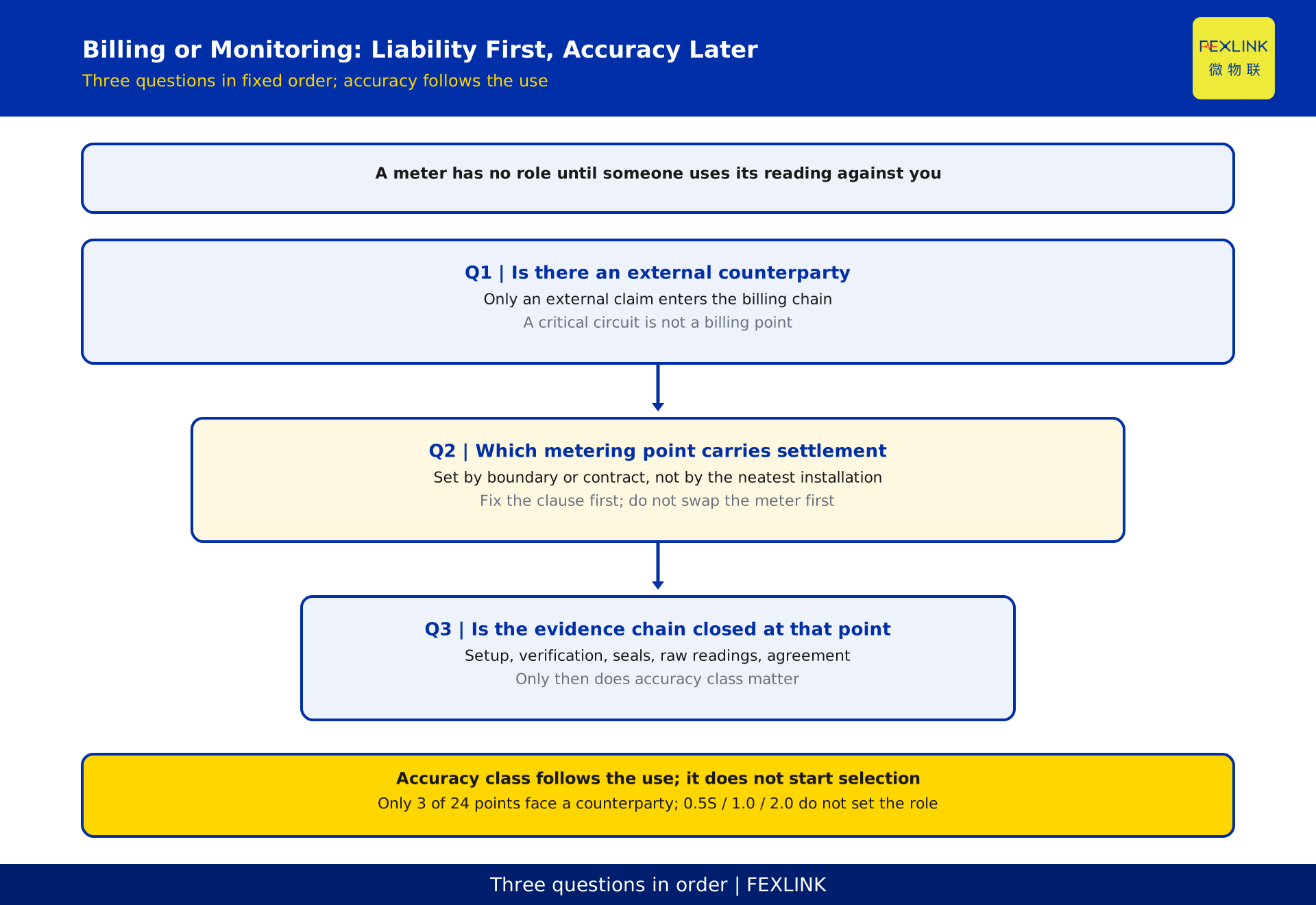
The line between a billing meter and a monitoring meter is not drawn on the device. It is drawn on the use. There is one order of questions: will an outside party use this reading to claim a difference in charges, which metering point does that responsibility attach to, and only then which accuracy class is required. Readings asserted externally are billing measurement; readings that serve internal energy analysis, allocation and efficiency work are monitoring measurement.
Reverse the order and two things happen. A monitoring reading used for settlement may have an adequate class, but the evidence cannot be produced and the claim is rejected. Or every point is specified to billing requirements: the budget is gone, while the agreement, certificate and register for the few real settlement points are still missing.
One test governs this article: whether a number can be asserted externally depends on whether the chain of responsibility behind it is closed, not on the meter class alone. Accuracy class is a consequence of use, not the starting point of selection.
1. Ask about responsibility before accuracy
A meter on a circuit is neither billing nor monitoring until someone decides how its number will be used. The same reading is monitoring data when an internal team watches a trend, and a settlement basis once written into an invoice for an outside party. An internal error can be recomputed and explained; a challenged external figure needs original records and an agreed basis.
The first question in a selection meeting is not what class the meter has, but whether the number will be used by a counterparty with a financial interest to claim a difference. If yes, the point enters the billing chain; if not, discuss the precision and frequency internal management needs. The order cannot be swapped: a class can be changed by replacing a meter, while a missing link in the chain cannot be reconstructed later.
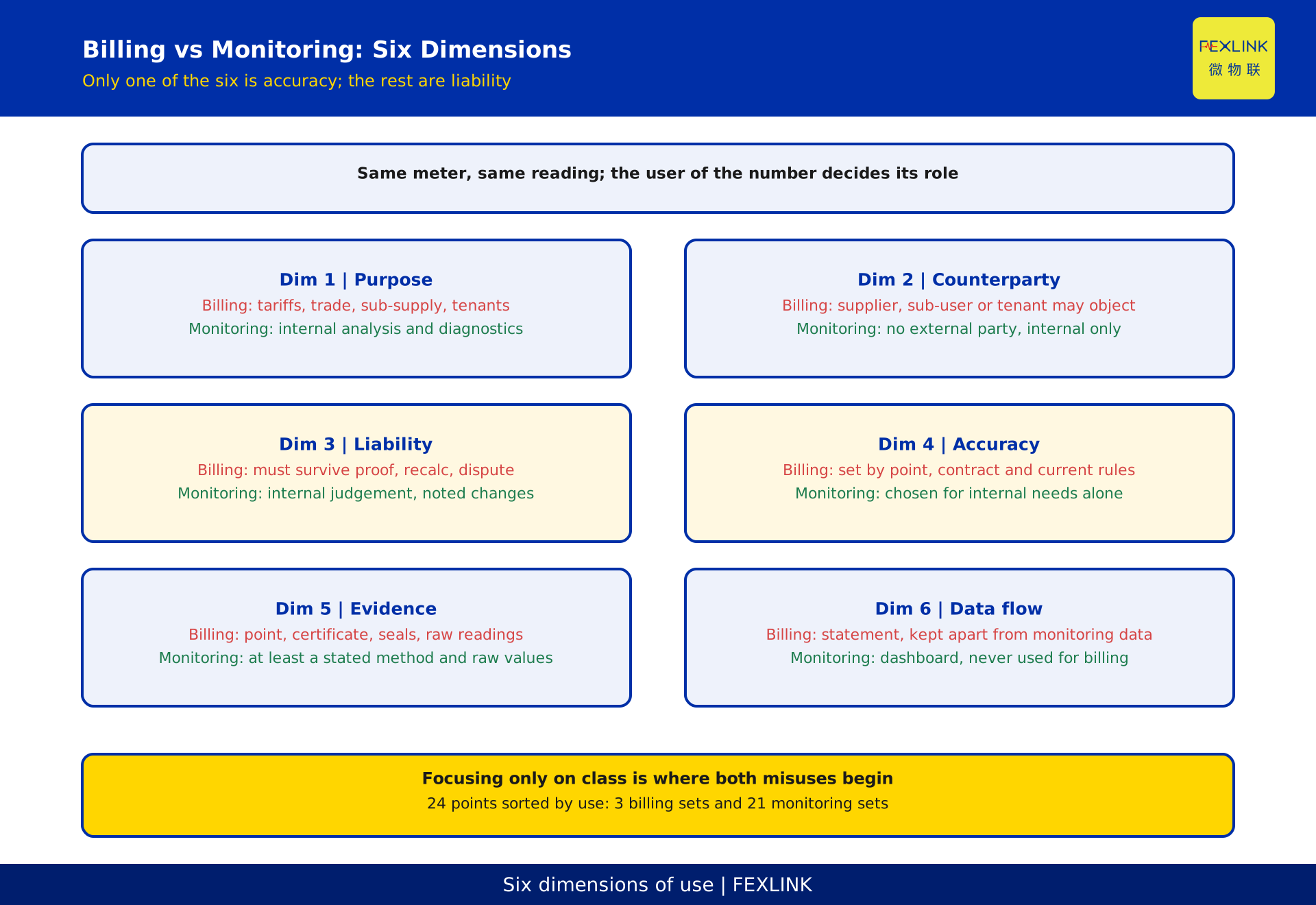
2. Six dimensions: billing versus monitoring
Use. Billing serves charges, trade settlement, resale and tenant allocation; monitoring serves internal energy analysis and efficiency diagnosis.
Counterparty. The first has an outside party who may dispute a reading; the second has none and data stays inside.
Responsibility. The first must survive proof, recomputation and dispute handling; the second supports internal judgement, and a change of basis is documented internally.
Accuracy requirement. The first follows the metering point, the supply contract and current technical management requirements, and needs a valid verification certificate matched to the use. The second is chosen for internal analysis.
Evidence chain. The first retains the metering-point agreement, matching records, verification certificate, seals, register, original readings and timestamps. The second needs a stated basis and traceable raw values.
Data destination. The first feeds settlement statements and is listed separately; the second feeds dashboards and is not quoted for external charging.
Only one of the six is accuracy class. Putting all attention on class is the shared origin of both misuses described later.
3. Three questions in order
First, is there an outside counterparty. Without one, even a highly accurate reading stays internal. An important circuit is not automatically a settlement point; neither capacity nor location changes that.
Second, which point carries the responsibility. External settlement follows the property boundary or the point named in the contract, not whichever meter is installed most neatly. Confirm this in the supply contract and settlement clauses; if they are vague, fix the clauses before replacing any meter.
Third, is the evidence chain for that point closed: device matching, valid verification, seals and register, original readings and timestamps, periodic re-verification and dispute procedure. Only then does class matter, as one condition inside the third. These three questions fit directly into a selection review sheet.
4. Accuracy class is a consequence: reading 0.5S, 1.0 and 2.0
Labels such as 0.5S, 1.0 and 2.0 name accuracy classes from the product standard family for electricity metering equipment; the difference between a class with S and one without shows up mainly at light load. This article gives no class table, no error-limit percentages, no per-load-point limits and no verification intervals. Those come from current standards, type-test reports and verification conclusions.
Two misreadings need correcting. A higher class is not automatically more compliant: which class a settlement point needs follows the point, the contract and technical management requirements, and the highest class does not satisfy every condition. Internal monitoring need not follow the billing tier either: internal analysis cares about comparability and trends, where timestamp alignment and data completeness often matter more than class.
ESA full-element smart meters and ZSA embedded multifunction meters can sit on points with different uses within one project, while the digital electrical supervision platform lists the two data streams as separate ledgers and curves. These components guarantee a single traceable source only. They do not decide whether a given meter may be used for settlement, and they do not replace a verification conclusion.
5. Why monitoring points need not follow billing requirements
Monitoring points usually far outnumber settlement points. Verification, sealing, registers and periodic re-verification at every point make cost grow with the point count, while the ability to prove a claim is rarely used internally. Worse, once the budget is thin, the few points that need strict retention are rushed through the same generic process.
Internal points instead need a common freeze instant, traceable original readings and timestamps, and a clear use marker. These decide whether curves can be compared and differences explained, and sit on a different axis from verification class.
6. Upgrading a point: closing the evidence chain
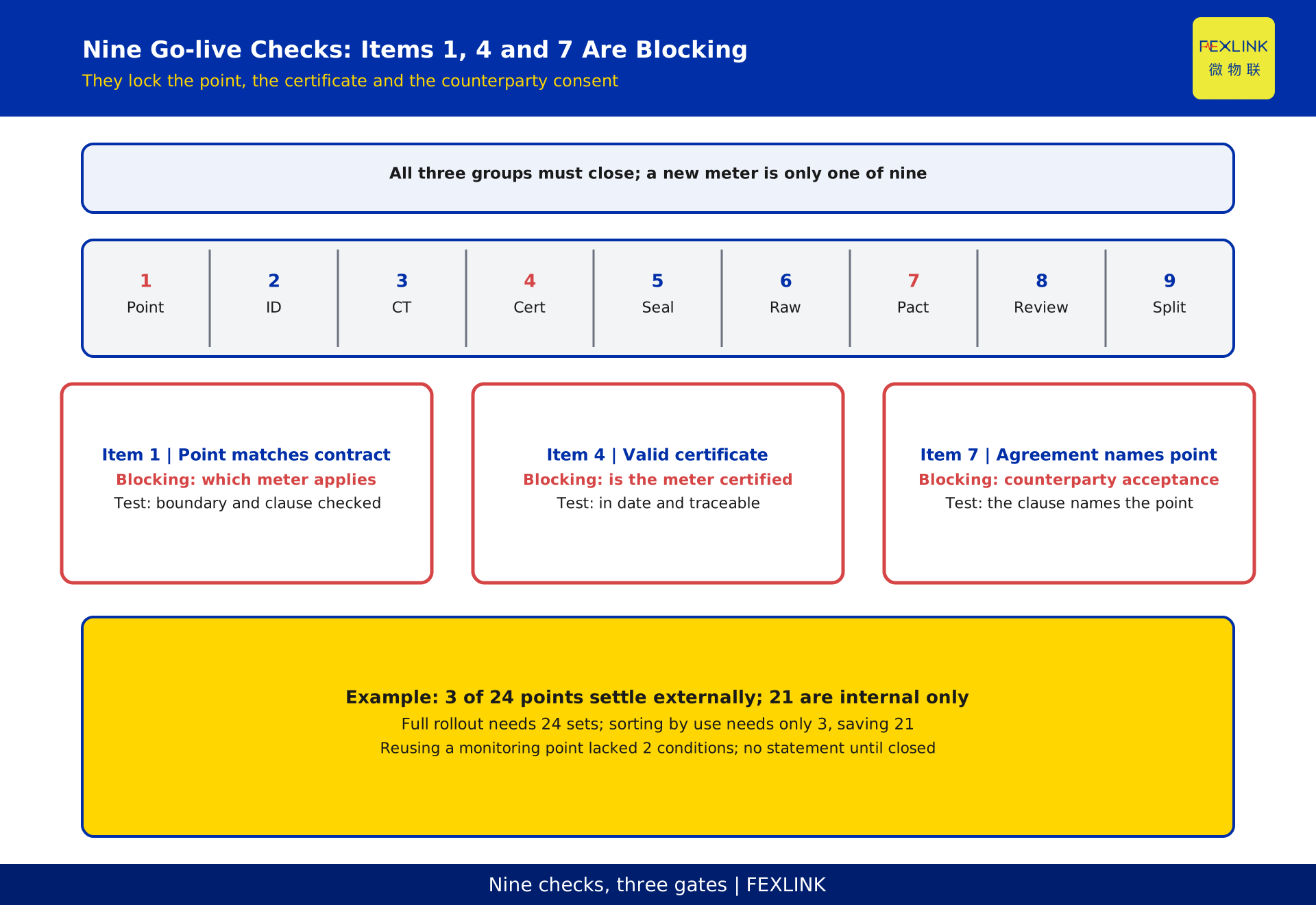
Upgrading from monitoring to billing use is often read as fitting a higher-class meter. Replacing it is one condition among nine; if the others stay open, the reading still cannot be asserted externally. The work falls into three groups.
A lawful metering point. Confirm the property boundary and the point named in the contract, align meter ID, circuit and register number, and check transformer ratio, polarity and secondary wiring against the meter.
Device and verification. Obtain a verification or calibration certificate matched to the use and still valid, keep seals intact with seal numbers recorded, and agree a periodic re-verification and out-of-tolerance procedure.
Agreement and retention. State in the settlement agreement that this point's reading is the basis, retain original dial readings and read timestamps, and list billing and monitoring data separately in the system.
The third group is skipped most often: with no clause and no raw values, an accurate meter still records only what we wrote down ourselves.
7. Worked example: only 3 of 24 points have a counterparty
A plant has 24 metering points. Asking at each one whether an outside counterparty exists gives 3 points that carry external settlement: 1 supply-side main gate and 2 resale or tenant settlement points. The remaining 21 are internal monitoring only. All figures below are constructed and anonymised, with no client, place, project or price.
The first draft specified all 24 points to billing requirements, which means 24 sets of verification, seals and registers. Sorting by use leaves 3 sets, 21 fewer; the released budget went instead to checking the contract clauses and raw-reading retention at those 3 settlement points.
The opposite direction is more instructive. Someone wanted an internal reading used for external allocation; a check found 2 critical items missing: a valid verification certificate and the metering-point clause. Until both are supplied, no settlement statement is issued from that meter, however high its class. The criterion stayed the counterparty, not capacity, price or perceived importance.
8. Two misuses and what they cost
Using a monitoring meter for settlement. What is missing when the claim is rejected is usually not precision but the ability to prove it. The other side asks which point gives the authority, where the verification certificate is, whether seal records exist, and whether original readings and timestamps can be traced. Without answers, the only options are conceding or renegotiating. The root cause is asking about use in the wrong order during selection.
Specifying the whole site to billing requirements. Cost is spread across 21 internal points while nobody reads the contract clauses at the 3 genuine settlement points word by word. The spending buys uniformity, not compliance.
A quieter variant: both streams sit in one report with no use marker, so nobody can tell which figure may be used externally. The fix is not another meter but another field.
9. Nine go-live checks, with items 1, 4 and 7 blocking
Tick each item before go-live:
- The metering point matches the property boundary and supply contract.
- Meter ID, circuit label and register number map one to one.
- Transformer ratio, polarity and secondary wiring are checked against the meter.
- A valid verification or calibration certificate is current and traceable.
- Seals are intact, with seal numbers and opening records retained.
- Read timestamps and original dial readings are traceable, with raw values kept apart from summaries.
- The settlement agreement names this point's reading as the basis.
- Periodic re-verification, out-of-tolerance and dispute procedures are documented.
- Billing and monitoring uses are listed separately in the system, with no shared data source.
Items 1, 4 and 7 are blocking: any one missing stops the settlement statement. The others are remedied within a deadline and recorded. These three are gated because they fix which meter has authority, whether the meter is verified, and whether the counterparty recognises it. Once one fails, no amount of clean downstream data restores the right to assert the number externally.
Frequently asked questions (FAQ)
Q: Can a monitoring reading be used to allocate charges to tenants?
Internal allocation and external settlement are not the same. If the settlement agreement names the point and the counterparty accepts it, the evidence chain must be completed to billing standard. Without such a clause or acceptance, the reading is an internal management basis only and cannot be asserted unilaterally.
Q: Is a class 0.5S meter always better for settlement than a 1.0 meter?
Not always. Class is one condition; the metering point must be lawful, the verification valid, the transformers matched, and the agreement must name that meter. Which class is required follows current standards, the supply contract and the verification conclusion. This article gives no class table.
Q: Is specifying every meter to billing requirements the safest option?
It is neither safest nor cheapest. It spreads cost over many internal points without automatically completing the agreement and retention work at the few settlement points. Sort by counterparty first, then concentrate the budget on settlement points.
Q: How should DL/T 448 and GB/T 17215 be cited?
The first is the technical management code for electric energy metering devices; the second is the family of product standards for AC electricity metering equipment, with many parts in differing states. Cite only the currently effective status published by the energy administration and the national standards platform, not a version fixed here or by any secondary list. This article names the frameworks only, with no clause numbers, class tables or indicator values.
Q: Does a passed verification mean the meter can be used for settlement?
No. A pass confirms the device's metrological performance. A metering-point agreement, seals and register, retained original readings and a contractual basis are still required. With an open evidence chain, a compliant meter still produces internal data only.
Scope and limitations
This article helps parks, plants and buildings draw the responsibility boundary between billing and monitoring uses during selection and go-live. It gives the order of questions, six dimensions of difference and nine checks. It does not unpack the error bands behind the numbers 0.5S, 1.0 and 2.0 (a neighbouring article reads the class parameters), does not calculate whether a higher class pays for itself (a neighbouring article handles that decision), and does not walk through the protocol timing of a polling cycle.
No error-limit percentages, class tables, per-load-point limits, verification intervals, class assignments for specific points, prices or return figures are given, and this article does not replace a compliance decision. Which class, verification interval, sealing and retention a particular point needs follows the current DL/T 448, the supply contract and local requirements; contractual or audit clauses take precedence where they say otherwise. The GB/T 17215 family is named as a product-standard framework only, with no clause numbers; publication, implementation, withdrawal and replacement follow the official platform's current status.
The 24 points, 3 settlement points, 1 main gate, 2 resale or tenant points, 21 internal points, 24 versus 3 sets and the 2 missing conditions are constructed examples with no client, place, project or price. Model numbers, ranges, class specifications, interfaces and capacity are customizable and follow the latest selection guide; this is not purchasing advice. Status is DRAFT_PENDING_REVIEW, and the author may not self-approve.
Frequently Asked Questions
Why Billing Meters and Monitoring Meters Are Not
The line between a billing meter and a monitoring meter is not drawn on the device. It is drawn on the use