 FEXLINK Research Institute
The short answer
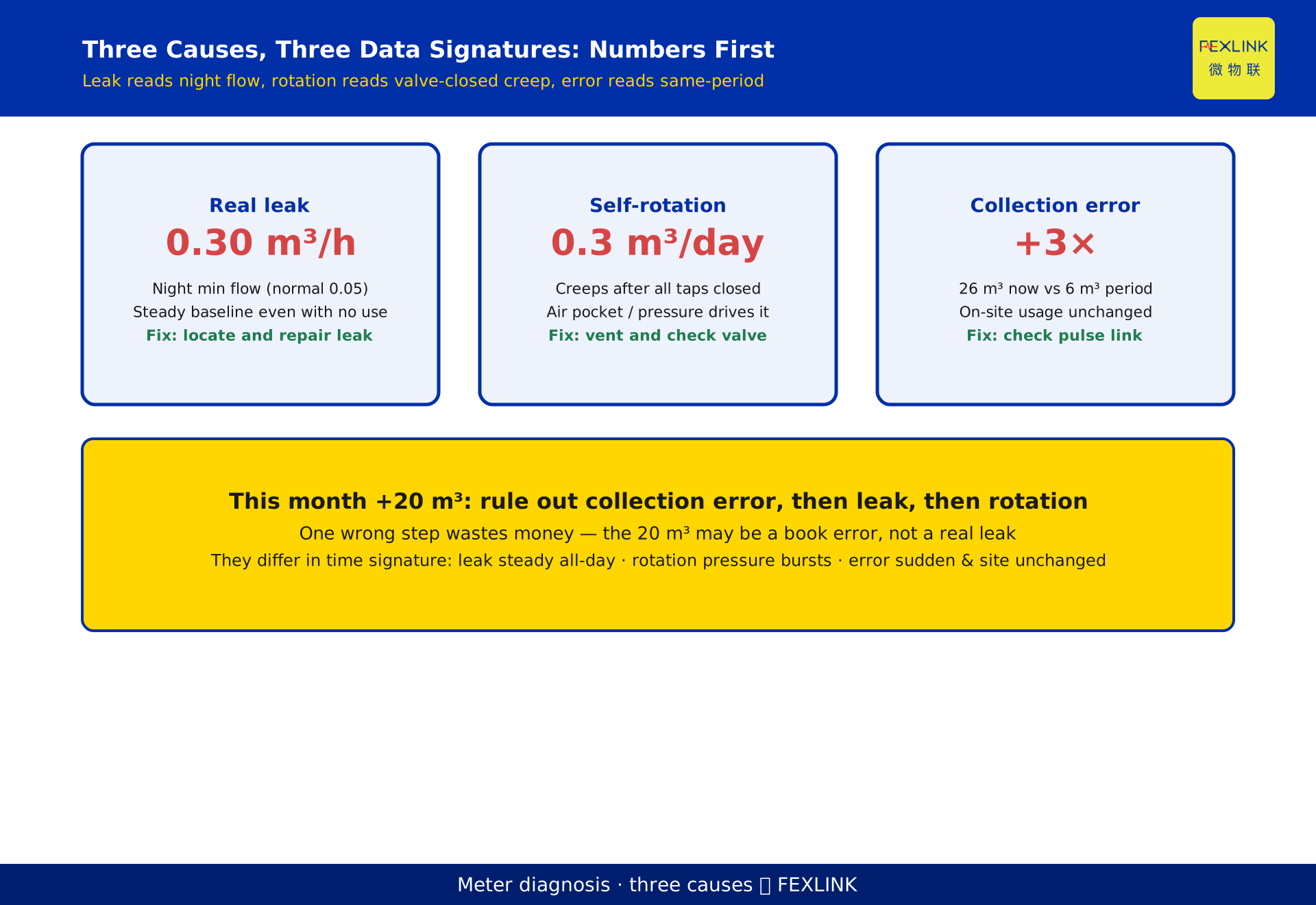
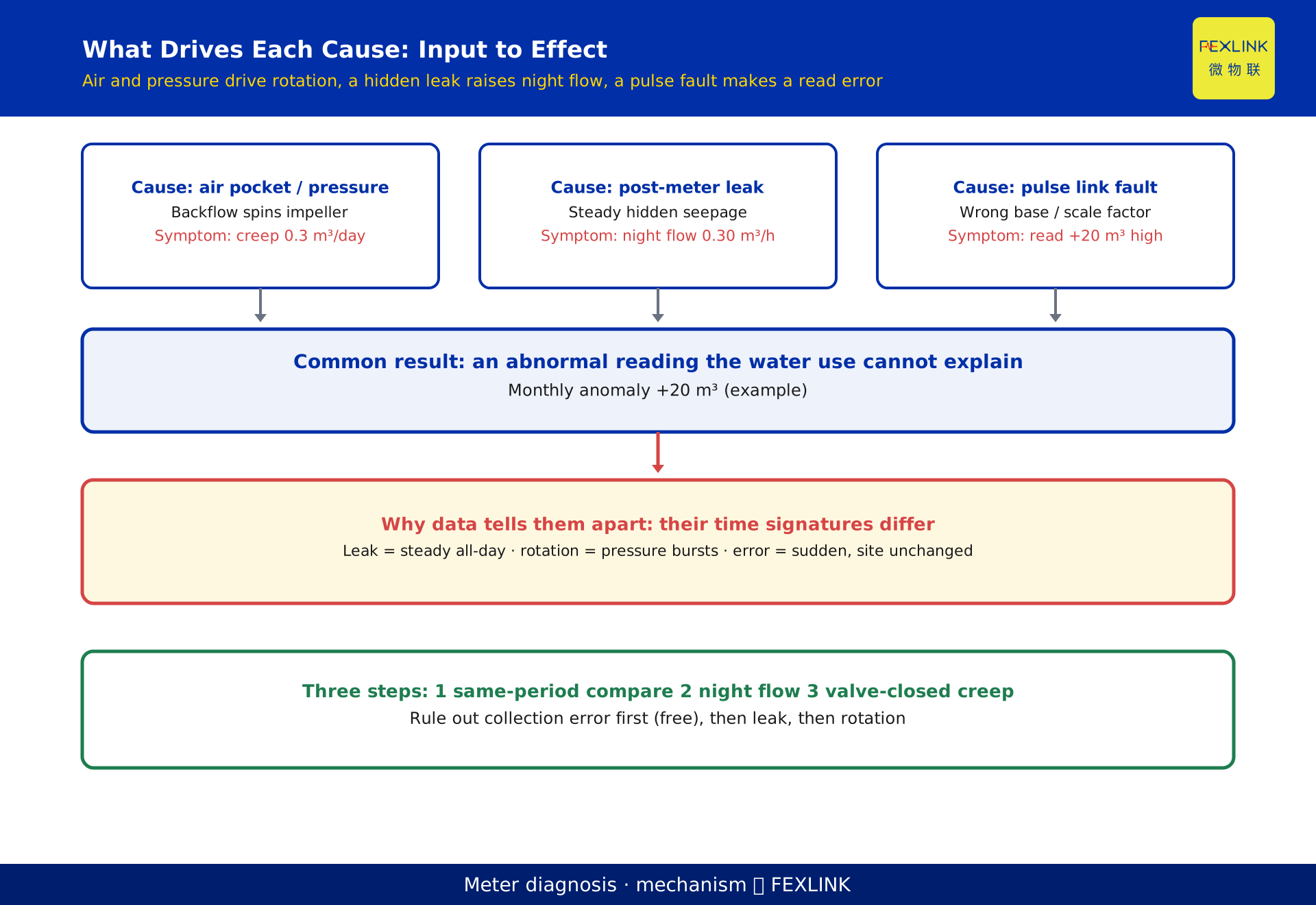
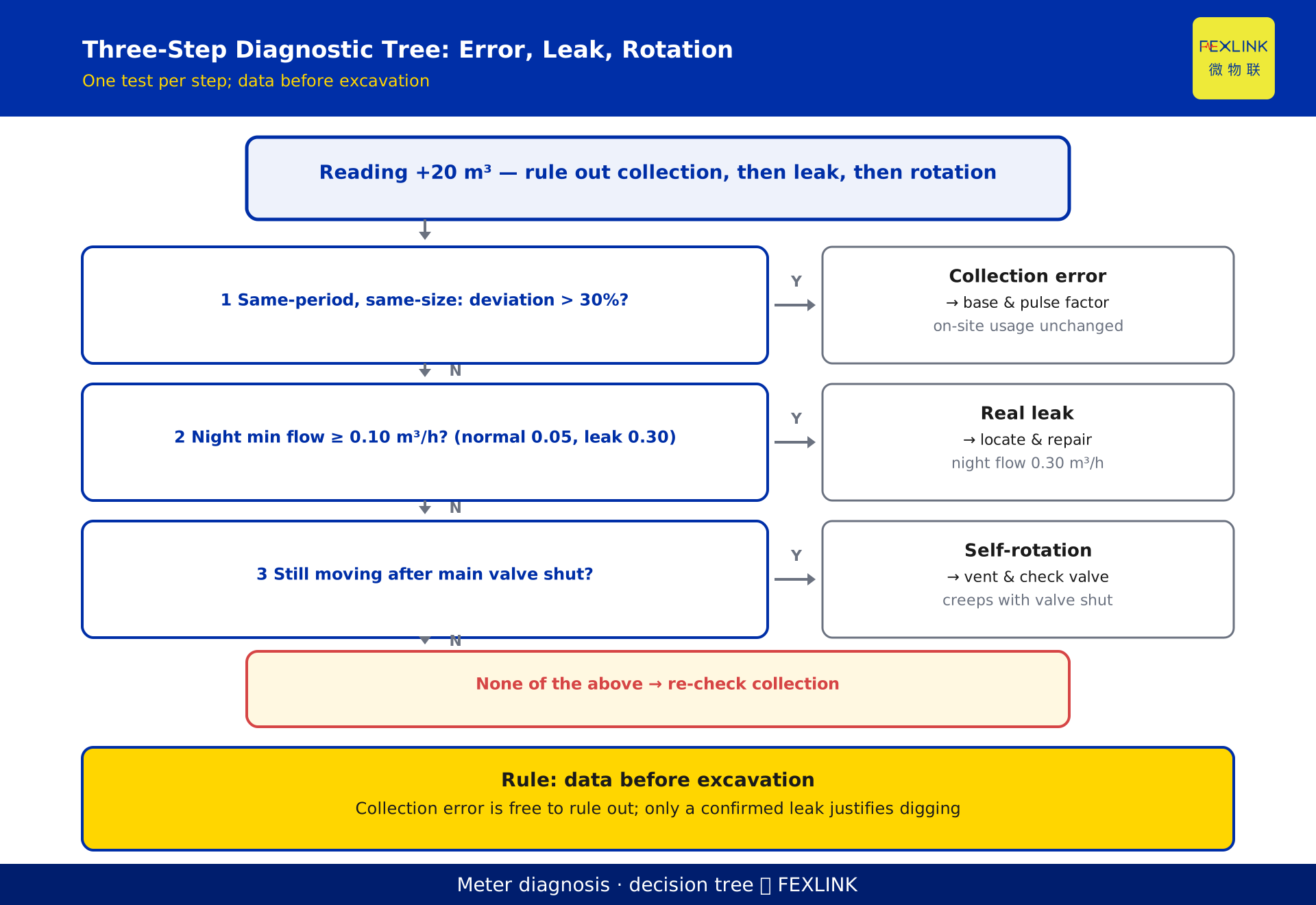
When a water meter suddenly records 20 cubic meters more in a month, do not rush to refund the bill or replace the meter. Three common causes — real leakage, self-rotation and collection error — each leave a distinct data signature, and three segments of data separate them: an abnormal rise in night minimum flow points to a real leak; a meter that keeps creeping with every tap closed points to self-rotation or trapped air; and a reading that jumps against the same period last year and neighbouring meters of the same size, while on-site usage is unchanged, points to a collection error (wrong read or a faulty pulse link). Diagnose in order: rule out the collection error first, then check for a real leak, then look at self-rotation. A confirmed leak goes to underground-leak repair; self-rotation goes to pipe venting and a check valve; a collection error goes to the pulse link.
1. One table to tell the three causes apart
An abnormal meter reading is not only ever "a leak". Put the three causes side by side and qualify them before touching anything — this avoids digging, swapping meters and arguing by reflex.
| Cause | Data signature | Typical magnitude (illustrative) | Action |
|---|---|---|---|
| Real leak (hidden) | Night minimum flow keeps rising; a stable baseline flow even with no usage | Night minimum flow from 0.05 to 0.30 m³/h (about 6×) | Locate and repair the leak |
| Self-rotation / air | Meter creeps or oscillates forward-reverse after all taps are closed | About 0.3 m³/day with no usage | Vent the pipe, add or fix a check valve |
| Collection error | Same-period, same-size comparison jumps while on-site usage is unchanged | 26 m³ this month vs 6 m³ same period; deviation over 3× | Check the pulse link and the read |
This table is the increment over KD-0462 (the principle of pulse miss-count and over-count): KD-0462 explains the mechanism, while this article explains "given an abnormal meter, which three data segments qualify it". The three steps below put this table into practice.
2. Rule out the collection error first: same-period, same-size comparison
The cheapest and first step is to pull the "false leak" out of the picture. Take three months of data: this month's reading, the same month last year, and the current month for a neighbouring meter of the same model, same size and same floor position.
If this month's reading jumps by around 20 m³ against both of those, while the household size, usage habits and season are unchanged, suspect a collection error. A human misreading the register, a wrong pulse scale factor on a remote meter, or a reset base not entered after a meter swap, all produce "leak on the books, none on site". A plain rule: if every comparable meter in the building sits in the 5–8 m³ band this month and only this one reads 26 m³, re-check collection before digging.
The whole point of this step is to keep the high-cost "dig or not" decision behind a data gate. Do not move on unless the same-period comparison is clean.
3. Night minimum flow to judge a real leak
In the small hours (typically 02:00–04:00) residents barely use water, so the flow the meter still records is called the night minimum flow. A healthy household meter sits around 0.05 m³/h, reflecting only pipe retention and a trace of seepage. If it climbs to 0.30 m³/h and stays there for days, there is a steady leak — usually a hidden post-meter leak (buried pipe, in-wall pipe, a joint).
Key points: first, if the reading does not return to zero after the building's main valve is shut, distinguish a pre-meter from a post-meter leak; second, log the night minimum flow for 7 consecutive days to see a stable rise rather than a one-off; third, the night minimum flow value is only a discriminant flag — the actual leak volume must not be read as that number times time, but verified by leak listening and locating.
The night minimum flow method is a standard engineering practice for urban water-network loss control and household hidden-leak detection, sourced from public engineering practice; the actual threshold is set by on-site measurement and the local water utility.
4. Creep with no usage to judge self-rotation
Self-rotation means the meter index slowly turns forward, or oscillates forward-reverse, with no water drawn at all. The causes are specific: trapped air in the pipe (a gas-water two-phase flow) that expands or contracts after use stops and pushes water along; pressure fluctuation from pump starts and stops in secondary supply, or a neighbour's draw, causing water-hammer micro-motion; and a missing or failed check valve that lets water flow back and spin the impeller.
To test: close every tap, open the highest faucet to purge the air, then watch whether the meter still moves; if it does, and it oscillates with pressure, it is self-rotation. Fix it by venting, repairing or adding a check valve, and fit air vents on long risers.
Note that self-rotation is usually small (about 0.3 m³/day in the example) and rarely produces a 20 m³ jump in a single month on its own, so it tends to ride on top of another cause or accumulate over time. A check valve suppresses self-rotation driven by backflow and trapped air — this is water-engineering experience from public sources.
5. A worked example: a meter up 20 m³ in one month
The following is an illustrative scenario constructed to show the diagnostic flow. It does not represent any real customer or project.
In a residential block, a household meter normally uses 6 m³ per month but reads 26 m³ this month. The owner complains of "a sudden extra 20 m³" and asks the property manager to refund or replace the meter. The manager runs the three steps. Step one, same-period same-size comparison: last year was 6 m³, a neighbouring same-model meter is 6 m³ this month, only this meter reads 26 m³ — over 3× deviation with no change in occupancy or habits, so rule out collection error first. Step two, inspect collection: the meter was swapped to a new pulse remote meter last month, and the old base of 1580 m³ was wrongly entered as the new meter's start, with a wrong pulse scale factor, inflating the reading by about 20 m³. Step three, re-measure night minimum flow at 0.06 m³/h and confirm no movement after the valve is shut, ruling out a real leak and self-rotation.
Conclusion: the +20 m³ was a collection error (wrong base and pulse scale factor), not real extra consumption. Correcting the base and resetting the scale factor restored normal readings. The case shows that a jump is not the same as a leak, and ruling out collection error first saves a lot of needless digging and meter swaps.
6. Review points for pulse collection errors
For a smart meter (pulse or remote), the reading relation is: reading = pulse count × pulse scale factor (volume per pulse, commonly 1 litre or 10 litres per pulse). Five common failure points to review:
One, a wrong pulse scale factor — for example 10 L/pulse set where 1 L/pulse was intended, multiplying the reading by 10; two, a base not reset or wrongly entered after a swap; three, pulse miss-count from aged reed or Hall elements or un-debounced chatter, causing under-count; four, pulse over-count from electromagnetic interference or chatter, causing over-count; five, unsynchronised read times or a mismatched month boundary, mismatching the billing period.
To review, use the ESI digital-state monitor to capture the pulse on-off timing and verify the scale factor, then use the ESX edge computing gateway to compute the monthly volume locally and cross-check against a manual read. The mechanism of pulse miss-count and over-count is covered in KD-0462 (the principle article); this article focuses on how to qualify the anomaly on site.
7. Workflow and responsibility split
Turn the diagnosis into an executable order: step one, data comparison, answers "is it a collection error"; step two, night minimum flow, answers "is it a real leak"; step three, valve-closed creep, answers "is it self-rotation".
On responsibility: the property manager owns the collection-link check and the same-period comparison — the first, zero-cost step; the water utility owns meter verification and network-side loss, with a real leak assigned by pre-meter versus post-meter boundary (pre-meter usually the utility, post-meter the owner); self-rotation is the owner's pipe venting and check valve. The principle is "data before excavation" — split the 20 m³ into "is it a real leak" before discussing who pays.
8. Where products fit: same-source water-and-gas collection
To make the three judgments run automatically, you need endpoint collection and edge computing. The ESX edge computing gateway aggregates pulse and readings from water and electricity meters at the building, on a common time base, and computes the night minimum flow and the same-period comparison at the edge, sending only anomalies upstream — cutting false alarms and cloud cost. The ESI digital-state monitor sits on the meter's pulse and valve state, catching abnormal creep, pulse miss-count and over-count. The digital electrical intelligent supervision system (same-source water-and-gas collection) puts water and electricity on one collection and time base so that "abnormal water use" and "equipment start-stop" can be read together — for instance a pump start that coincides with meter self-rotation points the cause straight at pressure fluctuation.
9. On-site checklist to avoid misjudgment
Five items, in order, stop almost every misjudgment: one, verify the base and pulse scale factor; two, log the night minimum flow for 7 consecutive days and watch for a stable rise; three, observe whether the meter still moves after the building main valve is shut; four, compare against a same-size neighbouring meter for the same period; five, re-test self-rotation after high-point venting. The first two cover collection error and real leak, the last three cover self-rotation and cross-checks; skipping any of them easily turns a "collection error" into a "leak" someone digs for.
10. FAQ
Q: The meter recorded 20 m³ more — does that mean it is leaking?
A: Not necessarily. Among the three causes, collection error and self-rotation are not real leaks. Use the same-period comparison and the night minimum flow method first; only excavate once a hidden leak is confirmed, or you may simply waste money.
Q: How do I measure night minimum flow accurately?
A: Between 02:00 and 04:00, after obvious indoor use is off, log it for 7 consecutive days and look for a stable rise rather than a one-off. A single reading is easily disturbed by incidental use. The value is a flag; the real leak volume needs separate leak locating.
Q: Should I replace the meter for self-rotation?
A: Most self-rotation is not a broken meter but trapped air or a check-valve issue. Vent first, check the check valve, then consider replacing. A blind swap treats the symptom and the rotation returns.
Q: After installing a new remote meter the reading went up — is the meter inaccurate?
A: Usually the base was entered wrong or the pulse scale factor is incorrect; that is a collection error, not a meter fault. Verifying the base and scale factor fixes most cases without blaming the meter itself.
Q: Who is responsible for the 20 m³, the property manager or the water utility?
A: Judge the cause, then assign: collection error is the property manager's link check; a real leak splits by pre-meter/post-meter (pre-meter the utility, post-meter the owner); self-rotation is the owner's pipe. The rule is data before excavation.
Scope and limitations
- The household and building meter anomaly diagnosis here applies to mechanical and pulse-remote cold-water meters. Electromagnetic or ultrasonic meters follow similar logic but their sensor differences are out of scope.
- The figures — night minimum flow 0.05 / 0.30 m³/h, self-rotation 0.3 m³/day, same-period deviation over 3×, and the example 6 / 26 m³ — are illustrative thresholds and data constructed to show the diagnostic flow. They do not represent any real customer or project; actual thresholds and leak volumes must be set by on-site measurement and the local water utility.
- The specific models, interfaces and parameters of the ESX edge computing gateway, the ESI digital-state monitor and the digital electrical intelligent supervision system (same-source water-and-gas collection) follow the latest selection manual and product knowledge base. This article is not a selection or procurement recommendation.
- The mechanism of pulse miss-count and over-count is detailed in KD-0462 (the principle article); this article is the on-site diagnostic decision piece and the two are complementary.
- The pre-meter/post-meter responsibility split follows the water-supply contract and local water-supply rules, which vary by location and are governed by the local water utility.
Frequently Asked Questions
A Water Meter Reading Suddenly Jumps 20 Cubic Meters
When a water meter suddenly records 20 cubic meters more in a month, do not rush to refund the bill or replace the meter