 FEXLINK Research Institute
The short answer
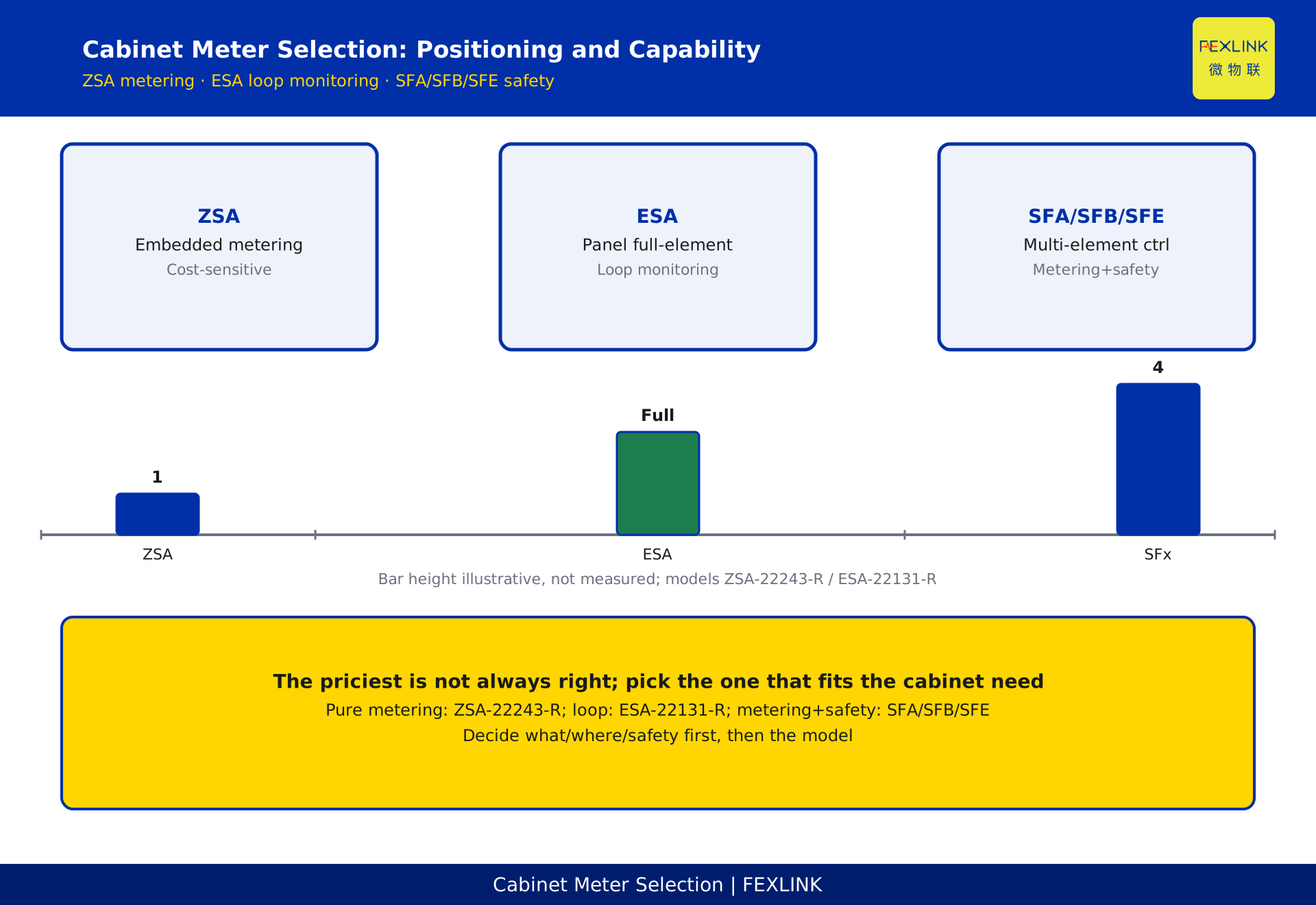
A cabinet retrofit can come back with three meter proposals, and the price gap is mostly because they are not the same class of device. The decision should not be "which is cheapest" but three questions: what to measure, where it mounts, and whether safety has to be covered as well. The FEXLINK ZSA embedded multifunction smart meter (ZSA-22243-R) fits panel-cutout, cost-sensitive pure metering. The FEXLINK ESA panel-mount full-element smart meter (ESA-22131-R) fits loop-level full-element monitoring. The FEXLINK SFA/SFB/SFE multi-element controller folds metering, leakage, temperature and digital inputs into one device, fitting the one-meter-per-cabinet model in smart-building multi-circuit deployments. Rule of thumb: pure metering goes to ZSA, loop monitoring goes to ESA, and metering-plus-safety-in-one goes to SFA/SFB/SFE.
1. Why the three quotes differ: three product lines, not one
Inside a cabinet retrofit, a meter is never a single commodity. The same cabinet can return three device classes: an embedded pure-metering meter, a panel-mount full-element monitor, and a multi-element controller that also picks up safety quantities. All three read voltage, current and energy, yet their positioning, mounting and cost structure differ enough that comparing unit prices alone leads to the wrong buy.
To choose well, separate the three lines along the same three axes:
- Mounting: ZSA is a panel-cutout embedded meter; ESA is panel-mount (DIN rail or front panel); SFA/SFB/SFE is a multi-element controller that can be placed flexibly inside the cabinet and suits the one-meter-per-cabinet approach of folding several measurements into a single device.
- Function surface: ZSA concentrates on electrical energy metering alone; ESA adds loop-level full-element monitoring of the circuit's electrical state; SFA/SFB/SFE further merges metering, leakage, temperature and digital inputs into one unit.
- Cost structure: pure-metering ZSA is the most cost-sensitive; panel-mount ESA adds loop-level capability and sits in the middle; the multi-element controller costs the most per unit because one device replaces several, yet often wins on the total cabinet bill when space is tight and one-meter-per-cabinet is the goal.
The governing principle is simple: the right pick is the one whose job matches what the cabinet actually needs solved. The next three sections take each line in turn.
2. Pure metering, cost-sensitive: choosing the ZSA embedded
Start with the FEXLINK ZSA embedded multifunction smart meter (ZSA-22243-R). Its positioning is unambiguous: panel-cutout embedded mounting, a function surface focused on energy metering, doing the job of recording voltage, current and energy solidly without extending into monitoring beyond metering.
When does it fit? First, when other devices in the cabinet already carry the safety quantities — loop monitoring, leakage protection, temperature measurement — and the meter only has to record "how much energy was used". Second, when the project is highly cost-sensitive and wants the mandatory metering done at the lowest cost. Third, when cutout space is limited and the instrument should integrate cleanly with the cabinet face. Stack those three and ZSA is the natural choice.
Its boundary is plain: ZSA is a pure-metering device that provides no loop-level leakage monitoring, no cable or contact temperature measurement, and no digital-input transduction. If the owner's real pain is "a leakage inside the cabinet nobody notices" or "cable temperature rise burns before anyone finds out", ZSA alone cannot cover that gap and you must look at the other two lines.
A one-line criterion closes the section: a cabinet that only cares about billing-grade metering and already has safety covered elsewhere picks ZSA; the moment safety quantities must also be carried by this meter, move down to ESA and SFA/SFB/SFE.
3. Loop-level full-element monitoring: choosing the ESA panel-mount
The second line is the FEXLINK ESA panel-mount full-element smart meter (ESA-22131-R). Its positioning is "panel-mount, loop-level full-element monitoring" — beyond metering, it also brings the loop's operating state into view, so operators not only read how much energy was used but also see that loop's consumption profile and health.
It fits two kinds of situation. One is a panel-mount cabinet that already has rail or panel space, where making the monitoring complete is straightforward. The other is any site that needs loop-level operations — per-loop load verification, abnormal-consumption identification, loop-level energy split and alarms. A single total meter is no longer enough; the owner needs "every loop, visible".
The core difference from ZSA is the function surface: ZSA only meters, while ESA merges metering with loop-level full-element monitoring inside one panel-mount unit. What ESA adds over ZSA is precisely that loop-level visibility.
Its boundary is also clear: ESA is strong on loop-level electrical quantities and loop-state monitoring, but leakage, temperature and digital-input transduction are not its headline function surface. If the owner's core need is to fully merge metering with safety monitoring and wants one device to save cabinet space, then the third line — the multi-element controller — is the better fit.
4. Metering plus safety in one: choosing the SFA/SFB/SFE controller
The third line is the FEXLINK SFA/SFB/SFE multi-element controller. What sets it apart from the first two is that one device folds four jobs together — metering, leakage, temperature and digital inputs — suiting the one-meter-per-cabinet, multi-circuit scenario in smart buildings, where both electrical metering and the loop's leakage, temperature and switch state should be acquired, while keeping the device count and wiring inside the cabinet down.
This family has three progressive sub-models, distinguished by the step-up of the function surface rather than by price alone:
- SFA: the base tier, covering metering plus basic leakage, temperature and digital-input acquisition; suited to cabinets with standard safety requirements in a relatively clean environment.
- SFB: builds phase-related capability on top of SFA; suited to sites that need a finer phase dimension and care about issues such as three-phase imbalance.
- SFE: adds harmonic monitoring on top of SFB; suited to sites with a complex harmonic environment where harmonics must be brought into the picture.
A practical selection: first set the tier among SFA, SFB and SFE using the two added dimensions — phase and harmonics; then decide how many controllers cover all loops in the cabinet. Its boundary is equally clear — it is designed for "metering and safety in one"; if the job is pure metering and cost is extreme, ZSA remains the better fit.
5. Function-by-function comparison of the three
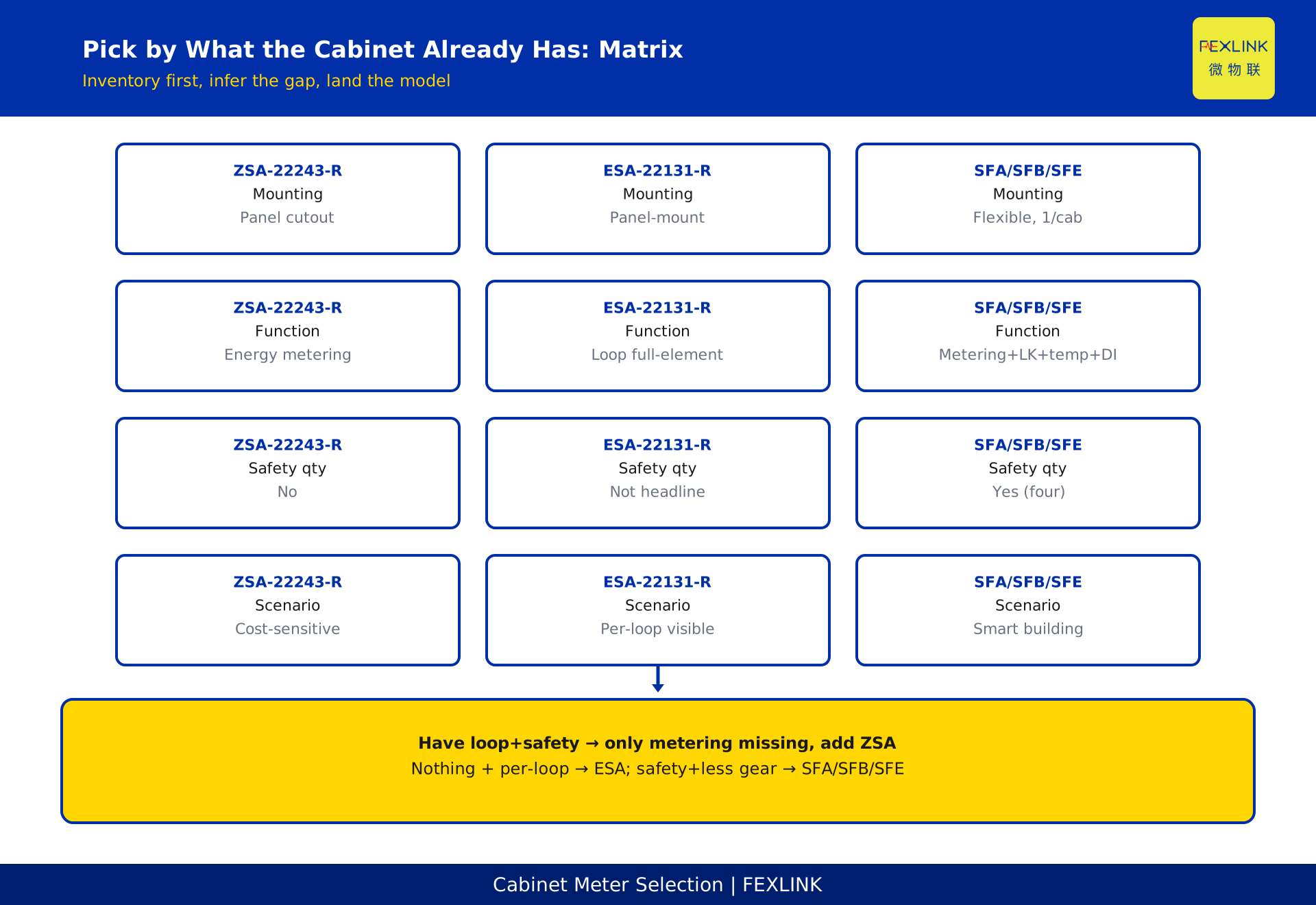
Laying the three lines side by side makes the differences concrete. The table below is a qualitative comparison only; specific accuracy, range and other parameters follow the latest selection manual.
| Product line | Mounting | Core function surface | Leakage / temperature / digital-input | Typical scenario |
|---|---|---|---|---|
| ZSA-22243-R embedded | Panel cutout embedded | Energy metering | No | Cost-sensitive pure-metering cabinet, safety already covered |
| ESA-22131-R panel-mount | Panel-mount (rail or front) | Loop-level full-element monitoring | Not headline function | Panel cabinet needing per-loop visibility |
| SFA/SFB/SFE controller | Flexible, one-meter-per-cabinet | Metering + leakage + temperature + digital-input | Yes | Smart-building multi-circuit, metering and safety in one |
The value of the table is that it breaks the surface impression that "they all measure voltage, current and energy". What you really compare is which extra layer of responsibility each meter carries on its function surface, and whether that layer is the one your cabinet is missing most.
6. Working backward from what the cabinet already monitors (decision tree)
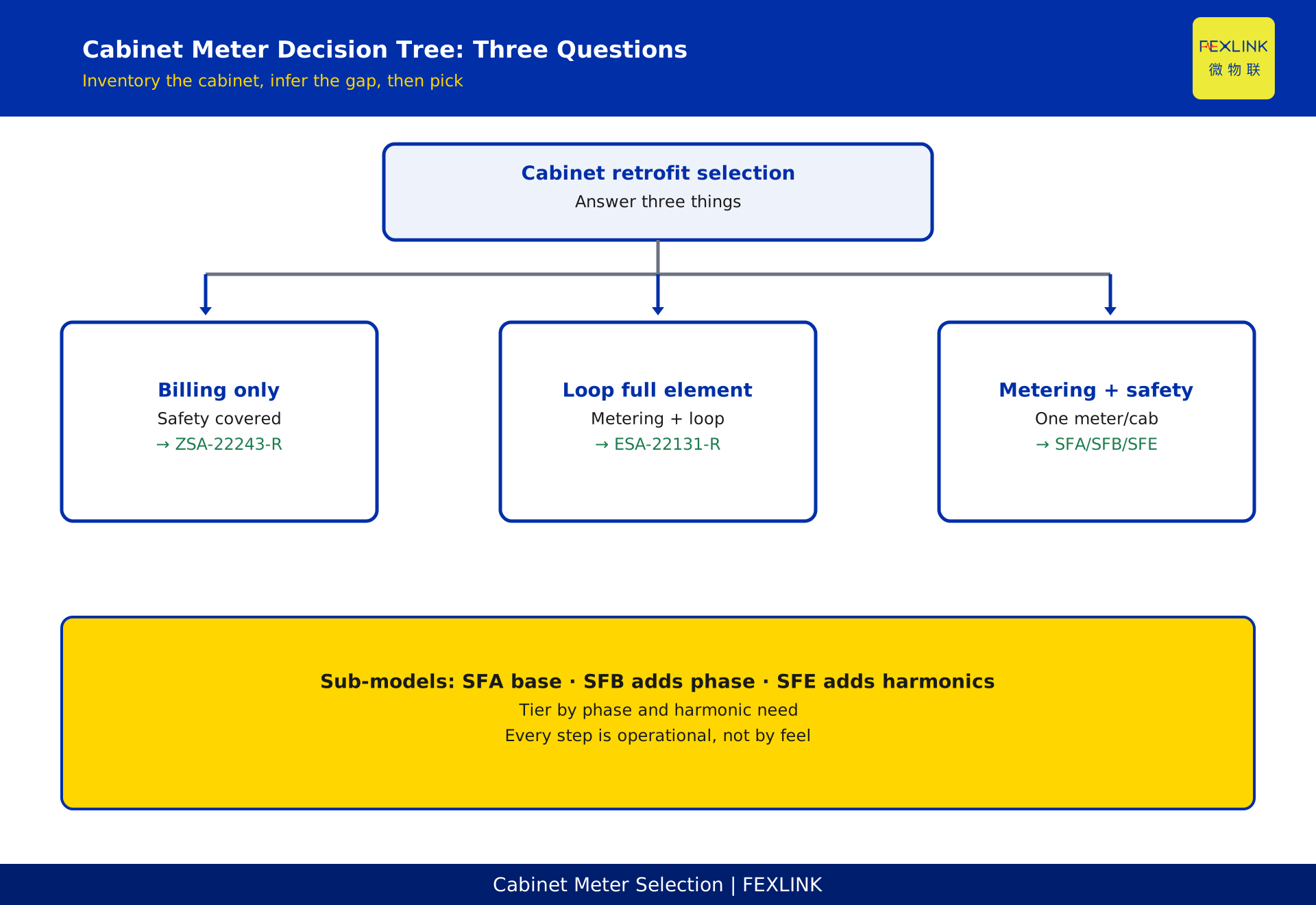
The riskiest way to select is by feel. The steadier approach is to work backward: inventory what the cabinet already monitors, infer what is missing, then land on a model. The decision tree below can be walked directly.
- Does other equipment already cover loop monitoring, leakage and temperature? If all are covered and you only lack a billing-grade meter — choose ZSA-22243-R.
- Is the gap loop-level full-element monitoring, and do you want one panel-mount device to show metering and loop state together? Yes — choose ESA-22131-R.
- Do you want one device to fully merge metering with safety quantities (leakage, temperature, digital-input) while taking minimal cabinet space? Yes — choose the SFA/SFB/SFE multi-element controller.
- Within SFA/SFB/SFE, does the site need the phase dimension, and does it need harmonic monitoring? Base only — SFA; need phase — SFB; need harmonics — SFE.
Every branch of this tree is operational: none depends on a vague "feels right". Each step maps to a cabinet status or a clear requirement. Walk all four and the choice is essentially settled.
7. A worked example: a campus cabinet retrofit walk-through
The following walk-through is constructed to illustrate the selection method and represents no real customer, project or location.
A floor distribution cabinet in an office building on a campus is being retrofitted. The original cabinet has only a mechanical total meter. The owner raises three points: first, they want to see each loop's consumption profile for loop-level energy management; second, they worry about leakage and cable temperature rise and want early warning; third, cabinet space is tight and they want to add as few devices as possible, ideally one meter per cabinet.
Following the tree: step one, the cabinet has no existing loop monitoring, leakage or temperature, so ZSA alone cannot cover the safety gap; step two, the owner does want loop-level full-element monitoring, but step three explicitly requires merging metering with safety and saving space — those two layers together point most naturally to the SFA/SFB/SFE multi-element controller. Step four: the on-site harmonic environment is ordinary and does not require harmonics, so the tier lands on SFA (if three-phase imbalance later proves significant, step up to SFB).
The only point this example makes is that selection is not "pick the cheapest meter" but matching cabinet status and owner requirements item by item, then letting the product line fit. Different floors of the same building can yield different answers.
8. FAQ
Q: All three meters read voltage, current and energy, so why not just take the cheapest?
Because they carry different responsibilities on the function surface. The cheapest, ZSA, is pure metering and does not address safety quantities such as leakage, temperature and digital inputs. If what the cabinet truly lacks is safety monitoring, picking the cheap meter leaves a critical gap. Select by "what the cabinet is missing", not by "who has the lowest unit price".
Q: Can ZSA also measure leakage or temperature on the side?
No. ZSA-22243-R is positioned as a panel-cutout embedded pure-metering device; its function surface centers on energy metering and does not treat leakage monitoring, temperature measurement or digital-input transduction as part of its capability. For those safety quantities, look at ESA or SFA/SFB/SFE.
Q: Both ESA and SFA/SFB/SFE are "full-element" — how do I tell them apart?
ESA's "full-element" means loop-level electrical quantities and loop-state monitoring, strong at the loop layer. SFA/SFB/SFE's "in-one" means metering, leakage, temperature and digital inputs merged into one unit, strong at metering-plus-safety and space saving. One governs loop visibility, the other safety integration; different needs pick different lines.
Q: What exactly separates SFA, SFB and SFE, and how do I pick the sub-model?
They are a step-up of the function surface: SFA is the base tier covering metering plus basic safety; SFB adds the phase dimension on top of SFA; SFE adds harmonic monitoring on top of SFB. The pick is simple — base suffices for SFA, need phase for SFB, complex harmonics on site for SFE.
Q: How does this differ from the neighbouring article on ESA current ratings?
That article only explains how to read ESA's six current-rating bands. This article makes the selection decision across three product lines, with its increment being the decision tree of mounting plus function surface. The two are complementary: one treats "how to read one model's parameters", the other "how to choose among several models".
Scope and limitations
- The positioning differences and selection criteria for the three lines — ZSA-22243-R, ESA-22131-R, SFA/SFB/SFE — discussed here apply to electrical engineers and project owners in scenarios such as distribution cabinets, panel-mount cabinets and smart-building multi-circuit power management. Specific mounting conditions (cutout dimensions, rail specification, panel space) follow on-site survey and the latest selection manual.
- The function-surface descriptions of the three lines are qualitative capability statements: ZSA is a panel-cutout embedded pure meter; ESA is a panel-mount loop-level full-element monitor; SFA/SFB/SFE is a multi-element controller covering metering, leakage, temperature and digital inputs, with SFA base, SFB adding phase and SFE adding harmonics. This article fabricates and cites no specific parameters such as accuracy, range, current bands or price.
- The decision tree and checklist logic are a methodological summary and an operational qualitative criterion. Real selection must integrate cabinet status, load nature, harmonic environment and on-site survey; this article does not constitute a mandatory selection conclusion.
- The example (a campus office-building floor distribution cabinet retrofit) is constructed to illustrate the method and represents no real customer, project or location; it must not be used as an engineering basis.
- The associated solution "Smart Building Multi-circuit Power Management Solution" is a solution-level association; this article does not expand its architecture or parameters, and concrete deployment follows the latest product knowledge base and manufacturer note.
- This article cites no standard number or clause; wherever thresholds, limits or specifications appear they are expressed as "follow the latest selection manual and manufacturer note", and the conclusions are not mandatory technical provisions.
Frequently Asked Questions
Installing Meters in a Cabinet
A cabinet retrofit can come back with three meter proposals, and the price gap is mostly because they are not the same class of device