 FEXLINK Research Institute
The short answer
A substation fitted with a meter, a residual-current monitor and temperature sensors still misses hazards when each device is read on its own, because the data is fragmented. The meter only quantifies consumption — it does not measure insulation, temperature or safety. The leakage and temperature devices each raise an alarm, but the alarm is never tied to the circuit, its load or whether the temperature is reasonable. The conclusion is a single sentence: energy alone reveals no hazard. You must read "energy (load) + residual current + temperature + switch status" correlated by the same circuit — current explains whether the temperature is normal, residual current combined with load reveals leakage. Reading any one signal alone invites both missed and false detections.
1. Two jobs, two logics
A meter's job is to quantify energy: how many kilowatt-hours were used, how much power, what power factor. It answers "how much was used and is the usage reasonable", not "is it safe". The residual-current monitor and the temperature controller are diagnostic devices whose job is to catch anomalies: falling insulation, overheating joints, overload. Two sets of equipment, two sets of readings — which produces the split where metering is metering and alarms are alarms. The fragmentation is not a device failure; it is that nobody put the readings in one coordinate system.
Public sources note that a significant share of low-voltage distribution faults and electrical fires originate from poor contacts, insulation aging and overload, and the early signs spread across energy, temperature and residual current. Read one type alone and you either miss it or misread it.
2. Three blind spots of metering alone
Take a circuit fitted only with a meter and you can see at least three blind spots.
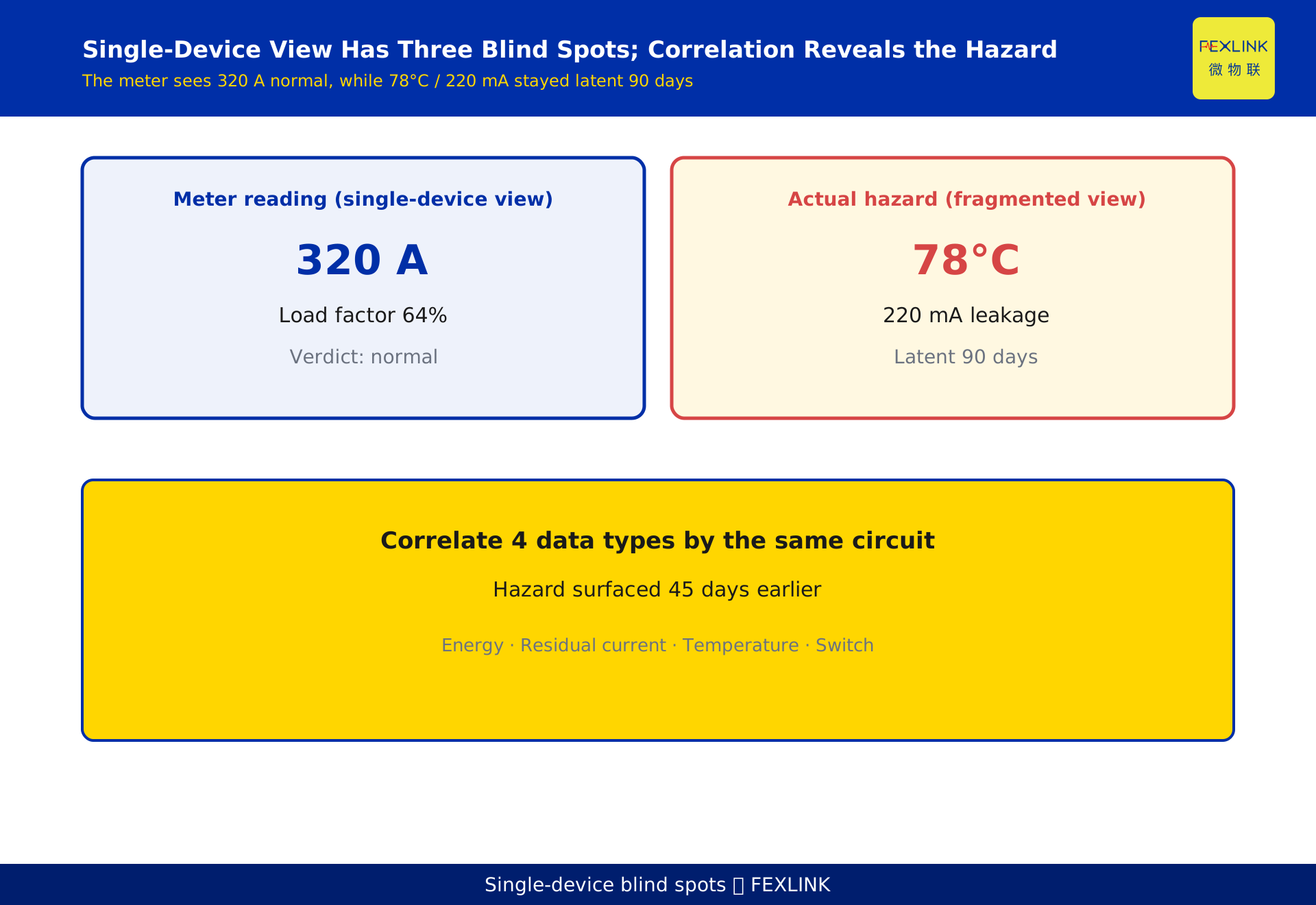
First, it knows how much was used but not whether it is safe. The meter reads 320 A at a 64% load factor yet does not tell you whether the joint is heating or the insulation is degrading. From the metering view everything is fine; from the safety view a mine may already be planted.
Second, when an alarm arrives you cannot tell which circuit it belongs to. The residual-current monitor and the temperature sensor alarm independently, but the alarm time is not lined up with the meter reading. Operations receive two isolated messages — "sensor point 78°C" and "RCD 220 mA" — and cannot assemble the picture of "one circuit running hot and leaky at the same time".
Third, a metering anomaly hides the hazard. A slowly creeping current is often read as natural load growth, when in fact contact resistance has risen and heating has intensified — current is only one of the symptoms. Read energy alone and you mistake a fault precursor for a busy production schedule.
3. A desensitized scenario: current looks normal, hazard latent for 90 days
The following is an illustrative scenario constructed to explain the mechanism. It represents no real customer or project.
A campus substation with two 10 kV incomers, two 800 kVA transformers and twelve low-voltage outgoing circuits. Circuit 7 feeds a motor control cabinet rated at 500 A. Day to day the meter reads 320 A at a 64% load factor, and for three months everything looks "normal".
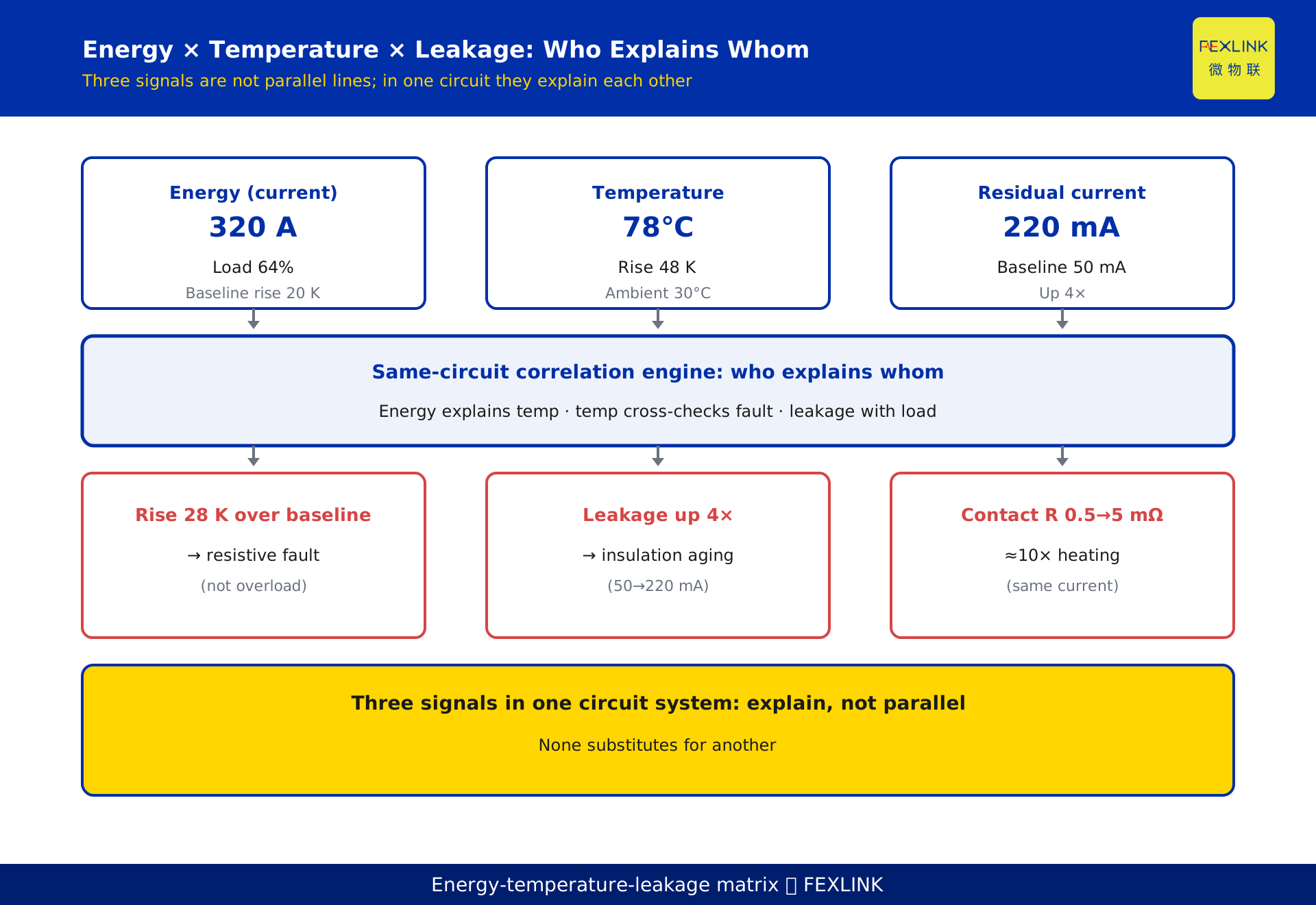
On that same circuit the temperature probe at a cable joint reads 78°C against an ambient of 30°C — a rise of 48 K. At the same current (320 A) the historical normal rise is about 20 K, corresponding to 50°C, so the present reading is a full 28 K higher. On that same circuit the residual current has moved from a baseline of about 50 mA to 220 mA, more than fourfold.
All three should point to one conclusion: the joint contact resistance climbed from about 0.5 mΩ to 5 mΩ, giving roughly 10× the heating at the same current, while the insulation degrades in parallel. But because energy, temperature and leakage sit in three separate systems, nobody aligned them by circuit, and the hazard stayed latent for 90 days. Only when the temperature approached 90°C and the residual current crossed 300 mA did a single-point alarm fire — by then the joint was severely carbonized.
4. The energy × temperature × leakage association matrix
Place the three signal types in one circuit-level coordinate system and they are not three parallel lines but three mutually explanatory ones.
Energy (current) explains temperature: heating power is approximately proportional to current squared times resistance, so the larger the current the higher the rise. "High temperature" therefore cannot be read in isolation; you must first ask "at this current, how hot should it be".
Temperature cross-checks the energy anomaly: if current is normal yet temperature is clearly above the historical same-current level, the cause is not overload but rising resistance — poor contact or insulation aging.
Residual current combined with load judges leakage: residual current is the vector-sum difference of live and neutral, and a few to tens of milliamps of imbalance is normal and varies with load. Leakage cannot be judged by absolute value alone; you must watch "load unchanged, residual current still climbing".
None of the three can substitute for another: reading energy while dropping temperature makes you think all is well; reading temperature without current invites false alarms from ambient heat; reading leakage without load mistakes normal swing for a fault.
5. Why "current correlated with rise" sees anomalies earlier than temperature alone
A standalone temperature alarm is usually a fixed threshold such as 70°C or 90°C. Two problems follow: an ambient-hot circuit is falsely alarmed, and the alarm only sounds once the temperature truly spikes — by which point damage is often done.
Bring current in. First build a per-circuit "current–temperature" baseline: 320 A corresponds to a normal rise of 20 K. When the measured rise departs from baseline by more than 15 K (28 K here) while current has not increased, that is an early "resistive fault" signal, long before the temperature reaches 90°C. In other words, correlation moves the alarm point from "absolute temperature" to "rise deviation", surfacing it about 45 days earlier.
The technical fact behind this step is public in the condition-monitoring field: electrical joint faults develop gradually, and rise deviation precedes temperature limit breach.
6. How to read residual current together with load
Residual current is most easily misread as "dangerous only when the absolute value trips". The more dangerous signal is actually the trend: residual current climbing steadily while load is steady.
A constructed example: a circuit holds load around 300 A, with a residual-current baseline near 50 mA; over two months it rises to 220 mA, more than fourfold, while current is unchanged. This cannot be explained by "more load means more leakage"; it points only to damp or aging insulation. Read absolute value alone and 220 mA may sit below the trip setting of some configurations, so the fault keeps hiding.
The correlation rule should be: within a window where load varies less than ±10%, if residual current rises more than 100% over its own baseline, treat it as a "leakage trend alarm". That moves the insulation-degradation discovery point forward.
7. The collaboration structure of multi-device same-network reporting
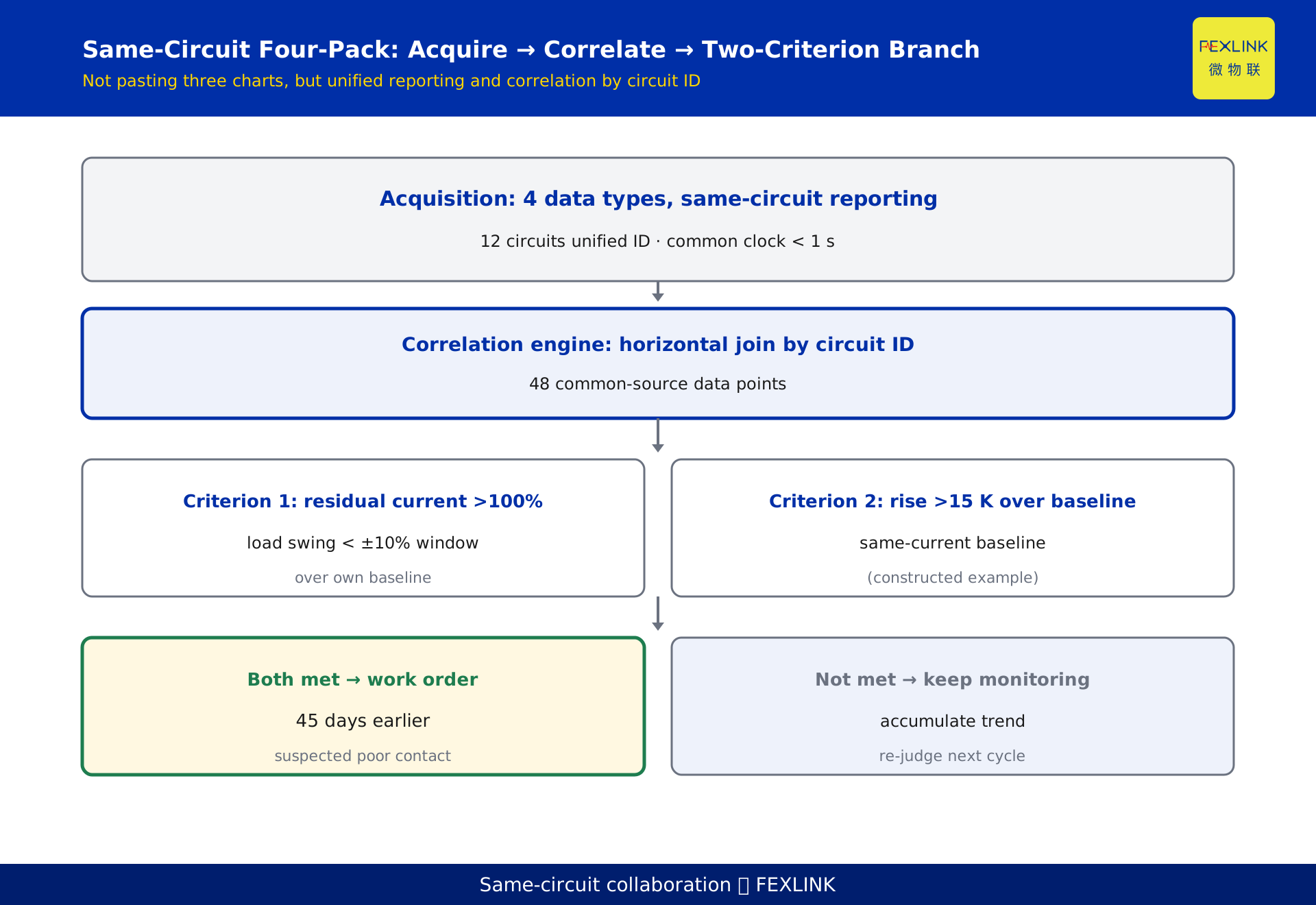
Collaboration is not pasting three charts together; it is making the four data types of one circuit report under "one identity, one timestamp".
The structure binds four items to the circuit ID: energy (who is using power and how much), residual current (insulation state), temperature (heating state) and switch status (breaker open/close, alarm nodes). All four carry a common-clock timestamp (deviation under 1 second) and share one circuit ID before entering one analysis engine.
A substation with twelve outgoing circuits, four data types each, yields 48 common-source data points. Only with one identity and one timestamp can the engine perform a same-circuit horizontal correlation.
8. A concrete correlation criterion (for operations)
Make it executable: give operations a hard criterion rather than "it depends".
On one circuit, if both conditions hold, raise a "suspected poor contact / insulation degradation" work order — (1) within a window where load swings less than ±10%, residual current rises more than 100% over its own baseline; (2) measured rise exceeds the same-current historical baseline by more than 15 K. Both are required, which avoids single-signal false alarms; when both hold, there is no need to wait until temperature hits 90°C or residual current hits 300 mA.
Revisiting the section 3 scenario: residual current 220 mA versus baseline 50 mA satisfies the doubling, and the 28 K rise satisfies the over-15 K rule, so the criterion can trigger around day 45 of the latent period — about 45 days before the single-point alarm. That is the extra time "correlated viewing" buys over "single-meter viewing".
9. How products implement it
Collaboration needs the endpoints to gather all four signal types, and the hub to correlate them by circuit.
Circuit-level energy metering uses the all-element smart meter, installed and read per circuit, solving "which line does the energy belong to". Insulation and leakage state use the electrical-fire monitor, mounted on the circuit to measure residual current and leakage trend. Heating state uses the multi-channel temperature controller, measuring key joints and busbars in parallel. The three report to the Taiyi central-control hub, which performs common-source correlation and trend comparison by circuit ID and presents the same-circuit multi-signal view of the electrical-hazard early-warning system. Selection follows the latest product manual; this article is not a procurement recommendation.
10. Three things most easily overlooked on site
Collaboration usually breaks not from equipment but from wiring practice.
First, circuit IDs do not line up. Meter, monitor and sensor each assign their own addresses, so the analysis engine receives three incompatible numbering schemes and correlation is impossible. Circuit IDs must be unified at installation.
Second, clocks are not common-source. The three device types keep their own time, so alarm time and meter reading differ by seconds to minutes and "same moment" correlation cannot be done. Require a common clock with deviation under 1 second.
Third, data is connected but criteria are not. Curves pile up on a platform, yet the "rise deviation + leakage trend" correlation rules are absent, merely moving the fragmentation from the field to the screen. Criteria must be written into the system, not kept in a veteran operator's head.
FAQ
Q: The meter is already installed, so why do you say hazards are still invisible?
A meter's job is metering: it reads how many kilowatt-hours were used and how large the current is, but it does not measure insulation, temperature or safety. The precursors of safety hazards live in temperature and residual current, which are outside the meter's field of view, so "a meter is installed" is not the same as "safety is understood".
Q: Don't we already have residual-current and temperature alarms?
We do, but they are isolated. An alarm only tells you "a point exceeded", not "on this circuit is the current normal, and does the temperature match that current". Without correlation you cannot assemble the full hazard picture, and normal swing is easily mistaken for a fault.
Q: Does high temperature always mean a hazard?
Not necessarily. A circuit with high ambient temperature or heavy load naturally runs hot, and temperature alone will false-alarm. What matters is "at this current, how hot should it be" — rise deviation from the historical baseline is what is meaningful, and that precisely requires correlating current with temperature.
Q: Does everything have to be wired to one platform?
The point is not "one platform" but "same circuit, same moment, same identity". Data can be collected by different devices, but must share one circuit ID and one common clock and enter one correlation engine. Stacking platforms without unifying circuit IDs stays fragmented.
Q: Won't correlation analysis produce more false alarms?
The opposite. Single-signal viewing both false-alarms (ambient heat read as overheating) and misses (trend read as normal). The correlation criterion requires both "leakage doubled" and "rise over 15 K" to hold together before alarming, which suppresses both false and missed alarms.
Scope and limitations
- The framework of correlating energy, residual current and temperature by the same circuit discussed here applies to early hazard identification on low-voltage distribution circuits; high-voltage and special locations require designs per their own codes.
- The scenario in this article (campus substation, circuit 7, 320 A, 500 A, 78°C, 220 mA, 90 days, 45 days, etc.) is constructed to explain the correlation mechanism and represents no real customer, site or project; actual thresholds and criteria must follow site survey and equipment manuals.
- Values such as "rise deviation over 15 K" and "residual current up over 100%" are constructed example criteria, not fixed standard values and not clauses of any standard; concrete settings should follow field measurement and product manuals.
- Products referenced — the ESA all-element smart meter, the electrical-fire monitor and the multi-channel temperature controller, together with the Taiyi central-control hub and the electrical-hazard early-warning system — have models and parameters per the latest selection manual, and this article is not a selection or procurement recommendation.
- This article contains no standard clause numbers and no fixed error limits; where standards and limits apply, the current effective version and the competent authority's interpretation govern.
Frequently Asked Questions
The meter is already installed, so why do you say hazards are still invisible?
A meter's job is metering: it reads how many kilowatt-hours were used and how large the current is, but it does not measure insulation, temperature or safety. The precursors of safety hazards live in temperature and residual current, which are outside the meter's field of view, so "a meter is installed" is not the same as "safety is understood".
Don't we already have residual-current and temperature alarms?
We do, but they are isolated. An alarm only tells you "a point exceeded", not "on this circuit is the current normal, and does the temperature match that current". Without correlation you cannot assemble the full hazard picture, and normal swing is easily mistaken for a fault.
Does high temperature always mean a hazard?
Not necessarily. A circuit with high ambient temperature or heavy load naturally runs hot, and temperature alone will false-alarm. What matters is "at this current, how hot should it be" — rise deviation from the historical baseline is what is meaningful, and that precisely requires correlating current with temperature.
Does everything have to be wired to one platform?
The point is not "one platform" but "same circuit, same moment, same identity". Data can be collected by different devices, but must share one circuit ID and one common clock and enter one correlation engine. Stacking platforms without unifying circuit IDs stays fragmented.
Won't correlation analysis produce more false alarms?
The opposite. Single-signal viewing both false-alarms (ambient heat read as overheating) and misses (trend read as normal). The correlation criterion requires both "leakage doubled" and "rise over 15 K" to hold together before alarming, which suppresses both false and missed alarms.