 FEXLINK Research Institute
The short answer
AMR was never about saving a trip. What manual reading loses is the timestamp and the evidence: meters in one batch are read on different days, so values reach the report without a common time reference, and no one can later tell which figure was copied wrong or filled in. Billing and energy analysis end up built on numbers neither comparable nor auditable, so month-end reconciliation becomes an argument.
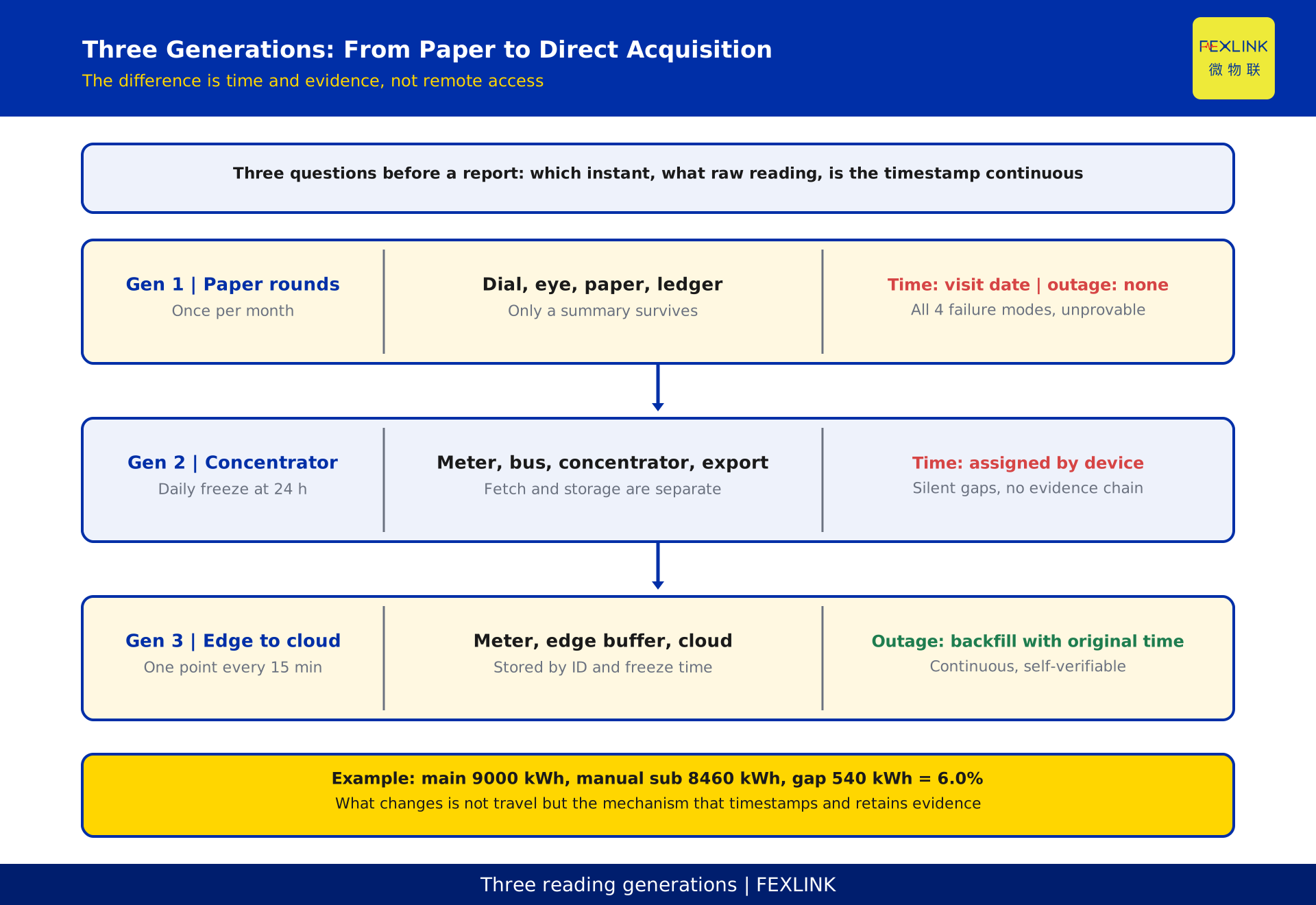
AMR turns a number glimpsed on a dial into time-series data frozen at a fixed instant, timestamped, stored, and traceable. Three generations — paper rounds, concentrator polling, edge-gateway acquisition to the cloud — all appear to fetch the reading. They differ in trustworthiness and timeliness: who assigns the instant, keeps the raw value, backfills gaps, and removes duplicates. Remote is not the differentiator.
One test governs this article. Before a number enters a report, three questions need answers: which instant, what raw register reading, and is that timestamp continuous in the series. If any is missing, remote acquisition has merely moved an untrustworthy number faster.
1. The bottleneck is not travel: manual reading loses time and evidence
Parks, property managers, and water utilities complain about low frequency, wrong figures, and month-end disputes. Saving labor is the shallowest. A reading has three acts: seeing the dial, recording the value, attaching an instant. Manual work guarantees only the first. The record is handwritten and the instant comes from the visit date, so neither shares a source with the reading.
At month-end the main meter settles on a calendar month while sub-meters were read across the first few days, so the difference mixes real losses with unaligned time, and the two cannot be separated. More staff or shorter intervals only compress the misalignment; they do not remove it. What must change is not the legs but the mechanism that assigns instants and retains evidence.
2. Four failure modes: estimated, missed, misaligned, untraceable
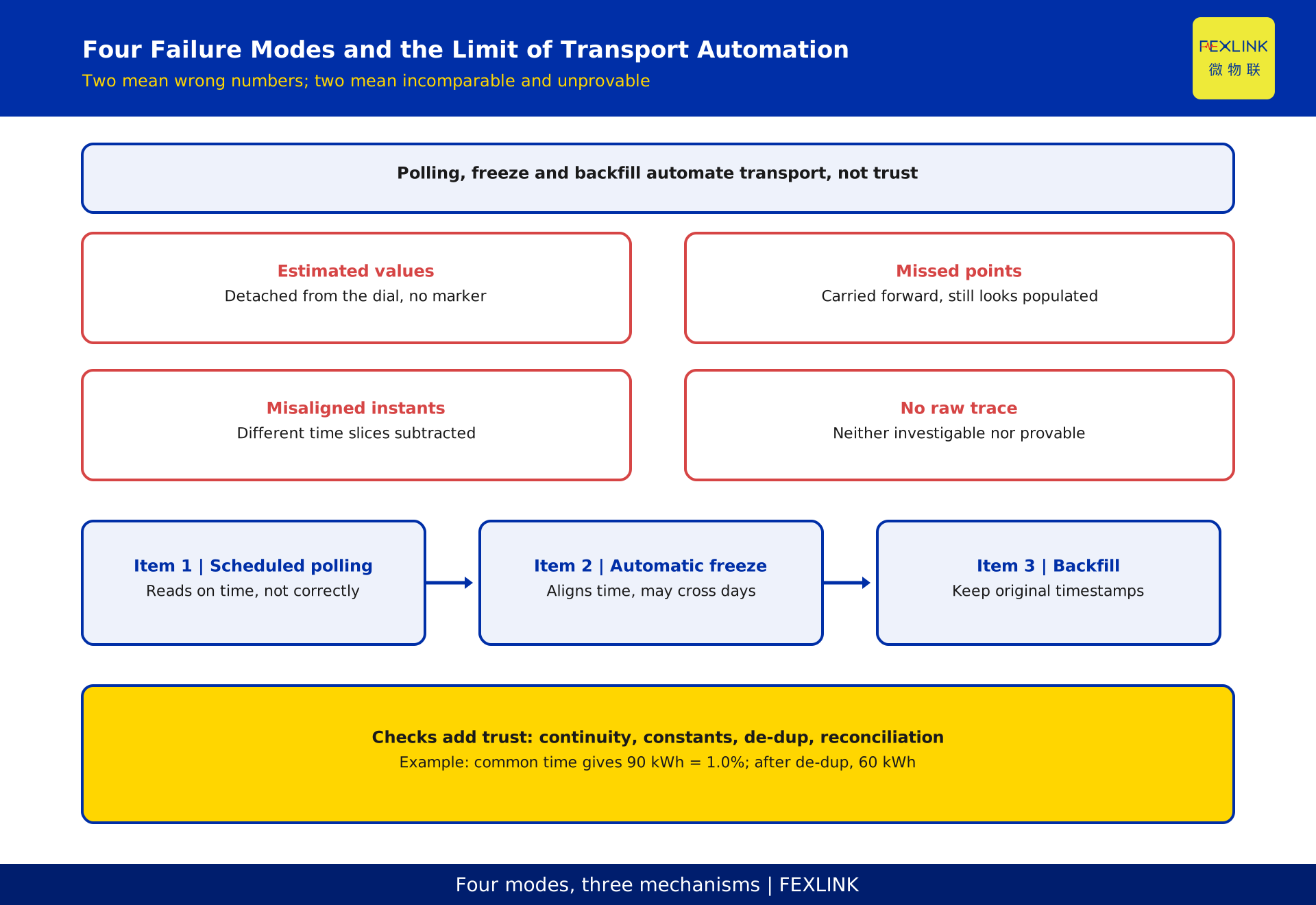
Outlines usually list three problems: estimated values, missed points, inconsistent reading times. All are real, but a fourth is missing — and it decides whether the first three can be detected.
Estimated values. When a point is unreachable, last month's value or a guess is written in. The number detaches from the dial with no marker, so no one can later identify the invented entry.
Missed points. An entire location is absent. The report carries forward the previous value or leaves a blank, and still looks populated.
Misaligned instants. Meters in one batch are read on different days, then subtracted inside one accounting interval: different time slices compared. This is the most underestimated mode because it produces no visible error, only incomparability.
No raw trace. Only a summary table survives: no register reading, no instant, no source. A dispute can be neither investigated nor answered.
The first two mean the number is wrong; the last two mean incomparable and unprovable. More staff and higher frequency help the first two, almost nothing for the last two. That is why monthly to weekly rounds reduce disputes without ending them.
3. Generation 1: paper rounds only answer whether a number exists
The path runs dial to eye, to paper or spreadsheet, to back-office entry, to report. The source is a person; the timestamp is the visit date, day-granular and with no common origin with the reading; frequency follows the roster, taken as once per month in the example; a link failure is not a concept, since if nobody went there is no data; and the only artifact is usually a summary.
All four failure modes are present. This generation solves existence: moving a field number into a ledger, nothing more. Analysis built on it is limited to one isolated value per month, with no curve or defensible trend.
4. Generation 2: concentrator polling aligns the instant but leaves data on site
The path becomes meter to bus, to concentrator, to host or export file, to report. Two things change. Scheduled polling replaces when a person goes with when a device reads, so equipment assigns the instant for the first time. Automatic freeze latches all meters at one instant, removing misalignment.
The limits are clear. Data mostly stays in the concentrator. If the hop to the platform relies on manual export or an intermittent link, outage values are lost or backfilled without original timestamps; overwritten local storage cannot be reconstructed; acquisition and storage are separate acts, so a missed export produces no alarm, just a silent gap. Generation 2 fixes the instant but not the evidence chain. The number is fetched; it still may not be stored or provable.
5. Generation 3: direct edge acquisition turns readings into time series
The path runs meter to bus, to edge gateway, over the network to the cloud, then to ledger and report. The decisive work is at the edge: the gateway stamps each reading, keeps a local copy, and after an outage backfills using original freeze timestamps instead of re-reporting the current value. The platform stores by meter ID plus freeze timestamp, deduplicates backfill on that key, and checks continuity directly.
Only here do high frequency, verifiability, and storage hold at once: a point every 15 min forms a stable series, not one isolated figure per month. ESX edge gateways and CW-C2 industrial gateways handle aggregation, buffering, and timestamping; FEXCloud stores by meter ID and freeze timestamp; the digital electrical supervision platform turns data into ledgers and curves. These guarantee a single traceable source only: not calibration conclusions, and not a verdict on any difference.
6. What is actually automated: polling, freeze, backfill
Three mechanisms need precise wording, or transport automation is mistaken for trust automation.
Scheduled polling automates the read, not its correctness. With a crossed point map or wrong constant, polling still returns values on schedule.
Automatic freeze automates instant alignment, not day assignment. If the timestamp rule disagrees with the accounting interval, values crossing midnight are filed under the wrong day.
Backfill automates gap filling, and what it resends must be historical values carrying their original timestamps. If it sends the current value instead, historical timestamps are overwritten, the post-recovery freeze may be stored twice, and the series shows jumps and duplicates.
All three sit on the transport chain. None produces trust. That requires the checks in the next section.
7. From reading to usable data: four checks
Timestamp continuity. The series follows a fixed interval, and any gap must be listable. Interpolation or smoothing a difference must not erase the hole.
Constant and unit. Pulse constant, transformer ratio, and dimension agree with the nameplate and point map, configured in one place. The pulse-versus-energy neighbor article develops this.
Deduplicated backfill. One meter ID plus one freeze timestamp is stored once, with a queryable backfill log.
Main versus sub-meter reconciliation. Subtraction uses the same instant and the same interval, and the difference needs an independent explanation. Getting smaller is not a pass criterion.
The hard gate sits on the first and third checks: a discontinuous series or missing deduplication log blocks the report. The second and fourth are remedied within a deadline and recorded. These are gated because once they fail, no later number recovers the original timestamps.
8. Worked example: six meters over 30 days, 540 down to 60
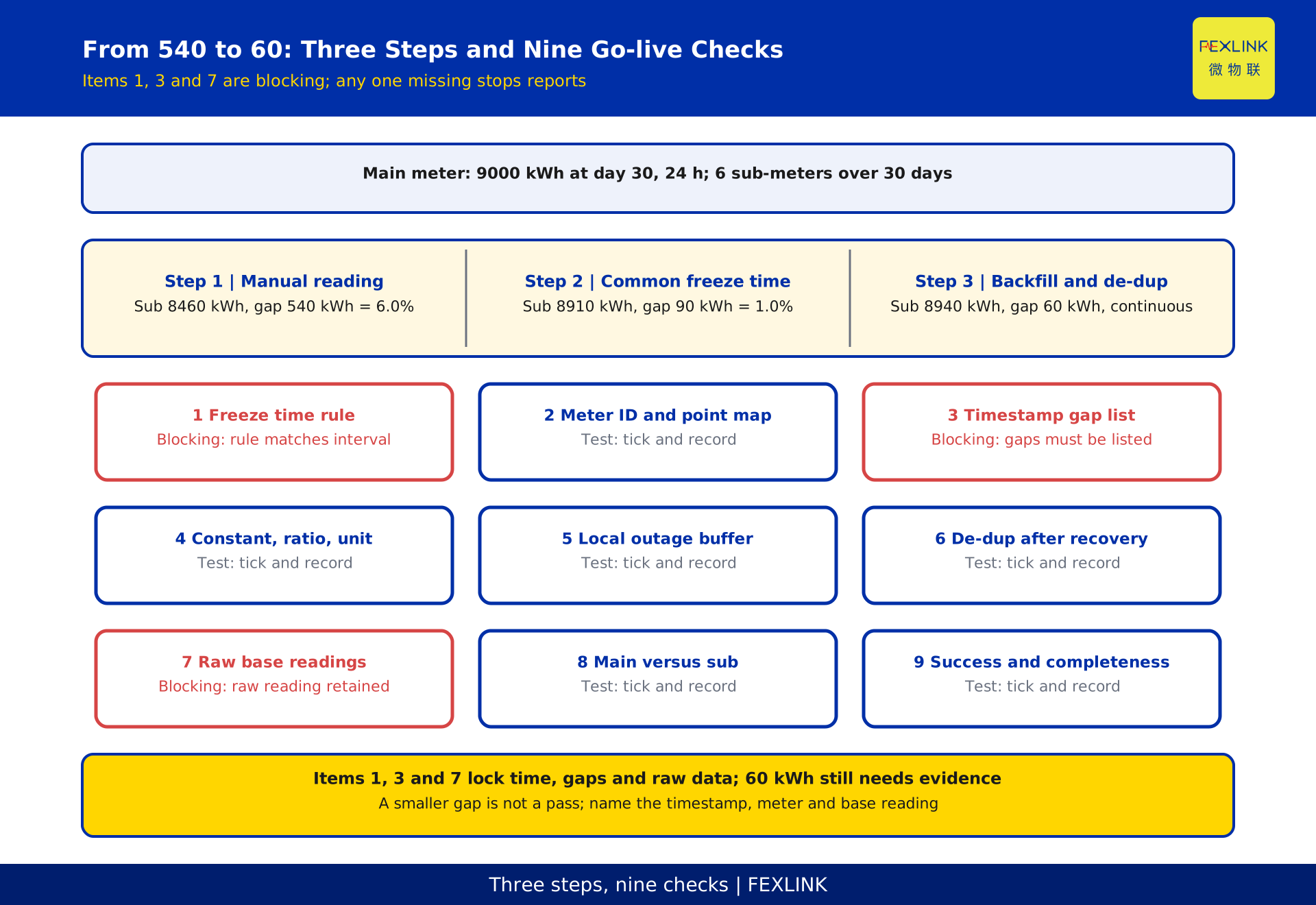
A site has 1 main meter and 6 sub-meters over a 30 day window. The main meter freezes at the day 30, 24 h point with an increment of 9000 kWh. All figures are constructed and anonymized.
Step 1, manual. The 6 sub-meters are read once each across days 1 to 6, summing to 8460 kWh. The difference is 540 kWh, and 540 / 9000 = 6.0%. The site books it as line loss.
Step 2, one common freeze instant. Using the same day 30, 24 h freeze values, the sub-meters sum to 8910 kWh, a difference of 90 kWh, and 90 / 9000 = 1.0%. The 450 kWh change between steps is not electricity; it is misaligned time.
Step 3, backfill and deduplicate. One meter is found missing 30 kWh from a 3 day outage. After backfill the sum is 8940 kWh and the difference is 60 kWh; post-recovery duplication is confirmed absent and the timestamp series is continuous.
The conclusion is not smaller, therefore correct. The 60 kWh still needs independent evidence, and no line-loss limit is given. The real change is that every step names the timestamp segment, the meter, and the raw reading, so a dispute shifts from a guess to a checkable record. Arithmetic: 540 / 9000 = 6.0%, 90 / 9000 = 1.0%, 540 − 90 = 450, 8940 − 8910 = 30, 9000 − 8940 = 60.
9. Three generations compared, and nine go-live checks
Six dimensions close the comparison. Reading source: eye, concentrator polling, direct edge acquisition. Instant assigned by: visit date, device freeze, edge stamp with original-timestamp backfill. Typical frequency: once per month, one daily freeze at 24 h, one point every 15 min. Outage behavior: none, local retention with possible silent gaps, local buffering plus deduplicated backfill. Raw trace: summary value, local record, platform storage keyed by timestamp. Self-verifiable: only generation 3 can show a continuous series.
Check each item before go-live. Items 1, 3, and 7 are blocking: if any is missing, no report is issued.
- The freeze-timestamp rule matches the accounting interval, with an explicit cross-midnight convention.
- Meter ID, point map, and circuit label agree for every meter.
- Timestamp gaps can be listed, and are not filled by interpolation.
- Pulse constant, ratio, and unit match the nameplate and are set in one place only.
- Outage values come from local buffering, and backfill carries original freeze timestamps.
- No duplicate storage after recovery; meter ID plus timestamp is unique.
- Raw register readings are traceable, with a base-reading record separate from the summary.
- Main and sub-meters are subtracted over the same interval, with a recorded explanation of the difference.
- Acquisition success rate and timestamp completeness are reported separately; fetched is not treated as correct.
Frequently asked questions (FAQ)
Q: Does moving from monthly to weekly rounds fix misaligned instants?
No. Higher frequency only compresses the misalignment; readings still do not share an instant. A common freeze instant is the fix, regardless of visit frequency.
Q: If a concentrator is installed, is that automated meter reading?
It is generation 2: the instant is aligned but the evidence chain may be incomplete. If the hop to the platform still uses manual export, outages are not backfilled, and base readings are not retained, the report still cannot be proven.
Q: Can backfill simply send the current value at recovery?
No. That rewrites a historical timestamp as a current one, causes jumps, and may store the post-recovery freeze twice. Resend historical values with their original freeze timestamps and deduplicate on meter ID plus timestamp.
Q: If the main-versus-sub difference shrinks, is the data correct?
No. Errors can offset each other, and an estimated value cancelled by a missed point can look even cleaner. Only with timestamp continuity, raw base readings, and a deduplication log does the difference carry meaning.
Q: How should DL/T 698 be cited?
It is the Electric Energy Data Acquisition and Management System series, subject to revision and withdrawal. Cite only the currently effective status published by the energy administration and national standards platform, not a version fixed here or by any secondary list. This article names the framework only, with no clause numbers or indicator values.
Scope and limitations
This article aligns understanding of reading methods during selection and go-live for sub-metering in parks, property, and water utilities. It covers the evolution path and how data takes shape. It does not dissect protocol frames or the timing of one complete poll — that belongs to the end-to-end timing neighbor article — nor does it expand pulse constants, ratios, or reconciliation algorithms, which belong to the myth-list neighbor article.
No acquisition-success target, timestamp-completeness threshold, prescribed polling interval, line-loss limit, accuracy-class table, or calibration interval is provided. Parameters follow the meter nameplate, manufacturer documentation, current verification rules, utility requirements, and project agreement. DL/T 698 is named only as a technical management framework, with no clause numbers; publication, effective, withdrawal, and replacement status follow the official platform.
The worked example — 1 main meter, 6 sub-meters, 30 days, a 24 h freeze, 9000 kWh, 8460 kWh, 8910 kWh, 8940 kWh, 540 kWh, 90 kWh, 450 kWh, 30 kWh, 60 kWh, 6.0%, and 1.0% — is constructed and anonymized, with no client, place, project, or price. The 6.0% and 1.0% values are example ratios, not limits. Model numbers, ranges, channel counts, interfaces, and capacity are customizable and follow the latest selection guide; this is not selection or purchasing advice. Status is DRAFT_PENDING_REVIEW: an independent party must review before publication, and the generator may not self-approve.
Frequently Asked Questions
Why Manual Meter Reading Still Fails
AMR was never about saving a trip